
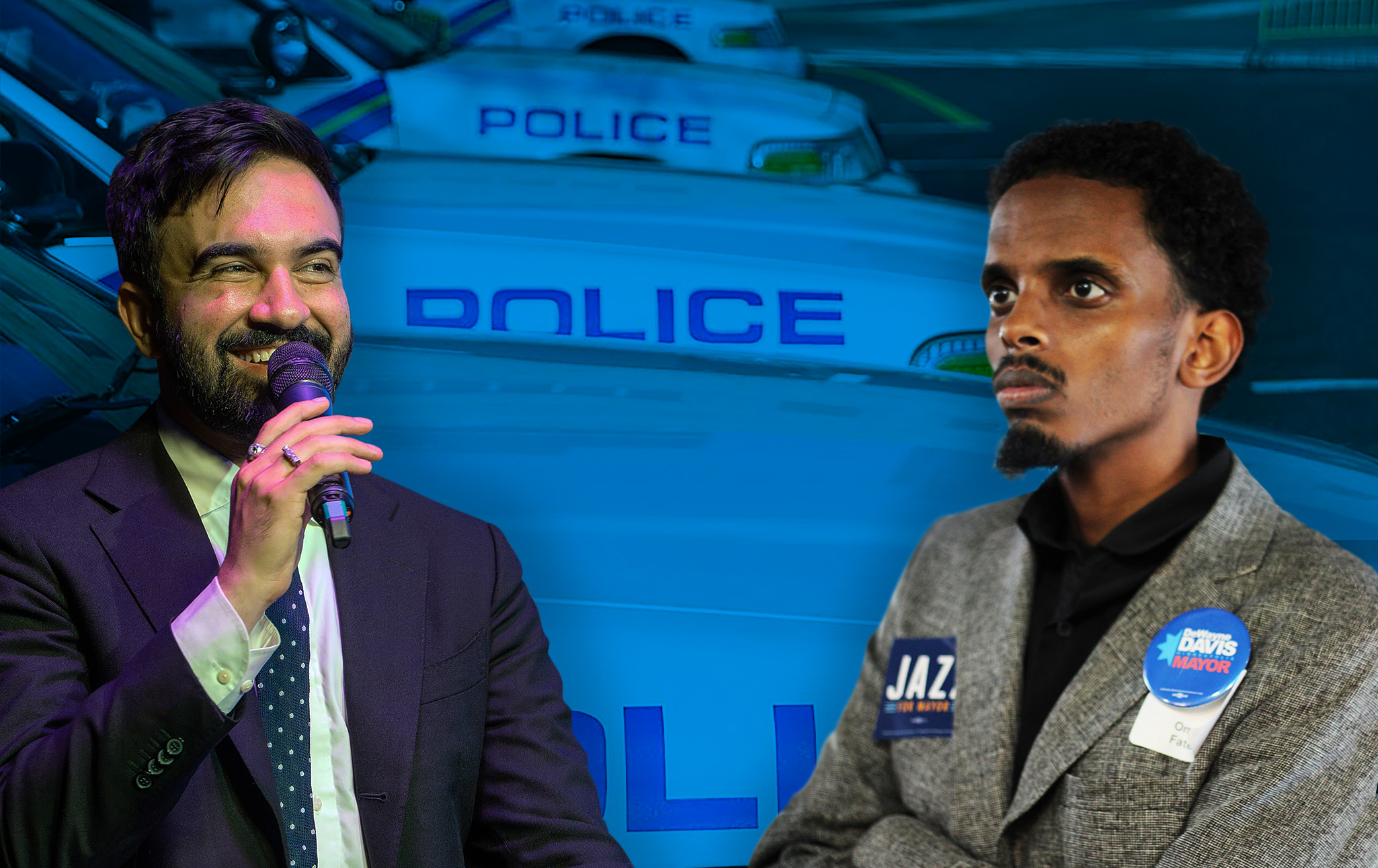
Prominent mayoral candidates are distancing themselves from “defund” and instead offering “cops and more” public safety plans. But that approach neglects the victims of police brutality and risks further entrenching police legitimacy and power.
Five years ago this past summer, global uprisings against police brutality and the murders of George Floyd and other Black Americans brought “defund the police” into mainstream discussion. The concept of “defund” is simple: a preponderance of evidence shows that policing does not bring about public safety. And even if it did, the costs borne to society by the use of violent, armed agents of the state to inflict brutality, killings, torture, arrest, and mass incarceration onto the population are too high. Instead, by the logic of “defund,” we should take money away from police budgets and redirect it into community-based programs that get at the root causes of crime. By dealing with things like poverty and education, the idea goes, we can prevent crime and violence from happening in the first place, rather than focus on punishing people after the fact. “Defund” is part of a larger vision of police and prison abolition, which encompasses a total rethinking of the notion of public safety and advocates for a long-term political project of moving away from austerity, policing, and prisons and toward a system of justice that doesn’t use violence and caging to address the harms that people commit against each other.
Two prominent democratic socialist candidates for mayor, Zohran Mamdani of New York City and Omar Fateh of Minneapolis—the city where George Floyd was murdered—have in recent months either walked back their prior support for “defund” (Mamdani) or distanced themselves from it (Fateh). Instead, they are promoting non-police efforts to improve public safety while at the same time saying they are not going to defund the police. While their efforts to build non-police public safety programs are welcome, they seem to have changed the analysis. Their new approach is essentially: the police are involved in too many things that they shouldn’t be, such as mental health emergencies. By using non-police teams to deal with those issues, we can free up police to do what they do best: preventing and solving violent crime. Not only does this shift the narrative—implying that police are simply overburdened, rather than a problem themselves—but this latter part about the police effectively stopping threats to the public, as I will explain, is simply not true.
Not only are these politicians continuing a trend of treating “defund” as noxious, they’re giving up the opportunity to use their platforms to educate the public about the true nature of policing and the true ways to bring about public safety. In this sense, they’re not being entirely honest. They’re betraying the public yearning for an end to police brutality and solidifying a kind of political amnesia about the urgent need to stop the police from brutalizing and killing people—something cops are doing at this very moment all over the country, maybe even to someone you know or care about personally. Their plans, I fear, may legitimize the police and what they do, when the bare minimum for leftists is not to do that. And if they end up cozying up to police—as Mamdani has started to do—they risk playing right into the now-entrenched bipartisan “law and order” politics that helped pave the way for President Trump’s authoritarianism.

A Reminder: “Defund” Never Happened
In 2020, a future where we moved away from policing seemed possible. A majority of Americans supported Black Lives Matter and even felt that the burning of a Minneapolis police precinct in response to George Floyd’s murder by police was “justified.” We saw what was possibly the largest protest movement in U.S. history as 15-26 million people took to the streets to protest police brutality and racial injustice, among other social justice concerns. Thousands of local elected officials and dozens of municipalities called for defunding the police or reducing police resources or power. New York State Assemblyman Zohran Mamdani and Minneapolis State Senator Omar Fateh, who both assumed office in 2021, were both sympathetic to calls to defund the police. In 2020, Mamdani made statements on social media critical of the NYPD, including the following:
We don’t need an investigation to know that the NYPD is racist, anti-queer & a major threat to public safety. What we need is to #DefundTheNYPD.
In 2022, Mamdani called for a reduction in NYPD officers, which would have subtracted 1,300 cops from the force’s more than 33,000. Over in Minneapolis, when the city voted on a proposal in 2021 to replace the police department with a Department of Community Safety, state Senator Fateh publicly supported the proposal. (It ultimately failed.) But he was also careful to point out that the plan would not “defund or abolish anything or the police.” Instead, the plan would have put the police under civilian control, which Fateh explicitly supported (along with reforms like ending qualified immunity).
When you go back and look at an October 2020 interview that Fateh did with Jacobin, the word “defund” doesn’t appear. But at some point Fateh clearly became sympathetic to the idea. In an April 2021 interview in Jacobin, he said:
We know what’s going on. People of color are being murdered; black men are being murdered. And it’s a decision whether we want to act or not. I just want to make one thing clear again: this is not a training issue. This is a decades and decades–old system that has gotten away with murdering black men and people of color. [...]
There’s a reason why people are calling for defunding the police and abolishing the police in general. It’s gotten to a point where there’s just a complete distrust of law enforcement based off of what people are seeing on TV and based off of their own lived experiences.
By the spring of 2021, states had passed some 140 bills to improve police accountability. Since 2020, more communities have implemented civilian crisis response teams to replace armed officers. But by and large, the promise of “defund” never materialized. While some cities made small cuts or shifted money around in the aftermath of 2020, those changes were reversed with subsequent increases. Police budgets have generally continued to go up every year (and, unfortunately, police have continued to kill more people each year than the previous since 2020, with 2024 the deadliest year to date). What happened to the momentum? Basically, two forms of backlash: conservatives doubling down on support for the police and Democrats capitulating to the right.
While the right directly attacked any progressive movement on criminal punishment and used the issue to scaremonger during elections—which some Democrats themselves bought into—Democrats offered empty symbolism and avoided real action. They knelt in kente cloth and thanked Floyd for his “sacrifice,” as if his murder had been voluntary. Then they came up with legislation (the George Floyd Justice in Policing Act) that would have given police even more money and wouldn’t have saved Floyd’s life, failed to pass their own legislation, and in the case of President Joe Biden, emphasized the importance of funding the police. Biden’s American Rescue Plan Act provided around $1 billion for “police hiring and retention bonuses,” and cities used pandemic aid to buy all kinds of militarized police equipment including drones, armored vehicles, SWAT rifles with night vision, and more.
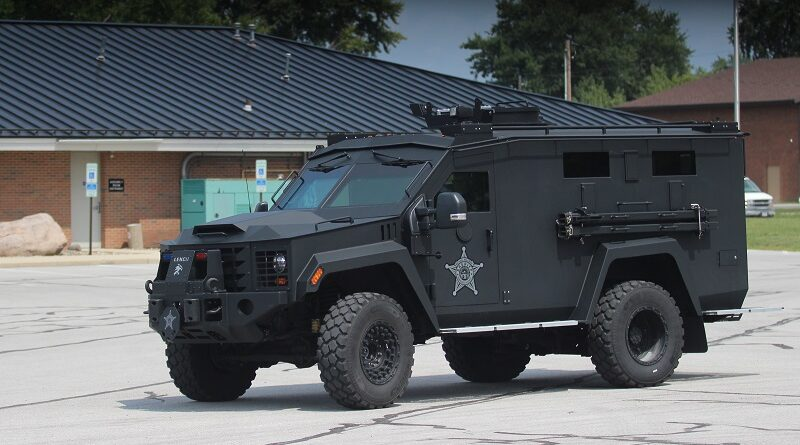
The Sheriff’s Department of Hancock County, Ohio shows off its new “BearCat” armored vehicle, purchased with approximately $250,000 of COVID relief funds in 2023.
The problem, though, with the Democrats ran deeper than just their unwillingness to meet the demands of 2020. As sociologist Alex Vitale has explained, long before 2020, the Democrats had already joined their fellow Republicans in support of “law and order” politics. At the municipal level, Democrats cooperated with the first Trump administration’s infusion of federal money for local law enforcement, which was then used to target social problems like homelessness and drug use. More recently, Democratic mayors have also “failed to adequately resist” ICE and in some cases directly enabled their violence. As civil rights attorney Alec Karakatsanis has noted in his recent book Copaganda, “There is not political support in either party to significantly change U.S. policing, hold police accountable, or reduce their power.”
Although the police remain generously funded, the urgency of “defund” has not lessened. As I’ve written before, the police are a “true crime” scandal hidden in plain sight. They’ve killed 1,023 people (and counting) so far this year and victimized countless others. Think of it this way: the fewer opportunities the police have to interact with the public, the fewer people will end up brutalized or killed or sent to a jail system where they very well may end up dying. The best way to achieve this is to start decreasing police budgets now and to stop giving the cops more equipment, technology, and other resources.
From “Defund” to “Cops and More”
In more recent years, Zohran Mamdani and Omar Fateh have been determined to distance themselves from any whiff of “defund.” In Mamdani’s case, he has repeatedly stated that he no longer supports “defund” and is not running on it as a policy issue. At a July press conference, he said:
I am not defunding the police; I am not running to defund the police. [...] Over the course of this race, I’ve been very clear about my view of public safety and the critical role that the police have in creating that public safety.
As the New York Times’ Eliza Shapiro reports, Mamdani now describes his past support for “defund” as “out of step” with his current views. Instead, he “has vowed to create a Department of Community Safety that would dispatch mental health teams to respond to 911 calls.” He has even gone so far as saying he would apologize for his 2020 comments about the NYPD being “racist, anti-queer & a major threat to public safety.”
The Times article that first announced this apology, by Maria Cramer, almost reads as if Mamdani was goaded into it by the interviewer (who, frankly, should be paid by NYPD Communications for her fine work here). The New York Times did not respond to a request for comment as to who (if not the interviewer) came up with the idea of Mamdani needing to apologize. And Cramer’s article never explains that, in fact, the NYPD is racist and anti-queer and a threat to public safety. There is no reason to apologize for statements of fact, but apparently Mamdani is willing to do just that.
Basically, as Nick French puts it approvingly in Jacobin in a discussion of Mamdani’s public safety plan, Mamdani is “emphasiz[ing] social services not as a replacement for but a complement to traditional policing” (author’s emphasis). I have written critically about this approach elsewhere, and I’ll return here to some of the arguments I’ve made, but first, let’s turn to Fateh.
In the aftermath of George Floyd’s murder in May 2020, nine of 13 Minneapolis city council members vowed to support defunding and “dismantling” the police department. That effort, which took the form of a charter amendment which would have replaced the police with a Department of Public Safety and “eliminated police staffing and funding minimums,” was ultimately rejected by voters in November 2021. The Minneapolis Police Department itself, meanwhile, by 2025 had come under both state and federal court oversight due to numerous problems including racism and its use of “dangerous techniques and weapons against people unnecessarily.” In the context of a larger effort to “unleash” the police and enact a “major rollback of federal civil rights investigations,” the Trump administration earlier this year cancelled the federal oversight of several police departments including Minneapolis. The current Minneapolis mayor, Jacob Frey, and mayoral candidate Omar Fateh have both vowed to proceed with the changes suggested in the federal consent decree anyway. Fateh, though, has maintained that precious little has taken place under Frey’s administration to improve the police. To that point, as Alex Skopic pointed out recently, Mayor Frey opposed efforts to defund the police after Floyd’s murder and allowed police to conduct no-knock raids despite announcing a moratorium on the practice. And Minneapolis still has the fourth most violent police department in the country.
This is the kind of problem that calls for a clear, decisive stance. Yet in a recent interview with local news, Fateh seemed cagey about whether, in fact, he had supported “defund” in the past.
Host: It’s my understanding, and as I saw it, as I covered in 2020, that you supported defunding the Minneapolis Police.
Fateh: In 2021, I supported the Charter Amendment which would create a Department of Public Safety in which we can have a police force that is accountable under them.
Host: But before that, didn’t you support defunding the police?
Fateh: Well, when we [speak] about public safety in general, police officers and law enforcement, they’re not the only form of public safety. What we know right now is, for example, last biennium, I worked really hard with our colleagues to bring in $19 million in public safety aid. The city’s own report showed that 47 percent of 911 calls can be diverted away from police officers. And I think that jives really well with what we heard at the capitol with law enforcement officers saying, “We can’t respond to every call. We need help.”
Host: But you don't, you’re saying you did not support defunding the police?
Fateh: No, I supported providing the conversations around supporting the Department of Public Safety, and I think we can do that. And what people understand here in Minneapolis is that being pro-police accountability does not mean you’re anti-public safety.
Now, Fateh ultimately does say that, no, he did not support “defund.” But it took three questions from the interviewer for him to get there, and Fateh comes off a bit defensive, like he does not want to answer the question directly. He also seems to emphasize that there are non-police options we can take rather than absolutely should, and he suggests that the police are overburdened by 911 calls, which almost makes it sound like a labor justice issue rather than an issue with police killings and brutality.

On his current campaign website, Fateh says that he will fund “public safety solutions that supplement traditional policing.” In an interview with Jacobin this year, Fateh clarified further that diverting 911 calls would help police “focus on violent crime, and only violent crime, and that, as a result, can make our city safer.”
At this point, it’s clear that neither candidate currently supports “defund,” and that if they’re elected mayor, both Mamdani and Fateh plan to implement non-police programs while otherwise leaving police budgets intact. While I have no argument against non-police approaches to, say, 911 mental health calls and homelessness, I do find it troubling that these candidates are unwilling to challenge police violence by at least pointing out the reduction in deaths that will result from their plans. For instance, according to Mapping Police Violence, nationally, over 64 percent of police killings that occurred last year happened during a response to a 911 call. This means that taking police out of some of these calls, such as for mental health issues (if that is what will in fact be done versus having non-police simply accompany police to these calls), will definitely save lives. But that’s not what the candidates seem to be emphasizing explicitly. (Mamdani’s proposal advocates for NYC residents being able to “request” a non-police crisis response team.)
Instead, they are running from “defund” (and the police killings that inspired the 2020 uprisings) like it’s some kind of contagion. As political commentator Briahna Joy Gray pointed out recently on the Bad Faith podcast:
Everyone’s always been running away from defund since like July of 2020. [...] [M]y feeling has always been that the reluctance to stand by defund has made it so that Zohran has to [...] basically describe defund in policy terms while saying he doesn't actually support defund.
Of course, it’s not clear that we should actually call the “cops plus more” plan “defund all but in name.” The focus on non-police alternatives to safety is consistent with “defund” logic, and if police are diverted from contact with the public, the effort will decrease the scope of policing, which is good. But it still leaves police budgets intact, and the reasoning used to justify it is concerning for the way it legitimizes policing.
Consider the facts. These public safety plans, as they’re being promoted by the mayoral candidates themselves, rest on two core assumptions:
- Police reduce crime (or, put another way, policing produces public safety)
- Police clearance rates (solving) of violent crime can be meaningfully increased, and this produces public safety
I have written in detail about why these assumptions are wrong, so I’ll just sum things up. The preponderance of evidence shows that police do not reduce crime or produce public safety, as Karakatsanis explains in detail in Copaganda. And as Alex Vitale points out in The End of Policing (while citing the work of police scholar David Bayley), there is literally “no correlation between the number of police and crime rates.” Adding cops does not make crime go down; subtracting cops does not make crime go up. (Anyone arguing otherwise perhaps hasn’t read enough about the issue, is cherry-picking evidence, isn’t considering the myriad harms that the police don’t concern themselves with and that cops themselves cause, or is deliberately out to peddle pro-police propaganda.) And as Vitale explained recently in The Nation, “[T]here is little evidence that clearance rates can be significantly improved by policy interventions or that such improvements translate into safer streets.”
In essence, if the approach relies on false assumptions, it also relies on being dishonest with the public instead of educating them about the truth, which is that police don’t make us safe. What the “cops and more” approach does is jump to the social policies without really challenging the notion that cops make us safe. Don’t get me wrong: social policies are good and necessary, and I fully support them. If they prevent a twitchy, trigger-happy cop from killing a mentally unwell person who is in crisis today, that’s a good thing. But if the cop can kill the same person in a different context when they’re mentally well tomorrow, that’s still a huge problem for society.
If you watch the short video on Mamdani’s campaign website, he makes a good pitch for his Department of Community Safety. But toward the end of the video, he says something that sounds a little funny:
Police have a critical role to play. But right now we’re relying on them to deal with the failures of our social safety net, which is preventing them from doing their actual jobs. It’s one of the reasons why so many crimes are left unresolved. [Image of news story about clearance rates appears.]
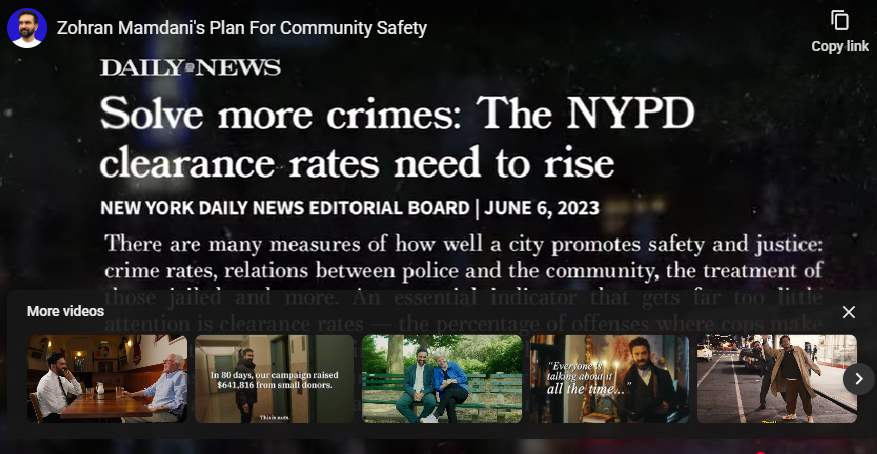
Maybe, you could argue, this is just the work of a clever communications person who has crafted language to avoid threatening the police. Maybe. But it’s not truthful. It makes it sound like the reason we need social programs is to stop burdening the cops, not because they’re good programs in and of themselves, or because police spending actually takes vital funds away from these services in the first place. And the idea that the police are so burdened by social problems that they can’t get their clearance rates up is very misleading. The public isn’t in the way of the police; the police are in the way of us having safety, especially when they kill people! Also, the suggestion that improved clearance rates are achievable and will lead to public safety has little evidence to support it, per Vitale.
This video concerns me because it shows that Mamdani is not currently willing to educate the public on really basic facts about the police and their “actual job”—which is social control. After all, a lot of what the police actually do on a daily basis is not meant to keep the general population safe but to protect property, discipline poor people, and help put down social and labor movements. But as leftist commentator and historian Keith Rosenthal has pointed out, Mamdani has gone to great lengths to avoid “saying anything that could come off as somehow suggesting that the actual function of the police [...] is essentially repressive.”
What’s worse, Rosenthal has argued, Mamdani’s approach to police and public safety represents a “summary retreat” from the “advances wrought by the movements and uprisings against police oppression over the last decade.” Of course, these movements were spearheaded by Black people demanding an end to racial injustice and police brutality. (Recall that Black Lives Matter began in 2013 in response to the acquittal of George Zimmerman after he killed Trayvon Martin, an African American teenager.) It’s no surprise, as Rosenthal points out, that Mamdani has been challenged about this issue in some Black media spaces.
For example, on the Joy Reid Show a few months ago, the journalist Touré asked Mamdani what he planned to do to help people (like Touré himself) who fear the cops more than criminals. Mamdani answered by saying that the cops are burdened by too many duties (such as assisting ICE and putting down protests). And on The Breakfast Club, Charlamagne tha God asked why “all of that” $10.8 billion budget needs to go to the NYPD. “Why not take some of that money and invest it into other alternatives?” he asked. To which Mamdani responded that he’d be in favor of cutting the NYPD communications department budget, which is a good idea. (In both interviews, though, Mamdani was careful to say that he was not being critical of the NYPD but was rather listening to them.)
When it comes to racial justice issues, then, I think it’s ill-advised for the left to take a page from centrist Democrats’ playbook of repeatedly throwing vulnerable groups under the bus in the hope of appealing to some mythical moderate voter. This also tends to happen with other marginalized groups such as trans people and immigrants.
Rosenthal makes the additional point that the Jacobin-left style of politics, which emphasizes the importance of candidates staying “laser-focused” on economic populism while avoiding mention of “divisive” racial or culture issues,1 glosses over the fact that policing is both a racial justice issue and a working-class issue. Rosenthal points out a very interesting fact that a recent Jacobin article on working-class social and economic attitudes fails to mention:
Between the years 1960-2022, although only a minority of the working class have supported the statement, “We spend too much on law enforcement,” it is the only “sociocultural” category in which the working class has consistently demonstrated “more progressive preference” relative to the non-working class.
So while the common talking point is that “defund” is not popular, we can see that the issue of policing is more complex when parsed out by race and class. But it’s also true that when the question is framed properly as a redirection of money from police budgets into social programs, it can and has polled well. In any case, as political scientist Naomi Murakawa has written, polling is “no substitute for political analysis,” and, as Nathan J. Robinson has pointed out, “you can’t just do what’s popular”! Being a leader requires just that—leading people toward a better future, which starts with telling the truth2 about police and public safety.
On the Bad Faith podcast, Gray recently asked Karakatsanis about Mamdani’s plan to apologize for his past positions. Here’s what he had to say about it:
If I were advising the Mamdani campaign, it would be: never, ever apologize for your past positions. Never walk back your legitimately held, evidence-based positions, and be unapologetic about who you are.
When I see somebody like Mamdani, who is so charismatic, saying he will apologize for having made basic statements of fact about the NYPD in the year 2020 and distorting the facts around policing and crime, I get frustrated. If there’s anybody who could be a good messenger for truth-telling, it’s somebody like Mamdani, who has already demonstrated “organizer in chief” energy.
Obviously, I have no idea whether Mamdani still believes in the premise of “defund” and is, as Gray put it, trying to do defund without initially calling it defund. But it doesn’t seem like it. And I’m suspicious of analyses that assume a self-proclaimed leftist is simply building political capital or moderating to win an election in preparation to unleash their true radicalism at a later date. I think there’s more evidence to the contrary: that moderating is not a 3D chess game. It’s just moderating, maybe in the service of one’s career.
As abolitionist and writer Yasmin Nair put it to me, if Mamdani is moderating or not fully telling the truth about policing and public safety, that’s not his problem, it’s our problem, broadly speaking. It’s his constituents’ problem—but also a problem for people who bear the brunt of police brutality (in NYC in particular, Black and Latino men). It’s a problem for the broader left, and it’s a problem for the abolitionist left. At the end of the day, politicians are vessels for the public’s will. They’re here to do things for us, not to be our friends. It’s up to us to get them to do the things we want.
We—the broad left—have to play the ball from where it lies. “Defund” may not be as popular as some think it should be or in every poll (depending on how it’s asked), but police body counts don’t lie, and the evidence is clearly on the side of defund. Going forward, constituents of Mamdani (and Fateh and anyone else left of center) who wish to tackle police brutality and killings in ways that don’t empower the police need to hold him accountable. They need to make sure he fulfills his commitment to making serious changes on public safety and need to challenge him to speak the truth about the police. And I don’t just mean to speak the truth for the purposes of being correct. I mean to educate and persuade the public that the police are not here for our safety and we need to start spending less money on them and rerouting the money to fund social programs. He needs to turn away from what Rosenthal calls “expedient falsehoods,” which risk “sowing political confusion among workers and oppressed people” and, I would argue, further entrenching police power and legitimacy in the eyes of the public.3 And last but not least, leftist leaders’ policy teams (and governments, once they’re elected) need to listen to and fund Black-led grassroots groups working to achieve public safety without police.

I don’t wish to make light of the challenges faced by Mamdani or Fateh or any other leftist who is seeking office or holds office. We’ve just witnessed the disturbing canonization of a murdered white supremacist, and this country is awash in dangerous levels of bigotry. Both men have been subjected to vicious racism, anti-African xenophobia, and Islamophobia. Fateh’s campaign office was recently vandalized with a threatening message, and Mamdani has also received death threats. And both, of course, will be called communists no matter what they do.
On top of that, challenging police power is risky everywhere because the police are powerful everywhere. When you challenge the police, you become a target. For example, investigative journalist Cerise Castle was stalked at her home, tailed in her car by sheriff’s deputies, and received death and rape threats after she exposed deputy gangs inside the LA County Sheriff’s Department. Karakatsanis has interviewed dozens of progressive officials who have challenged the police over the years and as a result got threatening calls or texts or had their children pulled over or their homes raided. What’s worse, he says, is that “a lot of progressive officials don't want to talk in public about the sort of underworld of what happens when you dare to take on the police in our society.” This is why, he says, more leaders need to start challenging the police. There can be some safety in numbers.
As to the NYPD in particular, political commentator Ross Barkan has pointed out that it “behaves more like an independent fiefdom than a taxpayer-funded municipal agency.” The department itself will throw a tantrum—and even riot—at the slightest hint of a challenge. Online, the NYPD’s social media teams have harassed city council members, journalists, and political commentators, and the police union even doxxed former Mayor Bill de Blasio’s daughter because she had the nerve to attend a protest in 2020. Then the cops literally turned their backs on de Blasio after he dared to speak publicly about the dangers Black youth and men face in encounters with the police. Of course, de Blasio was already on their bad side because he openly ran his mayoral campaign on police reform. “The threat police have dangled over mayors, left and right, is rather simple: you make us angry and we will unleash disorder. The Thin Blue Line mythology operates from this [principle]—police are the only entity standing in the way between peace and chaos,” writes Barkan. Indeed, the Free Press is reporting that some cops are saying, “I will quit if Zohran is elected.” To which our response should be: go right ahead. A reduction in police officers is a good thing. These stories, of course, are designed to make people think that a few cops quitting is going to cause a massive surge in crime. This is false. It’s pure “copaganda” and should be dismissed outright.
Reality, on the other hand, tells a different story about the police: every day, the NYPD, the largest police force in the nation, locks people up in a jail system that has seen record deaths this year. Excessive force complaints against the department are up and at a high since 2013. Mayor Eric Adams has decided to focus on “quality of life” concerns, but this is a policing approach that has been tried before and that doesn’t end up addressing the root causes of “disorder” and crime.
Now is not the time to moderate on the police. Moderating or deferring to failed reforms is essentially a conservative position and is unacceptable. Police and the larger criminal punishment system do not bring about public safety. Every aspiring (or current) elected official who understands this must commit to speaking the truth about these issues, educating the public, challenging the system, and bringing about policies that nurture and sustain people rather than enacting violence upon them.
It is we on the left who take up the struggles of the marginalized: the past and current victims of police violence and the people who are targeted every day by this cruel and unjust system. Accordingly, as Gray has said, we need to see ourselves in the George Floyds of the world. Especially in times like these, when free speech is coming under attack and we are seeing the power of the authoritarian police state, we on the left need to stay true not just to our belief in a better world, but in our obligation and capacity to hold our leaders accountable to moving us in the direction of that better world, not away from it.
1: In February of this year, Briahna Joy Gray asked Mamdani about Mayor Eric Adams and the idea that he was seen as someone who would, as a Black mayor, fight crime and enact police reform to address concerns Black New Yorkers have about police violence. Mamdani responded by mentioning that Adams had in fact betrayed his base by raising rents. He did not respond directly to the issue of police violence.
2: Like many on the left, I commend Mamdani for (somewhat) sticking to his principles on the Israel/Palestine issue during the primary, and I appreciate that it was not Mamdani but rather the media that chose to make the primary so focused on that issue. As Yasmin Nair pointed out to me, the public sentiment on Israel/Palestine has shifted against Israel, so that may explain some of Mamdani’s willingness to stick closer to the truth on that issue. On the other hand, “defund the police,” as I’ve pointed out, has been maligned politically.
3: Critics of Mamdani may also point to his focus on getting the NYPD Civilian Complaint Review Board to “have teeth” in terms of accountability or his stated intent to cooperate with a plan to build more jails. Both of these moves do not go in the direction of “defund.” The former legitimizes police by making police violence/misconduct seem exceptional and the latter legitimizes and expands caging.


.png?width=352&name=Screenshot%202026-09-04%20at%204.00.52%20PM%20(1).png)
%20(1).jpg?width=352&name=miasma-1%20(1)%20(1).jpg)