
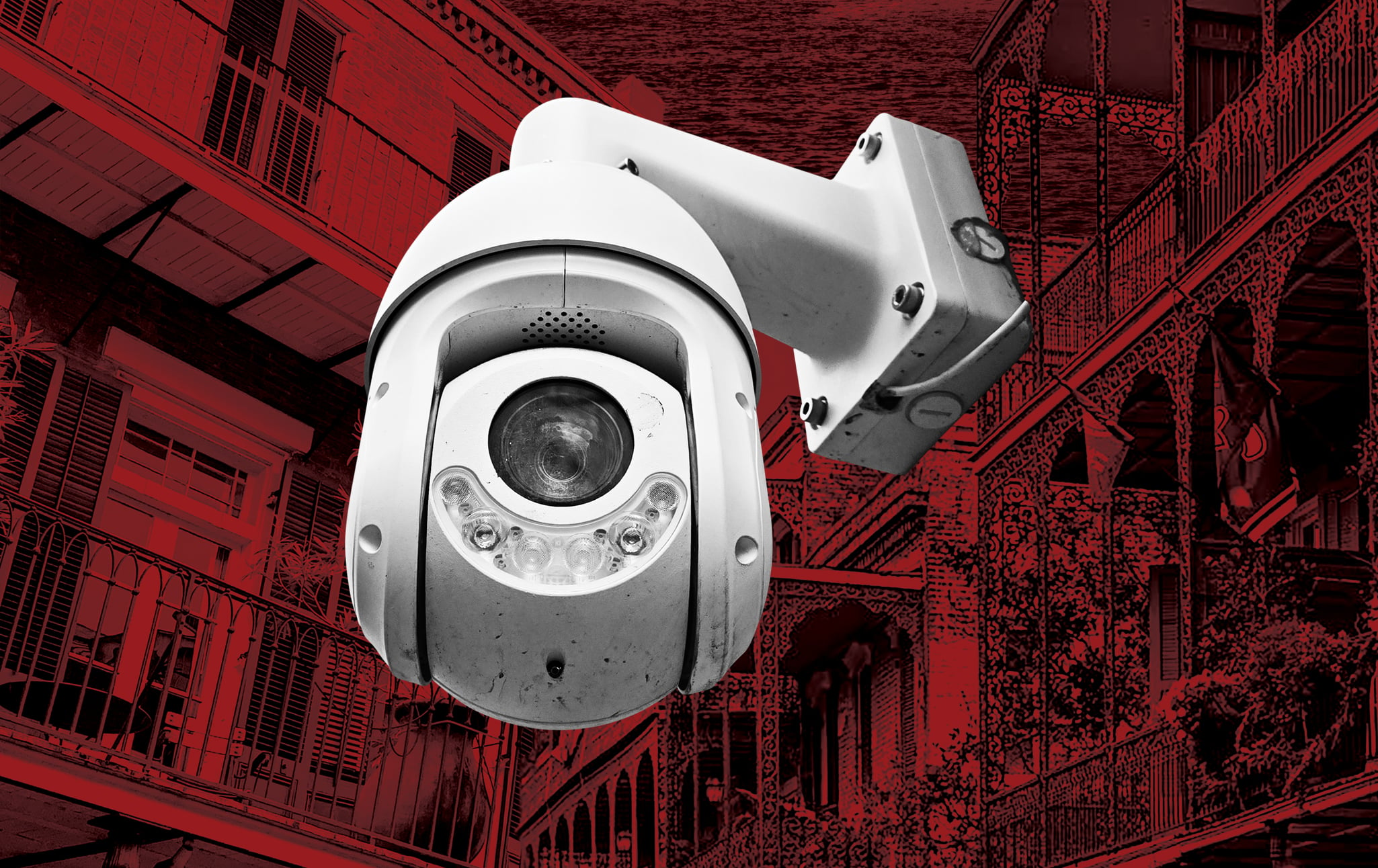
In New Orleans, everyone is being watched with facial recognition cameras and police drones—and your hometown might be next.
And I bade my comrades cast lots among them, which of them should have the hardihood with me to lift the stake and grind it into the Cyclops’ eye…
— Homer, the Odyssey
When you walk through the French Quarter in New Orleans, you’ll see—and be seen by—two distinct types of surveillance cameras. Some are the familiar little black bubbles and metallic cylinders, perched outside the doors of shops, or mounted on poles at the edge of parking lots. They’re usually pointed toward one particular business, and it’s a safe bet they’ve been put up by the owner to safeguard their wares. But then there’s the Cyclops.
That’s just what I call it, because it reminds me of the monster’s eye in Homer’s epic: sharp, glaring, baleful. But the official term is “PTZ camera,” for “pan-tilt-zoom.” Compared to the familiar, workaday cameras of shopkeepers and restaurateurs, they’re a whole different species. PTZ cameras are bigger, bulkier, and mounted on swiveling sockets, like gun turrets. Instead of pointing at a single building, they point out to the street, and as the name suggests, they “pan, tilt, and zoom” in all directions, sweeping a wide range of public space. When their glittering sensors detect motion, they move too, tracking whoever they’ve spotted. Frankly, they give me the creeps—and that was before I did some research, spoke to some local activists, and found out how sinister mass surveillance has really become.
“A Wonderful Force Multiplier”
Nobody knows exactly how many of these cameras there are in New Orleans. Back in 2015 it was around 1,500; by 2025, the number had ballooned to over 5,000, as estimated by NPR. Blogger and privacy advocate Matthew Wollenweber, who works as a computer security engineer here in the city, has been mapping their locations for years. So has the civil rights group Eye on Surveillance, which maintains a detailed digital map on its website, updated with contributions from volunteers. But more cameras are popping up all the time. And the reason there’s so little transparency about their numbers and whereabouts is because these things are being planted all over town, not by the city government or the police, but a private nonprofit. It’s called “Project NOLA,” and it’s the handiwork of one armchair vigilante: an ex-cop named Bryan Lagarde.
Lagarde seems to believe his own sales pitch; you can say that much for him. According to a profile in the International Business Times, he got into the mass-surveillance game back in 2011, when he became dissatisfied with the fact that New Orleans didn’t have its own city-run camera network and took it upon himself to provide one. “We said, ‘Merry Christmas. Guess what? We just created a crime camera system,’” he told the outlet. The model is simple: any home or business owner who wants one can contact Project NOLA and have a camera installed, for a monthly “cloud fee” starting at $20 for the simplest cameras. The unit will then be tapped into the nonprofit’s ever-expanding network, and the property owner can access the footage on request.
The police, too, work hand-in-glove with Lagarde, relying on him as a kind of unofficial consultant. As IBT reporter Eric Markowitz writes:
When Lagarde hears police dispatchers [on the radio] mention a gunshot, stabbing, home invasion or other serious crime on a certain block, Lagarde will drop everything he’s doing to see if Project NOLA has a camera in that area. If there is a camera nearby, he’ll put the video feed onscreen, and scan the area to see if he can locate a suspect. If he can, he’ll call the police dispatcher’s command desk to assist with any visual information.
Tyler Gamble, communications director for the New Orleans Police Department, confirmed in an interview that, while there is no formal relationship between Lagarde and police, Lagarde is routinely in touch with police dispatchers to provide information. “All of our operators in our command desk know him, and we allow them to relay that information when there’s a crime in progress,” Gamble says.
That was back in 2015, and at that point, the cameras were fairly simple technologically. Starting in 2022, though, Project NOLA added AI facial recognition to the network, making New Orleans the first city in the United States to deploy that technology on a mass scale. Their website now touts the benefits of “Advanced AI” which can identify people’s faces and “automatically alarm when a known shoplifter or blacklisted person is detected approaching.” (How, precisely, the “blacklists” are created isn’t specified.) According to the Electronic Privacy Information Center, this new generation of cameras can “not only track faces, but also clothing, cars, and bikes.”
Project NOLA aren’t the only ones working to expand mass surveillance across the Crescent City. This March, the New Orleans Police Department (NOPD) announced plans to use “Drones as a First Responder,” allowing them to “observe people of interest and[...] understand the situation better before deploying boots-on-the-ground officers.” And if that weren't enough, Peter Thiel’s Palantir has been operating here, too. As far back as 2012, Democratic political strategist James Carville was helping Thiel’s tech company establish a partnership with the city government, which reportedly used Palantir software for “predictive policing.” This included generating “databases of individuals who, based on a number of facts, are deemed a high risk of being offenders,” according to the Times-Picayune, and then targeting those people for surveillance before they’d committed any crime. (After the program became public knowledge in 2018, when the Verge reported that even the city council had been kept in the dark, it was quietly ended.) And in the Tulane Hullabaloo, college students report seeing more and more “AI-powered” cameras from the surveillance company Flock on and around their campus. Everyone, apparently, wants to watch New Orleans.
If you take the tech elite at their word, this all sounds downright heroic. “I recognized early on that it can act as a force multiplier. A wonderful force multiplier,” Lagarde says of his camera network. Palantir CEO Alex Karp, likewise, has described so-called “pattern of life” surveillance—in which all of a person’s everyday actions are tracked and scrutinized—as “a very, very, very important way of finding terrorists, and in general criminals.” If they have their way, the spy network won’t stop in New Orleans. It will expand everywhere, and your city or town might be next on the list. But if the era of Donald Trump and Elon Musk has taught us anything, it’s to beware of confident, wealthy men who say they’re going to save the world, or your corner of it. And when it comes to the glassy-eyed cameras turning and staring at us from New Orleans’ street corners, there are plenty of reasons to question the narrative we’re being sold.

Welcome to Dystopia
In the first place, the idea that surveillance is a silver bullet for stopping crime is questionable at best. There may be individual cases where it really does work as advertised: someone may notice they’re on camera and decide not to try breaking into a car, or someone who’s committed several assaults may get caught, preventing the next act of violence. But at best, this is a Band-Aid solution for a deeper problem. Surveillance only allows police to observe and punish crime after it’s been committed. It does nothing to address the basic conditions that cause crime: foremost among them, poverty and the desperation that comes with it. (For example, an eye-opening study in Chicago recently found that there’s a direct link between getting evicted and being more likely to commit a gun crime.) Punitive measures are like noticing that your kitchen is flooding, and responding by shoving more and more towels at the problem, rather than turning off the water at the source. And even if surveillance did lower crime rates, it wouldn’t justify casting a dragnet of cameras, drones, databases, and AI over an entire city, because the potential for abuse is truly terrifying.
There’s a phrase that was commonly trotted out a decade ago, when Edward Snowden sacrificed his freedom to expose the NSA’s warrantless spying on millions of Americans. “If you’re not doing anything wrong,” this sour little chestnut goes, “you don’t have anything to worry about.” It sounds reasonable. It’s totally false. The problem, which anyone can spot if they think about it for a second, is that you have no way of guaranteeing that what you consider “something wrong” will be the same thing the surveillance operators do. Maybe it is today. Maybe tomorrow, the people in power decide there’s “something wrong” with your political or religious beliefs, or your sexuality, or the country your family comes from. Then, suddenly, you’re the one in the lens. When you submit to be surveilled, what you are doing is handing over a copious amount of power. So you’d better be very, very sure you can trust the people you hand it to—and even if you do, can you trust their successors, five or ten years from now?
In fact, New Orleans already made a democratic decision that we don’t want this technology around. Back in 2020, our city council passed a law restricting the NOPD from using a wide range of surveillance and “predictive policing” technologies, including a blanket ban on “any software or system capable of tracking people and/or objects based on characteristics such as color, size, shape, age, weight, speed, path, clothing, accessories, vehicle make or model, or any other trait that can be used for tracking purposes.” This was totally unambiguous. But in 2022, the city government updated the law to give itself a loophole:
Nothing in this section shall prohibit the New Orleans Police Department (“NOPD”) from using evidence relating to the authorized investigation of a specific crime that may have been generated from a face surveillance or characteristic tracking system, so long as such evidence was not generated by, with the knowledge of, or at the request of the [NOPD].
In other words, they found a work-around: let private entities like Flock and Project NOLA do the surveillance, and then have the cops “partner” closely with them so they still get access to the banned technology. Obey the letter of the law, while eviscerating its spirit.
In practice, this type of unofficial partnership results in far less accountability. As your high school civics teacher probably told you, the Fourth Amendment protects Americans against “unreasonable searches and seizures,” and thus guards the fundamental right to privacy. It could stand to be updated and strengthened, since it was written for an era when “searches” meant red-coated officers rooting through the pigeonholes in Ben Franklin’s desk, and AI would have seemed like sorcery. But it’s still basically sound. The problem is, the U.S. constitution applies only to intrusive actions by the government, so a private institution like Palantir, Flock, or Project NOLA doesn’t have to care about the Fourth Amendment at all. “While government-installed cameras are constrained by constitutional law and thus cannot record or be pointed [at] places someone would have a reasonable expectation of privacy, home or business cameras can be anywhere, pointed anywhere,” wrote Jules Bentley in the local magazine Antigravity, all the way back in 2014.
Looking at Bryan Lagarde as a case study, we can actually give him some credit, because he has shown some signs of principle and restraint. Last year, when he discovered that the NOPD had given his program’s footage of a murder to a reality TV show called Homicide Squad, he temporarily pulled the cops’ access to Project NOLA, “out of respect for people’s privacy and also to maintain the dignity of the dead.” It was the right call. But something has gone seriously wrong when we are relying on the personal ethics of an individual to decide privacy outcomes for an entire city.
In interviews, Lagarde insists that he’s conscientious about the dangers of surveillance technology “in the wrong hands without guardrails.” But he believes Project NOLA’s are the right hands, and that a private system is actually safer than a government-run one, because each property owner is a “volunteer” participating of their own free will. “It’s a community’s choice. If they want it, they do it. If they don’t want it, they don’t do it,” he says. “And if they want it and do it and then later think ‘We don’t want to do it anymore,’ they can unplug the cameras themselves!” But the word “community” is misleading there. In fact, it’s not “we” the “community” of New Orleans as a whole that decides. It’s the small minority who are wealthy enough to own businesses or residential buildings, and unlike democratically elected leaders, they aren’t accountable to anyone but themselves.
This lack of accountability is important, because the potential for abuse with this technology is truly massive, and there have been disturbing cases recently that prove it. In Texas, for example, the Johnson County Sheriff’s Office was recently caught conducting a “nationwide search of over 83,000 Flock cameras” to locate a particular woman, in what they claimed was a missing-persons investigation. In fact, they were investigating her on the suspicion that she’d had a self-induced abortion, currently banned in Texas, because her partner—who “would later be charged with domestic violence against her”—had reported her for the so-called crime. Under false pretenses, the police used the surveillance infrastructure of states like Illinois, where abortion is a protected right, to carry out the abuser’s vindictive will. Or consider an equally creepy case from Denver, where a woman identified only as “Eden” believed herself to be taking a bath alone in her home—only to spot a police drone hovering outside her window, watching her.
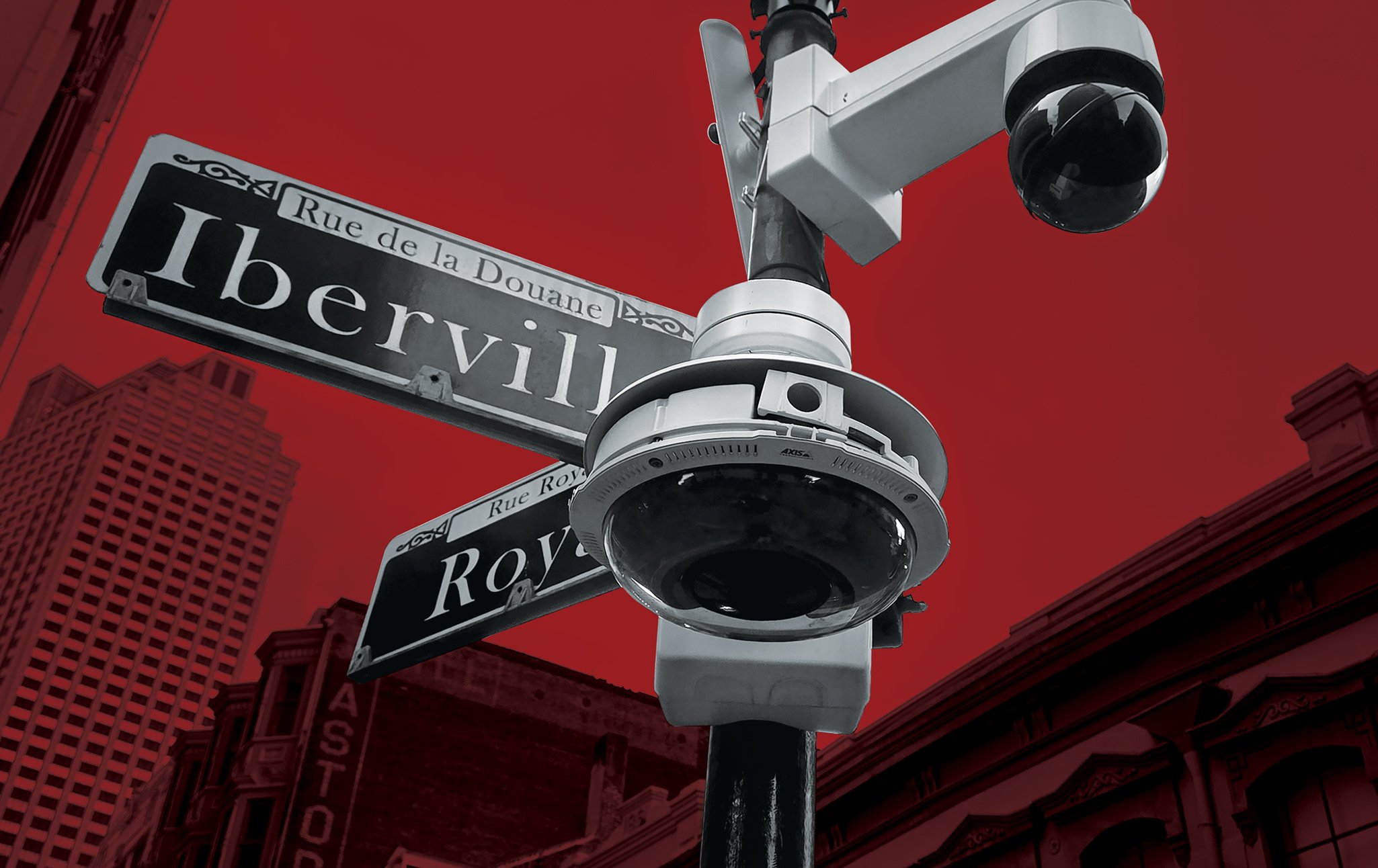
Those are only a couple of individual cases; you could plausibly attribute them to a few “bad apples” going rogue and abusing the technology. The real problem comes when the system is working perfectly, but for abusive ends. Like Texas, Louisiana has had an abortion ban ever since Roe v. Wade was overturned in 2022, so mass surveillance in a city like New Orleans could easily be used to track down any woman who tries to access proper reproductive healthcare. It’s striking that many of the city’s pharmacies—like the CVS on Decatur Street, or the Walgreens at the corner of Royal and Iberville—have PTZ cameras, and they’re also the most obvious places for someone to try to buy mifepristone pills or a Plan B tablet. Only the NOPD’s political decision not to enforce restrictions on reproductive rights, together with the camera operators’ personal ethics, protects those people, and neither are particularly reliable.
Louisiana also has a vicious new law targeting homeless people. On June 16, Governor Jeff Landry signed HB 211, which makes it a crime to sleep outside anywhere in Louisiana that isn’t an authorized campground. If you find yourself without shelter, and the cops find you nodding off, you can be targeted for punishment—including “fines, incarceration, and possible forced labor”—in the state’s prison system. So when supporters of mass surveillance talk about stopping “crime,” keep in mind that Louisiana’s government now defines being poor in public as a crime. Remember, too, that if you’re like the 59 percent of Americans who don’t have $1,000 in emergency savings, you’re only one financial crisis away from being on the street yourself.
Immigrants, too, can easily come into the crosshairs. This year, New Orleans has been the site of a dramatic crackdown on undocumented immigrants by ICE (dubbed “Operation Catahoula Crunch” after someone realized “Operation Swamp Sweep” spelled “SS,” and was therefore a little too on-the-nose). We know that ICE commander Gregory Bovino was using surveillance software to “monitor sentiment” about the operation online, even flagging Reddit posts that accused ICE of racial profiling as subjects of special interest. We know, too, that AI “characteristic tracking” cameras can identify things like a Mexican flag pin on a backpack, or a hijab or keffiyeh, as the identifying markers to be tracked. Profiling is very literally what these systems are designed to do.
When I spoke to Edith Romero, one of the organizers at Eye on Surveillance, she pointed out that Louisiana now has a law called Act 339 which criminalizes “any act intended to hinder, delay, prevent, or otherwise interfere with or thwart federal immigration enforcement efforts.” The scope is intentionally broad and vague, but can easily be read to include not handing over surveillance footage when it’s demanded. So the owners of the cameras may not even have a choice. But at the same time, reports recently came out that Palantir in particular has been awarded a $30 million contract to “use artificial intelligence and data mining to identify, track, and deport suspected noncitizens,” in partnership with ICE. So some CEOs, at least, don’t have to be persuaded.
The scope of these systems is hard to fully grasp. So as an exercise, take five minutes and think of all the ways you could exploit a network of AI cameras, if you were in the command center. With a few prompts, you could generate a list of every man who has visited a gay bar in the last six months—or a mosque, or an Alcoholics Anonymous meeting. (Not anonymous any more!) You could track everyone you suspect of being a sex worker, or everyone who speaks to a sex worker. You could create maps of their homes, workplaces, and known associates, with little red lines connecting them all. You could have photographs of every public display of affection between two people, and then check if either person involved was married to someone else. And all of it could be sold to private detectives and background-check agencies, or to advertisers, or handed over to the cops. We are talking, essentially, about the powers of an omniscient god.
And that’s not even counting the drones. These are a more recent development, put forward by the NOPD and approved by the city council in an April 2026 vote, where only ten minutes of public comment was allowed. A single police drone is now in operation in the 8th District of New Orleans, which includes the French Quarter. It cost $250,000, and there are reportedly plans for two or three more at a total cost of $740,000, much of it sourced from anonymous donors. Somewhat incoherently, the police claim their drones “will not be used for surveillance,” but also that they “record video from takeoff until landing,” and so will have a record of any misuse by the operator. This is a funny definition of “not surveillance.” In an op-ed for the Advocate, Wollenweber isn’t buying it:
A drone is an AI-powered aerial surveillance system. It’s a camera, and cameras don’t stop crime or provide first aid. Instead of a police officer responding to your call, he’s sitting at headquarters watching a screen. The response time metric looks fantastic. But help isn’t any closer. The drone isn’t for you. To quote The Wire, “You juke the stats and majors become colonels.”
Personally, I haven’t yet seen the drone overhead in the Quarter, though that doesn’t mean it hasn’t seen me. But we know it’s been circling over the heads of our poorest neighbors, because Wollenweber has a spreadsheet of all the reasons the NOPD logged for using it in a one-year time span—and one of them was “homless PERSON BLOCKING THE SIDEWALK.” (The misspelling, and the warped ethics, are the cops’.) The majority of the entries, though, don’t have a reason listed at all.
The Eye is White
And then there’s the racism. (Did you think a discussion of policing in Louisiana wouldn’t involve racism?) Both the ACLU of Louisiana and the national organization officially oppose the use of AI facial recognition, and there’s a good reason: AI has a nasty habit of falsely accusing Black people. As Amnesty International has documented, “facial recognition systems misidentify Black faces at a high rate,” and federal data shows that “African American and Asian faces were up to 100 times more likely to be misidentified than white faces.” The bias is hard-wired into the technology itself.
We can put names and faces to those statistics, too. Back in 2023, a Georgia man named Randal Reid was arrested and jailed for six days because the sheriff’s office in Jefferson Parish, Louisiana had issued a warrant for him. Another Black man who looked vaguely like Reid had stolen some luxury purses from a shop, and the sheriff’s office had a fancy new AI system that “compare[d] the faces of criminal suspects against a trove of mug shots, driver’s licenses, and even selfies plucked from social media,” per the Times-Picayune. But the AI got it wrong, because Reid had never even visited Louisiana, had a mole on his face which the suspect lacked, and was more muscular than the “flabby” thief. (Again, the cops’ word; they’re not known for their tact.) It was a travesty of justice, and Reid was eventually awarded $200,000 for the wrongful arrest.
Some cases are even worse: in Florida this year, another African American man named Jalil Richardson was arrested and jailed for almost three months because an AI with “85 percent accuracy” claimed he stole a car, which human investigators later determined he did not. As a result, he lost both his job and his home. “Our kids are scattered in different houses. We lost our car. We lost everything because my husband lost his income,” his wife Jasmine told reporters.
It’s hard to overstate the dystopian nightmare this tech creates. Imagine being watched and evaluated at every moment, everywhere you go, by a machine that’s terrible at identifying people who look like you. It’s like having the worst, most dim-witted racist cops in the South looking over your shoulder 24/7, waiting for an excuse to blow their whistles and accuse you of a crime you didn’t commit. In those circumstances, just stepping into a New Orleans street as a Black person puts you at risk.
The historical relationship between racism, white supremacy, and surveillance runs deep. At Eye on Surveillance, Romero compares facial recognition to the so-called “lantern laws” of New York City in the late 18th century. As the name suggests, these racial codes required enslaved Black and Indigenous people to carry lanterns if they walked anywhere at night without white supervision, so they could easily be spotted and followed by the police. Fail to do so, and they could be punished with a whipping. In an era without Flock cameras and Ring doorbells, it was the next best thing—an “early example of supervisory technology,” as author Simone Brown puts it in her book Dark Matters: On the Surveillance of Blackness.
Closer to home, you can take a tour of the Hermann-Grima house in the French Quarter—once the mansion of two successive families of slaveholders, the Hermanns and the Grimas, and now a historical museum. When you step into the courtyard, you’re immediately struck by the architecture. On the main house, a long second-floor balcony with an iron railing overlooks the entire compound, so the owners could look out and immediately see their human property working in the kitchens or the garden below, along with anyone who entered or left the quarters of the enslaved. “This was another means of exercising control over them and threatening punishment,” as the museum caretakers put it. The whole place is a pre-Civil War panopticon, a system of total surveillance built up brick by brick. And today, a black plastic bubble with a camera in it surveys the grounds from across the street.
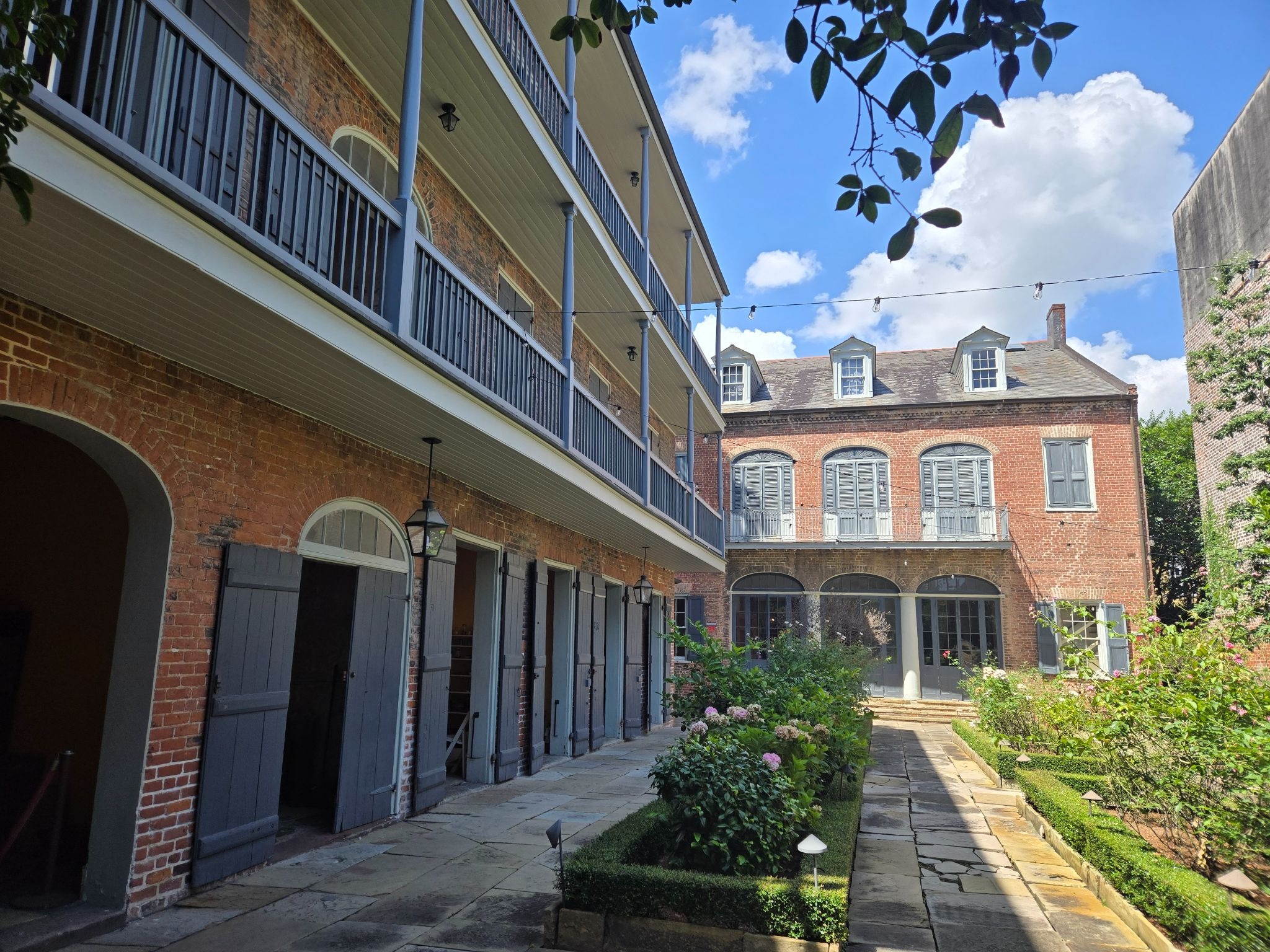
from the balcony of the hermann-grima house, the owners could see everything. (Photo: Alex SKopic)
In New Orleans today, the old dividing lines of wealth, power, and race remain, just below the surface. Surveillance is everywhere, but it’s not the city’s business elite who are being scrutinized the most, as they come and go from their stately homes in the Garden District. Instead, the PTZ units and the buzzing police drones are concentrated in the French Quarter, to keep an eye on the majority-Black working class who make the city run, on the property owners’ behalf. You don’t need to be an expert like Simone Brown to see what’s going on there.
Ironically, people have no trouble identifying mass surveillance as abusive and frightening when other countries do it. In a recent Fox News segment, reporter Bret Baier visited Beijing to cover the May summit between Donald Trump and Xi Jinping, and was shocked by the level of surveillance he found there: “Our driver parked illegally for two minutes and he got a message on his phone that he got a ticket for about 40 bucks U.S., because they saw it on the camera.” Soon afterward, fellow Fox pundit David Marcus ran a column about the incident, saying that it was “a glimpse into the surveillance state America must never become.” Similarly, American news networks like CBS have been rightfully concerned about the government of Iran using surveillance cameras to enforce the mandatory hijab for women. Well, the surveillance systems currently being established in New Orleans are not much different in scope and capabilities from the ones China and Iran currently have. So why on Earth is anyone accepting them here, when we condemn them there?
The really frustrating thing, too, is that surveillance is far from the only option. If you’re genuinely worried about crime and violence, there are plenty of alternatives available. When I asked Romero, she made this same point. “We know that in this country, the main sources of violence are under-resourced people and violent men,” she says. “These are the two main reasons that we have abuses of power and violence, and if we addressed these two things it could stop. But surveillance, and monitoring poor people and people of color, is a completely separate issue that has separate motivations. That leads to shareholder value going up for private prisons; it doesn’t actually lead to the safety of communities, or women and children. They have different value systems at the end of the day. We could fix violence, but instead we’re populating prisons.”
She’s right, and the literature of criminology bears the point out. Some of the approaches that have consistently been shown to lower crime rates are more investment in public schools and after-school programs, along with making jobs more easily available and better-paying. In New Orleans specifically, community organizers are doing their best to give people a path forward in life that doesn’t involve crime. They’re building community centers, setting up mutual aid networks to feed people, and working to help those with substance use issues. That’s the kind of effort that’s worth supporting. Not a drone above your head, or the Cyclops staring at you from the wall.

What Is To Be Done?
As citizens, we do not have to submit to being watched, tracked, monitored, and policed all the time. Nor should we. As we’ve seen, the people who call themselves our “leaders” can’t be trusted with the kind of power they want over us. In New Orleans our last mayor, LaToya Cantrell, was indicted on federal fraud charges. Oliver Thomas—the city council member who co-sponsored, then quietly withdrew, a 2025 resolution to expand facial recognition—previously spent time in prison for bribery. Above them is Governor Jeff Landry, who suspended our elections for the House of Representatives this spring. Above him is Donald Trump; no elaboration needed. And alongside them all are people like Alex Karp, Peter Thiel, Bryan Lagarde, and the executives at Flock, their hands outstretched for a check. These are not people I’d trust to come over and feed my cat, let alone run a city-wide panopticon.
Fortunately, power can be taken away. The first step is to make people aware of the problem. Most people, when they walk by the glaring eye of an AI camera, probably don’t give it much thought. Even the business owners who’ve volunteered to have them bolted to their shops and restaurants may not fully understand the implications of what they’re doing, or the threat to people’s civil liberties. At Eye on Surveillance, they’re working to fix that, opening conversations with the whole community and offering informative resources. It’s critical work, but it’s also a relatively small group, relying mostly on volunteers. They can’t change the balance of power alone.
But there are countermeasures the rest of us can take, too. In a city like New Orleans, you can physically show up at your city council member or U.S. Representative’s office; anywhere in the country, you can send an email or make a phone call, and demand the kind of legislation you want. You can turn up in an organized group to public meetings, and do the same. You can organize a street protest, while it’s still legal; in fact, I first encountered the folks from Eye On Surveillance at the 2025 “No Kings” rally. And when the circumstances are right and a business owner is being obstinate about keeping these abusive technologies around, you can organize a boycott, too. Really, any proprietor of a public business who allows mass surveillance is making it clear that certain communities won’t be safe there, so they should expect no less.
In Homer’s story, Odysseus is trapped in a cave, with the Cyclops watching him all the time. But he can’t lift the spear and drive it into the monster’s eye without his crew. The same principle applies, centuries later and continents away, to our present situation. Alone, nobody can do much about the surveillance state. Together, we may.
Special thanks to Edith Romero, Alex S. Vitale, and Matthew Wollenweber for their help and advice in putting this article together. Any deficiencies are, of course, my own.

%20(crop).jpg?width=352&name=wile-e-coyote%20(resize)%20(crop).jpg)