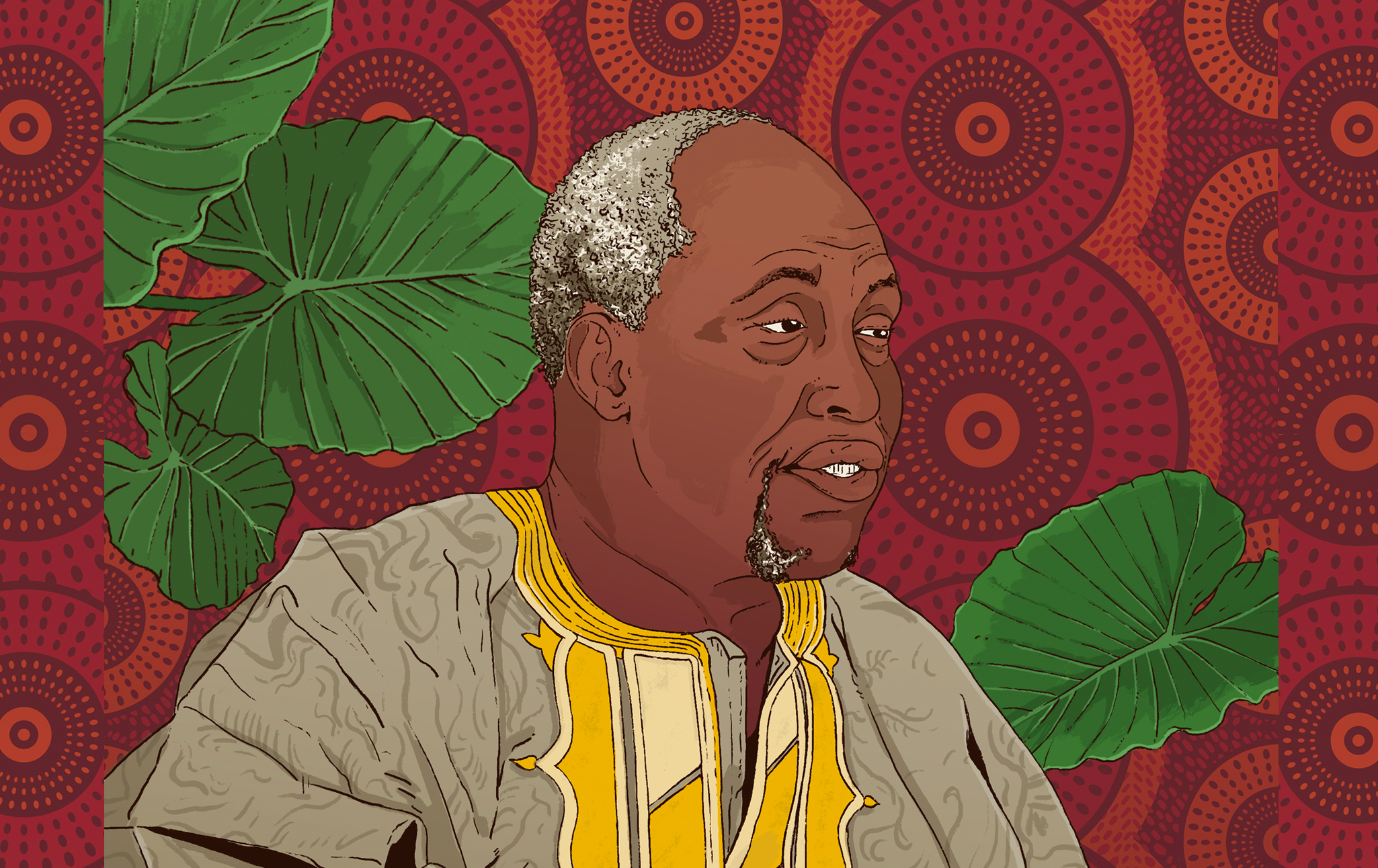
Kenya’s greatest novelist was never shy about confronting the politics of empire and capitalism.
The BBC termed him a “giant of African literature.” In a Guardian obituary, Lyn Innes called Ngũgĩ wa Thiong’o “a founding father of African literature in English.” For the scholar Helon Habila he “belonged to an age of prophets,” and “we must honor his teaching.” For others, he “was not just a writer, he was a militant.” For his writing, Ngũgĩ received numerous awards. Yet the Nobel Prize in literature always eluded him, perhaps because of his unrelenting criticism of colonialism, neo-colonial imperialism, and the capitalist West. For the literary establishment he was a dangerous intellectual who was still bitter about colonialism and its aftereffects. He was often seen as a leading and deserving candidate for the Nobel Prize for literature; so much so that in 2010 many reporters gathered outside his home on the day of its announcement. When it became clear that the award had gone to Mario Vargas Llosa, Ngũgĩ “seemed much less disappointed than the reporters, whom he had to console.”
On May 28th, 2025 Ngũgĩ wa Thiong’o passed away. He bequeathed the world a decolonial literature that challenged power, domination, and inhumanity. Today, his vision is more vital and pertinent than ever in our disputed and globalized world—a world filled with tyranny, racism, and xenophobia, and where imperialism is still very much with us.
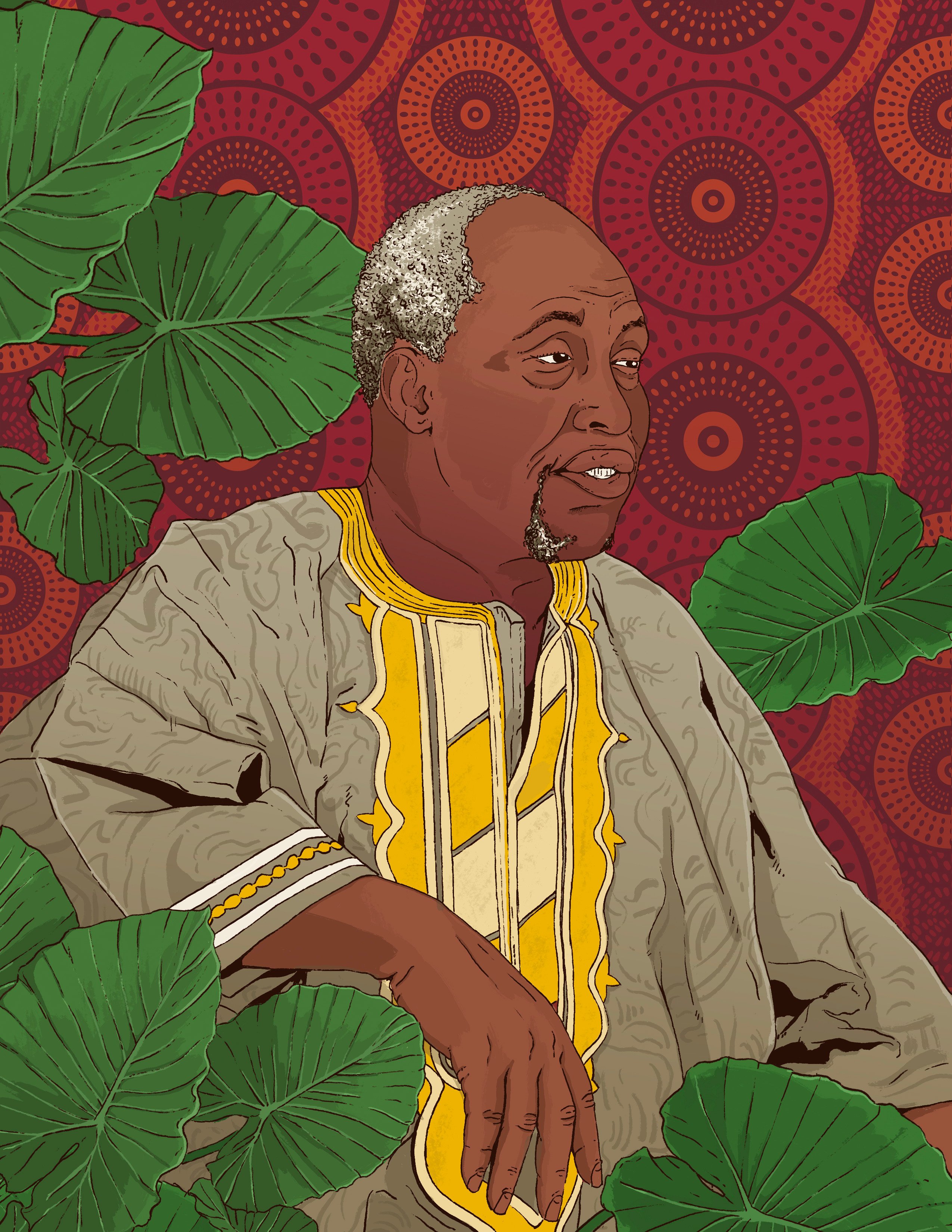
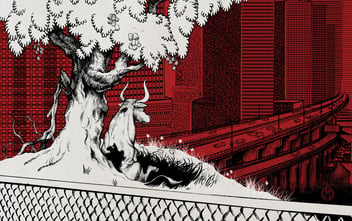
Art by Nik Richard from Current Affairs Magazine, Issue 56, November-December 2025
Early Works and the Formation of a Decolonial Consciousness
Born James Ngũgĩ in Kamiriithu, Kenya, in 1938, Ngũgĩ wa Thiong’o is one of Africa’s most prolific and significant writers, intellectuals, and cultural critics. He has written plays, novels, essays, memoirs, and academic works that examine the complex relationships between language, culture, colonialism, and emancipation during the last 60 years.
Throughout his body of work, Ngũgĩ showed a strong dedication to rediscovering and reclaiming what decades of British colonialism sought to erase: African languages, epistemologies, and identities. This effort to fight imperial rule and recover African futures is at the core of his intellectual and creative endeavors.
Early works by Ngũgĩ, written in the 1960s and early 1970s, capture the conflicts of a Kenya that had just gained independence and was attempting to reconcile its colonial history with its uncertain future. Kenya was a diverse country of different ethnic, linguistic and religious groups; and at the helm of political power were the beneficiaries of colonial education, who were indifferent to neo-colonialism. In the 1960s and ’70s, Kenya was led by President Jomo Kenyatta, whose government maintained close ties with former colonial powers and Western business interests. Rather than dismantling colonial economic structures, Kenyatta’s regime preserved settler land ownership, foreign investment dominance, and elite privilege, enriching a small African bourgeoisie. Ngũgĩ saw this as a betrayal of independence—a neo-colonial order disguised as nationalism, indifferent to the masses’ social and economic liberation.
His early English-language books, such as Weep Not, Child (1964), The River Between (1965), and A Grain of Wheat (1967), addressed the Mau Mau rebellion of the 1950s, the British policy of land confiscation, and the psychological and moral effects of colonialism which were ignored by the new elites. In Weep Not, Child (1964), the protagonist Njoroge is a young boy whose family’s ancestral lands were confiscated and given to a white settler, Mr. Howlands. Njoroge dreams of uplifting his family through education, especially by learning to speak English and embracing Christianity. He embodies the hope and disillusionment of a generation that believed cooperating and doing one’s best within the colonial power structure would bring freedom and equality, only to face betrayal and despair amid the Mau Mau uprising and the British crackdown against it. By the novel’s end, Njoroge has lost his father Ngotho and several of his siblings to the British Empire’s violence:
He recalled Ngotho, dead. Boro would soon be executed while Kamau would be in prison for life. Njoroge did not know what would happen to Kori in detention. He might be killed like those who had been beaten to death at Hola Camp. O, God — But why did he call on God? God meant little to him now. For Njoroge had now lost faith in all the things he had earlier believed in, like wealth, power, education, religion. Even love, his last hope, had fled from him.
Even in this earliest novel, Ngũgĩ hits on the idea that would define his career: that adopting colonial ways of thinking and acting cannot save anyone from the inherently violent nature of colonialism itself, and can lead only to ruin.
Through a perspective of humanist reflection and anti-colonial critique, these works played a crucial role in presenting African audiences with a fictitious depiction of their own recent past and the nightmares of independence and neo-colonialism. In The River Between (1965), Waiyaki is another ambitious young man who stands as a symbol of the tension between tradition and modernity, struggling to unite two rival Gikuyu communities divided by colonial influence and Christian conversion, only to be destroyed in turn by the same conflicting forces he tries to reconcile. In the novel, Kabonyi, an elder who is a former Christian convert, laments:
We were one people before the white man came. We had our ways, our customs, our wisdom. Then he came with his religion and his government. He told us we were children, that our ways were bad, our gods false. And some of our people believed him. Now brothers fight brothers, fathers fight sons. The white man sits and laughs. He has divided the living flesh of the tribe and taken the best parts for himself.
In A Grain of Wheat (1967), Mugo, a solitary and guilt-ridden man, represents the moral and psychological turmoil of colonial violence and the complex legacy of betrayal and heroism that haunted Kenya’s path to independence. The novel is set in 1963, the year the nation finally achieved its sovereignty, and initially the reader is led to believe that Mugo is a hero of the Mau Mau rebellion, who stoically kept silent under British captivity and torture. It’s only later that we learn Mugo actually betrayed Kihika, a courageous freedom fighter and symbol of revolutionary idealism, handing him over to the colonists:
“You asked for Judas,” he started. “You asked for the man who led Kihika to this tree, here. That man stands before you, now. Kihika came to me by night. He put his life into my hands, and I sold it to the whiteman. And this thing has eaten into my life all these years.”
Throughout he spoke in a clear voice, pausing at the end of every sentence. When he came to the end, however, his voice broke and fell into a whisper. “Now, you know.” And still nobody said anything. Not even when he walked away from the platform. People without any apparent movement created a path for him. They bent down their heads and avoided his eyes.
This act of treachery exposes the fragility of communal solidarity under the pressures of colonial terror and personal weakness. Mugo’s guilt and silence reflect the broader compromises and fears that undermined the liberation struggle. Although ultimately successful, the Mau Mau movement was never composed of perfect revolutionary heroes, and Ngũgĩ is honest about this fact. By placing Mugo’s confession on the day of Uhuru, Kenya’s independence, he also creates a powerful metaphor for the post-independence world, in which previous anti-colonial fighters were now neocolonial governing agents, betraying the ideals of freedom just as Mugo did Kihika. After independence, the memory of Kihika’s sacrifice stands in sharp contrast to the corruption and self-interest of the new leaders.

Theater and the Mobilization of Popular Resistance
One of the most radical and influential periods of Ngũgĩ's career was his work with community theatre in the 1970s. He collaborated with locals at the Kamiriithu Community Education and Cultural Centre to develop participatory theatre that tackled issues including corruption, exploitation, and landlessness. In addition to serving as a spur for community mobilization, his 1977 play Ngaahika Ndeenda (or I Will Marry When I Want) also infuriated the Moi dictatorship that replaced Kenyatta’s government.
Co-written with fellow playwright Ngũgĩ wa Mirii (no relation), Ngaahika Ndeenda was highly explosive because it openly criticized post-independence Kenyan society, exposing corruption, inequality, and the betrayal of the masses by the new political and financial elites. The plot follows Kĩgũũnda and Wangeci, a couple of poor farmers who are pressured by their richer neighbors to marry in a Christian church, since the neighbors view their traditional Ngurario wedding ceremony as illegitimate. As the play goes on, it becomes clear that this was all a ploy to steal the couple’s small plot of land, as they’re forced to put the deed up as collateral for a loan to fund the expensive wedding. Engaging in this way with clashes of religion and economic class, the play directly challenged both colonial legacies and Kenya’s contemporary elite, making it a bold act of political dissent.
Even more important, Ngaahika Ndeenda was Ngũgĩ's first major work to be written in his native Gikuyu, rather than English. By staging the drama in an indigenous African language and involving local communities, Ngũgĩ ensured its message reached ordinary Kenyans, amplifying its social and revolutionary impact. His choice of a native language was inextricably linked to his class politics. He maintained that African languages had the capacity to inspire the people, while English benefited the elite and those in power. To emancipate the African peasants, farmers and pastoralists, one had to “speak” and write in a linguistic medium they understood.
Ngũgĩ was arrested and jailed by the dictatorship in late 1977, and spent most of 1978 behind bars. But his incarceration and the play’s suppression only highlight the subversive and transformational power of vernacular culture. The Brazilian educator and activist Paulo Freire’s concept of praxis—the combination of introspection and action in the fight for liberation—was the foundation of his theatrical work, which is an example of decolonial teaching. For Ngũgĩ, theatre served as a vehicle for public empowerment and education rather than as a bourgeois hobby. At the theatre, the poor, the down-trodden and the peasants voiced their political agency and will.
Cultural decolonization poses a serious danger to neocolonial regimes, as seen by the state’s violent response to the Kamiriithu initiative. Ngũgĩ lost his freedom, his academic post at the University of Nairobi, and ultimately was exiled as a result of his dedication to the people and democratic cultural creation in postcolonial Kenya. These sacrifices, however, only strengthened his conviction and made his fight more global.

Rejecting English
The radicalization trend that Ngũgĩ’s work follows sets it apart from his peers. The experience of being imprisoned only strengthened his conclusion that language was a location of power struggles rather than a neutral medium. And so, he permanently “rejected” colonial languages as a means for emancipatory literature. English or French couldn’t capture the lived experiences of Africans and politics in a new neo-colonial world. Worse, they were weapons of the oppressor, intended to cultivate an attitude of submission and inferiority in the minds of colonized people, and prevent rebellion:
The biggest weapon wielded and daily unleashed by imperialism against that collective defiance is the cultural bomb. The effect of a cultural bomb is to annihilate a people’s belief in their names, in their languages, in their environment, in their heritage of struggle, in their unity, in their capacities and ultimately in themselves.
In this way, along with being a stylistic transformation, Ngũgĩ's transition from writing in English to adopting his native Gikuyu tongue represents a significant political stand against the effects of colonialism and its erasure and assimilation of indigenous languages and culture.
Ngũgĩ wrote his next novel, Caitaani Mutharaba-Ini (Devil on the Cross), while he was still imprisoned. The most radical novel yet, it follows a working-class woman named Wariinga who witnesses a “devil’s feast” held by wealthy Kenyan businessmen, where they boast and compete over who has committed the biggest acts of theft and exploitation. Ngũgĩ’s captors wouldn’t allow him paper, so he wrote the novel on sheets of toilet paper, slowly and painstakingly, and entirely in Gikuyu. Even while physically locked up, he used indigenous language to resist colonial cultural domination and reclaim his African identity.
One of the most important manifestos on language and decolonization is still Ngũgĩ's 1986 book Decolonising the Mind: The Politics of Language in African Literature. In it, he explained in detail his decision to write in Gikuyu instead of English. “Language, any language, has a dual character: it is a carrier of culture and a means of communication,” he wrote. He maintained that colonial languages were imposed in African schools as a kind of cultural imperialism that alienated pupils from their roots—ideas exemplified by Njoroge in Weep Not, Child, who places his hope in English education and Christianity rather than joining the rebellion, highlighting Ngũgĩ’s contrast between passive adaptation and active resistance to colonialism.
Ngũgĩ perceived English, French, and Portuguese as weapons of ongoing dominance, in contrast to other African authors who saw them as means of worldwide communication. According to him, reclaiming language is the first step towards decolonizing the African psyche:
The call for rediscovery and the resumption of our language is a call for a regenerative reconnection with the millions of revolutionary tongues in Africa and the world over demanding liberation. It is a call for the rediscovery of the real language of humankind: the language of struggle. It is the universal language underlying all speech and words of our history. Struggle. Struggle makes history. Struggle makes us. In struggle is our history, our language and our being.
In this way, his commitment to African languages challenges the dominance of Western epistemologies and calls for a pluriversal world where all cultures and knowledge systems are valued.
Exile, Globalectics, and the Expansion of Decolonial Thought
Ngũgĩ left Kenya in the early 1980s and carried on his decolonial work while living in exile, publishing extensively and lecturing in Europe and the United States. His nonfiction works in exile, such as Globalectics (2012), Something Torn and New (2009), and Moving the Centre (1993), expanded on his criticism of colonial modernity and imperialism, and examined the potential for international cooperation among oppressed peoples across the world.
Ngũgĩ opposes and challenges Eurocentric universalism with his interconnectivity model in Globalectics. Eurocentric universality is the idea that European culture, values, and ways of thinking are considered the standard or “universal” for judging all societies. It often ignores or marginalizes non-European perspectives, assuming that what works in Europe applies everywhere. In Globalectics: Theory and the Politics of Knowing, Ngũgĩ argues that “Eurocentrism presents Europe as the centre of the universe, the source of all knowledge, and the measure of all value. The rest of the world exists only in relation to Europe, often as a mere extension, reflection, or negation of it.” For example, Eurocentrism might evaluate a class of literature students by their knowledge of Shakespeare, even though the class is taking place in Kenya, Egypt, or Laos. In contrast, Ngũgĩ advocates for a world in which cultures interact horizontally as opposed to vertically through the impositions of empire, drawing on the writings of decolonial philosophers such as Frantz Fanon, Steve Biko, and Amilcar Cabral.
His concept of “globalectics” imagines a multifaceted world in which all languages and histories are significant; where all perspectives are legitimate and valid in their quest to express the human experience. For Ngũgĩ, cultures interacting horizontally means engaging with each other as equals, without one dominating or imposing its values over another. It emphasizes mutual respect, dialogue, and exchange, rather than the hierarchical, top-down relationships created by colonialism and empire. He writes that “Globalization, as it is now practiced, tends to universalize the particular—that is, the European experience—while particularizing the universal—that is, the experiences of the rest of the world. The result is a global hierarchy of cultures in which Europe becomes the centre and the rest are seen as peripheral. But true global culture can only emerge from the free and equal exchange of ideas among peoples and nations, each bringing their histories, languages, and imaginations to the global table.”
Furthermore, the diasporic reality and the transnational aspects of oppression and resistance are reflected in his writings from this era. He compares the African experience to that of Palestinians, African Americans, Indigenous peoples, and other marginalized groups. As he would later put it in a 2018 interview with the Nation:
Look at the Irish situation with the British. The humiliation of Native Americans, how their language was denigrated. In Africa, of course, we were forbidden to speak our mother tongues. Japan imposed its language on the Koreans. So wherever you look at modern colonialism, the acquisition of the language of the colonizer was based on the death of the languages of the colonized. So it is a war zone.[...] It is true of Africa, and anywhere where there was a colonial situation.
In his 2009 book Re-membering Africa, Ngũgĩ portrays various historical struggles of resistance by African people against colonialism and its aftermath, emphasizing the importance of solidarity among oppressed peoples worldwide. His decolonial criticism is enhanced by this global viewpoint, which also places Africa within larger movements for justice, humanity and dignity. His theory of Globalectics anticipates a world liberated from hate, violence and domination. He writes: “every culture, big or small, has something to contribute to the common pool of human knowledge. The globalectic imagination sees the world as an interconnected whole, where no centre or margin exists, only the ever-flowing energies of give and take among cultures. It is in this mutual recognition and exchange that humanity will rediscover its wholeness.” The book’s title is a pun on the word “dismembering,” with its goal being to literally “re-member” Africa in a healed world.
Why Ngũgĩ Matters Today More Than Ever
The writings of Ngũgĩ have become more relevant in the 21st century, as seen by the rise of decolonial initiatives at colleges, museums, and other cultural institutions. His lifetime endeavor is echoed by campaigns such as “Decolonize the Curriculum,” the “Rhodes Must Fall” protests that aimed to remove statues of Cecil Rhodes from university campuses, and indigenous language revival initiatives.
Several contemporary global crises, too, underscore the need for Ngũgĩ’s decolonial vision. African countries continue to grapple with neocolonialism and economic dependency, remaining ensnared in debt traps, exploitative trade agreements, and extractive economies dominated by foreign corporations (not to mention multinational institutions like the International Monetary Fund). Ngũgĩ’s critique of postcolonial elites and their complicity in global capitalism remains strikingly relevant, highlighting how the promises of independence have often been undermined by new forms of structural exploitation. His analysis calls for vigilance against both external and internal forces that perpetuate inequality and hinder true sovereignty.
The dominance of English in the digital age, artificial intelligence, and global academia illustrates ongoing linguistic imperialism, leaving African languages marginalized and underrepresented. Ngũgĩ’s insistence on linguistic justice emphasizes the need for investment in local language technologies and educational reforms, ensuring that African languages are not only preserved but also thrive as mediums of knowledge, creativity, and innovation.
Cultural hegemony and mental colonization continue to shape the global media landscape, which is heavily skewed toward Western narratives, aesthetics, and agency. African youth are disproportionately exposed to cultural products created outside Africa, which rarely reflect their realities, histories, or aspirations. Ngũgĩ challenges societies to create and sustain alternative cultural institutions rooted in indigenous values, morality, and humanism, while engaging with the wider world on equal terms.
Ngũgĩ’s valorization of traditional ecological knowledge also resonates strongly in the context of the climate crisis. Indigenous practices and cosmologies offer vital insights for environmental sustainability, as demonstrated by contemporary movements in New Zealand, where indigenous communities claim rights to land and steward it according to ancestral knowledge. His work underscores the importance of integrating indigenous approaches to mitigate ecological challenges and restore harmony between humans and the earth.
Finally, education remains a crucial arena for epistemic decolonization. Ngũgĩ’s vision of education as a tool of liberation rather than indoctrination advocates for inclusive, critical, and locally relevant pedagogy. By emphasizing culturally grounded curricula and critical thinking, his approach provides a roadmap for transformative education that empowers individuals and communities to challenge oppression and actively participate in shaping their futures.

A Legacy of Hope and Resistance
In his last years, staying true to his political activism and speaking truth to power, Ngũgĩ sent an open letter to President William Ruto of Kenya, where he expressed concern over Kenya’s alignment with the United States as a “major non-NATO ally,” recently sealed in a deal with President Joe Biden. At age 86, his prose still retained its sharp edge:
Dear William Ruto, The images of your recent State visit to the USA were very disturbing to me and to every patriotic Kenyan. I saw you seated on a chair, grinning, while Biden stood behind you, his face beaming with satisfaction. Why not? He had just announced that you had signed off our beloved Kenya[...]
Ngũgĩ viewed Ruto’s actions as a betrayal of the nation’s anti-colonial legacy. He criticized the president for becoming an “errand boy” in the West's geopolitical struggles, particularly in Africa, and for compromising Kenya’s sovereignty. Ngũgĩ also highlighted the hypocrisy of supporting the U.S. while Haitians protested in the streets against a possible U.S. military intervention, calling Ruto a “slave,” and urged him to reconsider his actions in light of Kenya’s history and the warnings of figures like C.L.R. James against becoming the instruments and tools of global neo-imperialism.
The life and work of Ngũgĩ wa Thiong’o demonstrate a persistent dedication and quest for justice, cultural dignity, and emancipation. His literary writing and academic outputs are living records of possibility and resistance, rather than being artefacts from the past. Ngũgĩ challenges us to envision alternative futures based on humanism, multiplicity, memory, and collective action in a world threatened by ecological collapse, xenophobia, totalitarianism and cultural standardization.
Because he provides both critique and optimism—a revolutionary hope based on the tenacity and inventiveness of the colonized—Ngũgĩ is more important now than ever. New generations of activists, artists, and philosophers who dare to create their own history and speak in their own languages are still motivated by his writing and voice. From popular theatre to language reclamation, from academic critique to international unity, his decolonial practice provides both a diagnosis and a solution for our contemporary age. He reminds us that language is important, that culture is a battleground, that the fight for decolonization is not finished, and that the mind, once freed, is capable of envisioning and creating better societies and nations.
Abdirashid Diriye Kalmoy is a PhD candidate in Sociology at Ibn Haldun University, Istanbul. His work has been featured in Daily Sabah, The Elephant, Africa Is a Country, and Modern Diplomacy. He is the author of Hopes in Transition: An Ethnography of African Migrants in Istanbul (Iber Akademi: Ibn Haldun University Press, 2025).