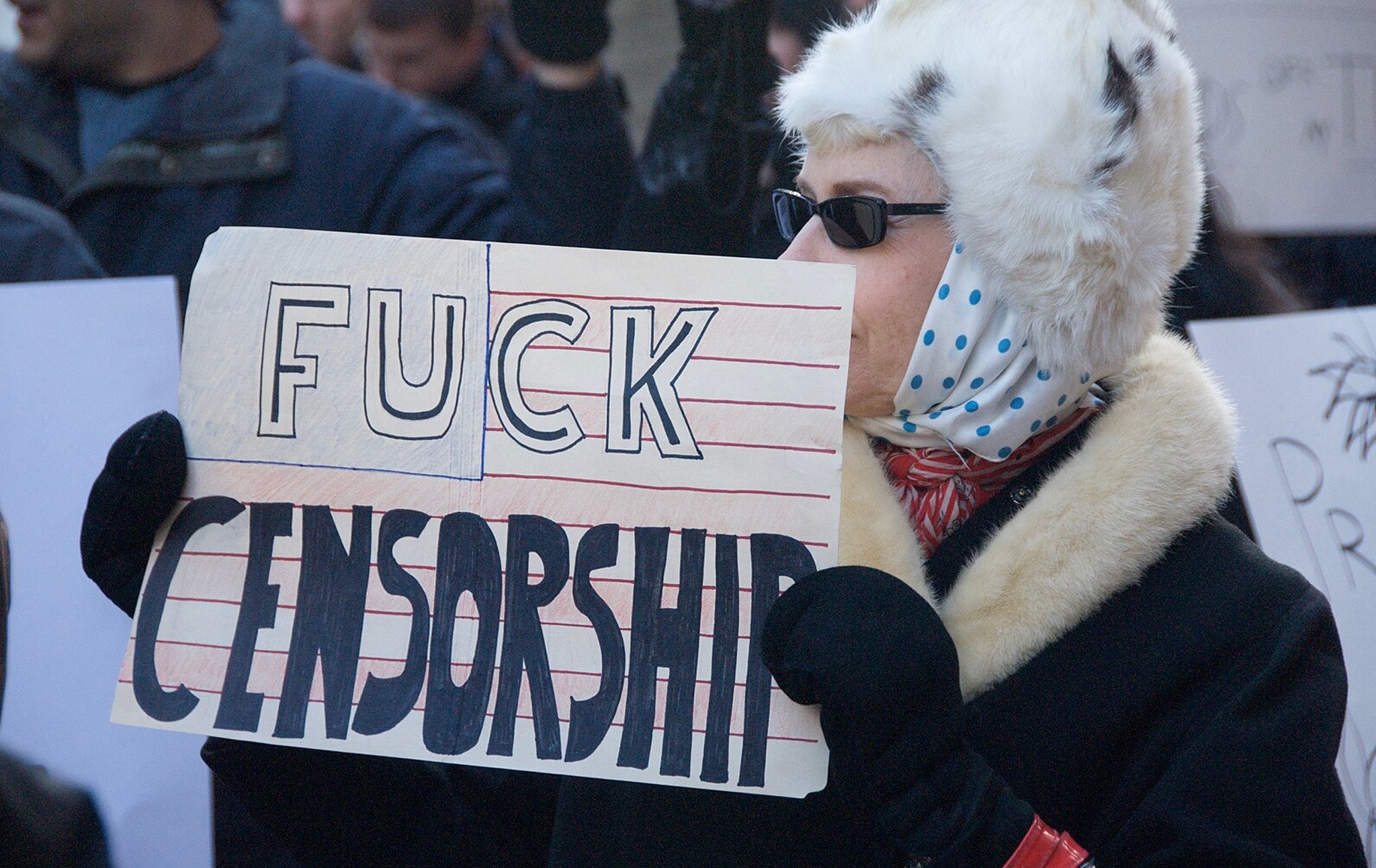
Right-wingers have been getting books removed from shelves across the United States. But they’re a fringe minority of weirdos, and they can be beaten. Here’s how.
You have probably been the victim of a book ban.
Don’t worry if you didn’t notice. While we tend to think of book bans in terms of towering infernos, the reality—as with most evil—is actually quite banal. There may have been a politely worded letter to the principal of your middle school about Alan Moore’s seminal masterpiece Watchmen, which features several explicit sex scenes. A worker developing the nonfiction collection at your public library might skimp on human sexuality topics if they know that they’ll just cause controversy—and endanger the rest of the collection budget to boot. Sure, you might have missed out on the big Ulysses ban of the 1920s and ’30s, but that kind of high-profile celebrity book shocker is easy stuff. Real book bans are quiet, insidious. That’s why the cure is a lot—and I do mean a lot—of noise. I was a librarian for about 13 years, and I have seen some shit. Here’s what to do.
First, we’re going to cover exactly what a book ban is, because you may be surprised to learn that you don’t know. Then we’re going to talk about why book bans are a thing, and why preventing them is so important. If you’re serious about resisting censorship, then you’re going to need some kind of answer when the nattering nabobs ask you, “but why do you want sweet, innocent children to have full, nay, even compulsory access to this sexually deranged and traumatic content?” And trust me, they will ask.
Finally, we’re going to give some examples of book bans here, there, now, and then, and the countermeasures people have taken against them. Buckle up, kids.

A “book ban” is exactly what it sounds like—the banning of a book by the government—right? Wrong. Removing a book from a library shelf is the tip. The iceberg beneath is massive, and bans can happen at several different levels. They can be national, as in the case of Ulysses and Shanghai Baby, the novel by Wei Hu that was banned in China for its depictions of sex and drug use in 2000. In that case, a government makes a law prohibiting the book and enforces the ban by punishing infractions. But in the U.S., at least, national bans are rare, and local book bans are far more common. The American Library Association estimates that over 2,000 books were “challenged” by individual people in 2024, although that number is probably underreported, because in 2023 the number of known challenges exceeded 4,000. Here’s one statistic that will blow your mind: in the period from 2021-2022, the Washington Post found that 60 percent of book banning requests nationwide originated with the same exact 11 people, who are spamming their areas with repeated demands for the removal of books from schools and libraries.
However, there is a larger movement on the right to push out books that inform people about LGBTQ and BIPOC experiences. Moms for Liberty, a conservative activist group that cut its teeth on mask mandates (and once quoted Hitler in its newsletter), has moved on to book banning. Their system includes tactics like elbowing their way onto school boards and barraging districts with removal demands. In Texas, Governor Greg Abbott signed a bill into law that will allow you to sue your kid’s teacher for providing them with a book you consider sexually explicit. In Florida, Governor Ron DeSantis packed several conservative activists onto the board of the traditionally-liberal New College, which promptly shut down its gender studies center and threw all the relevant books in a dumpster. In other words, the people trying to ban and remove books are a small cadre of right-wing wackos. They are categorically the minority, but they’re loud and increasingly backed by both money and political clout.
The big talking point in book ban attempts these days is that teachers and librarians are trying to sexualize kids by exposing them to LGBTQ content—or, as these folks call it, porn. It isn’t true, obviously, but it’s hard to argue that LGBTQ books have a place in libraries when the other side is screaming Porn! Porn! Porn! all the time. The accusation is designed to enrage liberals and confuse conservatives. After all, queer folks are more than just sex, and so are the books they write. But busy middle-right conservatives probably won’t want to risk exposing themselves to “explicit content” just to find that out.
In large and small-scale cases, a book ban is an attempt to eradicate information. This might seem redundant in a digital-first literary world, but books serve to break bubbles in a way the internet is ill-equipped to. Look what has happened to the CDC website, where the Trump administration has been scrubbing away information about contraception, transgender healthcare, and other subjects it disapproves of. Snap. Presto change-o. Info voided. That digital resource was highly vulnerable to censorship. Books are nowhere near as centralized. You could very well stumble upon one by accident in a Little Free Library and have your life changed. And note that there’s no algorithm when it comes to your public library. Ann Coulter and Michael Moore sit side by side on the shelves. Book bans do not happen because the information itself is necessarily dangerous. It’s the possibility that a book might be discovered by you; that it might break the edges of your world and make you grow beyond what your previous environment could handle. A book ban is a way to insulate your population against change.
Queer folks, in particular, are change machines. Gender breakers, rule breakers, breakers of expression and mode, every one is unique, and they are a powerful engine for liberal and progressive thought. That means that conservatives must despise and fear them. They are a threat to conventionality and conformity through the fact of their existence. Reducing them to sexual perverts intent upon abusing children is more than a way to excise them from discourse; it’s a way to additionally prevent new, rule-breaking ideas from infecting questioning young people. That is why Moms for Liberty is on a tear against All Boys Aren’t Blue, the most commonly-challenged book in American libraries in 2024, and Gender Queer, the second most targeted.
Books require courage. Every book changes you. Some books change you a lot. To read is to embrace that our opinions about the world—including sexuality, race, country and God—aren’t who we are. WE can change. So can our opinions. And they should! Change is scary, but without it, growth can’t happen. Book banners, including fascists, don’t want that growth. They want to freeze time in some imagined past, based on the images they saw in the propaganda they consumed growing up. They don’t want to deal with hard topics, or with kids asking hard questions, because then there could be change, and that change may end with new power structures that aren’t favorable to legacy regimes. Banning books is an attempt to halt another person’s mental growth, and not give them a chance to wake up. To a Nazi, an unexpected book can mean death to their entire ideological cesspool.
Nazis were, notoriously, big book banners. One of the first things they did upon consolidating power in Germany was to burn gay activist doctor Magnus Hirschfeld’s entire library on human sexuality topics to cinders, along with works by Karl Marx, Sigmund Freud, and anyone else whose views clashed with their own. To point at Nazis as the goose-stepping poster people for book banning is to end the conversation. Obviously nobody is storming the public library with literal torches, right? Well… there is Valentina Gomez, a Texas candidate for the U.S. House of Representatives, who attacked a Quran with a flamethrower in an unhinged, wildly Islamophobic campaign ad in August 2025. But she’s clearly an extremist. Surely normal people would never burn books like that.
Except, of course, that they have, right here in America. In 1954, there were flames. This was the year that parents nationwide proudly photographed their children burning comics that are now exceedingly rare for this exact reason. A well-meaning but misguided psychiatrist, Fredric Wertham, had whipped up a moral frenzy against comics, specifically work published by E.C. Comics and its publisher William Gaines, that eventually resulted in the creation of the Comics Code Authority. This was a governing body designed to neuter an entire format. Without the CCA stamp of approval, shops didn’t dare carry a title and risk being inundated with rage from their community. Prior to 1954, comics dealt with serious topics of life, death, love, sex, race, morality, and everything in between… for a general audience. Everyone read comics in the early fifties, regardless of age. That ended with the CCA. After 1954, Superman and Batman were best friends who beat the bad guys and comics were for kids. Anything more complex than that—including beads of sweat on a Black astronaut’s face—was cause for swift and brutal censorship.
Now, you might be asking yourself what was immediately done about this ban. Where were the marches in the streets? Which librarians stood forth and bravely hid the last tattered pages? What was done to stop this book ban? I have an answer for you: nothing. The cavalry did not arrive for American comics. Even public libraries didn’t rally to their defense, because most librarians didn’t consider them “real” books. After all, these were lightweight, almost ephemeral publications of a format that was generally considered worse than pulp novels in terms of artistic merit. So what if a bunch of horror and romance comic books went up in flames? It would have been a good question for comic book publishers, several of whom went under overnight. Careers were ruined. An entire subset of American literature was choked on the vine. If you want to see what mainstream American comics would have looked like by now without the ban, look at Japanese comics. That’s right, losers. We could have had manga.
Because of the 1954 catastrophe, American comics are nowhere near as mainstream or well-integrated in a literary sense as they ought to be. But that’s not to say that the ban was effective. The fact that nobody stood up for comic books didn’t mean that the impetus was lost—just driven underground. Here’s one way to resist a book ban when your resources and influence are limited: make your own subculture.
The original reasons that Wertham and his allies wanted to lobotomize comics were that, according to the censors, they were lurid, weird, scary, ridiculous, and without artistic merit. They really weren’t—no more so than any other piece of pulp fiction, anyway. But demonizing the twisted minds behind comic books really left those minds with nothing to lose. Talented visual artists, newly divested of an outlet for visual narrative, went absolutely rogue. They self-published. They self-sustained. In their bohemian creative niche, these new comics became just as artistically bizarre, confessional, sexual, filthy, violent, drugged-up, and freakish as the public had erroneously believed pulp comics to be prior to 1954. More so, in fact. This was the era of Underground Comix, the most famous denizen being R. Crumb.
The art that came out of this book ban was unprecedented in human history. While Batman and Superman woodenly punched their way out of their problems, Basil Wolverton, whose pen work was caricaturish and bizarre but still capable of depicting the Bible, was actually changing the face of narrative expression.
Here’s the lesson, kids: there was no way to save those comic books. But they also couldn’t be killed. Driving them into the shadows made them cooler, more dangerous, more interesting. It took a while, but when they came back, they came back like weeds, a testament to both the unstoppable force of creativity and the fact that suppressing books suddenly makes them wildly interesting.
We see this snapback effect of popularity happen in American bans from Uncle Tom’s Cabin to Leaves of Grass. In fact, in the 1920s, Boston banned so many books that printers specifically tried to get caught being smutty there to drum up interest for their titles elsewhere in the country, using the phrase “Banned in Boston” as an advertising slogan. That counterintuitive popularity boost is typical for American book bans right up to the present day. The right-wing campaign against Maia Kobabe’s Gender Queer, one of the most banned books in America at the moment, has also spurred great interest in the title—and has arguably aided Kobabe’s career.
When books burn, make new books. Book harder. Book weirder. Book in new places. And whatever you do, don’t stop booking. Because guess what? You’re cool now. And whether they know it or not, you’re going to win.

Now let’s fast-forward to today. Right now, here in these United States, book banning is a fact of library and school life. Incredibly, as we’ve seen, it is dominated mainly by just 11 people spamming their home towns with objections. And it works. For all the librarians who fight back, there are plenty of books that get removed from the shelves. There are librarians and teachers who get removed, too. However, notice that these removals often make the news. People love a good anti-banning protest—and sometimes they even work. The Unite Against Book Bans toolkit encourages ban resisters to contact the media, show up with talking points, and generally be as annoying as possible.
Today, you can protest. Call your senator. Call the media. Show up to town halls and board meetings. Raise an absolute stink and be completely annoying. File complaints about book complaints. Stock your Little Free Library with copies of the banned book, because the dollar reigns supreme in this country and Amazon makes money every time a book ban hits the news. There’s a lot you can do about book bans in your community right now, when only a relatively small, puritanical fringe is attacking books, not our overarching system of government.
And be ready for them to call you a pervert who wants to sexualize children, when an LGBTQ book is involved. Be ready with other titles in that library that feature straight love, the weirder the better. Flowers in the Attic, published in 1979, was a well-read mainstay in my high school. In case you haven’t had the pleasure, it’s about incest. See? This is what they want to do to our children, those straight sickos. Depending on what edition of Grimm’s Fairy Tales your school has, Snow White and Sleeping Beauty might both involve rape. But hey! They each involve a man and a woman, so apparently it retains cultural value. There’s also a good deal of active begetting in the Good Book itself. Does your library make Bibles available to children upon request? What about Shakespeare, where people are always cross-dressing and making lewd jokes?
Take a stroll through your library’s catalog and pick out the books featuring straight love, especially when those stories feature or reference sex and bodies. Take a list with you when you show up to the town hall, and confront the would-be censors with their hypocrisy. Dare them to remove spicy teen romances like Anna and the French Kiss. Either they’ll have to admit that it’s really the existence of LGBTQ people and their stories they object to, or they’ll have to propose a ban so sweeping that every normal citizen will be appalled by it.
Remember how the Naval Academy library deep-sixed Maya Angelou’s work because Pete Hegseth and his lackeys thought she was “DEI?” Well, public outcry reversed that decision. There wasn’t a lone hero there. Everybody got upset. Tons of people wrote letters. Alumni got involved, and once you’ve got alumni, you’ve got the institution’s donors, and once you’ve got the donors, you’re cooking. Remember, donors matter to everybody from public schools to private colleges. If you want change, get yourself an alumnus and tell them why they need to be pissed off. They’ll tell all their friends, someone will call the media, and that is what you want.
Central York, Pennsylvania students were able to reverse book bans by working together, too. Student protests were visible, embarrassing, annoying media catnip—and making them go away was as easy as letting teachers return books to the classroom. North Attleborough, Massachusetts had a thrillingly dramatic Town Council meeting where a councillor stormed out of the room. The media had a field day and the book came back.
The media loves this stuff. Use them. Students protested, alumni got huffy, a politician friendly to the cause grandstanded, but none of it meant a fig without the media. Get that book banning out into the light and let everyone see it for the wretched, cowardly little misery that it is.

The impetus behind even the U.S. based wave of book bans is the total erasure of LGBTQ people and Black cultural and historical life. But as serious as it was for Gaines to face the death of his industry, or modern students to watch their literary representation ripped away from their hands, there are darker, more dire scenarios under which books are destroyed. Some of us might hesitate to bring up Munich in 1933, or Phnom Penh under Pol Pot, when discussing American book bans because they were so extreme. Suggesting that there’s any analogue between Nazis goose-stepping around a pyre made of Torahs and a banal request to limit access to Watchmen could end a conversation and make you look like a radical—heaven forfend. That said, the late great Frank Zappa would urge you to reconsider your assessment that it can’t happen here. So would his inspiration, Sinclair Lewis.
Let’s be honest: the rubber hits the road a lot harder when the people in charge decide that they’re done talking to you reasonably about your books. Let’s talk about the worst-case scenario. Let’s talk about Dr. Abdel Kader Haidara.
Dr. Haidara was a librarian living in Mali in 2012, and he knew that the torch was coming. Religious radicals—the infamous Al-Qaeda itself—were poised to invade Timbuktu, his home, where he kept thousands of manuscripts detailing Mali’s rich history of Islamic culture and heritage. And these radicals were mad. Specifically, they were mad that Abdel Kader Haidara had so many books. They were not coy about their proposed solution to this state of affairs. They were going to raid his library, burn it up, and probably shoot him.
A lot of these manuscripts were unique, and Haidara didn’t have trouble securing the funding he needed to get them out of the country. Worldwide, there were lots of people who believed in the need to save the books. The problem was that they were out here and Haidara and the books were in there. The extremists were searching cars. If they found Haidara shipping crates of manuscripts out of Timbuktu, the game would be up.
Haidara and his brave allies pulled it off anyway. Not just in cars, either. Imagine smuggling books out of an occupied theocratic nightmare by canoe. They did that. Metal boxes full of books left the country under piles of fruit. They left two or three boxes at a time in car trunks. In carts. And, yes, in canoes. It was a massive manual effort coordinated by a guy who would have absolutely been executed—along with his books—if he’d been found out. There were close calls. There were tense moments. There was quick thinking by everyone involved. And there was an awful lot of courage. Abdel Kader Haidara, his family, and his colleagues saved hundreds of thousands of books in this way—perhaps as many as 350,000.
The big logistical problem was that the books were important, unique cultural items beyond the information that they contained. They were specifically valuable as objects in their own right. Even scans wouldn’t have been sufficient to preserve every detail, and even then they’d have needed to digitize too much material and there was no time. The books needed to get shipped out. That required certain skills and, let it be said, a certain level of intestinal fortitude.
Here’s the lesson we learn from Haidara, aside from the plain fact that it is worthwhile to risk your life for books: when shit gets hot, cool heads prevail. You can’t muscle out the people who are in charge of the guns. You need to out-think them. You need to not panic.
You might be wondering why I’m presenting you with a red-alert situation like this. Timbuktu was violently taken over by rebels. Surely the United States would never find itself controlled by theocratic religious zealots intent on crushing freedom of thought. Surely.
But what would we do here in the U.S. if we did face a situation like Haidara’s? It’s not like the whole country can ship all its LGBTQ books out to safety. And if a fascist regime is capable of overcoming the power of the Almighty Dollar on American soil, it’s hard to imagine what an ordinary person could possibly do to resist it.
If that government-level ban happens—if a fascist ruling party ever gets enough power and brains to realize that ideas can’t die unless books die first—then it’s time to get creative. Haidara shipped his precious books to safety in canoes. We would do so digitally, packing them into USBs and making thousands of copies. We’d save them as text files and upload them to torrent sites. We’d hide them in homes and circulate them carefully. And most of all, we’d foment. We’d take pages and pages from Zap Comix and turn our simmering resentment into something beautiful, strange, and impossible to suppress: a new reading culture that runs on rage. We’d do it with the courage of a Malian librarian and his team of grimly defiant book people. We’d do it with the madcap vengeance of cartoonists who, when told that their brilliance was perverted trash, invented Wonder Warthog.
At least, I’d like to think that’s what we’d do. I don’t know, to be honest. We’re sailing into uncharted territory in the United States at the moment, and Sinclair Lewis isn’t around, so I have nobody to ask. Do Americans have the determination Haidara did? It remains to be seen. But if I were you, I’d do a little personal test. I’d do some DuckDuckGo searches and find out how one might go about browsing the Internet in a completely anonymous way, where one might torrent books, and what might be available on those servers. What titles are being banned, after all? Are they present on those sites? Maybe I’d even download four or five hundred of the most commonly challenged books and stock up a few USBs with core LGBTQ and BIPOC-centered titles. Maybe. Then maybe I’d make ten copies and distribute them to all my friends and tell them to make a whole fucking boatload of copies themselves. And, of course, distribute freely. Maybe that’s what I’d do.

.png?width=352&name=Screenshot%202026-09-04%20at%204.00.52%20PM%20(1).png)
%20(1).jpg?width=352&name=miasma-1%20(1)%20(1).jpg)