
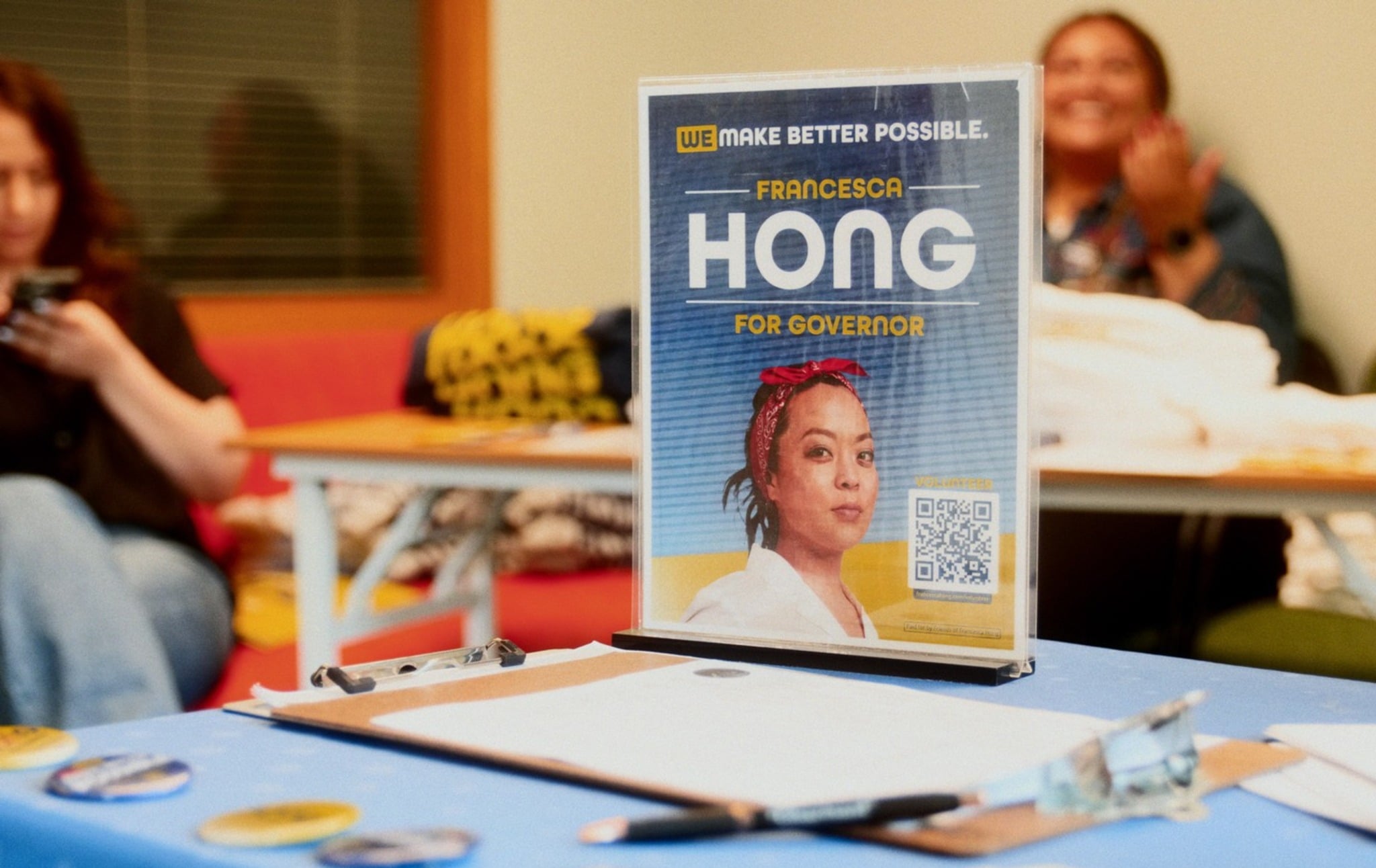
In Wisconsin, I volunteered for a campaign that narrowly failed, but also showcased the Left’s path forward.
The Wisconsin Democratic primary for governor is over, and the media is saying socialists have “hit a wall.” They’re asking: does Democratic Socialists of America (DSA) member Francesca Hong’s narrow loss to moderate David Crowley show where working-class power ends and begins? And should the left move out of the way for the party establishment in races like these? It’s been a year of effort and growth, and the left is still figuring out how to roll with the punches.
Earlier this year, I served as Policy Director for the Wisconsin Legislative Socialist Caucus, where I led the research and drafting of a first-of-its-kind bill to establish a state-owned grocery system to combat food deserts and food insecurity. While the initial briefing was scheduled only with state Representative Darrin Madison, Francesca Hong heard about my meeting and took time out of her busy schedule to hear about the legislation. The meeting went exceptionally well. She made helpful suggestions about grocery store cafeterias based on her background as a service worker and complimented the presentation on the way out.
Many months later, in the heat of primary season, a friend pointed out that AB 1221 was on her platform for governor. I could barely believe it: a politician believed in my ideas enough to make them a policy priority, even if it might be seen as radical and attract attacks (and it did, with Fox News frequently tearing into her support of the bill).
When I attended the Wisconsin Democratic Party convention in June of this year, Hong was the only gubernatorial candidate who treated us, the few delegates under 30, as equals. There was no question that she was the young people’s candidate in the race, as we crowded around her for long political conversations in the lobby.
I knew in each instance what I was seeing: someone who commits to doing what’s right, even if it’s inconvenient or unpopular. That was an authenticity worth the left’s time and labor to see through to the finish line. So we put in the heavy lifting. My comrades canvassed for hundreds of hours for Hong. We went to rallies, donated, and phone banked. For many young people, hope felt on the line.
I voted absentee by mail weeks before the election, because I began law school in New York City a few days after the primary. So after all this, around election day, I was forced to leave home. I felt proud of my peers, hoping for our efforts to lead to a Hong victory. But saying goodbye to my family and friends, donating my possessions, and expecting a political victory for the working class in my home state made it very hard not to wonder, “Was the time I put in for this a mistake?” And I was thinking that as I arrived in New York with nothing more than what fit in my bags.

I kept trying to balance the excitement of a new city with the anxiety I felt, up to the day of the primary. On the night of August 11, I stayed up until 2:30 AM, talking to my friends as I watched Hong lose. They vented to me about how scared they were for their home state, thinking maybe the work they contributed was for naught. One told me about crying while watching the faces of Hong supporters at the election party. We prepared and fought all we could for a very long period, and then we fell, and we lost nonetheless.
It was an empty feeling. A candidacy like this, as such a significant source of hope in our lives, suddenly face-planted. Stepping into its place was the corporate Democrat David Crowley, who skipped candidate forums with Muslim voters and emphasized “bringing venture capitalists to Wisconsin.” For our home, he offers more of the same capitalist policies that have wreaked havoc through our communities. It wasn’t acceptable, but the gun of a possible Republican victory is now at our heads, telling us to accept it. Is that an easy pill to swallow?
Reflection after a difficult year wasn’t. We were in a situation that we weren’t used to, coming so close to power, yet falling short. That didn’t make us feel any less grief. But this moment of loss was also a moment of learning.
Some argue that Hong’s defeat can only be understood within the transformative string of victories for the insurgent movement across the country, not as another loss in a series of defeats. This is true. But I’d go further, saying that the race in Wisconsin and the larger insurgent left are part of the much longer war between workers and owners, a struggle that workers must win to survive. Everything that the left is doing now—the organizing, the victories, and increasingly the power—is a direct consequence of the existential struggle leftists have been waging against the capitalist class for years. The process we are watching now is the bearing of fruit. The left five years ago couldn’t have ever anticipated a socialist gubernatorial candidate who backs universal childcare, a public bank, and publicly owned grocery stores performing as well, or coming within 0.5 percent of securing the Democratic nomination. And yet now we are here. All this is now a reality.
Assuming we continue to maintain and expand leftist power, this primary performance will be the minimum for the left going forward. The Democratic Party apparatus’ tiny margin of victory (by as many people as a mid-sized concert) only came as a result of an extreme level of their money, consolidation, and propaganda. It’s hard to say whether the establishment could have done much more to sabotage the left candidate. Nearly tying with party leadership’s preferred candidate is our floor now, and it may be their ceiling.
So the left is just beginning. DSA now has the numbers and the organizing power to (almost) win a statewide Wisconsin race, organize workplaces, deliver mutual aid, and begin to develop independent and alternative political structures. The Badger State could have a Democratic trifecta next year, with Legislative Socialist Caucus bills like Healthy School Meals for All poised to pass. And the state will see a Presidential and Senate race in 2028.
If the socialist movement wants to seize coming opportunities, they have to recognize their own weaknesses, which the primary exposed. DSA’s strength is in canvassing urban areas, but in rural areas where voters are spread out across many small towns, knocking doors becomes far more difficult, and TV can be a winning strategy. Hong overperformed in areas with out-of-state TV markets, which didn’t feature attack ads against her, and she underperformed in areas inside the state’s media markets, where those ads were common. This suggests that her decision not to run TV ads of her own was a tactical misstep.
This was a cash-strapped grassroots operation, unlike its opponents, who spent millions on media. So dropping large sums on TV ads is easier said than done. But her campaign certainly should have redirected some amount of funds towards the initiative. Though a campaign of young people might not want to accept it (and neither do I), boomers still watch cable.
The lack of national endorsements was also a real crisis, leaving the Wisconsin left on its own. Save for Hasan Piker, Ro Khanna, and Kat Abughazaleh, national progressives like Alexandria Ocasio-Cortez and Bernie Sanders declined to back Hong, seemingly out of aversion to risk in a “swing” state. But if they had backed Hong, she almost certainly would have earned the few thousand votes needed to secure the nomination. The risks of endorsing her would have been significantly lower if national progressives had been unified in endorsement, pushing Hong over the finish line. If the left’s biggest names refuse to unite or tolerate any risk in winnable fronts of the class war, our power will always be limited.
The corporate faction did not show such division, surviving a series of their candidates dropping out amid campaign finance controversy (in Sara Rodriguez’s case), sexual misconduct accusations (see Mandela Barnes), and another financial scandal (Crowley), only to resurrect Crowley’s dead campaign and consolidate the field around it, with Governor Tony Evers’ endorsement. With the help of the GOP’s anti-Hong spending and a massive donor network, moderate leaders united to crush socialism. If national progressives continue to hesitate over whether to champion a strong local leftist candidate, the establishment, even during the rough road of the Democratic primary for governor, will continue to defeat us.
Perhaps most essential to recognize as a strategic disadvantage, the weaponization of “electability” still wins races. The moderate wing claimed Hong couldn’t break through in the general election, even though she was the highest-polling candidate and her opponents were plagued with controversy. By actively organizing against Hong, electability advocates undermined her ability to win. It was a self-fulfilling prophecy, one commonly utilized against leftists from marginalized backgrounds. The formula usually goes like this: the establishment plays into bigotry and Red-Scare-style propaganda to call anyone remotely anti-capitalist unelectable, while uplifting corporate candidates from marginalized backgrounds as “representation.” This is a tool continually used to lock working-class people out of electoral politics and maintain capitalist dominance over the Democratic Party.
For now, the capitalists retain control. Crowley is the first Black nominee for Wisconsin governor, and that’s a success. But he’s made clear that he will operate in relation to the same incentives our white centrist governor Tony Evers does, being outflanked on data centers by his Republican opponent (a 73-27 issue in the state according to Marquette polling) and undergoing scandal over the alleged irregularities in his campaign finances. Is that really more “electable” than Hong?
But people keep falling for the argument. While Hong’s campaign energized them, they still voted for Crowley because they thought he could win the general election. In their reporting, the Associated Press described one 61-year-old who voted for Crowley as someone who “agreed with Hong on some issues but worried that Hong’s deeply progressive politics and the democratic socialist label would make it harder for her to defeat Republican Tom Tiffany,” saying that “I didn’t vote my heart.” Moderate campaigns are scaring voters into accepting the establishment choice because electability is their strategy, not a neutral measurement.
Even leftists are subject to this propaganda tool. A postmortem in Jacobin claimed socialists like Hong failed “to make the case they’ll defeat Republicans,” neglecting her constant appeals to voters about how she was well positioned to do so. Some leftists have also been retroactively calling Hong a bad candidate on Twitter, seeming to forget that earning around 311,000 votes, more than any previous gubernatorial primary candidate this century, is as positive a reflection as any on the quality of her candidacy.
The truth is, as journalist Ken Klippenstein pointed out, no one, not even Party leadership, knew how the primary would turn out, much less the general. So voters should have chosen the candidate with the best policies, not what the old guard said a winning candidate should look like.
While Hong had some less-than-refined answers to some of the questions she was asked in the national media (such as in the frequently referenced “Thanksgiving-gate”), she would have faced bad press no matter what she said. Take Zohran Mamdani in his bid for Mayor of New York City, who bent over backwards to give clean, media-trained, strategized answers to tough questions. But a year into his term, much of the media still calls him a Hamas supporter who “would have cheered on” 9/11 simply due to his ethnicity, religion, and ideology.
So I suspect “cleaning up” Hong’s responses would have swapped one form of contrived criticism with another, simply because that’s the nature of running as a socialist from a marginalized background. She would have faced disapproval and objection, no matter how much she avoided “Woke 1” stereotypes, or how technically correct her responses to bad-faith questions from the media, because she is a leftist Asian woman. The capitalist media’s hobby is trying to take socialists from marginalized backgrounds down a peg.

Prediction markets, trusted by outlets like FOX News and CNN, were also almost entirely wrong. Kalshi had Hong’s chances of victory in the primary at 95 percent the day before the vote was actually held, with other betting platforms showing similar numbers. Political gambling often reflects insiders’ or moneyed interests’ views on a subject, but hasn’t shown it’s a reliable indicator of reality.
Polling made similar estimates of Hong’s success, yet had significant issues with measuring nonrespondents, undecideds, independents, and Republicans who ended up voting Crowley in Wisconsin’s open primary system. One survey even estimated Hong would win by more than 20 points, before being outed as completely fake. It’s difficult to be certain, but the media’s widespread trust of polling may have hurt the left’s continued efforts, convincing some that the race was already a lock, so it was safe to ease up. Taking polls with a grain of salt and turning out with maximum force no matter what they say is crucial.
The pseudo-party that’s now the face of leftist organizing, DSA, needs to find any way it can to scale up across the country if the insurgent left is to win. Their national program funding offices for local chapters is a great start. And mounting campaigns that imagine a better future like Hong’s, even when they don’t result in victory, also helps recruit new people into chapters and expand their organizing capacity. The problem of DSA’s size will get less and less relevant as the organization becomes larger, so let it flourish.
Did DSA make a mistake by spending time and effort on a primary if it didn’t work out? I’ve felt that same doubt somewhere else. In the first few speeches during my school’s orientation, an administrator told us to raise our hand if we felt we didn’t belong here. Hands went up around the room. Overcoming self-doubt was half the battle of becoming who we were meant to be.
So should the left accept its limits and pass the torch of power to the old guard in states like Wisconsin? Maybe corporate campaigns can behave that way; for them, the difference between winning and losing affects only the résumés of the consultants involved. But our effort is worth something more. This struggle cannot afford to pause for failure. Let the losses, and the successes, continue.
Roman Fritz is a socialist writer and law student based in New York City.

%20(crop).jpg?width=352&name=wile-e-coyote%20(resize)%20(crop).jpg)