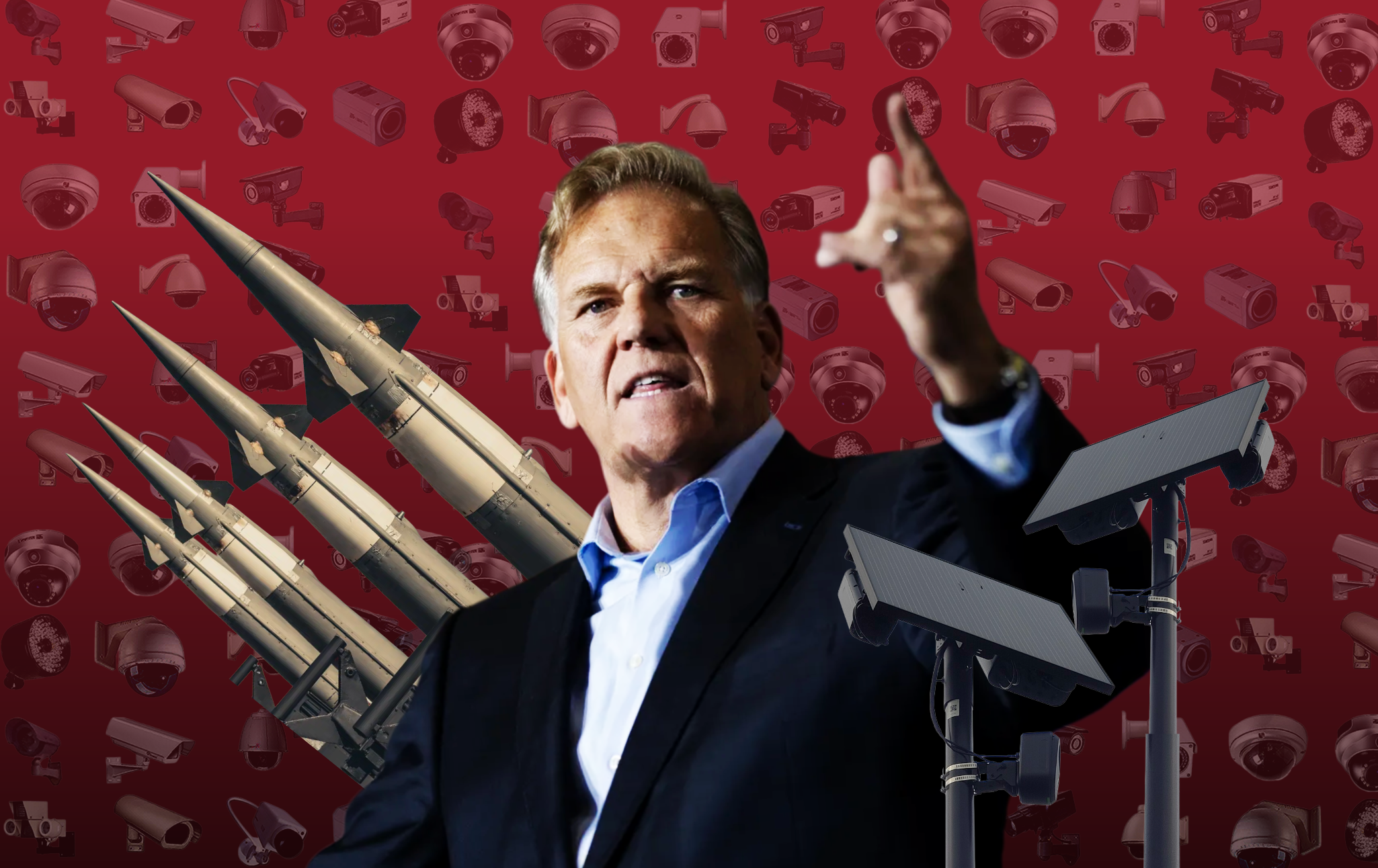
In a decades-long political career, the Michigan Republican has consistently pushed to bomb other countries, while spying on Americans at home.
Right now, the U.S. Senate election in Michigan is anyone’s to win, with most polls giving Democratic nominee Dr. Abdul El-Sayed a slight lead over Republican Mike Rogers. El-Sayed has been the subject of relentless media criticism, ranging from his perfectly reasonable comments on the victims of the War on Terror to being forced to answer for seemingly everything Twitch streamer Hasan Piker has ever said. Rogers, on the other hand, has received markedly less scrutiny, despite a decades-long career in Washington. But there is plenty to criticize, from his well-documented ties to religious extremists, to a track record of using his political influence to promote war and surveillance at every opportunity. In fact, if you’re a lobbyist trying to sell bombs or spy software, Mike Rogers is your best friend.
Rogers has never let principles get in the way of political expediency. From a loyal vote in favor of free trade deals like 2005’s CAFTA, which prioritized corporate profits and led to the displacement of millions throughout Latin America, he has become a champion of the Trumpian trade war against Canada. From denouncing Donald Trump’s attempts to block the certification of Joe Biden’s victory in 2020, he has become a conspiracy theorist arguing Biden stole the presidential election. From saying that Trump’s “time has passed” in 2022, he has become one of the president’s staunchest loyalists. From championing data centers, he has become a supporter of a one-year moratorium on their construction.
If anything, Rogers’ career has been reminiscent of W.H. Auden’s poem “The Unknown Citizen,” about a man who “held the proper opinions for the time of year; When there was peace, he was for peace: when there was war, he went.” Yet there is one major exception to the former Congressman’s ever-changing moods: his longstanding love for the American empire and the national security state it rests upon. However ugly they may appear to many others, they remain nonetheless enthralling in his eyes.

Rogers was in Congress for far longer than anyone seems to remember, and in all that time, he never met a war he didn’t like or a military intervention he couldn’t support. He was first elected to represent Michigan’s 8th district in November of 2000, and took office in January 2001, just in time for 9/11. He, like the entire House of Representatives sans Barbara Lee, supported the post-9/11 Authorization for Use of Military Force that radically expanded the president’s powers to make war without congressional approval. That legislation has since proved to be a blank check for military actions around the world, most recently U.S. strikes against Venezuelan boats. It is a cornerstone of the 21st century’s “forever wars.” In 2002, Rogers voted for George Bush’s war on Iraq. In the 2010s he supported military action against Libya and Syria.
Support for war and empire have at times led Rogers to some odd places. Although his current campaign website boasts of his time in the FBI battling “drug trafficking,” there have been some cases of flexibility to this otherwise hardline anti-drug stance. During the U.S. occupation of Afghanistan, the country produced 95 percent of global heroin. Evidence mounted that President Hamid Karzai’s brother, Ahmed Wali Karzai, was a major drug trafficker, protected by both his brother and the CIA. Yet he was never seriously investigated for reasons Rogers explained thus: “We certainly need the president to be with us. That would be hard if we’re hauling off his brother to a detention center.”
A similarly strange position Rogers adopted, despite his habit of burnishing his own “tough on terrorism” credentials, was his support for Iranian terrorist group the People’s Mojahedin Organisation of Iran (MEK). The MEK had been a State Department-designated terrorist group since 1997, mainly for its bombing and assassination campaign which lasted from the 1970s to the ’90s. Among the victims were six Americans, three servicemembers and three civilian military contractors. Still, in 2012 the group managed to get itself delisted as a terrorist group after supporters spent millions of dollars lobbying Washington. Among the beneficiaries of pro-MEK generosity was one Congressman Mike Rogers. In 2012 Rogers received $2,500 from Dr. Massod Magshoodi, a member of the board of advisors for the pro-MEK Organization of Iranian American Communities (OIAC). Rogers was praised for his efforts on the terrorist group’s behalf by the OIAC and later spoke at one of their events.
A longtime Iran war hawk, Rogers pushed for war against the country for two decades. He repeated falsehoods that the country was close to developing a nuclear weapon and that military force was necessary to prevent it. When he said of U.S.-Israeli strikes last year that he “was for all of this when it wasn’t very cool to be for all of this,” he was completely correct. Regarding how “cool” bombings that killed at least 436 civilians are, readers must decide for themselves.
It’s therefore unsurprising that he has taken every opportunity to applaud the historically unpopular U.S.-Israeli war against the Islamic Republic. He has called the war both “absolutely right” and a “win-win-win for us.” To voters feeling pain at the pump due to higher gas prices as a result of the war, Rogers stated “We’re gonna be fine, we got plenty of oil.” Given this loyalty to the cause of Israeli aggression, it is no great shock that Mike Rogers was an attendee at three American Israel Public Affairs Committee (AIPAC) fundraisers in August, even if he has cannily asked the lobbying group to not air advertisements on his behalf because of their toxic reputation.
Giving up his seat in the House in 2015 did not stop Rogers’ militarism. Once he left office he founded Americans for Peace, Prosperity, and Security, a pressure group of military contractors and their lobbyists. The group sought to convince 2016 Republican presidential hopefuls to adopt a hawkish foreign policy, including a massive military buildup. Conveniently, this would also be a massive financial windfall for the arms industry backers of Americans for Peace, Prosperity, and Security.
As is to be expected from an ex-FBI agent, Rogers has been fiercely loyal to his fellow members of the so-called “intelligence community.” Along with beating the drum for overseas wars, Rogers has rarely passed up an opportunity to further restrict civil liberties at home. He voted for the PATRIOT Act, which vastly expanded surveillance powers and authorized indefinite detention of noncitizens. Russ Feingold—the sole Senate dissenter—argued the Act shredded civil liberties to such an extent that the United States would “not be a country in which we would want to live. That would not be a country for which we could, in good conscience, ask our young people to fight and die. In short, that would not be America.” But Rogers, who apparently does want to live in such a country, voted to reauthorize the PATRIOT Act when it came up in 2005, 2006, and 2011.
Not content with the vast spying powers he had already helped grant the federal government, in 2011 and 2013 Rogers introduced the Cyber Intelligence Sharing and Protection Act or CISPA. CISPA would have created a cybersecurity exemption to the Fourth Amendment, allowing warrantless spying under the guise of preventing hacks and cyberattacks. Private companies could hand over vast amounts of user information to the government with no judicial oversight. Brooking no opposition, Rogers characterized the typical CISPA critic as a “14-year-old tweeter in [their] basement.”
Aside from Rogers’ rhetorical basement dwellers, CISPA was opposed by Reporters Without Borders, the Electronic Frontier Foundation, and the American Civil Liberties Union, the last of whom stated the act would “create a cybersecurity exception to all privacy laws and allow companies to share the private and personal data they hold on their American customers with the government for cybersecurity purposes.” Fortunately for the right to privacy, CISPA never became law. Even more fortunately for Mike Rogers, his CISPA advocacy netted him a cushy consulting job with AT&T.
When Republicans took the majority of the House after the Democrats’ 2010 drubbing, Rogers assumed the chair of the House Intelligence Committee, a position he held from 2011-2015. Set up after the explosive Church Committee hearings of the 1970s, the ostensible goal of the Committee is to oversee the CIA, FBI, and NSA and prevent them from abusing their powers. But Rogers, who once said “You can’t have your privacy violated if you don’t know your privacy is violated, right?”, was far less watchdog than lapdog.
After the Obama Justice Department dropped its investigations into most accusations of CIA torture, Rogers praised the administration for having “lifted an undeserved cloud of doubt and suspicion from all of our intelligence professionals.” When the Senate’s report on CIA torture was set to be released in 2014, Rogers argued that to do so would create such an anti-American frenzy as to “incite violence” and be “likely to cost someone their life." The crimes themselves never much concerned Rogers, only the idea that someone might face accountability for them.
Similarly, Rogers opposed greater restrictions of the CIA’s drone assassination program after drone strikes accidentally killed three US citizens, saying that even President Obama’s belated and insufficient guidelines were “endangering the lives of Americans at home and our military overseas...”
If Rogers loved the nation’s various three-letter agencies, he abhorred those who let the public know information that the government would prefer we didn’t find out about. He called for the execution of Chelsea Manning, saying “I argue the death penalty clearly should be considered here[…] [Manning] clearly aided the enemy to what may result in the death of U.S. soldiers or those cooperating. If that is not a capital offense, I don’t know what is.” Recall that among the most important information leaked by Manning were instances of U.S. forces in Iraq committing war crimes and evidence that the government was lying about the progress of the war in Afghanistan.
A few months after telling the Atlantic there was “no [CIA drone assassination] list where Americans are on the list,” Rogers joked that he could “help [former CIA and NSA honcho General Michael Hayden] with” putting Edward Snowden on precisely such a list. Yet it goes without saying that, despite his enthusiasm for dealing out death, Rogers is nevertheless being supported by various “pro-life” organizations due to his longstanding opposition to legal abortion. Such are the ironies of American politics.
During the aftermath of Snowden’s revelations of the illegal mass surveillance of American’s communications, Rogers assumed his most prominent public role. He was a regular guest on radio and television, using every venue as an opportunity to defend the NSA and defame Snowden. Rogers used discredited Agency talking points crediting the warrantless surveillance program with stopping an Al-Qaeda bomber. He cited similarly shaky figures to claim the NSA was responsible for thwarting 54 terrorist attacks because of their mass surveillance program. Rogers smeared Snowden as a Russian spy who ought to be charged with murder. (Exactly whose murder was never clear.)

During a debate over libertarian Republican Justin Amash’s amendment to strip funding from the NSA’s bulk surveillance of phone records, Rogers channeled his inner Lois Griffin. “Have 12 years gone by and our memories faded so badly,” Rogers asked, “that we forgot what happened on September 11?” If Samuel Johnson was correct that patriotism is the last refuge of the scoundrel, the cheap invocation of 9/11 is maybe the penultimate one. Unfortunately, the libertarian-progressive alliance Amash sought to create failed to overcome the combined efforts of the Democratic and Republican establishments. He still carries a grudge, calling “Deep State Mike Rogers” the “last person we need in the Senate.”
Threats against whistleblowers, mass digital surveillance, and continuous lies on behalf of intelligence agencies have nothing to do with protecting us from terrorism. They have everything to do with protecting the political establishment from deserved scrutiny and accountability. A representative democracy cannot coexist with an all-powerful national security state. One or the other must go.
From yesterday’s COINTELPRO and CHAOS programs, to today’s Operation Puppet Master, our intelligence agencies have ironically taken to German socialist Karl Liebknecht's injunction, “The main enemy is at home,” with deadly seriousness. The Flock cameras that have sprouted up like so many weeds are another useful tool for spy agencies and have already been used to surveil protesters and activists. The long career of Mike Rogers gives no indication that if he returns to Washington he will stand up to these assaults on civil liberties. Quite the opposite. We can expect him to be a reliable vote for every new bomb to be dropped on an unsuspecting country, every new technological tool to be deployed to pry into our private lives. Mike Rogers loves Big Brother. Do you?
Hank Kennedy is a Michigan-based writer whose work has appeared in the Progressive, Responsible Statecraft, and Fairness and Accuracy in Reporting, and others. He is keenly interested in comics and cartoons and has written about them for the Comics Journal, Solrad, Shelfdust, and others.

%20(crop).jpg?width=352&name=wile-e-coyote%20(resize)%20(crop).jpg)