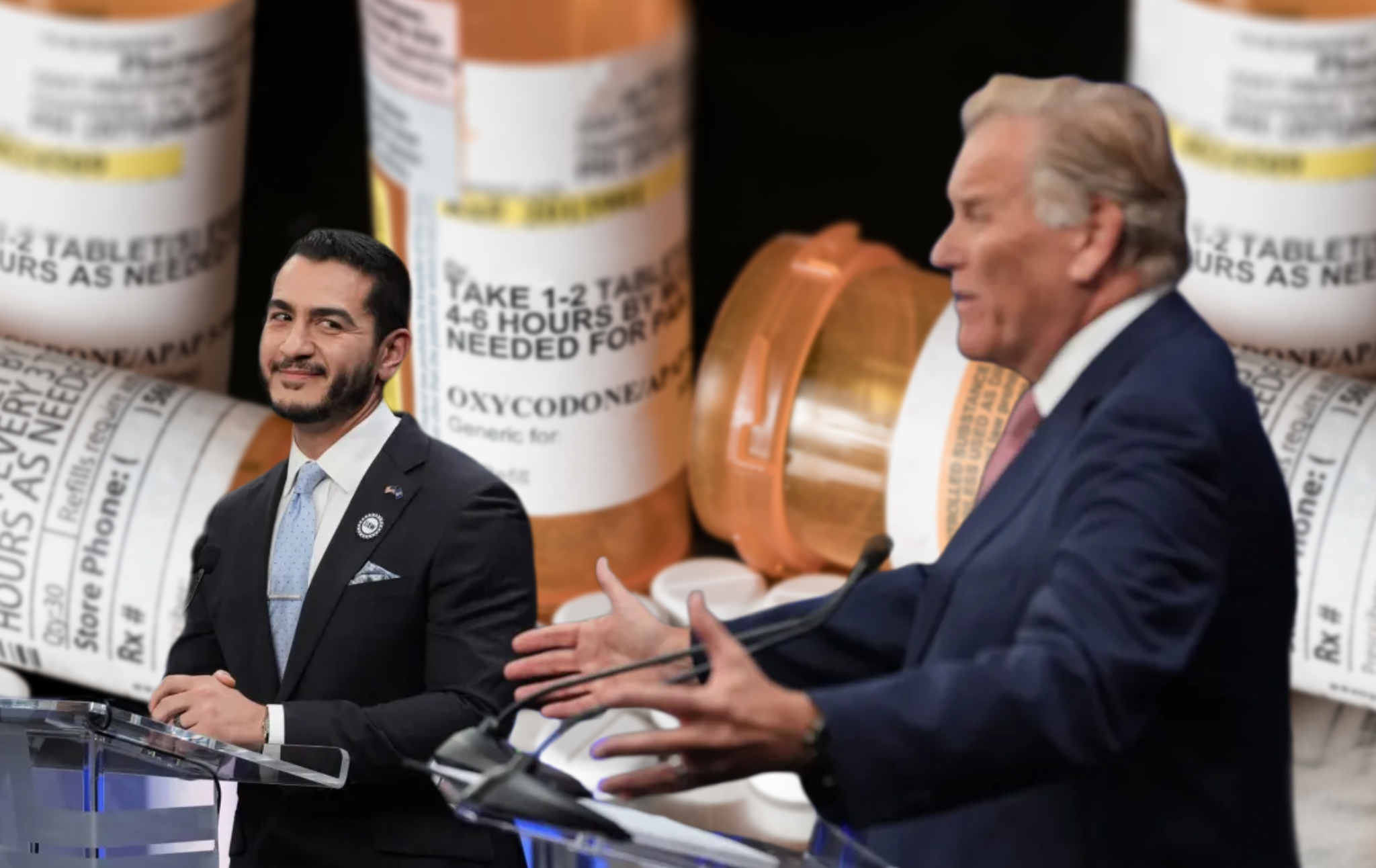
The race between a pro-pharma politician and a public health doctor raises an essential question: will the leaders who enabled this deadly catastrophe ever be held to account?
One of the most important things I’ve learned in my experience with opioid addiction, and later recovery, is the virtue of honesty. Most people in recovery will tell you it’s hard to get clean without a “searching and fearless moral inventory” of your past transgressions. It’s a way of cataloging the times you may have been wrong, so you can hopefully make it up to yourself and everyone else when you’re ready. This process is necessary for growth and change.
Today, the history of America’s opioid crisis is returning to the surface in Michigan’s Senate race. Republican nominee Mike Rogers’ inability to come clean about his role in that crisis does not exactly inspire confidence among voters seeking a leader willing to be honest with the public, or, more importantly, with himself. The revelations aren’t new, and his failure to show even a modicum of regret for his role in what documentarian Alex Gibney called the greatest crime of the 21st century isn’t either.
Rogers, who represented Michigan’s 8th congressional district in the U.S. House of Representatives from 2001 to 2015, has long downplayed his role in advancing legislation that helped “pain management clinics” proliferate, even as he accepted hundreds of thousands of dollars in campaign contributions from pharmaceutical companies profiting from extended-release OxyContin. (The FDA, meanwhile, had either been complicit in—or misled into—approving the drug’s marketing and labeling.)
He continued to minimize his role in the larger epidemic during his most recent Senate campaign against Elissa Slotkin in 2024. I can understand why he would want to distance himself from that record. Harder to accept is his apparent inability to acknowledge his role in the broader crisis. That refusal to reckon with the consequences of his actions raises a troubling question: whether he was willing to sacrifice his constituents’ well-being for pharmaceutical money—and, decades later, still cannot express even the slightest contrition.
And then there’s his Democratic opponent, Dr. Abdul El-Sayed. As a medical doctor and the former public health director for Detroit, he makes a dramatic contrast to Rogers, and he has been more forthright over the years about the devastating reality of the opioid crisis. His campaign did overstate one point: Rogers could not fairly be described as having helped start the epidemic. El-Sayed said in an August 2026 interview with CNN that Rogers had “helped to architect the legislation that kicked off the opioid epidemic.” The bill Rogers supported, however, did not emerge until the early 2000s, while the crisis was already taking shape by the mid-to-late 1990s. Like politicians everywhere, El-Sayed is taking what he sees as his opponent’s weakness and magnifying it, even to the point of exaggeration. As usual, the truth is murkier, more complex. But that correction does not erase the larger issue.
Rogers may not have been there at the epidemic’s inception, but he and his team have taken conspicuous pains to scrub away his own small, yet consequential part in shaping the policy environment that allowed it to deepen. For me, this is not an abstract argument about chronology or campaign rhetoric. The opioid epidemic changed my life and reshaped the lives of my family and countless friends; Rogers’s record deserves to be weighed with that human cost in view.
(Neither the Rogers nor El-Sayed campaign responded to requests for comment.)

I was 16 in 2007 when I took my first OxyContin pill. It was an alarming age to encounter a drug that powerful—then, and certainly now. As I wrote in a previous piece, timing shaped the course of my life in ways that are hard to overstate. Had I been born five years earlier or five years later, I doubt OxyContin—and, eventually, black tar heroin—would have been so easy to find while I was still in high school.
The years I spent suffering as a heroin addict in Tigard, Oregon, roughly from 2008 to 2013, were shaped by a perfect storm of legislative and regulatory decisions championed by Rogers and others. These policymakers helped create an environment in which powerful prescription opioids were widely available, marketed aggressively, and treated too casually. That access did not remain confined to doctors’ offices or legitimate patients; it filtered into suburban high schools and communities like mine outside Portland, many of which were profoundly unprepared for the scale and severity of addiction that followed.
Michigan was hit hard, too. In the early 2000s, one of the state’s biggest cultural exports was Marshall Mathers—Eminem—a rapper whose own descent into prescription-pill addiction nearly killed him before he got sober in 2008. This April, he marked 18 years clean.
The legacy is audible in the music that still comes out of Detroit and Flint. Rio Da Yung OG’s dispatches from Flint, where prescription pills circulate as readily as cash or designer clothes, are not simply rap-world color: they are part of the cultural afterlife of a crisis Rogers helped enable. Rio’s not an artist who deals in metaphors. He prefers to get straight to the point, like on the 2021 collaboration track “OPIOID” with Nuk, where he illustrates just how many pills are flowing through his hands alone, saying, “Sell about a thousand every week, they call me opioid.” His music is so infused with lines like these that it’s hard to pick just one to make the point. Michigan’s prescription-opioid overdose deaths rose from 60 in 2000 to 697 in 2016, before declining to 282 in 2024, according to state mortality records. Nationwide, overdose deaths involving prescription opioids rose from 3,785 in 2000 to 17,029 in 2017, before declining to 13,026 in 2023.
In September 2003, as overdose deaths climbed, Rogers introduced what would become a signature bill: the National Pain Care Policy Act. He aligned himself with leaders of the American Pain Society, an industry-funded pain advocacy group, whose messaging echoed opioid manufacturers’ push for more aggressive pain treatment. Backed by organizations linked to Purdue Pharma—the Sackler family-owned maker of OxyContin—and promoted through a media campaign financed by the American Pain Society, the bill sought to make expanded pain care a federal priority through robust funding and a loosening of regulations around the prescribing of certain narcotics. For an industry still fighting to grow its market and deflect responsibility for the mounting death toll, it offered a powerful ally in Washington.
Rogers has spent the remaining years doubling down on his support of policies that he claims were meant to battle real physical pain felt by his constituents. He does this by reframing his work as helping people who suffer from chronic pain get access to medication, and even invokes his brother’s many back surgeries to drive home the point, saying, “Without that relief, the last ten years of his life would have been, well, candidly, we wouldn’t have had him for that last ten years of his life.” He doesn’t seem to place the bill he supported on the timeline of the national opioid epidemic. This assumes that without the bill someone like his brother would not have been given pain medication at all.
To Rogers, the current reality of American streets flooded with fentanyl, and the hundreds of thousands of suffering addicts whose real physical pain had only been exacerbated by the policies he supported, are not downstream from decisions he’s made, but instead are separate phenomena that he’s had nothing to do with. It makes sense, though, when you consider Rogers’ law enforcement background. Before he was a member of Congress, he worked for five years as a special agent for the FBI. Now, he clearly feels he must both defend his congressional record and make the case that his law-enforcement experience speaks to health, not only crime. In recent campaign ads, he frames the problem of drug addiction exclusively as a threat coming across the Mexican border, promising a crackdown in response. Rogers is actively seeking credit for knowing how to police the crisis without accepting responsibility for the policies that helped create it.
In 2014, El-Sayed was an assistant professor of epidemiology at Columbia’s Mailman School of Public Health, and opioid deaths were climbing across the country. The era of for-profit pain clinics was giving way to cheap heroin, increasingly cut with something far deadlier: fentanyl. Over the next several years, the synthetic opioid would spread through the illicit drug supply. Around that time, people I knew began dying after smoking it. That same year, I left Portland, checked into an inpatient rehab center and got sober. I couldn’t have known it then, but I may have gotten out just in time.
Mayor Mike Duggan appointed El-Sayed as Detroit’s health officer and executive director in August 2015. He left in February 2017 to run for governor after roughly 18 months on the job. His assignment was broader than simply advocating for harm reduction and sensible substance-use policy. He was charged with rebuilding a municipal health department after Detroit’s fiscal crisis and bankruptcy-era restructuring.
During this period, El-Sayed oversaw lead-exposure prevention after the Flint water crisis. He advocated for water testing in Detroit schools and early-childhood centers, expanded pediatric lead testing, and established the Lead Safe Coalition. He also led a partnership that ultimately distributed more than 5,000 pairs of glasses to Detroit students. That does not mean opioids were irrelevant to Detroit during his tenure. They plainly were a major issue. But El-Sayed had his hands full.
When he first ran for governor of Michigan in 2018, El-Sayed positioned himself firmly within the Bernie Sanders-style left Like Sanders, he advocated hard for universal coverage, Medicare for All, and opposition to corporate influence in healthcare. Sanders and El-Sayed also echoed each other on the opioid crisis, arguing that the leaders of Purdue Pharma should be held legally accountable for their roles in the crisis, and not just hit with hefty fines. El-Sayed would go on to coauthor a book about Medicare for All, host Crooked Media’s America Dissected podcast from 2019 through 2024, and use the show and other commentary to make public health an arena for political and economic argument, rather than simply an administrative field.
El-Sayed didn’t truly focus on harm reduction until he returned to local government as director of Wayne County’s Department of Health, Human and Veteran Services in December 2022. During that tenure, Wayne County partnered with Wayne State University’s Center for Behavioral Health and Justice on the Well Wayne Stations initiative. The program distributed free Naloxone/Narcan (the overdose-reversal drug), fentanyl test strips, xylazine test strips, and other overdose-prevention supplies. The initiative had 96 stations in 92 locations and distributed more than 36,000 Narcan kits, according to Bridge Michigan.
In recent months, El-Sayed has seized on this narrative parallel between himself and Rogers. Much like Kamala Harris’s 2024 campaign strategy, where the vice president emphasized Donald Trump’s status as a newly-convicted felon in contrast to her own record as a prosecutor, El-Sayed is casting the race as a contest between a doctor who worked to prevent overdoses and a politician who served the industry that fueled them. He has carried that contrast through paid advertising, social media, a recovery-community visit, and campaign statements explicitly connecting the crisis to his demand for Medicare for All. With only 20 days until Election Day, we’ll soon find out if the approach works.

For the Sacklers, the reckoning came in dollars, not criminal convictions. In October 2020, Donald Trump’s Justice Department announced that Purdue Pharma, the family’s OxyContin manufacturer, would plead guilty to three felonies: one involving fraud against the federal government and unlawful opioid dispensing, and two involving kickbacks for paying doctors to prescribe opiates, and for paying Practice Fusion, an electronic health-records company, in exchange for referring, recommending, and arranging orders. The company faces more than $8 billion in penalties. The Sacklers themselves agreed to a separate $225 million civil settlement. The company admitted criminal wrongdoing; its owners did not. Asked why prosecutors had not brought criminal charges against family members, Deputy Attorney General Jeffrey Rosen declined to explain. The agreement left future prosecutions possible, but delivered no such charges against the Sacklers.
This outcome frustrated those who’ve been holding on to hope that some form of accountability would reach the Sackler family. A corporate guilty plea is not a conviction of the people who owned the corporation. And a multibillion-dollar headline is not necessarily a multibillion-dollar check: Purdue was already in bankruptcy, and the government’s $2.8 billion civil settlement became an unsecured claim against its estate. New York Attorney General Letitia James argued that the deal allowed the family to preserve wealth while failing to account adequately for the billions withdrawn from Purdue.
The legal fight did not end there. In 2024, the Supreme Court rejected a bankruptcy arrangement that would have shielded the Sacklers from civil claims without the claimants’ consent. A replacement $7.4 billion settlement took effect in May 2026, ending the family’s control of Purdue, barring it from selling opioids in the United States, and directing money toward treatment and recovery. But in an ironic twist of fate, a large chunk of that money never reached the treatment centers and recovery communities that are so greatly underfunded. Instead, more than a dozen law enforcement agencies have used opioid settlement money to increase surveillance through the purchasing of AI-powered automatic license plate readers.
Rogers has closely aligned himself with the president whose first administration negotiated the 2020 deal. Trump gave Rogers his “complete and total” endorsement in July 2025, and Rogers has made his access to the president a selling point of his Michigan Senate campaign. He’s leaning on Trump’s pedigree among the Republican Party while sitting comfortably alongside the administration that secured a guilty plea from their company while letting its owners escape relatively unscathed.
Which brings us back to Michigan, and a Senate race that puts the choice in unusually blunt terms: a tough-on-crime, pro-pain clinic candidate versus a candidate espousing harm reduction and Medicare For All. After everything this country has lost, what should come next—a politics that protects the people who profit from sickness, or one that treats access to care as a right? El-Sayed has rightfully criticized Rogers’ outdated “War on Drugs” approach that has only exacerbated an already hopeless situation. It reminds me of an old Alcoholics Anonymous idiom that I learned in treatment, which states that the definition of insanity is trying the same thing over and over and expecting different results.
I was undoubtedly lucky to have gotten sober in 2014. There are countless people I knew who didn’t live long enough to see this election. Hell, they didn’t even live long enough to see Trump in the White House. I won’t pretend a Senate seat could have saved them. The only thing that could have helped is a top-down approach that promises to help addicts get the care and empathy they need when they are at their lowest. From my experience, this isn’t achieved by throwing money towards more policing, or by having taxpayers foot the bill by tossing addicts into jail cells with few options for treatment. Regardless of what happens in Michigan this November, America needs a much deeper change than that.