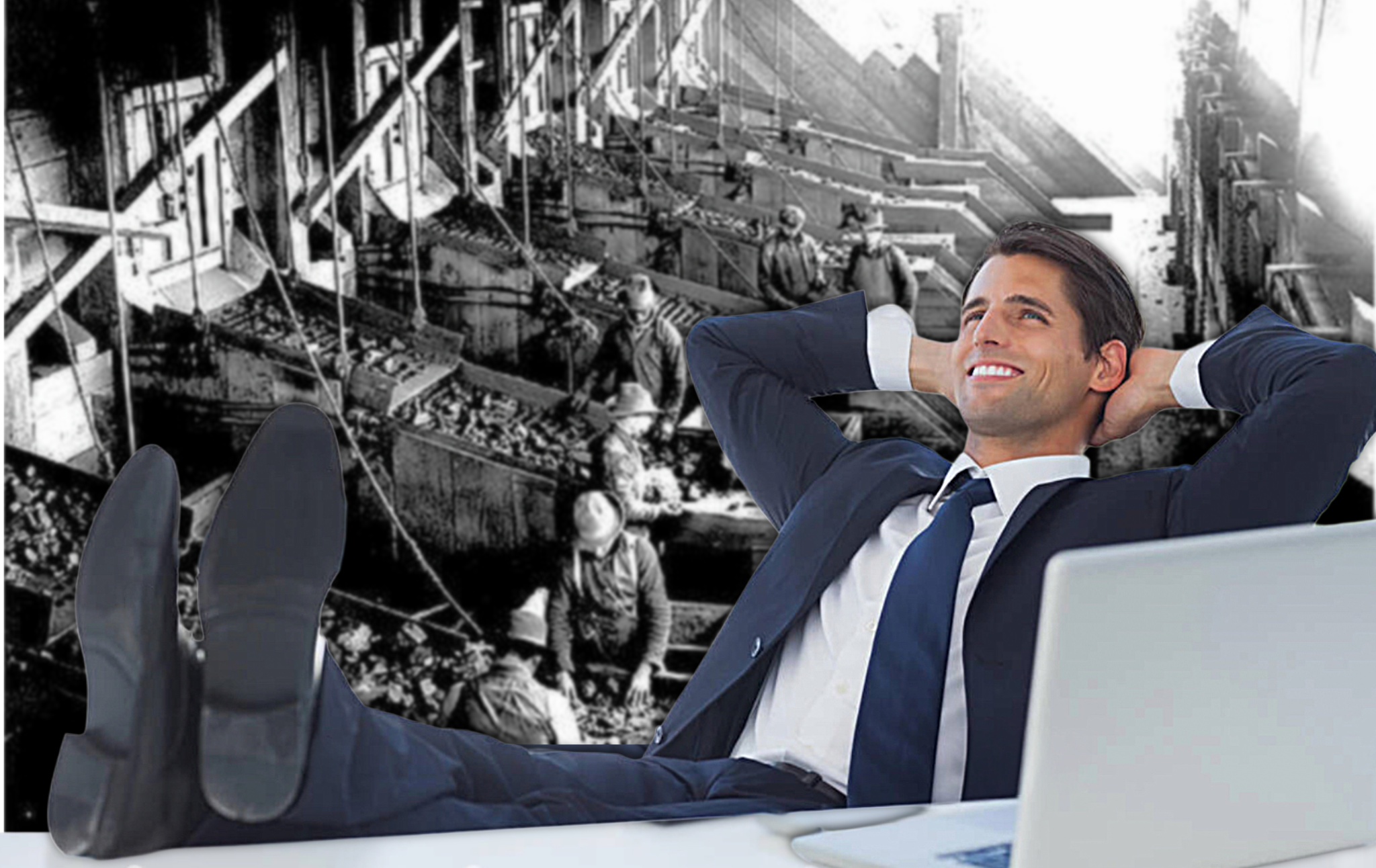
We’re often told business owners deserve their profits because of the “risks” they take. Nonsense.
Among the half-baked platitudes used to defend modern capitalism (usually including phrases like “free market,” “personal responsibility,” “innovation,” etc), we often hear the justification of capitalists’ “risk-taking.” Whenever someone says workers should receive more of a business’s profits, you can trust a capitalist or one of their lackeys to pop their head up and object. The strongest and most coherent version of the argument, or the “steelman,” goes something like this:
“Yes, workers create products through their labor, but business owners are the ones taking all the risk. If a business fails, the owner has lost their investment, which might be their life savings. Meanwhile, the workers have lost nothing, and are free to find another job. Therefore, the owner is entitled to a large share of the profit, to compensate for the risk they’ve taken.”
I’m confident you’ve heard some variation of this defense, which is as common as it is wrong. Let’s examine why.
A Bad Idea With a Long History
Capitalism is frequently misrepresented as a “natural” system, civilization’s base state, absent government involvement. This misconception is used to argue that, like a brave Neolithic hunter who ventures from the fire to slay the wolf, capitalists are “naturally” entitled to reap the rewards of their risk-taking. In an article for the academic journal Synthese, Swedish philosopher Sven Ove Hansson presents a comprehensive history of this idea, tracing it back to the late 18th and early 19th century. In England it was expounded by John Stuart Mill, who wrote in 1848 that every capitalist “exposes his capital to some, and in many cases to very great, danger” of loss, and should therefore be compensated in the form of profit. In France it was the economist Jean Gustave Courcelle-Seneuil, who insisted that “profit is, properly speaking, the compensation for the risk run in the company” by the owner. Hansson documents several more historical examples like this, all using similar language.
The odd man out was Adam Smith. True, Smith defined profit in part as “the compensation, and in most cases it is no more than a very moderate compensation, for the risk and trouble of employing the stock” in a given enterprise. But he saw a little further than his peers, warning that capitalists would also be able to shield themselves from risk using various political and legal strategies, to the extent that it was no longer a particularly meaningful factor. In The Wealth of Nations and elsewhere, he strongly opposed limited liability and other methods that separated money managers from the consequences of a failing business. Smith ruthlessly criticized the joint-stock companies of his day, saying “negligence and profusion” were inevitable whenever investors were shielded from consequence.
As we’ll see, Smith was right to say that capitalists would insulate themselves from risk whenever they could. Like his skepticism toward landlords, though, Smith’s warning has been almost entirely forgotten by the modern free-market zealots, who venerate him as a deity. While de-risking investors and owners is a crucial component of modern capitalism, that’s not how it’s presented to the public. Instead, those investors claim they are daring adventurers, bravely charging into the unknown and deserving of whatever spoils they find along the way. Here’s how self-described entrepreneurial guru Mike Michalowicz presents capitalist risk-taking and the right to profit:
Profit is a reward to the shareholders, the risk-takers in the business. These are people who have made an investment in the business. Sometimes it’s cash; buying machinery, equipment. Other times it’s sweat equity; just raw effort. Usually, it’s a combination[...] We, as small business owners, have taken the ultimate risk, the inception of a business. When that profit comes out, this is a reward for doing what 97% of the world population will never do, which is start a business. It is never to be re-invested, plowed back, pushed back. Those are all soft terms for saying ‘There is no profit. This is an expense.’
This is a reward for taking on massive risk. That’s what profit is.
While the author of The Money Habit and Profit First talks a big game, his actions paint a different picture. His company, Profit First Professionals, is a Limited Liability Company (LLC). If you’d like to learn Mike’s secrets and “deliver transformative results as a fractional CFO” (whatever that means), enroll in a course. But don’t expect Mike to cover the debt if his gimmicks bankrupt your business. He protected himself from risk, of course.
But even if we set aside capitalism's structure and the rank hypocrisy of those who praise themselves as courageous risk takers while hiding behind legal protection that reduces their exposure to financial risk, even the idea that risk earns the right to profit doesn't stand up to the lightest scrutiny.
You Took a Risk. So What?
The belief that the person taking a financial risk should receive the lion’s share of company profits rests on a false assumption that risk-taking is inherently more valuable than any other part of the production process. It’s really a normative claim: at its most basic level, we’re expected to believe that the worker’s labor is somehow less “worthy” than the boss’s financial speculation, even though without labor, no products or services would exist, and no one could profit. But this is a bizarre assertion, since that same logic doesn’t apply to any other aspect of society, where risk-taking in and of itself is not treated as particularly worthwhile.
I could take a big risk by breaking into your house to steal your money. I risk being shot dead as soon as I smash through the window. But if I survive and am caught, I would be arrested, sent to prison, or forced to pay fines. But if I accept these risks and pull off the heist unscathed, should I get to keep your money? After all, I was the one taking a risk. My life and liberty were at stake, a wager of far more significance than the capitalist who “risks” losing money on a questionable business endeavor. If we’re applying the logic that risk itself is the greatest contribution one can make to society, and therefore deserving the largest reward, shouldn’t I be allowed to keep the savings I snatched from your sock drawer? Of course not! The presence of risk does not supersede your claim to possession or basic common sense. It’s your money; no amount of risk-taking will make my claim to the cash stronger than yours.

The internet is brimming with videos of idiotic risks, from playing beer pong amongst wild buffaloes to the crazy fad of hanging off skyscrapers. The daredevils in these videos take extraordinary risks. No one thinks they should reap life-changing rewards, since the risk itself has no inherent value.
Those inclined to defend the capitalist legal order will say the example of a break-in is irrelevant because robbery is illegal while capitalists’ rights to profit are legal. But that begs the question: who wrote those laws? The capitalists and their political allies, of course. Merely writing something into law doesn’t make it right. If the government legalized murder and you shot someone, you wouldn’t be arrested. But your peers would still see you as a monster, because you violated a universal moral principle that needless killing is wrong. I argue there’s a similar disconnect between what is legal and what is moral in the current structure of the United States’ economy, and that of any other capitalist nation. While capitalists have created a legal right to profit, the natural principle that the one who sows shall reap is of greater significance and should be the heart of society’s economic organization.
Safety Nets for Me, Not For Thee
Even this, though, assumes capitalists are actually taking on the kind of life-changing risk they claim. In reality, every historical elite class—ancient slavers, medieval landlords, and the modern bourgeoisie—have used their political influence to minimize financial risk, preserving their place atop the social hierarchy.
The earliest form of what is now called limited liability—a legal status that limits an investor’s financial risk to a fixed sum and protects them from legal consequences—dates back to Ancient Rome. Roman decree protected slavers from losses by limiting their responsibility to the peculium, the sum given to the enslaved person for that specific venture. The granting of a peculium created an Ancient Roman equivalent of a modern limited liability company — though the enslaved and the allotted funds were still the master’s property, the peculium became a separate legal entity. If the enslaved made bad investments or caused damage, the master’s liability was limited only to the peculium, ensuring his total wealth was never at risk. Investor protections continued to increase throughout Medieval Europe, which saw the creation of the first “legal persons,” or persona ficta, a primitive precursor to the status corporations enjoy today. The 16th and 17th centuries brought the birth of massive state-backed trading corporations such as the Dutch East India Company and the English East India Company. The former eventually protected both non-managing and managing shareholders from losses, which is why some researchers see it as a revolutionary moment on the path from mid-millennium commerce to modern capitalism. Though these companies had private shareholders, their governments heavily controlled them, meaning limited liability for investors remained largely confined to state-sanctioned monopolies. But as profits grew, early capitalists gained power, and commerce developed into capitalism, business owners “won” the right to be emancipated from the risks of private enterprise.
In 1807, Napoleonic France legalized the limited liability structure for joint-stock companies, and the English Parliament did the same in the 1850s. When California switched from proportional liability to limited liability for joint-stock companies in 1931, the transformation was complete. Across the globe, capitalists could rest easy knowing their personal wealth was protected from legal or market threats, no matter how risky or harmful their operations were. Still, capitalists were unsatisfied. So, they turned to the American political class, who happily rewrote corporate law to please their corporate masters.
While limited liability for stockholders became standard business practice on the eve of the Great Depression, the first limited liability corporation (LLC) wasn’t created for another half a century. In the late 1970s, the Denver-based Hamilton Brothers Oil Company tried to bring Panamanian-style protections to the U.S. After failing to convince the Alaskan legislature to legalize the LLC form, the company found success in Wyoming. The legislature passed the “Wyoming Limited Liability Company Act,” and the first LLC was incorporated. The IRS formally recognized the LLC tax structure in 1988, sparking an explosion in LLC formations. 40 states legalized LLCs between 1992 and 1994, with Hawaii being the last state to do so in 1996. Now, capitalists across the United States could enjoy the privilege of being taxed as a partnership, with a corporation's legal personhood and limited-liability protections. While ruin would never be entirely avoidable, capitalists had effectively captured state operations to ensure they would never face devastating losses—the very thing they say justifies their claim to profit.
To make matters worse, LLCs aren’t the only way capitalists avoid risk. Hedge funds, private equity firms, business trusts, and other firm structures have greatly reduced investment losses and personal liability by removing the human owner. Instead of a person or partnership owning a company, these firms are property that owns property. Researcher John D. Morley calls this the “separation of funds and managers,” a state-created legal phenomenon that keeps the capitalist class secure from overexposure to losses. For example, you’ve probably heard of Fidelity, a household-name investment company that offers mutual and retirement funds to its customers. While all the funds sit under the Fidelity umbrella, each is a separate legal entity with its own owners. This Russian nesting-doll structure protects Fidelity’s owners, who inherited the firm from their grandfather.
As if god-like invulnerability wasn’t enough, the most reactionary elements of the conservative movement are pushing for even more protection for the least trustworthy product on the market, artificial intelligence. In June, Argentinian President Javier Milei wrote an op-ed in the Financial Times announcing new legislation that would make Argentina's AI laws what the government of the Netherlands was to the Dutch East India Company. To do so, Milei is urging the Argentine National Congress to create the legal entity of a “non-human corporation,” a business run entirely by AI robots. As if ChatGPT encouraging criminality and suicide weren’t bad enough, the ostensible “anarcho-capitalist” president wants to let AI systems run entire companies and shield them from any legal ramifications. As Milei writes, these autonomous companies would inevitably break laws and harm citizens, so complete and total immunity is the only way the non-human corporations could exist:
Where these systems exercise independent judgment in unpredictable environments — as they must, if they are to be genuinely useful — their actions entail real risks. Limited liability is not a luxury for such entities; it is a precondition for their existence
Critics are fighting back against the proposal by stating the obvious. While investors in these autonomous businesses will be entirely shielded from legal risk, everyday people whose physical safety and human rights this technology endangers are prevented from seeking legal recourse against those who wronged them. It's no surprise that the day before Milei’s op-ed appeared in the FT, AI investor Peter Thiel announced he was moving to Argentina. The Antichrist-obsessed venture capitalist and the flamboyant South American president are highlighting the falsehood of capitalist risk-taking better than I can. Javier Milei is literally governing with the Lord Farquaad Doctrine—“Some of you may die, but that’s a risk we’re willing to take.”

Legal structure aside, one only needs to look at our oligarchical reality to see that capitalists aren’t the daredevils they claim to be. When the ill-fated streaming app Quibi lost roughly $1.7 billion in its short life, founders Jeffrey Katzenberg and Meg Whitman simply moved on to other projects, their billionaire status still intact. The same goes for Mark Zuckerberg, who rebranded Facebook, Inc. as Meta Platforms, Inc. in 2021 as part of a strategic pivot toward the Metaverse, a virtual reality world. Less than five years later, the Metaverse was dead, and Meta lost a jaw-dropping $80 billion. Even in spectacular failure, the oligarchs suffered only minor setbacks. The only thing Zuckerberg, Whitman, and Katzenberg ‘risked’ was a bruised ego and a slight dip in their ever-increasing net worth.
While the wealthy stroll through life without facing any serious threat to their person or prestige, the working class faces a very different reality. For those who have to work for a living, risk is inescapable.
Meanwhile, On the Warehouse Floor…
To no one’s surprise, those who wield “owner risk” as a cudgel against socialism seldom address the real risks workers take every day. While owners risk things, workers risk their lives, limbs, and minds. Though unions have greatly raised modern safety standards, workers still face all manner of risks every time they clock in.
Take Jeff Bezos's corporate fiefdom, for instance. Amazon warehouses are notoriously dangerous, not only for their high walkways and heavy machinery but for the unbearable demand the company puts on its workers, which has resulted in many Amazon workers dying of cardiac arrest. Workplace danger is as common in old industries as it is in new ones. A century after Upton Sinclair’s The Jungle exposed horrible conditions of turn-of-the-millennium slaughterhouses, the meatpacking industry remains incredibly risky due to union density collapse and the removal of workplace protections. As Chance Phillips pointed out in Current Affairs last year, 81 percent of poultry workers are at high risk for musculoskeletal disorders, and more than 42 percent of swine processing workers report “moderate to severe upper extremity pain.” Not to mention the limbs and extremities lost to unwieldy meat cleavers and dangerous heavy machinery.
For outdoor manual-labor workers, climate change is an increasing concern. A new study from NPR and Boston University finds the CDC drastically undercounts heat-related fatalities. Researchers estimate that “some 9,000 deaths each year in the country are impacted by heat,” an average five times higher than the government data. With inaccurate information and global temperatures rising every year, the risk of death or disability increases with every shift. Even jobs we consider less taxing, such as Uber drivers and food delivery drivers, are quite deadly, as auto accidents are one of the leading causes of death for Americans. In fact, research shows rideshare services increased traffic fatalities by three percent between 2011 and 2019.
Physical safety aside, workers also take risks inherent to the dictatorial hierarchy of workplaces, such as mental abuse and sexual harassment. This dynamic recently came to light with a string of McDonald’s franchises in Nevada, Arizona, and California, where the company settled a nearly $2 million lawsuit for “frequent unwanted touching, offensive comments, unwelcome sexual advances, and intimidation” by managers. A nearly identical case arose in the United Kingdom, where bosses reportedly took advantage of “zero hours” hiring law—which doesn’t guarantee any minimum number of working hours in a week—to make predatory “sex for shifts” arrangements. The international parallel should surprise no one. Wherever capitalism exists, the antidemocratic fiefdom of hierarchical workplaces forces employees to endure horrible abuse just so they can earn enough to survive.
Beyond immediate threats to safety and security, workers take extraordinary risks every day. Except in Montana, every state uses at-will employment, meaning workers can be fired for any reason at any time. Your boss doesn’t think you smile enough? Fired. You’re a Denver Broncos fan, and he’s a card-carrying member of Raider Nation? That’s grounds for termination. Now you’re unemployed and have no idea how you’ll feed your family or pay rent. Unlike capitalists and owners, American law hasn’t been shaped by a need to protect workers. Rather, as capitalists have controlled the state to further protect themselves, they have also stripped union rights and shifted the social safety net to only cover the “deserving” poor—a category they’re also working to shrink. Given that workers face extraordinary risks every day while capitalists shield themselves through the state, the argument that owners should control a business and reap its profits because they “take all the risk” just doesn't hold water.
Risking What, Exactly?
For owners, the risk-reward calculation of starting (or purchasing) a business is straightforward. They front the capital needed for business activity, such as tools, factories, offices, computers, materials, and operating funds. In return, they have the legal right to control the business and collect all its profits.
Especially in the age of the LLC, what the owner “risks” is finite. When a capitalist starts a business, they put up a limited amount of money for the chance at unlimited reward. Nowhere else in society can one achieve limitless reward for limited risk. And for good reason. This tradeoff isn't logical; it is a dubious argument created to justify the artificial creation of capitalism.
Now, if the business goes belly up, the owner will lose every dollar they put in. But as we’ve seen, in the modern world of LLCs and corporate bankruptcy proceedings, when a business closes, most capitalists shrug, write an annoying LinkedIn post as if they’re the first person to learn from failure, and turn their attention back to their other businesses while living comfortably. The only thing they “risked” and lost was capital that, in all likelihood, was created by another set of workers at an earlier point in time. So there’s really little or no risk to the owner themselves, as such
In the worst case, the capitalist could lose all his capital. This is more common for smaller capitalists, who go all in on one or a few businesses. If ruin befalls the smaller capitalist, he will be personally bankrupt. Broke, destitute, and no longer able to live off the profits workers create, he will be forced to do something drastic to survive—he’ll have to get a job. The horror!
In this nightmare scenario, we see the folly of claiming capitalists take risks. The only thing the capitalist risks is becoming a worker. This is no different than a medieval king ordering conscripts into battle while lecturing them that he is the one taking a risk. Though the castle walls and royal guard hide him from blades and bolts, if his army is vanquished, the king will lose his crown and be forced to flee into peasantry. He might even be conscripted into an army and forced to fight!
That’s why this defense of capitalism can't withstand even the lightest scrutiny. What the capitalist risks is seeing “his” business sold to another member of the ruling bourgeoisie, forcing him to clean out the corner office and join the workers on the factory floor. To those with common sense, this is no risk at all. But to capitalists and their sycophants, who believe the likes of Elon Musk and Mark Cuban are inherently superior to the rest of us, it’s a great tragedy, their own personal 9/11. As most capitalists feel they have pulled themselves to the heights of our society through ingenuity, hard work, and, more often than not, a “small loan of a million dollars” from their parents, what they are really risking is their ego. When the coffers run dry, and they can’t pay their debts, they’ll be forced to accept the fact that their self-images as the conquerors of industry were nothing more than delusions. Because that’s precisely what it is. A delusion, a faux accomplishment built on a misconstructed legal, social, and economic order that gives the value created by laborers to whichever trust-fund baby happens to be born at the right time and place.

They say billionaires become rich through hard work. That’s true. But not their own. Their wealth comes from the continuous labor of others who staffed their factories, plants, and storefronts, day after day, year after year, so that they could earn a wage—a tiny fraction of the value they generate—to feed their families.
While the workers were bettering society through their labor, a process that often involves actual risks—whether of losing a hand on an assembly line, missing their children’s formative years, or catching COVID—the capitalists sat in distant offices, moving numbers between balance sheets, and patting themselves on the back for having the “guts” to profit off of work they will never do. Whatever myths people believe about “self-made” billionaires and millionaires, that’s not our reality. According to The Union Bank of Switzerland, 91 people inherited their way to billionaire status in 2025. That’s a 33 percent increase from the year prior, and the most nepo-billionaires created in one year since UBS began tracking the metric in 2015. The capitalist class isn’t just getting richer; it's getting lazier and greedier as workers work harder than ever before.
Unlike workers, capitalists take minimal risks. It’s time to build a society that recognizes human labor as the paramount economic contribution and rewards it as such.