Sold as the successor to “Disco Elysium,” “Zero Parades: For Dead Spies” is well-executed, but lacks the soul of studio ZA/UM’s debut effort.
Disclaimer: This article is written with a complete disregard for avoiding “spoilers.” Read at your own risk.
When composing their latest offering, the creators of the futurist communism-flavored spy adventure Zero Parades: For Dead Spies had to reckon with three proverbial elephants in the room. First, their studio’s first game, Disco Elysium, was an instant classic and critical darling that revitalized the genre of Computer Role-Playing Games (CRPGs) and set sky-high expectations for their sophomore effort. Second, they aren’t actually the creative talent responsible for Disco Elysium, but the businesspeople who took over studio ZA/UM and fired most of its founding talent, completing its transition from an Estonian artists’ collective to a subsidiary of a for-profit company. Third, the game’s themes, which set the ideologies of communism, neoliberalism, and techno-fascism against each other, are becoming much more salient in the political world. The U.S. government has rediscovered its zeal for hunting communists at home and abroad and revived its longstanding obsession with Cuba, billionaire tech-men are attempting to achieve immortality, various trends associated with the People' s Republic of China are trending on U.S. TikTok, and remaining neoliberals continue to tinker around the edges as Rome burns (good riddance, but still).
These looming realities create a central irony at the core of Zero Parades, which was released on PC this May. While it attempts to comment upon ideologies that are increasingly relevant in the real world, it does so without the intellectual grounding in those ideologies that the original creative team brought to the table for Disco Elysium. Instead, the new ownership ape the style and basic subject matter of their first game without fully understanding the political substance that made it compelling. In this way, ZA/UM’s new owners have taken the crystallized output of a decade of labor from a Marxist artists’ collective and repackaged it for private profit, garbling their message in the process.
The warping of the first game’s distinct perspective is apparent in the opening of each game. In the first five minutes playing Disco Elysium, you are confronted with a labor strike, hints at racism in society, and anti-police sentiment directed at your character, a detective. Meanwhile, in Zero Parades, the initial framing suggests that political change isn’t driven by the streets or the shop floor, but by the elite, secretive machinations of spies and assassins.
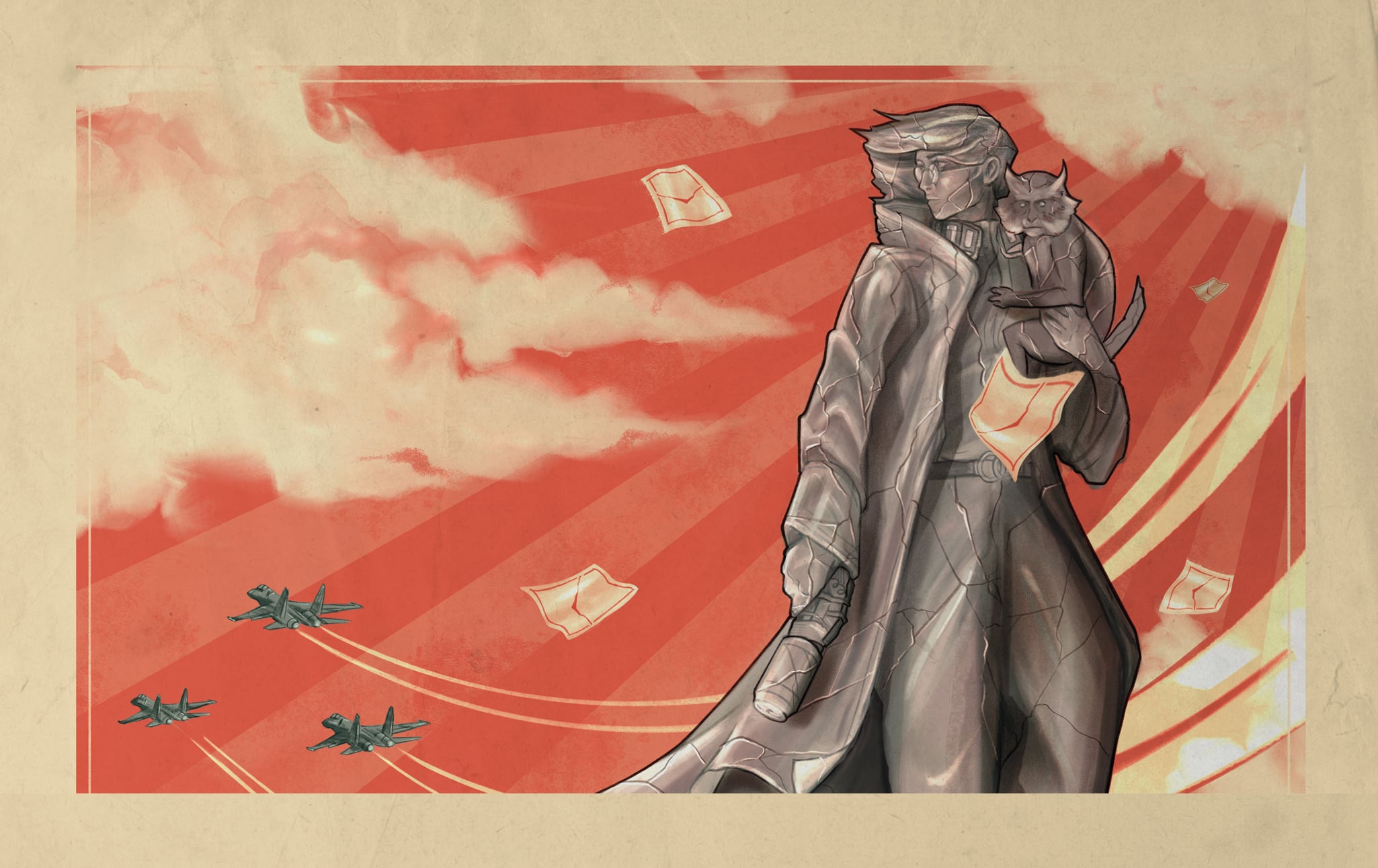
Your character, Hershel Wilk, is a spy with a checkered service record who has been reactivated after five years of punitive desk duty to return to the site of her greatest failure for one last mission. Unfortunately, by the time you reach your partner—codename PSEUDOPOD—he has been rendered comatose through unknown (probably nefarious) causes. Upon hearing this, your handler tells you to abort the mission, but Hershel decides to figure out this mystery herself.
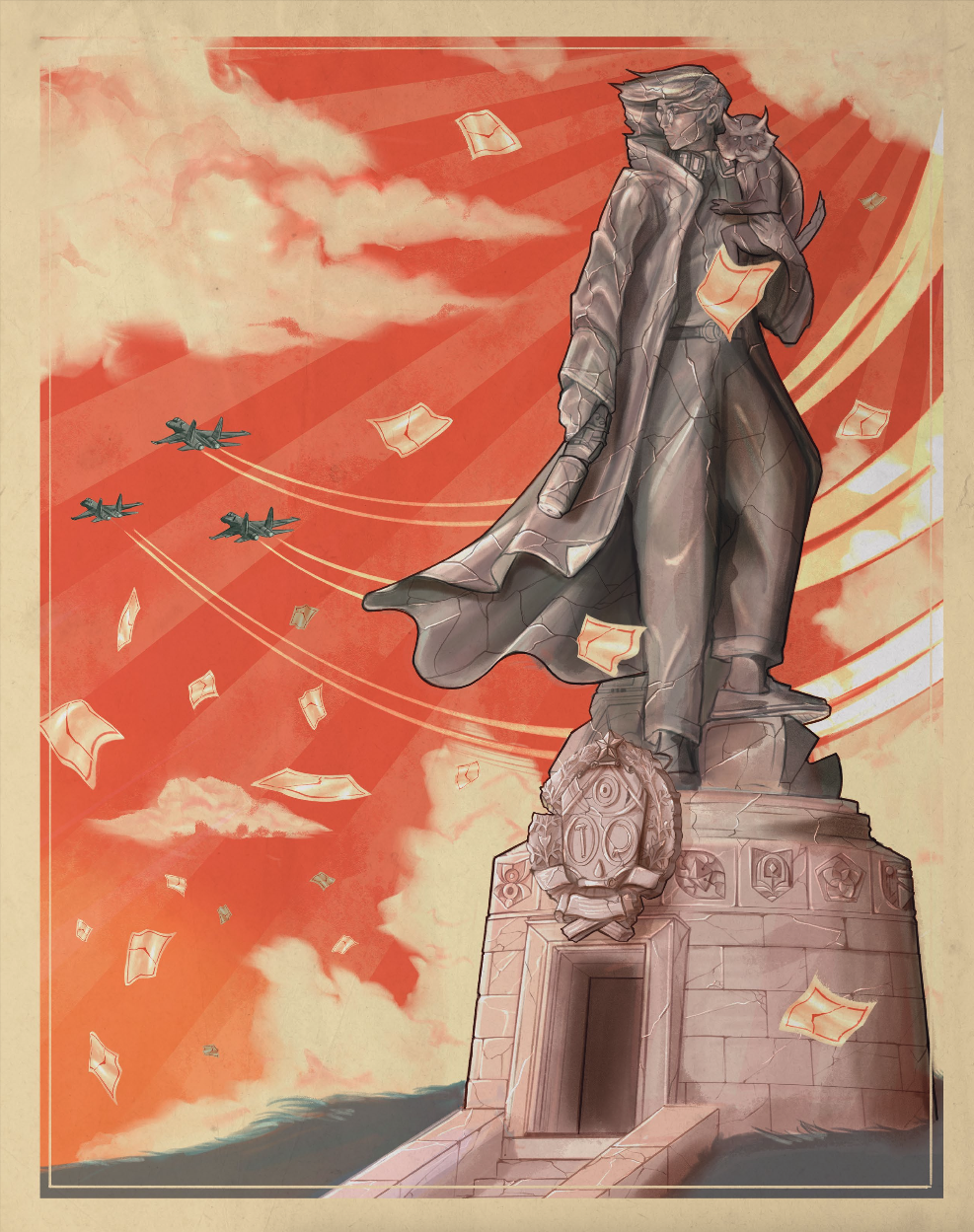
Art by john biggs from current affairs magazine, issue 61, september-october 2026
Once you exit the initial scene you are let into the game’s main setting, the charming but dilapidated city-state of Portofiro. The game’s environment, with its Spanish-sounding proper nouns, Caribbean architecture, old propaganda posters, makeshift structures built in the shadow of past glories, and run-down civil infrastructure, feels like a heightened caricature of communist Cuba, complete with a heavy international debt burden and a neighboring imperial power threatening invasion. Once there, you talk to its people, using Hershel’s spy skills and your own ability to tie together patterns to learn about the world around you, Hershel’s own history in Portofiro, your former comrades, and ultimately, your mission. From the first moment you start interacting with the people of Portofiro, the underlying politics of the situation (and the helplessness of ordinary people to influence them) are foregrounded in each new mystery you encounter—from a young woman whose father has been abducted by agents of a multinational investment bank to a man whose vocal cords have been removed as punishment for ferrying refugees escaping genocide. In Portofiro, it is especially true that, as the saying goes, even if you aren’t interested in politics, politics is interested in you.
The three major ideologies in the world of Zero Parades are almost immediately introduced, each with their own geopolitical champion. First, there is the player’s employer, the “Supreme Union of Proletarian Republics” or “Superbloc,” a clear analogue to the Soviet Union that seems to have surrendered the political momentum to its rivals (for now). This may be because their ruling ideology of “Post-Historical Materialism” holds that human history has reached its ultimate conclusion with the signing of a treaty 96 years before the game starts. In this treaty, the communists renounced “perpetual revolution” against the neoliberal Developed World, restarted their calendar, declared history a thing of the past, and ushered in the uneasy detente, cold war, and slow decline that seems to have ensued since.
The second piece on the board is the Developed World, a rough analogue of the so-called “West” in our world; it’s made up of several post-industrial wealthy nations with governments ranging from monarchies and dictatorships to constitutional republics. These governments are knit together by an organization called L’Empire sans Territoire, also known as EMTERR or simply “The Bank,” a multinational investment bank and extraterritorial governing structure that represents the forces of global capital. Their governing principle is profit, and they are the true power behind the thrones, juntas, and parliaments of the “Developed World.” They issue predatory loans, overthrow governments at risk of default, conduct assassinations and kidnappings, and generally do whatever is necessary to protect their shareholders and investors from losing their shirts.
Those shirts were probably designed in the third major nation, the Illuminated Empire, or “La Luz.” This proudly technofascist empire is one of the most cartoonishly evil polities I have ever encountered in fiction, but also manages to maintain cultural dominance in fashion, popular culture, and even children’s cartoons. La Luz was always an empire, but it wasn’t always techno-fascist. That happened when an advisor to the emperor, Anomio, devised an ideology based on conquering “The Three Fears” to build something called “The Final Society." First, the “Fear of Unknowing,” which leads the good technofascist to pursue technological discovery with no regard for any kind of moral, ethical, or religious taboo (including unwilling human experimentation). Second, the “Fear of The Other,” which references the classic fascist desire to erase humanity’s cultural diversity through horrific violence and subsume everyone and everything into a single united culture of oppression. Third, the “Fear of Death,” which is potentially the most chilling (and particularly relevant to our times as tech CEOs fantasize about living forever through AI and robotics).
Anomino, like many delusional tyrants, wanted to live forever, but computers did not exist yet to hold out the false hope of consciousness preserved in silicon. Therefore, he attempted to “imprint” his consciousness into a child. He arranged for a series of young boys to undergo first torture, then a mystical form of brainwashing to attempt to instill his consciousness into them. After many casualties, he named three of the surviving boys as passable copies of himself. These three traumatized, brainwashed, dissociated boys became the templates for the consciousnesses of the entire Luzian ruling class. First, through repeating the analog “imprinting” process, then through an “imprinting machine” invented later. This governing structure is a closely-guarded state secret, particularly the fact that even the more faithful imprinting machines introduce errors into the copies. This means that the Luzian ruling class, from the generals to the ministers to the bureaucrats, are twisted copies of copies of copies of the original brainwashed boys, created through a game of intergenerational telephone that constitutes the Big Lie at the core of the Illuminated Empire.
I will admit that ZA/UM shows a basic familiarity with aspects of fascism, post-industrial capitalism, and communism. La Luz is suitably genocidal, “The Bank” issues predatory loans to poor countries, and one of the People’s Republics employed their former monarch as a gardener, a reference to the fate of the final Chinese emperor after the Chinese Revolution. However, the game’s creators seem substantially more confident when describing the game’s fascist and neoliberal regimes. By contrast, the game’s descriptions of the Superbloc feel hollow, and seldom show any understanding of why people remain loyal to it. They often feel like echoes of decades-old criticisms of the Soviet Union, complete with gulag jokes.
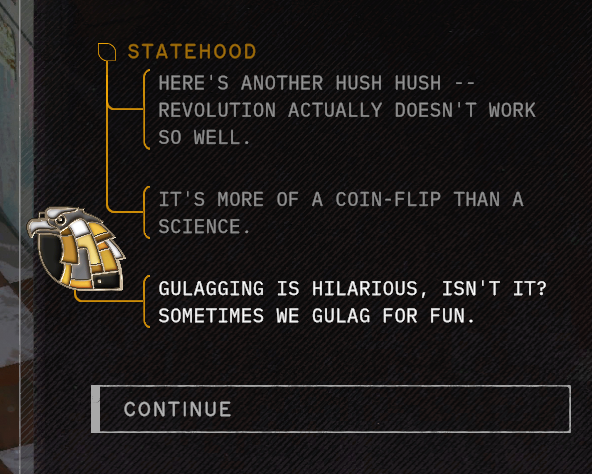
“Statehood,” an aspect of Hershel’s psyche, often appears as a bad caricature of communist ideology.
While the Superbloc is portrayed as a stagnant, decaying state, La Luz is shown as a dangerous, but vigorous nation. Under the leadership of the Minister of Mass Culture, Facundo Reyes, aka the “Grand Lich of Technofascism,” La Luz has embarked upon an aggressive campaign of cultural promotion, spreading Luzian music, television, fashion, and other forms of culture (all of which are laced with technofascist ideology) in order to overwhelm local culture and entice former territories to willingly rejoin them.
When you first set foot in Portofiro, it appears well on its way to losing touch with its proud revolutionary history and succumbing to its former jailer’s propaganda. It is particularly disturbing to see truant Portofiran children watching fascist cartoons, wearing Luzian fashion, and listening to addictive “L-Pop” when you learn Portofiro’s origin as a penal colony for prisoners of La Luz.
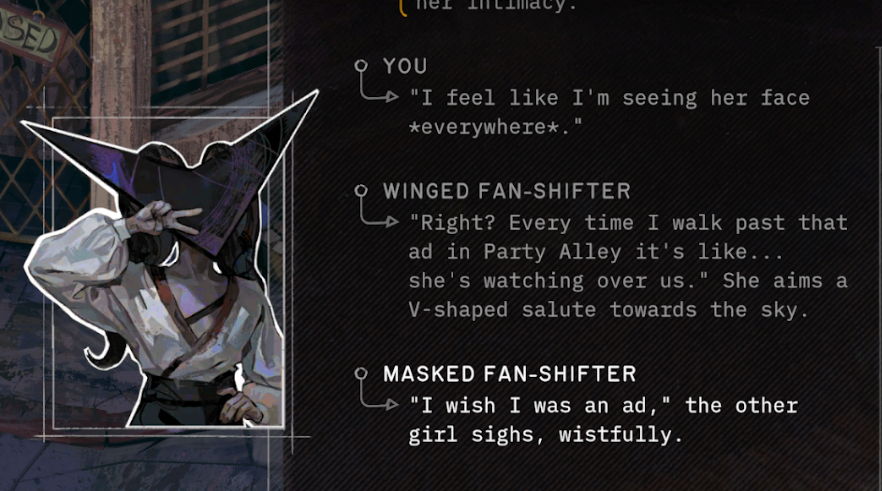
Portofiro’s young people mold their entire personalities around fascist pop music and cartoons.
This history underscores the role it plays in the game as a meeting place for the world’s great powers. At some point, Portofiro’s people executed a jailbreak and a post-colonial communist revolution, breaking free of La Luz, building domestic industries, achieving natural resource sovereignty, and breaking down class divides. However, as is often the case in postcolonial states, a charismatic strongman eventually took power. Over time, the putative ideals of the revolution began to look suspiciously like the personal interests and passing fascinations of its increasingly dictatorial leader. Instead of joining the communist “Superbloc,” “Sweet Nestor,” as he was known, instituted his own personal ideology called “Nestorismo.” This involved taking out the first of 15 predatory “stabilization” loans from “The Bank” and locking in his country’s dependence on The Developed World for generations.
This complex political environment unfolds gradually as you fulfill quests that lead you inexorably toward your Hershel’s version of the game’s final conclusion. Your first breakthrough comes when you finally discover the purpose of your trip to Portofiro. It turns out you were sent here to assassinate Facundo Reyes, the aforementioned minister and war criminal who is responsible for the flood of Luzian fascist cultural products that often precede their bombs or guns.
At this point, you assemble a team of spies, recruiting various old and new acquaintances including members of your previous crew. You then select a method of assassination and enter the game’s final action sequence. In my playthrough, we managed to kill the fascist spymaster, but not the minister, at the cost of two of our own lives.
When reading about the game’s various endings, I felt that mine was far from the worst, but that wasn’t saying much. No matter what your Hershel chooses, the ending you’ll get is ambiguous at best (and at worst, you might provoke La Luz into carpet-bombing Portofiro). It seems that the best you can hope for is getting an imprinting device for your employer while preserving the status quo and losing at least one member of your new crew. Portofiro’s people will still live in the ruins of their proud revolutionary history, waiting to be either culturally swallowed by their more powerful neighbor or bombed into sand, but have gained a temporary reprieve. As for Hershel herself, she may be sent back to her desk job, but she may not, and at least she spent some time in the sun.
This status quo ending underscores a curious inconsistency that struck me about the world constructed by the new team at ZA/UM. It seems that for the game’s developers, communism and socialism are primarily associated with stagnation, not with revolutionary change (perhaps this is elements of the Estonian cultural memory of the Soviet Union talking). It was striking to me that the ideology they constructed for the Superbloc was called “Post-Historical Materialism.” As someone who is quite familiar with socialism and communism, I found it telling that the creators of Zero Parades associated communist ideology with the end of processes of historical change as opposed to their advancement.
First, the “end of history” as an idea is most famously associated with neoliberal political thinker Francis Fukuyama, who prophesied that after the fall of the Soviet Union, capitalism and liberal democracy would usher in a new post-historical age of freedom and prosperity. It is capitalism, not socialism or communism, that constantly attempts to convince us that it has always existed and will always exist as the inevitable state of human society.
Second, one of the founding premises of socialist thought is that historical change cannot really “end.” Under the philosophical worldview of dialectical materialism, history is driven by contradictions in the material world, particularly class conflict, which cannot end until classes themselves no longer exist. With this decision, it seems the Zero Parades creative team either misunderstood or co-opted a socialist term to imply the opposite of its actual meaning.
This betrays cracks in the game’s political lens which I am tempted to attribute to the purge of the original creative team responsible for the outspoken radical perspective of the first game, Disco Elysium. Despite creating a game where you play as a communist spy pitted against fascists, there are moments like these throughout the narrative where I questioned whether the creators really understood these ideologies. For example, I thought it was strange that they portrayed fascist cultural products as so compelling. While the game implies there are technological dirty tricks La Luz may be using to foster addiction to their culture, one would hope that a unitary society where differing perspectives are considered immoral would not be much of a cultural dynamo. I could see the creators explaining away the Superbloc’s lack of influence by echoing anti-Soviet criticism about the stifling effect of state ideology on the arts, but why isn’t that a much bigger problem for La Luz, and what about the Developed World? Presumably, they would have the needed capital and the intellectual and cultural diversity necessary to develop cultural institutions, particularly since our world’s version of the Developed World is extremely culturally influential (blue jeans, anyone?).
In this way, the game’s writers accurately portray the fascists as evil, but also as the only culturally or politically dynamic force in the world, implicitly discounting the potential for any kind of effective resistance to their agenda from the Superbloc. This is classic liberal ideology, in that the fascists are certainly portrayed as dangerous, but not so dangerous that it’s worth encouraging the communists to gain power instead. In this way, the communists are simultaneously presented as dangerous imperial actors themselves and as somehow doomed to fail due to the inherent failings of their economic and political systems.

One of the themes of my writing about video games from a leftist perspective is the way in which the default political assumptions of our society inform how these virtual worlds are constructed, thereby strengthening those assumptions. While I have not played all the way through Disco Elysium, it seems so far to be a rare game that substantively challenges default pro-capitalist political attitudes. For just one example, take this line of dialogue the player receives upon starting Disco Elysium’s communist quest:
Yes—you’re ready to start building communism *again*. You’ve built it before, *they've* built it before. Hasn’t really worked out yet, but neither has *love*—should we just stop building love, too?
There’s nothing similarly hopeful in Zero Parades. This may be because unlike the vast majority of games, the world of Disco Elysium was not initially written by employees of a for-profit games company owned by shareholders, but a cooperative artists’ collective conceived by several outspoken Marxists (they literally thanked Marx and Lenin at the video game awards for the political education that allowed them to create the game). It leads me to the conclusion that a collectively-owned project made a game that seriously grappled with the potential of collectivism, only for the means of production to be privatized. Of course, these more conventional material conditions could not help but create a more conventional sequel, which used the trappings of the first game but could not understand what made it special. And indeed, history has repeated itself: after disappointing sales figures, many of the creators behind Zero Parades have likewise found themselves abruptly laid off by the capitalists who now control ZA/UM.
While I deeply enjoyed playing through this game and would recommend it to others, I would caution any aspiring revolutionaries taking serious inspiration from the Superbloc’s “Post-Historical Materialism.” The old-fashioned dialectical kind works just fine.