
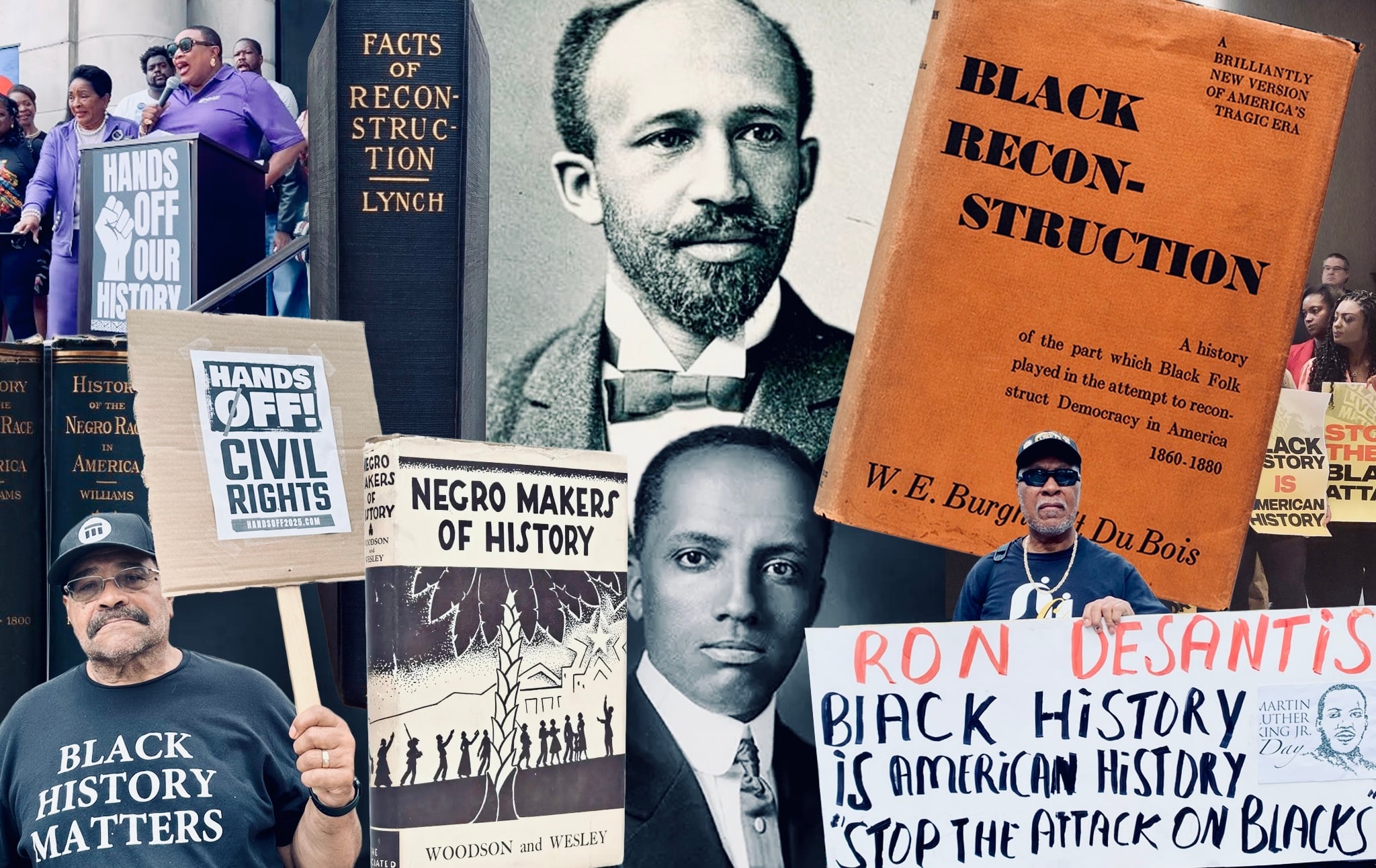
Since the era of Reconstruction, Black historians have always fought to defend the truth against white supremacist mythology. In the second Trump administration, we must again.
“If our people are to fight their way up out of bondage,” declared Mary McLeod Bethune in the pages of the Journal of Negro History in 1938, “we must arm them with the sword and the shield and the buckler of pride—belief in themselves and their possibilities, based upon a sure knowledge of the achievements of the past.” When Bethune made this argument at the height of the Great Depression and the New Deal, it was clear to her and the readers of the Journal of Negro History that Black life in the United States was only made harder by a misinterpretation of the past.
By the late 1930s, most white Americans assumed there was little worth learning about Black Americans in history—whether it was the kingdoms, empires, and tribes from which their ancestors were ripped away by the Transatlantic Slave Trade, the centuries-long presence of Africans in the Americas, or the unique and critical contributions of Black Americans to United States history. The smash hit film of 1939, Gone With the Wind—which set a record for Academy Award wins and remains the highest-grossing film of all time, adjusted for inflation—was based on the Dunning School interpretation of Reconstruction, seeing it not as an attempt at genuine, multi-racial democracy but as proof that Black Americans were incapable of self-government. And how slavery was understood by many white Americans can be seen in this excerpt from Francis Butler Simkins’ A History of the South, a general history of the region that covered the period from colonization to the middle of the 20th century:
Kindliness and patience, frequently extended even to a tolerance of slackness in every concern not vital to routine, created a degree of contentment among the slaves sufficient to keep them docile.
But Black Americans knew better, and through the creation of organizations such as historian Carter G. Woodson’s Association for the Study of Negro Life and History (now the Association for the Study of African American Life and History, or ASALH), and its journal, The Journal of Negro History (now the Journal of African American History), they strove to keep that history alive during difficult times.
Today, keeping Black history alive—never mind other aspects of American history that reveal the less savory side of the nation’s past—has taken on a renewed urgency. The second Trump administration has taken a chainsaw to any and all aspects of Black history that fall under the federal government’s influence. The White House’s March 27, 2025 executive order, titled “Restoring Truth and Sanity to American History,” was a declaration of war by the Trump regime on teaching, writing, and displaying an honest appraisal of our nation’s past. “Museums in our nation’s capital,” the order reads, “should be places where individuals go to learn—not to be subjected to ideological indoctrination or divisive narratives that distort our shared history.” The White House has continued to criticize the Smithsonian broadly, and the National Museum of African American History and Culture in particular, for what Trump perceives as a “woke” version of history. In their August 2025 letter to Lonnie Bunch, the Secretary of the Smithsonian Institution, the White House stated that they wanted “Americanism” to be at the core of the museums—explained by them as “the people, principles, and progress that define our nation.” But in the President’s “Restoring Truth and Sanity” executive order, they made it clear that they would not allow exhibits that “divide Americans based on race.” This, of course, is merely a euphemism for any type of history at museums that deals honestly with the long legacy of racism and white supremacy in America.
And the battle over history does not end with museums. Government websites have reportedly taken down tributes to African American military heroes, for example, with their examples being labeled “DEI.” (Even the website for Arlington National Cemetery, with its “notable graves” page, wasn’t immune from this digital purge.) When Trump returned to the White House, he and his Secretary of War Pete Hegseth overturned attempts from the Biden Administration to rename federal bases that were once named after former leaders of the Confederate cause. For example, North Carolina’s Fort Bragg—named after Confederate general Braxton Bragg—was renamed to Fort Liberty in 2023. By early 2025, the name was reverted to Fort Bragg.
This month, news came out that officials in the U.S. Navy have considered renaming the USS Doris Miller, originally named after a Black war hero who served at Pearl Harbor, as the USS Donald Trump. NAACP President and CEO Derrick Johnson chastised President Trump for this decision, linking it to the long debate about African American valor in the U.S. military juxtaposed with anti-Black racism within the United States. Johnson argued that the President was “making a mockery of that legacy by treating military service as another opportunity for personal branding.”
The disparaging of African American history by the national government is, arguably, without parallel in American history. It may only be matched by the late 19th century move towards the “Lost Cause” ideology that explained away the American Civil War as a war over states’ rights, and intentionally forgot that the war was caused by the problem of American slavery. At the time, that narrative became dominant—with the exception of ardent former abolitionists and African Americans, who weren’t fooled.
Just as we can look to the past to understand so many of America’s current problems, we can also look to the past for tactics and strategies that can—and should—be utilized to keep alive Black history during an anti-Black, anti-academy, and anti-intellectual backlash. African Americans have experience in protecting and nurturing their history in a hostile land. Just a few examples can show the light of how to do so again—and how various individuals and organizations are taking steps, right now, to preserve, protect, and defend the sanctity of African American history.

The Reconstruction era, from 1865 to 1877, was the first time in the history of the United States that the nation embraced—if belatedly—the idea of a multiracial democracy. Across the U.S. South, Black American men exercised the right to vote on a mass scale for the first time in the nation’s history, and in the process, built a robust, progressive democracy in many Southern locales. This was destroyed by regional terror organizations, such as the Ku Klux Klan, White Leagues, and Red Shirts, but also by a white Northern public that had little stomach for the difficult work of safeguarding democracy in the South. Genuine democracy in the South would not be seen again until after the Civil Rights Movement of the mid-20th century—and even that, it must be ruefully noted, is on the verge of retreat in 2026.
The post-Reconstruction period of the 1880s forced African Americans on the defensive all across the United States, not just in the U.S. South where Reconstruction had been left to die by the national government. The United States Supreme Court’s 1883 Civil Rights Cases decisions defanged the 1875 Civil Rights Act passed by Congress, the last act of its kind guaranteeing equal access to accommodations for African Americans. Those protections wouldn’t be restored until the middle of the 20th century. Southern states, such as South Carolina, were already moving ahead with poll taxes, literacy tests, and other laws designed to restrict the voting rights of African Americans, without explicitly using race in official law. This allowed states to skirt the 15th Amendment to the U.S. Constitution, and set the stage for the rise of Jim Crow segregation across the South in the 1890s and early 1900s.
The realm of history and education was not exempt from this crisis of white supremacy. As mentioned before, the Lost Cause began to take hold, first in the South and then across the entire nation, by the end of the 19th century. At the same time, the recent collapse of Reconstruction was touted as proof positive instead that African Americans could not govern themselves. “In the place of this old aristocratic society,” wrote James Pike about South Carolina in his 1874 book The Prostrate State, “stands the rude form of the most ignorant democracy that mankind ever saw, invested with the functions of government.” Despite Pike also being a Republican, like the party that had advocated abolition and governed South Carolina at the time, he found much to criticize about a government which included a majority-Black state legislature—the only one of its kind in the entire nation.
Frederick Douglass saw the problem clearly, when he wrote in his third—and final—memoir, The Life and Times of Frederick Douglass, that Reconstruction had been failed by the country at large. “Our reconstruction measures were radically defective,” Douglass wrote in 1881. “They left the former slave completely in the power of the old master, the loyal citizen in the hands of the disloyal rebel against the government.”
But even then, a generation of African American writers, intellectuals, and politicians were writing and compiling histories that pushed back against the white backlash toward emancipation and civil rights for African Americans.
George Washington Williams was one of the first to undertake the mission of re-writing the history of Reconstruction to better reflect the actual history of that era on the ground, as it was experienced by African Americans. As a veteran of both the American Civil War and the fight to restore democracy in Mexico alongside Benito Juarez during Emperor Maximilian’s French-backed reign, Williams had participated in two of the biggest conflicts over democracy and self-determination in North America in the 19th century. As such, he understood the importance of writing and history in the larger fight for African American civil and human rights. In the second volume of his History of the Negro Race in America, From 1619 to 1880, Williams dealt with the then-recent history of Reconstruction and its immediate aftermath. “Many pages of this history have been blistered with my tears,” Williams wrote in the “Note” at the beginning of Volume II, “and, although having lived but a little more than a generation, my mind feels as if it were cycles old.” Published in 1882, the volume featured several chapters on the Reconstruction period, and what African Americans both did and experienced during the era.
While critical of some Black leaders during the Reconstruction period, Williams found much of the fault of the collapse of the regimes in both the federal government and the white South. He argued that African Americans worked hard to rebuild the governments of the South during Reconstruction. He also provided raw data about the growth of education throughout the South, largely at the behest of newly freed African Americans who yearned to know how to read and write. Throughout his chapter, “Representative Colored Men,” Williams reminds his readers of the many African American political, social, and cultural leaders that arose during Reconstruction. Williams’ own view of Black rule during Reconstruction mirrored that of the later Booker T. Washington—he, like Washington, believed African Americans needed to be “industrious, frugal, saving, diligent in labor, and laborious in study,” and would eventually return to elected positions in the U.S. South. At the end of his book, however, Williams expressed a grander hope: that racism would whither away over time: “Race prejudice is bound to give way before the potent influences of character, education, and wealth.”
Mississippi politician and writer John Roy Lynch, in the 1910s, would also pick up the pen as a weapon mightier than the sword, and respond to the Lost Cause ideology’s portrayal of the Reconstruction period. His 1913 book, The Facts of Reconstruction, was a direct refutation of what most Americans assumed they knew about Reconstruction. “If, in writing this book,” Lynch wrote to a mostly skeptical public, “the author shall have succeeded in placing before the public accurate and trustworthy information relative to Reconstruction, his highest ambition will have been fully gratified, his sense of justice entirely satisfied.” In his critique of the end of Reconstructon, Lynch included interviews with prominent Republicans, such as President Ulysses S. Grant, that he conducted while involved in Mississippi state, and later national, politics. Lynch surmised that, in fact, Black Americans had proven crucial in saving the South in the post-Civil War period, that the passage of the 13th, 14th, and 15th amendments to end slavery, make Black Americans citizens, and grant Black men the right to vote had vindicated the sacrifices of the Civil War and its aftermath. As he put it, “The black man, therefore, was the savior of his country, not only on the field of battle, but after the smoke of battle had cleared away.”
By the early 1910s, others had also entered the arena of the battle over Reconstruction history. W.E.B. Du Bois had already published chapters in his famed 1903 book The Souls of Black Folk that pushed back against the prevalent Reconstruction historiography of the era, and in 1910 would give a paper to the American Historical Association titled “Reconstruction and its Benefits.” More broadly speaking, Carter G. Woodson’s crusade to create ASALN in 1915, and his founding of The Journal of Negro History the following year, meant that African American scholars and lay people alike finally had much-needed forums in which to disseminate the true and unabashed history of African Americans. Many of these forums were in Black-run K-12 schools, colleges and universities, churches, and other establishments within the Black community, far away from the heights of “mainstream” American academic and intellectual discourse.
When we think of African American history in the 20th century, pivotal writers and books such as Du Bois’ Black Reconstruction in America and Woodson’s The Miseducation of the Negro often stand out. But we should not forget the many attempts to bring African American history, among so many topics, to African Americans where they were across the nation in the 1930s, 1940s, and going into the modern Civil Rights Movement. Organizations such as the Southern Negro Youth Congress, a youth wing of the left-wing National Negro Congress, hosted various schools and workshops to teach people history, citizenship education, and the like to prepare the graduates for lives as activists, organizers, and engaged citizens. In South Carolina, activist Modjeska Simkins formed a citizenship school in the late 1940s, designed to give history and citizenship education to anyone willing to learn it.
A decade later, Septima Clark, an African American school teacher from Charleston, South Carolina, created “Citizenship” or “Freedom” Schools across the South during the Civil Rights Movement. Such schools have their origin at the Highlander Folk School, the famed interracial center of education based in Tennessee that trained generations of labor, civil rights, and human rights activists. In the late 1960s, the Black Panther Party created a reading list that was required of anyone who wanted to join the organization. Books such as Du Bois’ Black Reconstruction in America were listed alongside John Hope Franklin’s From Slavery to Freedom, and even C. Vann Woodward’s The Strange Career of Jim Crow—often cited as the “historical bible of the Civil Rights Movement” by the Rev. Dr. Martin Luther King, Jr.
By the 1970s and 1980s, African American history had become more mainstream. Black students at college campuses across the nation had pushed for the inclusion of more courses on Black history, often via campus uprisings that were dangerous for those students. The original Negro History Week, founded by Dr. Woodson in 1926, had expanded to Black History Month in 1976, as part of that year’s Bicentennial celebrations. Veterans of the Civil Rights Movement worked hard to make Martin Luther King, Jr.’s birthday a national holiday, which they achieved via Congressional legislation in 1983. Reluctantly signed into law by President Ronald Reagan—who had questions about Dr. King’s links to communism, echoing conservative talking points from the Civil Rights Movement’s heyday—the holiday quickly became an occasion to observe both how far Black America had come since Dr. King’s assassination in 1968, and how far was still left to go.
At that point in time, at least some Republicans would join with Democrats to celebrate certain aspects of Black history. Now, however, President Trump has made it clear that virtually all Black history is forbidden knowledge, a stain on more “patriotic” interpretations of the past. Such a measure of distaste for Black history even goes beyond what was once acceptable—see, for example, the World War II-era propaganda film The Negro Soldier, which spoke of various historical achievements by African Americans, and was designed to increase the morale and patriotism of African Americans during the war. No one could imagine the current administration even backing such a modest film as that today.

Various groups and organizations have stepped up in recent years to make sure this history is not forgotten. In Florida, where the assault on Black history has been going on for years under Governor Ron DeSantis, Black churches have banded together to teach Black history to young people in their towns and cities. In 2023 and 2024, Black churches in the Sunshine State offered many such programs, an echo of how Black churches often served as another space for Black children to learn about the history of their people outside the classroom. For many years during Jim Crow segregation, Black-run schools across the South also emphasized Black history, despite the lack of support—if not downright hostility—from white Southerners to such education.
Additionally, the freedom school model continues to flourish in the 21st century. The Zinn Education Project, named after famed radical historian Howard Zinn, has led the way in national efforts to continue his legacy of a “people’s history” perspective. In South Carolina, the Modjeska Simkins School of Human Rights, founded by the South Carolina Progressive Network in 2015, has spent over a decade teaching what we call a “People’s History of South Carolina.” As Lead Instructor of the program, I have been delighted since 2019 to see so many citizens of South Carolina learn about the radicals, firebrands, and freedom fighters of our history—including, of course, Modjeska Simkins herself.
Another valuable place where Black history is being kept alive is via Black-owned bookstores. Democratic candidate for the U.S. Senate from Florida, Angie Nixon, has touted her bookstore, Cafe Resistance, as more than a place where someone can find a good book or enjoy a cup of coffee. Describing it to Jacksonville-based The Jaxson as “a community hub,” Cafe Resistance is part of a long tradition–dating back a century–of Black-owned-and-operated bookstores serving as cultural centers, political debating spaces, and community centers combined. Think of the impact Lewis Michaux’s Harlem-based bookstore, the African National Memorial Bookstore, had on Malcolm X. Or the creation of bookstores such as Drum and Spear in Washington D.C., which served as a key meeting place for Black Power activists and intellectuals. Today, well-known bookstores such as Baldwin and Co. in New Orleans, Uncle Bobbie’s Coffee and Books in Philadelphia, and so many others across the nation, now serve this purpose as a valuable meeting space in which to preserve Black history and Black culture. These spaces have even expanded into the world of the internet, with rapper and artist Noname’s radical book club being a prime example.
While Black history is under attack by President Trump, and while the humanities and social sciences struggle for funding across the board, it will be up to a coalition of activists, intellectuals, educators, writers, artists, and engaged citizens to keep these histories alive. The good news is that we have done this work before. Building more freedom schools, finding new ways via traditional and social media to talk about history, and always forcefully pushing back against the “fake news” of the current White House—every tool in the tool box will be important to safeguarding Black history. Because if we fail to safeguard Black history, we shall fail to safeguard democracy itself.

%20(crop).jpg?width=352&name=wile-e-coyote%20(resize)%20(crop).jpg)