Democrats treat Jim Clyburn as the voice of Black America. But whose interests is he really serving?
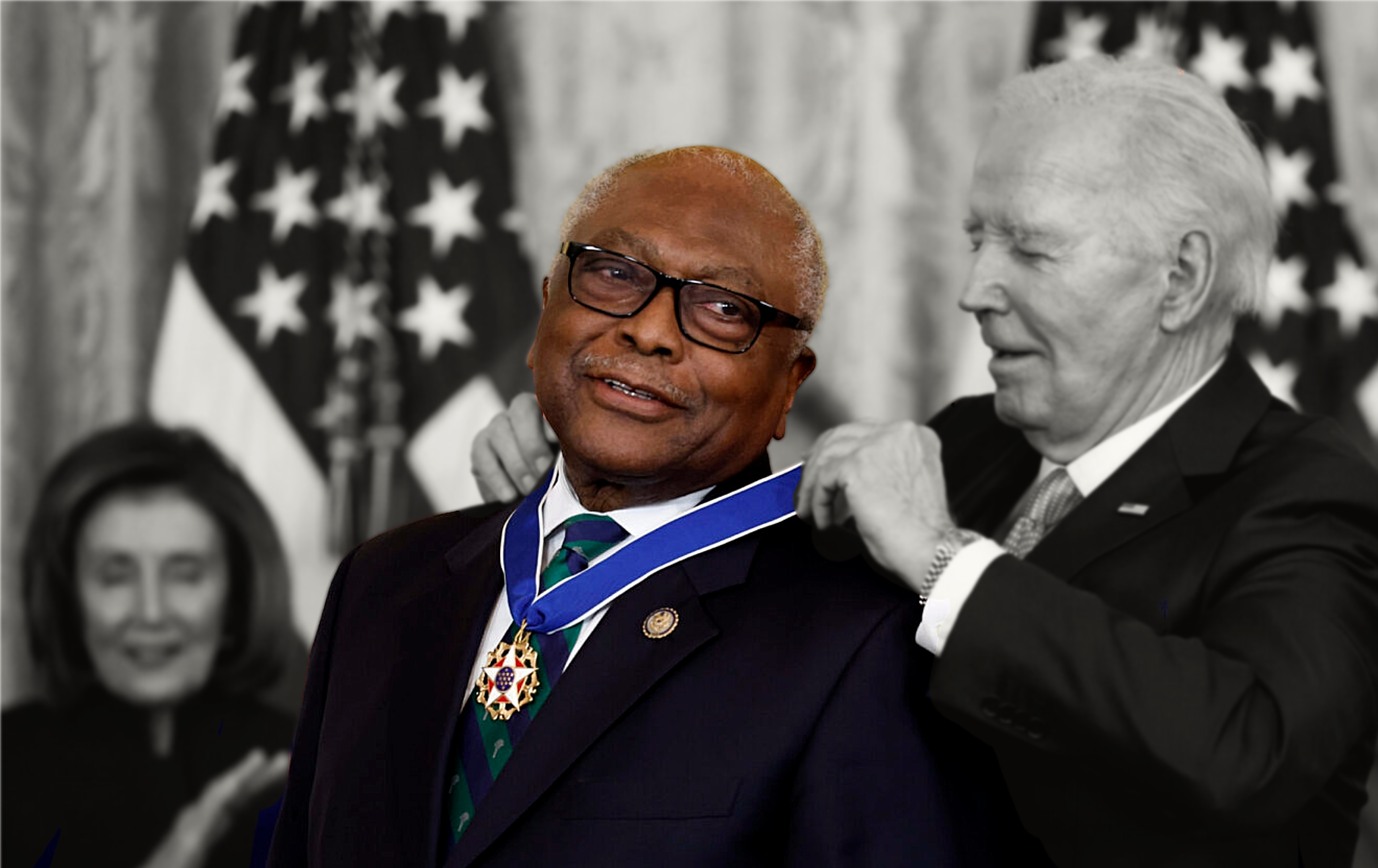
Civil Rights icon. Black elder. Kingmaker of the Democratic Party. That is who South Carolina Representative James (“Jim”) Clyburn is. His name commands respect and draws groans among the Democratic base. At a time when Democrats are on the verge of losing many of their remaining seats in the South as a result of gerrymandering, Clyburn’s status as one of the last Southern Black Democrats in Congress has made him into a major player in the party’s power structure. Party leaders vie for his endorsement, treating him as the whisperer of Black people as a whole. He has been able to gain enormous influence within a desperate party run by desperate leadership, searching for anyone who can save them. But that savior is not Representative Jim Clyburn.
Back in 2012, the late journalist Glen Ford wrote an editorial in Black Agenda Report laying out his definition of the “Black Misleadership Class”—a group of influential figures who had taken advantage of Black voters and dragged their community down a path that betrays its future. As Ford put it:
Most often, in our usage at BAR, the term refers to those Black political forces that emerged at the end of the Sixties, eager to join the corporate and duopoly political (mostly Democrat) ranks, and to sell out the interests of the overwhelmingly working class Black masses in the process. It is both an actual and aspirational class, which ultimately sees its interests as tied to those of U.S. imperialism and its ruling circles. It seeks representation in the halls of corporate power, and dreads social transformation, which would upset the class’s carefully cultivated relationships with Power.
In other words, a group of Black individuals used the Civil Rights movement to climb up the political ranks, then pulled the ladder up behind them, because all they truly cared about were their own interests.
Jim Clyburn perfectly represents this idea of the Black Misleadership Class. Over the course of decades, he became the person you must suck up to if you want to get anywhere in Democrat circles. Every election cycle, every possible Democratic presidential candidate—from John Kerry to Kamala Harris—goes out of their way to win his attention and support. But at the same time, he has sold out the community he was once so proud to serve and push toward prosperity. He chose to become part of the problem rather than the solution.
As a Black progressive, I do have knowledge of how the Black community works. But as a Democratic voter, I view the party through the lens of an outsider. I chose to be part of the Democratic Party the first chance I could. I turned 18 during the 2016 election, and my first vote was for Hillary Clinton to become president that November. I chose to be a Democrat because my parents were, and because it was expected from me as a Black woman. I maintained my loyalty through that loss because I believed that when Democrats took back control, they’d rebuild our country. Instead, President Joe Biden and his colleagues were more focused on getting back to “normal.” To them, “normal” meant how the country was before 2016. They had no interest in punishing Trump or his people. They just didn’t want to be uncomfortable and have to actually do anything worthwhile. They went back to brunch while the country and the rest of the world continued to burn. Still, I stuck with them because at the time, I agreed with the idea that they were better than Trump and the Republicans. For many years, I had no problem with just accepting the Democrats as they were. That has long since changed, as it’s become clear that the party has no intention of doing anything outside of making empty promises while basic rights are stripped away.
About two years ago, I started noticing a pattern when it came to Black leaders and how they interacted with the Black community and the Democratic base, especially as I watched how they responded to criticism. One leader in particular, Representative Jim Clyburn, seemed to have made it his goal to lead the community astray, preying on generational trauma to fearmonger. Clyburn relies on his racial identity to do his leading for him—all while betraying his Black constituents by cozying up to openly racist colleagues, voting against measures that would close the wealth gap, and accepting wads of donations from corporate and pharmaceutical PACs.

I am part of a group that you would expect Black leaders like Clyburn to want to appeal to: young, Black and progressive—a group you’d expect the Democrats to focus on in order to propel the party and the community forward. However, we have not seen any embracing of young Black voters in general. Instead, Democrats have abandoned their future voters while simultaneously guilt-tripping us and taking our votes for granted.
Progressives are outsiders in the Democratic Party, and that status becomes even more obvious as a Black progressive. Party leaders like Clyburn seem to believe that Black voters are a monolith, and by extension the party has become secure in the idea that Democrats never have to worry about whether or not they will win a majority of Black votes. Our existence and unfailing loyalty to the party is used to help maintain the status quo. Being on the outside only gives you a clearer view of this dynamic.
The Rise of Jim Clyburn
According to the official biography posted on his congressional website, Jim Clyburn came from humble beginnings. The son of an activist minister, Clyburn participated in the Civil Rights movement in his youth, getting elected president of his NAACP youth chapter at only 12 years old. Young Clyburn truly was the famed Civil Rights icon his current supporters claim he was. He even hosted sit-ins and marched to the state House in 1960 and 1961, a genuinely bold action that ended with him being arrested and jailed. A little while later, he taught social studies at C.A. Brown High School after graduating from South Carolina State College in 1962. He then went on to study at the University of South Carolina Law School (though he did not earn his degree). From there, Clyburn ventured into community organizing and employment counseling. He was an advisor for Governor John C. West in 1971, and would serve as the South Carolina Human Affairs Commissioner until his run for Congress in 1992. His win made him the first Black congressman to represent South Carolina since 1897, when George Washington Murray—a distant relative of Clyburn’s—left his seat.
After that, Clyburn continued climbing his way up within the Democratic Party hierarchy, mastering its power structures as he went. He became chair of the Congressional Black Caucus in 1998, then vice-chair of the House Democratic Caucus in 2002, before becoming House majority whip in 2007 and again in 2019.
Clyburn’s race-based accomplishments and historic “firsts” are a core part of his political identity, which allows both him and his supporters to use them as shields against even the most mild of criticism. Criticize Clyburn, and you must be racist—or, if you are Black and criticizing him, then you are a token being used by your white friends. When progressive Ohio state senator Nina Turner ran against Clyburn’s preferred candidate in a 2021 special election, she found herself on the receiving end of this narrative: as one online commentator put it, “Nina Turner ain’t for us she’s for WYT FOLKS. For her to disrespect Jim Clyburn[...] in the name of Bernie Sanders is telling.”
But there are serious criticisms that have to be made. Take a look at his track record over these decades, and it becomes clear that Clyburn’s rise in power and influence runs parallel with a downward slide into more and more conservative politics.
How, for instance, does someone go from marching in the Civil Rights movement to working with, and even praising, the one-time South Carolina Governor and long-serving Senator Strom Thurmond? Thurmond was a well-known segregationist, and in 1957 he launched one of the longest filibusters in Senate history—speaking continuously for over 24 hours—in a last-ditch effort to prevent the Civil Rights Act from passing. His entire life went against Clyburn’s image as a Civil Rights icon. And yet in 2017, many years after his death, Clyburn said that “Strom Thurmond and I were good friends.” (Clyburn also said he could work cooperatively with Donald Trump, just as he had with Thurmond.)
And what of Clyburn’s support for the 1994 Violent Crime Control and Law Enforcement Act? By now, the crime bill’s impact on the Black community is well-known: more aggressive policing in Black neighborhoods, harsher sentences, and the expansion of the death penalty, which critics called “a direct descendant of lynching.” Yet even today, Clyburn still defends his vote in favor of the bill, despite the harm it caused. He saw an overly policed country, where Black Americans are the primary targets of policing, as an absolute necessity. Today, when questioned about those harms, he claims they were the result of a Republican-led Congress stripping away vital protections and preventative measures. Because there’s always an excuse; it can never be Democrats’ fault.
And then there’s his 2020 endorsement of Joe Biden. Not only is Biden the man who helped author the infamous 1994 crime bill, but he is also the man who was famously called out for his racist past by Kamala Harris, who he’d later choose as his Vice President. This is a candidate who was vehemently pro-segregation until as recently as 1977—more than two decades after the Supreme Court’s Brown v. Board of Education decision deemed it unconstitutional—until he realized it hurt him politically. Like Clyburn, Biden carried on a friendship with Strom Thurmond despite Thurmond’s deep racism, and even spoke at his funeral in 2003, where he said that the vehemently pro-Jim Crow politician was merely a “product of his time.” Later, Biden would dabble in racist language himself, saying in 2020 that unless Black voters supported him, “you ain’t Black.” And of course, he consistently voted against and shunned legislation that would actually benefit the Black community (such as Medicare For All, which studies show would close racial gaps in access to life-saving healthcare).
Another glaring example of Clyburn’s betrayal of his community and party in favor of his own personal interests is his 2021 collaboration with Republicans to help gerrymander South Carolina. Here, as journalist Marilyn W. Thompson reports for ProPublica, the representative protected his own district at the cost of Black political power and the erasure of Democratic districts across his state.
According to the report, on November 19, 2021, the chief of staff for South Carolina’s Judiciary Committee sent a message to Clyburn aide Dalton Tresvant: “Hey Dalton – Andy Fiffick here,” he wrote. “We wrapped up some morning things quicker than we thought, so if you want/can come earlier than 1:30 we’re available.”

This was a secret meeting between Clyburn and South Carolina Republicans who were convening to redraw the maps for the state. Clyburn’s district was losing its population, and he desperately needed to rebuild it. He chose to do this not by making inviting pitches and legislation that would draw in new or younger citizens, but by collaborating to absorb parts of other Black and Democratic districts into his own. This coordination with state Republicans ensured that Democrats only had one district they could win—his.
More proof that Jim Clyburn no longer cares about the Black community and his constituents comes in a short interview with Drop Site News journalist Julian Andreone from April 15, 2026. (For more on Andreone’s work, see “Getting Them On the Record,” in this issue.) In the clip, Clyburn is asked about the federal government’s surveillance of Black Lives Matter protesters in 2020. In response, he simply says “I don’t worry about that[...] I just live through it.” The representative openly admits he hasn’t heard about the issue, and that he doesn’t worry about the implications of the federal government spying on Black protesters. This isn’t a new or shocking revelation, but from someone who has built an entire career out of the idea he knows what is right for Black Americans? For him to say he doesn’t worry about the government abusing its power to target his constituents and members of his own community reveals a lot.
Clearly, Glen Ford’s criticism of the Black Misleadership Class still holds true. Once Clyburn gained power, he used it to enrich himself, to prop himself up, and to become part of the same system that he once led protests against.
So, what happened to this former man-of-the-people to make him abandon the principles he once believed in?
Money is the Root of All Evil
The first and most common theory is always money. And you know, I don’t doubt it at all. This is a man who is a favorite of megadonors—especially those from the pharmaceutical industry and the pro-Israel foreign policy lobby.
But can the promise of dollar signs really be all there is?
Money certainly has a huge impact on politicians and their decisions. According to the Post and Courier, Jim Clyburn has received well over $1 million from drug companies over the last decade. The financial disclosure site OpenSecrets, meanwhile, found that pro-Israel lobbying groups (specifically AIPAC and its various affiliates) funded him to a tune of $165,256 between 2018-2024. Another estimate from the Washington Report on Middle East Affairs cites an even larger figure: more than $200,000. And his voting, behavior, and public statements are perfectly in line with donors’ wishes.
Some of the congressman’s alleged corruption, in fact, is a little more direct. ProPublica just published a new article detailing how Clyburn was being investigated by the FBI in early 2025 for bribery—until the inquiry was derailed by Donald Trump’s return to the White House. Along with two South Carolina Republicans, including the late Senator Lindsey Graham, Clyburn came under investigation after he accepted $20,000 in campaign donations from a Hawaiian naval contractor called Navatek, then voted to approve spending packages that awarded the company lucrative military contracts. (The contractor also provided a $10,000 gift to Clyburn’s alma mater, specifically calling it “Congressman Clyburn’s favorite school.”) But the Southern Democrat managed to escape scrutiny, as the investigating agents were caught up in Trump’s purge and the case was closed.
Another possibility is that Clyburn is motivated by the fame and influence he gets from being one of the few Black Southerners in federal office—and he isn’t the only one. There’s also Representative Jasmine Crockett (D-TX), another Black liberal who seems to possess the same sense of arrogance and entitlement, boasting to the press earlier this year about being “one of the 535 most powerful people” in America. Notoriously, Crockett has declined to campaign for Democratic Senate nominee James Talarico after losing the primary to him in March, but has found time to make a public appearance with R&B singer Chris Brown (after honoring the serial domestic abuser with a congressional award). You leave with the idea that these politicians crave the fame they get from being in office.
Unfortunately, the Democratic establishment is all too willing to give them exactly what they want. What we have seen is a party too eager to feed the need for attention, while also being too eager to ignore the concerns and needs of its voter base. This leads to the problem of certain Democrats like Clyburn and Crockett being too influential while simultaneously lacking the ability to draw in new voters.
We are stuck in an abusive, hostage-type situation with this party. Even Black voters are being held hostage, while our votes are held over the heads of other groups within the Democratic base—especially when those votes come from older Black Southerners. They are a group that is shrinking with every election cycle, and a group that skews more conservative (religiously and socially) than the rest of the party’s base. But Clyburn knows this, and makes a point to build rapport within the church, partly because of his origins as a preacher’s kid. He’s maintained a steady presence in those spaces year round, and he understands how to get people on his side when he needs them.
But with those socially conservative tendencies, the party these older Black voters in the South actually match best is the Republican Party—the party they refuse to vote for. Their younger counterparts in the cities are more progressive, more willing to accept change, and more likely to support progressive candidates. In the New York City mayoral race, an estimated 70 percent of Black voters under 50 years old went for Zohran Mamdani. And this trend holds across the country. There is a clear generational divide that the Democratic Party refuses to address. And despite the data that has come in over the last few years regarding that divide, older Black voters are the only ones the Democrats are willing to acknowledge.
Most recently, the Democratic Party has moved to place South Carolina as the first state on the 2028 primary calendar, giving its voters—and Clyburn—disproportionate influence over the next presidential nominee. The logic seems to be that a group that is progressively being gerrymandered out of electoral power must be allowed to shape and direct the Democratic Party to make up for their dwindling influence in the South. But although the South is crucial for control of both the White House and Congress, Democrats have not done well there the last several election cycles. So the decision to elevate Clyburn and his state seems more ideological than strategic, used to boost the Democrats’ more conservative factions. At the same time, his Blackness is used against his progressive critics, and the idea that it would be good to allow new or younger leaders to step in.
When activist and former DNC vice-chair David Hogg tried to advocate for younger people to be elected to Congress and start a conversation about how it was time for many of the older members of Congress to pass the torch, he was accused of racism by various officials, voters, and even Black Democrat-leaning media. While Hogg never directly mentioned Clyburn, the controversy came after Clyburn spoke about how he could never leave Congress because—as he put it—“What the hell am I supposed to do now? What do you want: me to give up my life?" (So far, Democrats have had seven sitting members die, including two back to back in Texas, in the same exact seat, eight months apart.)
This debacle would end with Hogg getting removed as a vice-chair of the DNC just two months later. But the incident perfectly shows a dynamic where Black elders in the party know how to weaponize their race against their critics. They hold the party hostage because they refuse to leave their positions, even as they are dying in office.
The idea that Democrats must listen to Black Southerners in order to win the South would make sense, if it included all Black Southerners, and not only Jim Clyburn and his supporters in South Carolina. Any other Southern state gets ignored, and so do those states’ Black leaders. Notably, Georgia’s Senator Raphael Warnock or Texas Representative Al Green haven’t enjoyed the same “kingmaker” (or elder) status as Clyburn; their endorsements, or non-endorsements, aren’t treated as headline news. Why is that? South Carolina is a state Democrats haven’t won at the presidential level since Jimmy Carter in 1976. Ultimately, Clyburn is only one U.S. representative out of 435.

If the idea was truly about Black representation and giving a voice to Black voters, why choose a state so gerrymandered that there’s only one Democrat representing it? Because it’s Clyburn, and the establishment can always count on him to help spread their bland and corporate-favored policies, from Israel to the pharmaceutical industry to mass surveillance.
Combine that with the guilt many white Democrats feel over slavery and the historical treatment of Black people, and you get a party that can be manipulated by those who use their race to prop themselves up. Democratic leaders love to pull out the Black president card (Obama!), knowing that his name is enough to make Black voters do what they want regardless of their actual policies. It’s offensive, but what’s more pathetic is that enough of the community falls for it every time.
The only moment when the 86-year-old Clyburn was even said to be considering retiring from Congress was when speculation arose that he would be handing over his seat to his daughter, Jennifer Clyburn-Reed. In March 2026, reports emerged that he was “weighing” retirement—but only if the seat went to his daughter. Of course, the idea that a member of Congress can just hand his seat down as an inheritance, like a prized piece of furniture or dishware, is openly anti-democratic. The closest comparison would be across the hall in the South Carolina GOP, where the recently-deceased Senator Lindsey Graham was replaced by his sister Darline. And as the Washington Post pointed out, it was “unclear” whether Clyburn-Reed even wanted to run. It didn’t matter in the end, because her father refused to step down. He is currently running for an 18th consecutive term; if reelected, he’ll be 88 by the end of his next term, in January 2029.
But we have to remember: he can’t be criticized, because he is Black and a Civil Rights legend, and criticizing him means you’re racist. Or you’re helping Trump and the Republicans. Oh, and how dare you disrespect your elders! The idea that pushing back against bad ideas or policies put forth by Black leaders is disrespectful is repeated every time one of them is criticized. You can find similar responses in the comments of any post on social media that advocates for older members of Congress to step down before they die in office. For the Black community, seniority is treasured, because after having worked their way to the top, these organizers and leaders are finally seeing the fruits of their labor.
The problem is that they then choose to hold onto the reins of power until they die. The pattern plays out state after state: in Illinois, for instance, Chicago activist Kina Collins reported that when she ran against then 81-year-old incumbent Representative Danny K. Davis in the 2022 Democratic primary, she was “told repeatedly to wait her turn or run for a lower office until Davis retired.” Or in 2024, when many young Black voters were reluctant to vote for Joe Biden over his response to the genocide in Gaza, Jim Clyburn’s message was simple: that their elders needed to “talk some sense into their children.” There’s this view that respect is earned by way of seniority, not by action or behavior. The older you are, the more respect you deserve.
However, not every pivotal figure in Black history is treated the same. Where establishment-friendly politicians like Clyburn or Davis are treated as hugely consequential and worthy of respect, more revolutionary icons aren’t given the same type of reverence. For example, we rarely hear the argument that we should defer to the wisdom and experience of the surviving Black Panthers, or Angela Davis, or the words of Malcolm X. Apparently, you’re only a “Black elder” if you have a stamp of approval from the Democratic Party—and Clyburn is given that approval because he is not considered a threat to their power. The others I mentioned believed in sharing power, allowing underprivileged groups to have a real say in how money was spent and policy was created. Clyburn does not. He exists in leadership to protect the very people the Black Panthers, and other Civil Rights leaders like the Rev. Dr. Martin Luther King Jr., would have been suspicious of. He does not care to smash the system to bits and rebuild it for a new and more diverse coalition, since that would mean smashing his own comfortable perch.
And that is where the Democratic Party likes its Black voters: quiet, submissive and willing to go along with the flow. Don’t question leadership or expect real results.
But that doesn’t work any more. Things have only gotten worse, and Democrats have responded to this by putting up even worse candidates and expecting us to just suck it up and vote for whoever they try to force on us. Clyburn represents everything this party establishment stands for, and he is a living reminder of everything that has gone wrong as a result.
If there’s good news to be had, it’s that Clyburn’s power and influence may finally be waning. Because as it turns out, his chosen candidates have had a very hard time winning their primaries lately.
New York City
The first real glimpse we got of the weakening of the Black Misleadership Class’s power was the New York City mayoral primary.
Disgraced former governor Andrew Cuomo was running against a slate of seasoned politicians and up-and-coming activists. His main opponent was a rapper turned city advocate and activist, Assemblymember Zohran Kwame Mamdani—a democratic socialist. Unsurprisingly, once it became clear that Cuomo was not going to run away with the nomination, all the establishment endorsements started falling out of the sky. And yes, Jim Clyburn was the major one.
There are a few strange things about this. The first is the idea that a House representative from South Carolina would necessarily have influence with Black voters in a mayoral election in New York City, as if Black Americans everywhere are one interchangeable group. What’s even more striking is that this is the exact same Jim Clyburn who called for Cuomo’s resignation four years earlier. Clyburn and a myriad of corporate Democrats were so focused on stopping progressives that they backed a known abuser over Zohran Mamdani and a wide slate of other candidates.
Clyburn and his allies had plenty of options to choose from, including Black candidates like Michael Blake and Adrienne Adams. Yet, they bypassed them to rally around a man they had condemned years earlier. In the end, Zohran Mamdani got the nomination.
With Clyburn’s endorsement was supposed to come the Black voters—or a good chunk of them, anyway. And he knew what his job was, because it had worked before. For years, Clyburn has been a tool used to put a stop to rising progressive campaigns. It worked with Bernie Sanders twice: including in 2020, when Clyburn acknowledged that Sanders was the party’s frontrunner, but wanted South Carolina to have a say before the nominee was chosen. He then turned his endorsement, and the support of South Carolina’s Black community, into a pivotal victory for Joe Biden. (“You brought me back!,” Biden would later tell him in gratitude.) It worked in Ohio in 2021, when Clyburn’s endorsement again played a key role in blocking Sanders ally Nina Turner from becoming a U.S. representative. Because of Clyburn’s influence over the party’s Black voters, the Democratic establishment assumed it would work in their favor in New York City. Instead, the largest city in America would be the first to deliver a hit to Clyburn’s influence.
Michigan
The Michigan senate race is the most recent demonstration of the fact that Clyburn’s machine still holds some power. Again, Clyburn flew in from the South to the Midwest to back a centrist candidate, this time Representative Haley Stevens, against the progressive Dr. Abdul El-Sayed. His intervention was part of a broader push that included nearly $70 million in campaign spending against El-Sayed—and the terrifying thing is, it almost worked. Despite polls showing a wide lead for El-Sayed, the actual election was an incredibly tight race: one that wasn’t called until 2 AM, with a final margin of victory of just one percentage point.
Throughout the whole campaign, the Stevens camp implied heavily that she’d been endorsed by former President Barack Obama (again, bringing Obama out to fool Black voters!) despite the photos and quotes being from years before. There was a blatant, coordinated effort to deny El-Sayed his American identity, and claim he had no idea how to represent Black Michiganders. Like other races during this primary cycle, the strategy from Black leadership and the party itself was to prop up one group through pure fearmongering. Clyburn was the perfect accomplice.
El-Sayed would still win, because his team had an impressive grassroots operation similar to Mamdani’s, strong enough to beat the party establishment. He proved that you can beat political machines such as Clyburn’s if you put the work in. Still, during the November general election, El-Sayed was forced to field more attacks targeting Black voters. A late ad campaign by the “Democrats for Mike Rogers PAC” featured a series of videos of Black Michiganders saying things like “Abdul El-Sayed cares more about west Gaza than the west side of Detroit.” Of course, the coalition was actually funded by Republican-aligned groups and donors—but their rhetoric would have sounded right at home coming from establishment Democrats like Clyburn.
Looking back at how different Jim Clyburn has become from his days as a Civil Rights protester, one has to wonder if his younger self would be proud of who he is now. I’m sure if you were to ask him today, he’d give you an enthusiastic “yes.” But the reality is, he’s the very person he would once have promised he’d never turn into. How would 20-year-old Jim respond to an older Black leader blaming Black Americans for the Democratic Party’s troubles? The young Jim Clyburn would surely have pushed back on that idea—which is why the fact that he decided to go on TV and blame Black voters for Donald Trump’s victory in 2024, saying that “Black people let Kamala Harris down,” is so disappointing.
I would like to believe that young Clyburn would be shocked at how he has strayed so far from his former beliefs and values. But even that may be wishful thinking, when looking at how so many of our leaders transform once they’ve tasted even the slightest bit of political power.