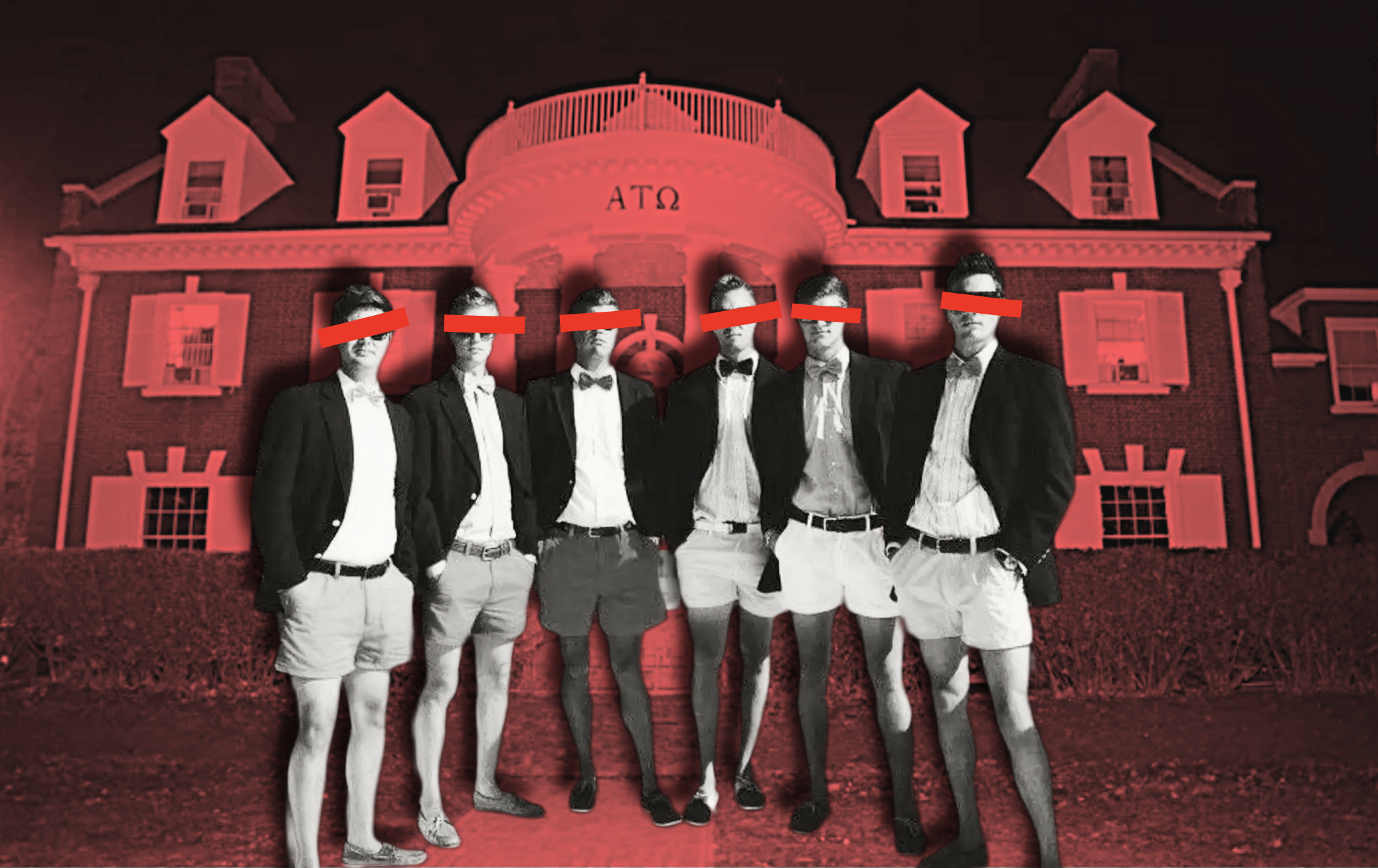
For centuries, fraternities have offered young men a pathway into elite society. They've also offered them impunity.
I grew up near the University of Alabama, arguably the fraternity capital of the world. When I was in high school in the late 2010s, whispers spread about a girl in my sophomore class who had gone to a party at a frat house near UA’s campus. The rumor was that she was very intoxicated, and that multiple fraternity members sexually assaulted her. Not many people seemed to care, though. It was assumed that if you were a girl or woman attending a frat party, especially a younger and more vulnerable one, this outcome was almost a given. She should’ve known that, right? I remember asking the classmate who told me the rumor if she was all right, since I wasn’t very close to her. They didn’t know, and didn’t want to stir up the memory again by asking her. I regret not asking her myself, but I had the same fear. I later went on to attend the University of Alabama. I never forgot that story, and I never forgot the callous response to it, either.
This story is, unfortunately, all too common. For too long, America’s campuses have been witness to acts of sexual violence against women, and treated them as a routine feature of “Greek Life,” leaving victims with little to no recourse. Now, with more horrific stories coming to light, many are asking why this violence seems so inevitable, why campus decisionmakers are allowing it to continue.
The statistics, after all, are clear. We know fraternities are breeding grounds for harm, including traumatic hazing rituals, heightened pressures for substance abuse, and, of course, rape and sexual assault. Frat members are vastly disproportionately likely to commit a sexual assault compared to their non-frat peers—as much as 300 times more likely, according to some studies. Sorority women are also four times more likely than their unaffiliated counterparts to report being sexually assaulted in college, with studies citing their close association with frats as one of the reasons. As one 2022 study noted, “being a fraternity member indeed is associated with a greater risk of exhibiting sexual aggression in the future. This provides strong justification for prevention efforts that target this high-risk population of men.” Their high-risk nature, the studies note, is in part due to “mechanisms through which fraternity membership socializes men to be more sexually aggressive.” In other words, frats foster, then perpetuate, sexual aggression and other forms of violence.
With that in mind, why would any serious educational institution allow them to exist on campus? We know fraternities are a completely voluntary part of American university life, and one’s educational experience is not dependent on participation in them. In the last few months, the horrible details of the Cornell case have been national news, and brought the underlying issues with fraternities and their status within universities to light. From the leaked text messages, to the fact that Cornell could punish anti-genocide protesters while protecting alleged rapists, the case shows the extent to which systemic rape, torture, and abuse of women has been gladly swept under the rug, not only on university campuses, not only in the U.S., but everywhere in the world. The anger and pain that many of us are feeling needs to be channeled somewhere. A structural issue like this one requires structural response, pushing for abolition of fraternities to start, then with overhauls of the systems that enable them to perpetuate their violence.
To anyone who isn’t based in North America, the existence of fraternities can seem bizarre. They are a uniquely American (and sometimes Canadian) institution, rooted in some blatant forms of sexism, racism, and patriarchal power. Essentially, a fraternity is an all-male social club that men can join when they begin their studies at big universities, like Alabama; in past decades, many of them were all-white as well. Their names are usually a combination of Greek letters, hence the term “Greek Life.” To become a member, one must be approved by current members, and may go through processes like interviews, networking events, and secretive rituals—often including humiliation and violence, or “hazing.” And this is the key to fraternities’ role in broader systems of power, because passing these rituals gives members access to a network of usually well-off and powerful people. Fraternity “brothers” typically pay dues, and in exchange get housing in collective “frat houses,” where large, debaucherous parties are a regular occurrence. Dramatized in movies like 1978’s Animal House, the reality of these events is often darker, as women who attend may be harassed, assaulted, or drugged with spiked drinks—only to be told, afterward, that they “should have known” what they were getting into. The relative privacy of the frat house makes these acts easy to conceal, and the victims get the blame.

What constitutes a “fraternity” can vary, and there are valid critiques of sororities too. For the purpose of this argument, I am focusing on historically white social frats (over professional frats or Black frats/sororities, which are materially different and were created for different reasons).
The frats that I am primarily arguing about are those belonging to the North-Interfraternity Conference (IFC) and, potentially the sororities of the National Panhellenic Conference (NPC).These differ from the historically Black sororities and fraternities in the National Pan-Hellenic Council (NPHC).
A common defense of such fraternities is that while some members may commit acts of violence and sexual misconduct, on the whole, the groups have a positive influence in the community. Frats, their supporters say, carry out charity work and raise money for good causes; they provide much-needed community for young people away from home for the first time, opportunities for fun, and career advancement.
But we should keep in mind that nothing about those worthwhile goals requires the specific organizational form of the fraternity, with its hierarchy, houses, parties, and gender roles. Many other groups, from clubs based around academic majors to religious and political ones, create a sense of community without the harms fraternities bring. And as we’ll see, those harms outweigh any potential benefits (which are in any case not guaranteed). Not only are fraternities literally costly, with membership dues being hundreds or thousands of dollars per semester, but they come with a significant risk of discrimination and danger, and even death.
Earlier this year, a police bodycam video surfaced from a 2024 incident at the University of Iowa’s Alpha Delta Phi fraternity house. In it, 56 “pledges” (or prospective members undergoing initiation) stand in a pitch-black basement, shirtless, blindfolded, and covered in unknown substances. The police officer, sounding shaken, asks the men what was going on. Another asks who is in charge. None of the men respond to the questions. They stand still and stare at the officers silently. The two frat members who do respond to questions are older members, including Joseph Gaya, who would be arrested that night for interfering with the investigation. The two appear calm, though annoyed by the police’s interruption of whatever was happening in the basement, as Gaya drinks a beer, vapes, and checks his phone. This was just a “ritual” in the “lead up to initiation,” one of the frat members told police. It was later deemed hazing, and the University of Iowa suspended Alpha Delta Phi until 2029 as a response.
Hazing is a time-honored tradition in frat initiation. While technically banned, in practice, it is still common for both frat and sorority initiation. It involves putting pledges through humiliating, painful, or dangerous activities as a test. Typically, hazing is only the final step, after a pledge has already jumped through multiple hoops. They may need to have connections and recommendations; they may need to dress up and show that they have the disposable income to participate in Greek life activities. Hazing completes the process, and is meant to show the pledge’s loyalty to the group—but also their willingness to submit and obey its hierarchy.
Depending on the school and the specific fraternity, the range of activities involved in hazing can vary wildly.
Some rituals include being a “slave” for an older “brother,” doing all their homework and errands, swallowing live goldfish, or forced binge drinking. But hazing can be more heinous. This year, a disturbing incident was reported at the University of Wisconsin-Madison Alpha Epsilon Pi chapter, where some accounts claim that human feces was thrown at frat pledges, with some being “visibly injured.” In 2010, a pledge was reportedly branded with the symbol of Texas’ Kappa Sigma fraternity on his buttock, using a “hot coat hanger,” while he was passed out drunk. Other fraternities simply make their pledges endure beatings, some of which have led to death. The details change, but the core elements—hierarchy, humiliation, and sadism—stay the same.
Hazing is sometimes criminalized, and is usually against a university’s codes of conduct. Although hazing rituals are not necessarily forced, the coercive nature of the whole Greek life environment, as well as pledges’ feeling of the sunk cost fallacy, weigh into their willingness to go along, and their reluctance to speak out against it. Is it any surprise, then, that groups which begin by committing violence against fellow “brothers” become breeding grounds for violence against others?
To understand why frats and hazing are so tied, one only needs to look to their history.
The first fraternities can be traced to the 18th century, when Freemasonry was all the rage in the pre-revolution American colonies. At the time, frats were conceptualized as a response to the rigidity and religiosity of higher education institutions. Because the Freemasons represented liberal thought, students aspired to create secret brotherhoods like the Masons to bring more intellectual and social freedom. The first frats are thought to be Phi Beta Kappa and the Flat Hat Club at the College of William and Mary. The former was a debate society; the latter, a social fraternity more akin to fraternities today. Both only accepted white men as members, and their early membership included slaveholders, future presidents, and future presidents that were also slaveholders. Higher education was already barred to most who weren’t elite white men, and frats served to create even more exclusivity for these students. They used Greek letters as names to reflect some higher aspiration to classical philosophy and fraternal “brotherhood,” much like the aspirational and exclusionary liberalism of the Founding Fathers.
Fraternities were considered “secret societies” until the 1800s, though an open secret. They were not nationwide, formal organizations like they are today, though they spread and grew as former members became wealthy and powerful, and made ongoing donations to perpetuate them. But unlike today, universities did not have formal or preferential relationships with frats. In fact, most universities banned them until the 1900s. Two factors spurred university acceptance and formal incorporation of frats into their sphere of oversight. First was the anti-secret society movement brought on by the “Morgan Affair,” the disappearance of William Morgan in 1826. Morgan was a print shop owner who claimed to have been part of elite-run Masonic lodges and documented some of their secret ceremonies and rituals, threatening to publicize them.
These secret ceremonies and rituals were likely hazing rituals not unlike what today’s frats undertake. Masons reportedly retaliated by trying to destroy Morgan’s shop. Then, police officers, perhaps in league with the Masons, arrested Morgan for supposed debts. Morgan was bailed out by a group of Masons and carried away. He was never heard from again. The Anti-Masonic Party grew in part due to Morgan’s disappearance and the small slaps on the wrist Masons received for his alleged kidnapping and murder. There was working-class outcry over the elitism and secrecy of the Masons and secret societies as a whole. Many frats, who were associated with the Masons, chose to become more public as a response. Because they were no longer secret, or because universities wanted to have more oversight and regulation over frats, they began accepting them as part of the university ecosystem, though they would retain many of their discriminatory aspects, hierarchies, and autonomy. They also began to form as more powerful, well-funded national organizations with university-specific chapters, as they are today.
As attendance rose at U.S. higher education institutions, particularly post-World War II, there was a need for accommodation for students. Universities often did not have enough space on their own campuses. Fraternities with their own private houses became popular, and a status symbol, because they offered accommodation close to campuses. Black students, however, were barred from living in these houses.
At Cornell, for example, they had to either board with local Black families or live in the servants’ quarters of white fraternities that they worked in. The first Black fraternity was created in 1906 as a response to this exclusion at Cornell. Frats generally remained spaces for elite white men, however, and many were formally segregated until Title VI of the Civil Rights Act of 1964 was passed.
Even today, they remain mostly in de-facto segregation. It took my university, UA, until 1991 to hold an integrated “rush” (the sorority recruitment cycle). It still wasn’t until 2003 that a Black woman was accepted into a traditionally white sorority. And still, there are allegations of racial discrimination in Greek life across the country. In 2013, UA’s student newspaper The Crimson White broke a story that alumni from several white sororities were threatening to withdraw funding if the sororities were to accept a Black member. This year, allegations of racial discrimination not only in UA, but in chapters around the country, continue.
But what does systemic violence against women and hazing have to do with this history? Everything. First, we can see that fraternities have always served to preserve patriarchy and hierarchy. They began as safe spaces for elite white college men to be without supervision, and that is what they continue to be today. As elites are wont to do, they create internal hierarchies within a larger hierarchy, fostering competition amongst members. The sadistic throughline of hazing comes with this. The hierarchy, vows of secrecy, and hazing rituals form a bond among members, and can also serve as a form of mutually assured destruction. Frat members continue the cycle of hazing, as once they get past their own hazing and are part of the brotherhood, they will then haze or witness hazing of the new pledges. Then, if a brother steps out of line, they risk not only losing their social network, but could be blackmailed or face deeper repercussions due to the extreme nature of the hazing they’ve undergone. The frat forms a pact to further foster loyalty. And they can weaponize their elite network outside of the frat or use elites’ sympathies toward the boys’ club and frat pacts of silence, to prevent victims from speaking out.
These practices are nothing new, as exhibited by groups like the Masons. And the movement against these groups is nothing new either, as shown by the 19th century backlash and movement to end secret societies. Then, and now, people realize that these elite, secretive spaces allow for corruption and violence to flourish systemically and without recourse.
The secrecy, hierarchy, mutual protectiveness, and competition associated with frats allows rape culture to survive and thrive. Frats are already made up of young men who are influenced by patriarchal narratives of women as conquests. The frat environment worsens them, making sex with women a competitive endeavor. Sexual encounters can signal status within the frat, driven by hierarchy and already attuned to violence and forced submission. Gang rape could be so associated with them because the practice has long been a form of coordinated bonding ritual which is fostered by heavily patriarchal environments like frats. Just to name one illustrative example, Yale’s Delta Kappa Epsilon fraternity was suspended for five years in 2010 after several pledges stood blindfolded and chanted “no means yes, yes means anal” on a campus lawn. The graphicness and openness with which these men chanted those words is telling. They seem to fear little consequence, and it’s almost like a game to them, just another open secret that won’t be spoiled.
Sororities are also typically paired with frats, and largely do not host parties with alcohol at their own houses due to NPC-issued codes and tradition. If they want to party, they usually do it with the fraternity they’re paired with, at that chapter's house. Sororities may pressure their members to maintain a favorable relationship with said group of men, and sometimes require their "sisters" to attend frat parties. This essentially forces a feeder relationship, wherein sororities exist in a subordinate position to fraternities, and function as a pipeline that delivers young women to the latter’s door. As a result, sorority women are often the ones victimized in frats.
However, those sorority members are not the only victims of this systemic violence, and other women, or men, who attend frat parties or events may be subject to it as well. Consent-focused sexual assault prevention methods will do nothing in this kind of environment, as consent was likely not even considered in the first place. The environment tends to promote the opposite, conquest and violence. Combined with a legal and social environment that is already hostile to victims, exemplified by New York’s voluntary intoxication “loophole,” and many sororities’ parallel structure of silence and hazing, many victims feel like they can’t speak out, and if they did, nothing would happen anyway.
Frats not only mirror higher patriarchal institutions in their operations, but they can also continue an elite pipeline into those higher institutions. This is a selling point to frat brothers: that they will gain access to a network of like-minded elites for career opportunities. Frat members have a clear sense of loyalty, shown by alumni donations, and are often well-off. While only seven percent of all American men are part of a fraternity, frat members make up a vastly disproportionate amount of presidents, CEOs, and congressmen: comprising 76 percent of male members of Congress, and 85 percent of Supreme Court justices. Infamously, President George W. Bush was a member of Yale’s Skull and Bones Society, a male-only “secret” society modeled after the Masons, as well.
However, as Maria Konnikova wrote for the Atlantic, “[f]raternities don’t breed leaders so much as leaders breed and perpetuate the fraternity system,” meaning frats themselves don’t necessarily teach leadership skills, but rather, preserve elitist networks for leadership positions for those who they know will play ball and keep the system intact.
While many think of frats and sororities as being part of the debaucherous “Animal House” archetype, they can also wield serious, organized power, serving as a training ground for their elite memberships in their careers. Take for example, the “Machine”: a not-so-secret, “secret” coalition of frats and sororities at my alma mater, UA. Perpetuating the longstanding history of secretiveness and concentration of power, the Machine is said to have manipulated UA’s student government elections for decades. The Machine leadership reportedly internally chooses candidates for student government elections, then forces the coalition’s entire memberships to vote for those candidates.
Thus, while the Greek life of UA is a minority of the total student body, due to learned helplessness from the rest of the student body, Machine members have won the majority of elections for decades. The Machine has also been said to attack, punish, or threaten those that pose a threat to it. UA is not alone in having a reportedly manipulative Greek life political bloc, either. These tactics of keeping party members in line to maintain elites’ political power and foster apathy amongst the rest of the populace, is something to take note of in the broader political space. While frats alone don’t cause these secret political coalitions to form, they do foster them, and provide an infrastructure for elite students to become elite professionals with the help of elite power coordination. Political power, built on frat ritual hazing and forced conformity, mirrors many institutions and elite party politics.
Speaking of elite power, one must ask: why do universities maintain relationships with frats? Statistics show how disproportionately frats contribute to sexual violence and drug and alcohol abuse on campuses. Their presence on campus actively makes other students less safe. Surely, universities would want to protect students and higher learning as a whole?
Sometimes, maybe. Larger, national fraternities tend to “affiliate” with universities, meaning they are recognized by the university formally, and the university has some oversight and sanction capacity over the fraternities. This has some liability implications for schools in the event of frat violence or misconduct. Some universities do take note of this potential liability, and use their power to suspend frats and/or punish individual members, like IU and Cornell did. However, frat suspension is far from a complete solution to these issues, which are, again, systemic. Investigations, punishments, and protections for victims can also be infuriatingly lax, given Title IX’s vast flaws. Some have argued this is by design.
Universities are businesses, however, and like any business, they have likely done a cost-benefit calculation. In most cases, they have determined that they can tolerate or even protect frats for the sake of their bottom line. Frats are private organizations, and their chapter houses are not always located directly on a university’s campus, which sometimes allows schools to shirk responsibility for frats’ actions.
But frat alumni are known to be some of the most generous and loyal donors to their alma maters. They can be powerful, and frat members may even make up some of the decision-making boards of universities. Further, as universities are in a competition for amenities to justify their extreme tuition fees, Greek life is seen as a differentiator and emblematic of a fun-filled atmosphere for students. Campus police, which allow for universities to have a form of parallel jurisdiction over campus matters outside of local police, may also lack resources or conduct shoddy investigations without much public oversight, which can protect the university and the frat. Money is clearly a decision-making factor when it comes to the question of frat abolition, and universities won’t give that up easily.
In the last few months, there has been social media speculation that the publicization of the Cornell case was some form of psy-op to stoke division ahead of midterms, or a means to further deter or prevent women from entering higher education. I cannot say why this story became as large as it is, when the sad truth is that cases like this are quite common. But I would say that regardless of how the story grew, this case is provoking discussions that must happen if we are to address rampant sexual violence. It can make advocates and survivors feel hopeless when we see apathy or hostility to Jane Doe or Kendall Francis, which re-traumatizes them rather than helping them get support or justice. However, we must remember we can and must do something about it. Channeling our energy into systemic change can help stop the feeling of helplessness, because we are resolving to help ourselves. There has been discussion of the “failure” of the MeToo movement to help survivors in this regard, to which I would say it was because it was only the beginning of a much larger effort; it was not yet systemic, sustained, and had no specified aims or demands.

Already, student organizers are initiating more concrete actions. At Cornell, the school’s Black Student Union and NAACP chapter organized a seven hour sit-in and an economic boycott of their university on October 7. Participants did not purchase anything or attend classes for a day, occupying spaces for the same amount of time Jane Doe said she was assaulted, per her suit. As with the pro-Palestine student protests, the organizers know that money is everything to these institutions, and thus, are taking aim at the university’s income streams. At least one alumni donor to the University has said he is telling other alums to withhold their donations to Cornell like he did, which is another potential financial blow meant to force Cornell to take accountability and action. Universities have shown that this is what they care about more than their students or scholarship, so this is what must be done. However, these efforts cannot end with Cornell or this case. As this news story has exploded, a high school football team, states away in Idaho, wrote threats to rape and murder a girl in their class in a private group chat, referencing the Cornell case. “U think Cornell was bad just wait for us,” one student said. The fact that these messages are constantly being circulated, then being ignored or minimized, is part of the harm too. Gang rape is a known tool of systemic violence, used to bond men through the suppression and pain of women. Spaces like frats are known to enable gang rape, in providing a place to initiate and continue the cycle of pain and violence. To remove the violence, the spaces themselves have to be removed, too.
Of course, there is the question of how to actually abolish frats when they are moneyed private organizations, largely owning their own properties. To start, I would say that at least, universities or localities could begin larger-scale suspensions of their activities. The mayor of Ithaca, for example, issued a blanket moratorium on all student group event permits, given Cornell’s mishandling of the current case and potentially many others. The University of Arizona took similar action in early October 2026, with a dean issuing a suspension of Interfraternity Council frat activity on its campus given multiple reports of assault and hazing only weeks into the fall semester. These actions may not fully stop frat activities, however, and do not address the root causes of the harm they bring.
The “Abolish Greek Life” movement is not new, and became somewhat more formalized and ramped up in 2020, amidst frat parties’ spread of COVID during the pandemic and Black Lives Matter racial justice protests. Organizers have been thinking about these questions, and say that pushing for members at individual campuses to “disaffiliate,” causing the chapter to disband for lack of membership, is an option. Another option is working through various Panhellenic councils at universities to push for votes to stop recruitment activities. The IFC and NPC, organizations overseeing almost all major historically white fraternities and sororities have their own CEOs and business structure, representing another barrier to this method. They, or the chapters’ national organizations, may maneuver to stop organizers’ abolition efforts on the university-level. To counter this, perhaps universities could write into their codes that students cannot be a part of fraternities and/or sororities, like they had with their secret society bans of earlier years. Given the various definitions and types of fraternities that exist (like minority-led or academic fraternities), the potential litigation that could follow, and the organized and moneyed opposition to these measures, this would be an uphill battle. Still, there are legal arguments available for taking action against frats.
Those of us who call for abolition know that abolishing frats alone won’t stop campus rape and rape culture. However, if we can’t target these obviously regressive organizations, then what can we do? Like any abolition effort targeting structural power, organizers know this will be a long fight. The fight won’t stop at frats. They are a symbol of many patriarchal laws and power structures that must be targeted and disrupted for true justice. But it needs to start somewhere.