
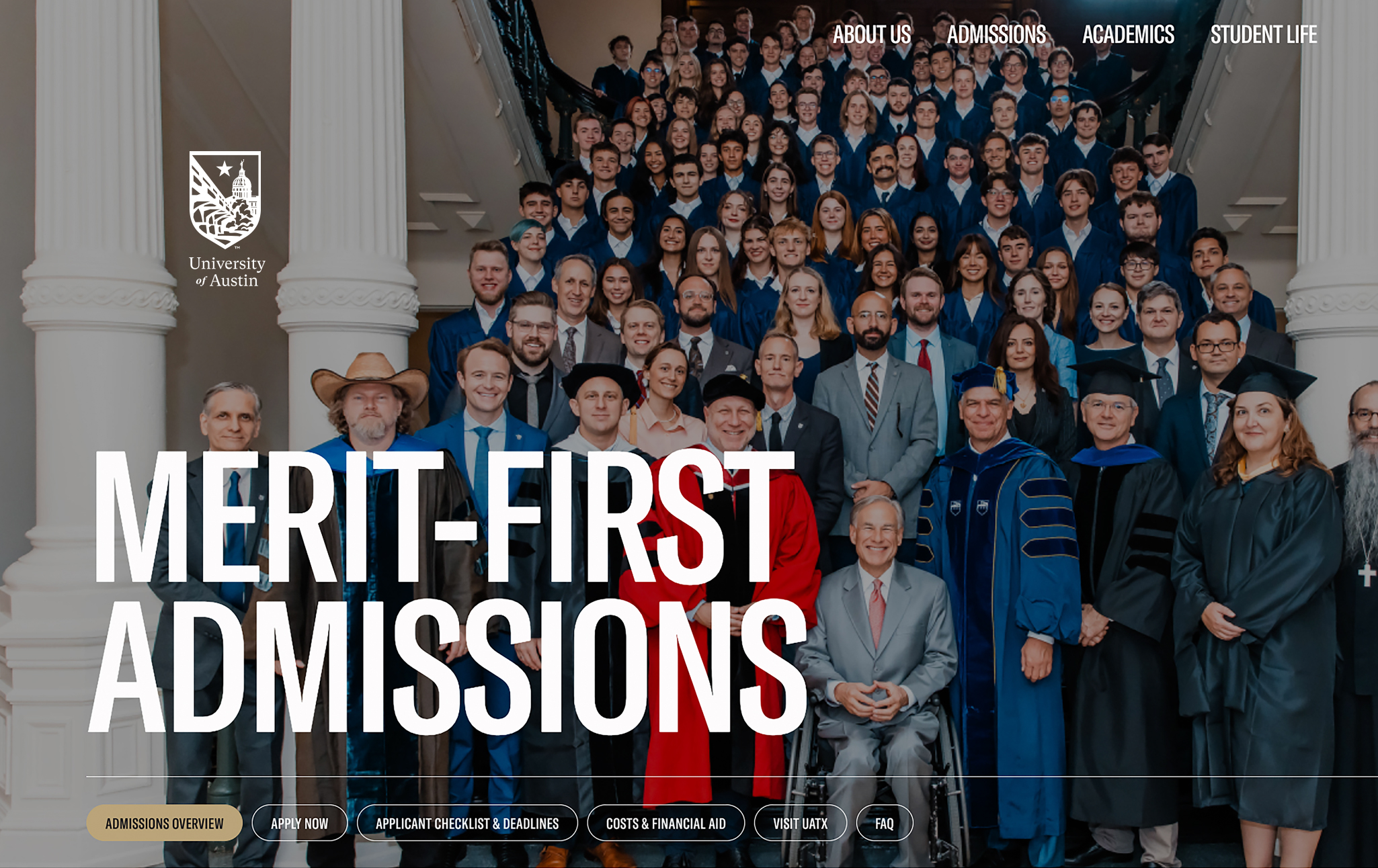
At the University of Austin, an anti-woke application claims to restore fairness—while promoting the opposite.
During the 2022-2023 admissions cycle, Stanley Zhong applied to college. His application was impressive. He had a 4.42 weighted GPA. He’d launched his own software startup. And, to boot, he scored 1590 on the SAT, a score well above the 99th percentile. Yet, to his—and later the country’s—surprise, 16 of 18 of his college applications were rejected. Some of those rejections, Zhong admitted, were “certainly expected.” Think Stanford, MIT, and Cornell. But others, from schools like Cal Poly and the University of Illinois, were harder to accept.
Following the rejections, Zhong’s family sued for racial discrimination in several states, arguing that he was unfairly treated as an Asian applicant. Part of his argument, and those of similar students, rests on opposition to race-conscious admissions, which were legal at the time of his applications. (Affirmative action was banned nationwide by the Supreme Court in June 2023.) Interestingly, though, race-conscious admissions had already been eliminated at many schools that Zhong was rejected by; his home state of California has banned the practice since 1996. He thought racial discrimination was still happening and sued anyway.
Zhong, however, would have gotten into the University of Austin. To them, he more than deserved it.
We can say this with certainty because the University of Austin (UATX)—not to be confused with the University of Texas at Austin—operates on what its faculty call a merit-first admissions policy. Their application, which they assert takes only five minutes to complete, consists of just a few basic elements, and students can rest assured that they will gain admission due to its clear thresholds. If students score at least 1460 on the SAT, 33 on the ACT, or 105 on the CLT, they are automatically admitted, provided they can pass an eligibility and integrity check. That integrity check consists of one letter of recommendation and disclosure of any disciplinary or criminal history. If students score below that magic threshold, a combination of their scores, AP/IB results, and one-sentence descriptions of three achievements is used to evaluate their application.

At face value, the merit-first admissions policy sounds appealing. First, it simplifies the college application season for both applicants and those who read them, many of whom agree that the traditional process is cumbersome. Second, it promises a standard of objectivity and consistency that often feels obscured in the conventional process. In other words, the randomness is eliminated, and cases like Zhong’s don’t happen anymore. There’s some comfort in that. And, most of all, the result is that only the best and the brightest get admitted, right?
But putting merit first isn’t that simple.
To understand the limits of the merit-first admissions policy, one needs a sense of the context within which it exists. Briefly put, UATX was founded in 2021 by academics Niall Ferguson and Pano Kanelos, venture capitalist Joe Lonsdale, and Bari Weiss, founder of The Free Press, who was recently and controversially named editor-in-chief of CBS News. Their vision was of an anti-woke university that values “the fearless pursuit of truth” over censorship, identity politics, and indoctrination.
As it stands, the University is unaccredited and offers only one degree, a Bachelor of Arts in Liberal Studies. Students can explore just four areas of study: computing and data science; economics, politics, and history; ethics and politics; or literature and creative writing. In total, students are taught by a faculty of under 40 members.
The people behind UATX have faced scrutiny for some time, some of which has come from Steven Pinker, a former member of the board of advisors at the University. Pinker, a renowned academic, left the board just one week after UATX’s founding was announced. At first his reasons for stepping down were ambiguous, but he later expressed concern to The Harvard Crimson that “UATX’s ‘entire faculty and board of advisors were people who had been canceled.’” Some of those coalition members include Kathleen Stock, who resigned from Sussex University after transphobia accusations; Peter Boghossian, who left Portland State University, which he dubbed a “Social Justice factory,” after several controversies; and Dorian Abbot, who was disinvited to lecture at the Massachusetts Institute of Technology after expressing contempt for DEI policies.
Pinker also expressed that UATX’s political pendulum had swung too far to the right for comfort. As he explained, UATX “was kind of stacked with right-wingers,” some of whom not only failed to advocate for free speech, but actually opposed it. This red shift underscores an unfortunate contradiction between the University’s supposed nonpartisan ethos and what it’s actually turned out to be.
It doesn’t take much digging to see what Pinker means. As Bari Weiss puts it, a goal of UATX is “to preserve the precious virtues that have made this country the last best hope on Earth.” According to the school’s website, students are not just to “understand,” but also to “appreciate the unique vibrancy of the American form of government and way of life,” an obvious intellectual suggestion. For a school that claims to “teach students how—and not what—to think,” they sure do have one message down: America rules, and its students should be prepared to keep it that way.
UATX has made this imperative clear. As Jake Howland, then-provost and dean of the Intellectual Foundations program at UATX, remarked in 2023, UATX hopes to shape students “who make every effort to renew and increase their culture,” and “who, if need be, can refound their civilization,” a future that UATX’s coalition probably thinks is already on its way. These descriptions of their mission sound more like that of a nationalist boot camp than a university.
Within their steadfast patriotism lies their twisted justification for merit-first admissions. The school’s 2025-2026 academic catalog opens with a message from UATX president and provost Carlos Carvalho, who states that the University believes “in the American experiment: that free people can govern themselves, that merit matters more than ancestry,” as though ancestry not mattering has ever been a hallmark of the American experiment. The statement is also a dog whistle suggesting that at other schools, non-white students don’t have the merits sufficient to attend.
UATX’s admissions policy is grounded in a more general political illusion called the myth of meritocracy. In a meritocracy, it is so-called merit rather than people’s positionalities (e.g., race, gender, class, ability, etc.) or histories (e.g., slavery, colonization, intergenerational trauma, etc.) that predicts their success or lack thereof. But we don’t live in a meritocracy, and it is for this reason that some scholars refer to meritocracy as a myth. The truth is that no matter how much merit—hard work, diligence, talent—some people display, reaching success is just harder, and sometimes it is near impossible to surmount structural barriers in the way.

As Jeff Fuhrer explains in his 2023 book, The Myth That Made Us, the idea of meritocracy is leveraged to ignore systemic discrimination, often giving undue credit to those already at the top, while pacifying less fortunate folks into believing that in a purportedly post-racist nation, hard work pays off. Treating the myth of meritocracy as a reality gets you policies like UATX’s merit-first admissions. But critical examination reveals that the case for fairness and equality, as UATX puts it, is really a case for simply ignoring unfairness and inequality.
Ironically, overlooking the unfairness that pervades society can actually do more to obscure merit than to identify it. For example, a low-income student at an underfunded public school with an incarcerated parent scoring 1450 on the SAT might be more impressive than a wealthy private schooler scoring 1500. Timing how quickly students reach the 1460 finish line in a race where they start at drastically different locations doesn’t help us identify the fastest runners.
But the matter of ignoring inequality or even actively reinforcing it doesn’t seem to matter much to UATX. Take it from this exchange between Carlos Carvalho, then-professor of statistics and business at the University of Texas at Austin, and a Stanford student at a 2023 UATX panel.
Student: [...] If there are factors that would obfuscate a person’s true intelligence, a person’s true excellence, do you think that we should, let’s say, try to get rid of those factors as much as possible in a person’s application?
He later specified his question, continuing:
Student: If one of those factors is the amount of money that your family has… we should discriminate against that, at least a little bit, right? [...]
Carvalho: [...] If income predicts that you’re going to be even better, so be it. Richer people are going to get into Harvard. I have absolutely no problem with that.
Student: And what type of society would that be? Let’s say, if it’s extremely polarized?
Carvalho: It’s a society that’s going to advance further. Because knowledge is going to be better served in that way.
Carvalho’s statement here is deeply concerning. It’s an admission not only that equality is not one of UATX’s values, but also that it supposedly gets in the way of UATX upholding its value of knowledge production. Reading this, I can’t help but wonder whose knowledge is “better served” when the people representing higher education institutions “have absolutely no problem with” reinforcing stratification. The image of a future for higher education when no one takes issue with its class reproduction is worrying—and it’s just one part of a larger political story about increased ideological control over educational institutions exercised by the ultrawealthy and the right.
As a recent article in The New York Times pointed out, we’re seeing an acceleration in the control that billionaires are exercising over American colleges and universities. Much of that control has been enabled by President Trump, who has platformed voices that seek to “expunge progressive orthodoxy from academia and tilt campuses rightward,” all behind the seemingly innocuous veil of “encouraging open debate.” This brand of manipulation is what we see at UATX, which has no problem with ideology so long as it aligns with their vision of classrooms filled with merit.
Interestingly, though, UATX doesn’t even seem to fully agree that the SAT is a predictor of merit in terms of hard work. There’s an even scarier axiom operating here: that the test is really a fixed measure of someone’s IQ.
As professor of geophysics at the University of Chicago, Dorian Abbot stated in the same panel, “SAT training,” which requires hard work, “doesn’t actually change the SAT [score] very much because it’s highly correlated with IQ, and so… there’s not a huge effect.” Abbot continued by mocking families who support SAT optional policies, and Carvalho then added that “there’s nothing you can do at 17 to close that gap.”
At best, this is a crude oversimplification of what determines an SAT score; at worst, it borders on treating that score as a measure of inherent or inherited traits, which would be a dangerously slippery slope for college admissions. It’s also simply not true. Largely, students who score high on the SAT weren’t just born more intelligent. They have access to more money, attend better schools, and receive more support. A study by Harvard-based researchers and policy analysts, for example, “found that children of the wealthiest 1 percent of Americans were 13 times likelier than the children of low-income families to score 1300 or higher on SAT/ACT tests.” So, no, merit-first admissions aren’t getting you the best and the brightest. They’re getting you the most privileged.
While UATX’s coalition would have you believe that SAT and IQ tests are objective measures of intelligence, critical academics disagree, highlighting the racist history of standardized tests. As author and professor of history at Howard University, Ibram X. Kendi explained in 2020, “to tell the truth about standardized tests is to tell the story of the eugenicists who created and popularized these tests in the United States more than a century ago.” That story tells us that standardized tests were developed and popularized for the express purpose of justifying hierarchy by proving racist, sexist, and ableist hypotheses about the intellectual inferiority of already marginalized people. The creator of the SAT, Carl Brigham, was a eugenicist, and IQ tests played a key role in stratifying people during the eugenics movement.
For this reason, there’s due concern about the implications of statements that UATX’s merit-first admissions policy selects for “high quality students” with “raw talent.” Standardized tests have never been a fair measure of people’s quality, and, for some, descriptions of them as such evoke images of 19th and 20th-century ‘good stock’ eugenics when similarly biased or innocuous measures were used to hierarchize people. Just as eugenics was once used to make all the –isms seem quantifiably sensible, merit-first admissions, its justifications, and its position against affirmative action and DEI can quickly lend it over to eugenic thinking. If we’re using standardized tests to say that good knowledge comes only when we select for high IQ, high scorers, we’re in trouble.
The issues of race, fairness, and merit in college admissions are ongoing, and researchers have begun to investigate the impacts of the ending of affirmative action in 2023. For Asian students, results varied in the first admission cycle following the Supreme Court decision: while Asian American enrollment increased significantly at schools like Brown and Columbia, it actually decreased at Yale, Princeton, and Dartmouth. Harvard remained exactly the same, with 37 percent of freshmen identifying as Asian in both 2023 and 2024. (To be sure, these results are complicated by the fact that many more students chose not to disclose their race on college applications in 2024.)
Other researchers have identified alternative factors at play. UCLA School of Law professor Jerry Kang argues that Asian American applicants are disadvantaged, but not because other students of color are favored. Instead, Kang says, it’s because white students are still given preferential treatment in admissions.
“This happens principally because of implicit biases that read Asian Americans as less charismatic or less likely to be leaders,” he said, adding that structural preferences also benefit white students. “Asians are disproportionately less likely to be legacies, since most of our immigration was permitted only after 1965; less likely to be athletes in elite country club sports like tennis, lacrosse, or crew, which are disproportionately white; and less likely to live in rural or smaller communities.” The landmark Supreme Court case did not address these issues.
Regardless of the reason that students like Stanley Zhong are rejected from top colleges and universities, it’s hard to imagine that a system like the University of Austin’s is the best solution. So, to those who care about the dangerous developments in higher education, keep an eye on UATX. Their merit-first admissions talk is a lie. Their ideological neutrality is a lie. And if we’re genuinely concerned about the groupthink happening at some of America’s oldest colleges and universities, the solution isn’t to build new schools to do groupthink all over again.