Banned in 1971 and returned to theaters in a new 4K restoration, Ken Russell’s tale of sex, blasphemy, and corruption in high places feels like it was made for the politics of 2026.
One of the most powerful movies in theaters right now is not an A-list action flick, not a big-budget superhero sequel, but a surreal, perverted, 55-year-old historical horror/drama about a priest persecuted for being too sexy, Ken Russell’s The Devils (1971).
Warner Bros. Clockwork, which carried out the film’s restoration, only planned to run it in theaters for a week in October. But after The Devils grossed an average of $4,925 per screen on its opening weekend, outperforming Digger and Primetime in far fewer theaters, the company opted to keep showing it as long as it kept selling tickets.
The attraction of The Devils is more than curiosity, certainly more than 1970s nostalgia. The film feels just as fresh, just as shocking, and (perhaps unfortunately) just as politically relevant today as it did when it came out.
“This Film is Based Upon Historical Fact”
Period pieces are often about the present just as much as they are about the past. Arthur Miller’s The Crucible retold the Salem witch trials as a metaphor for Senator Joseph McCarthy’s anti-communist frenzy during the Red Scare of the 1950s. Christopher Nolan’s recent adaptation of The Odyssey is largely about the USA’s sins in the so-called War on Terror; its source material and the themes within could be considered a period drama as well, given that Homer (if he ever existed) lived many centuries after the Trojan War.
The Devils is based on John Whiting’s 1961 play of the same name, itself based on Aldous Huxley’s 1952 book The Devils of Loudun. These works, collectively, tell of a real-life incident in 17th century Loudun, France, in which a priest named Urbain Grandier was executed for supposedly inflicting a series of demonic possessions upon the nuns of a local convent. These witchcraft allegations were politically motivated: Grandier was standing in the way of the powerful Cardinal Richelieu’s plan to increase the central government’s control over Loudun by demolishing the town’s defensive walls.
Russell’s screen adaptation proudly leans into aesthetic anachronism to reinforce the timelessness of the story’s themes of religious corruption and tyranny. Production designer Derek Jarman built the walls of Loudun in a retro-futuristic style reminiscent of THX-1138 or George Orwell’s descriptions of the Ministry of Truth, sleek and sterile and gleaming, in stark contrast to the dark interiors of the cathedral and the grotesque opulence of Louis XIII’s court. “I don’t believe in filming ancient cities as a load of mossy old rocks,” Russell told Sight and Sound. “To the people living in Loudun at that time, it was not ancient, it was a modern city.”
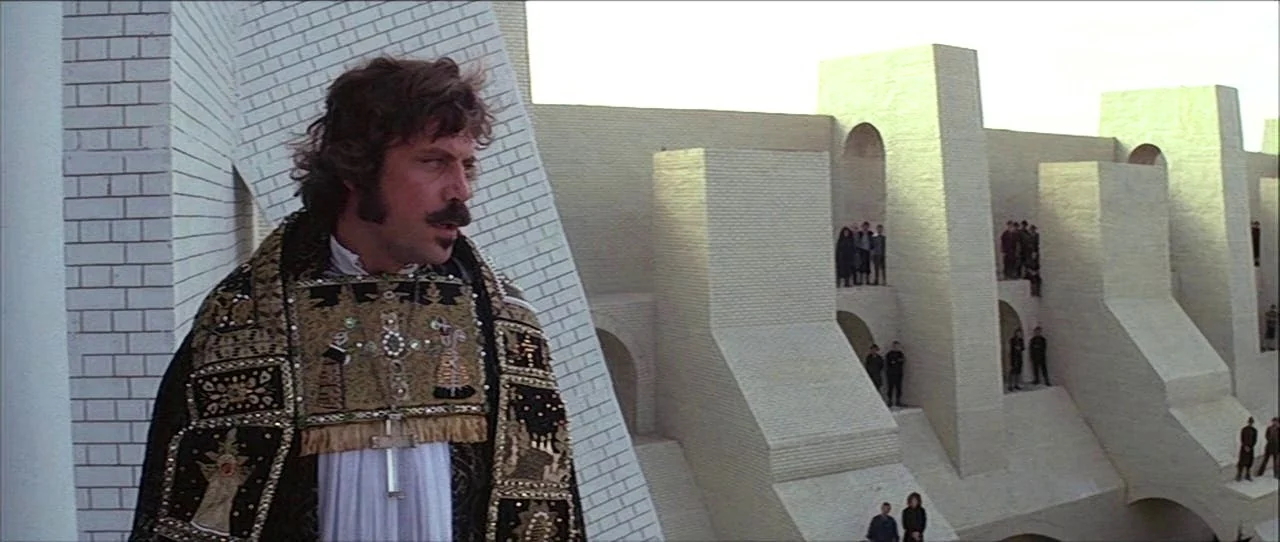
Oliver Reed as Father Urbain Grandier, surveying the walls of Loudun.
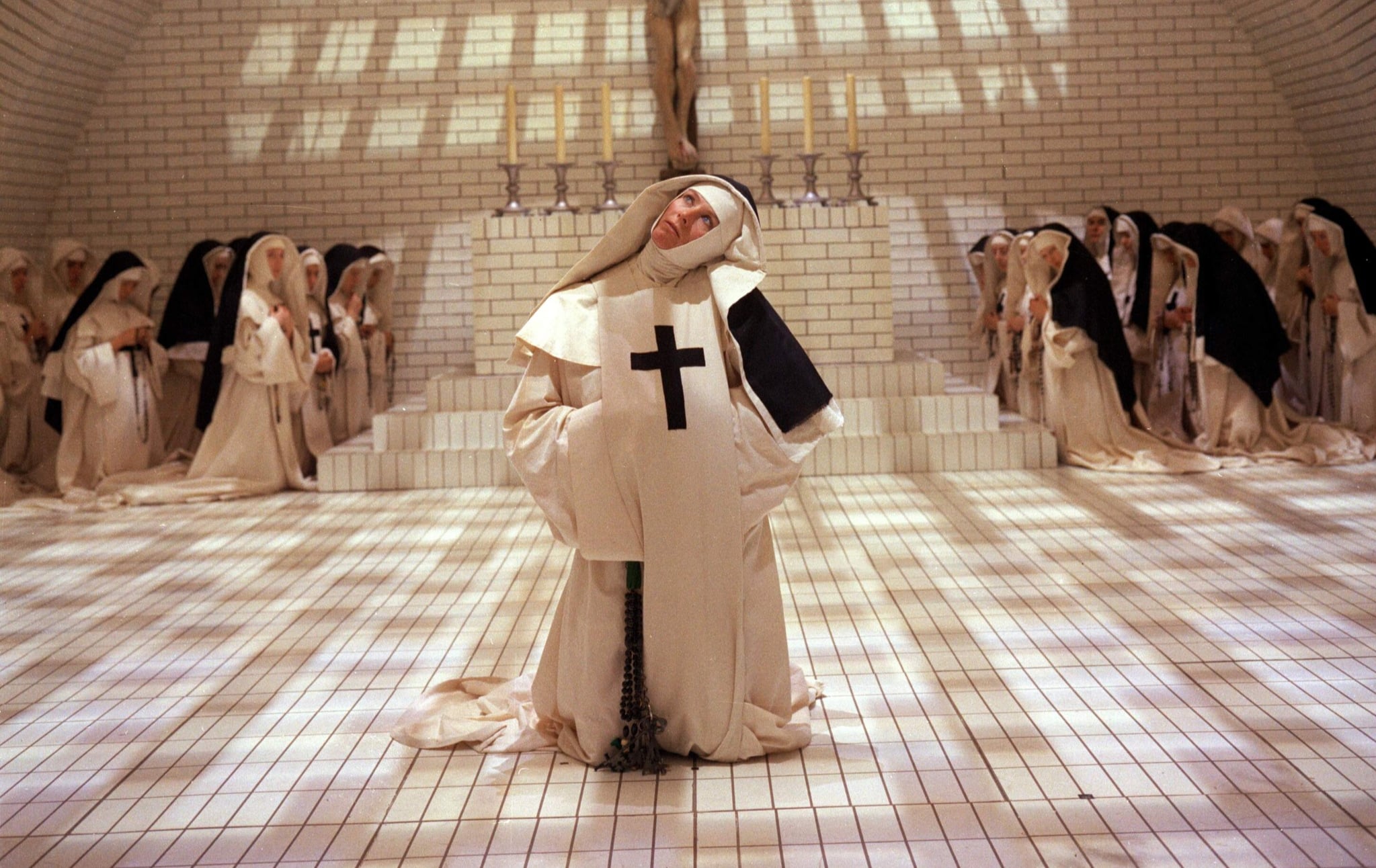
The convent, a claustrophobic prison whose low ceilings force its hunchbacked Mother Superior Sister Jeanne to creep and crawl on her knees, is decorated in white tile, echoing the kind of psychiatric wards where disobedient women were electro-shocked and lobotomized in the 1950s. Jarman said he based his design on a sentence from Huxley’s book comparing the exorcism of Sister Jeanne to a rape in a public lavatory. “The image of the public lavatory, the impersonality of it all, stayed in my mind. That’s why I went for white tiles for the convent.”
Witchfinder Father Barre, with his John Lennon glasses and long hair and silver lamé gloves, looks like he could have opened for The Who. The character’s ’60s rocker costume design brings to mind Charles Manson, who turned his failed dreams of music stardom into a cult where he manipulated young women into carrying out horrific violence. Viewers of the day might have recognized Barre as a “Jesus freak”—a member of the late ’60s/early ’70s Protestant revival that combined old-timey fire and brimstone with a heavy dose of hippie weirdness. Soon after the release of The Devils, the Jesus freaks gave birth to Christian rock, the Twelve Tribes cult, and the kind of televangelist megachurch pastors who whipped up the Satanic Panic of the 1980s. During that decade dozens of unlucky daycare workers and preschool teachers were falsely accused (and occasionally convicted) of raping, killing, and eating children in demonic rituals. Barre would have been proud.
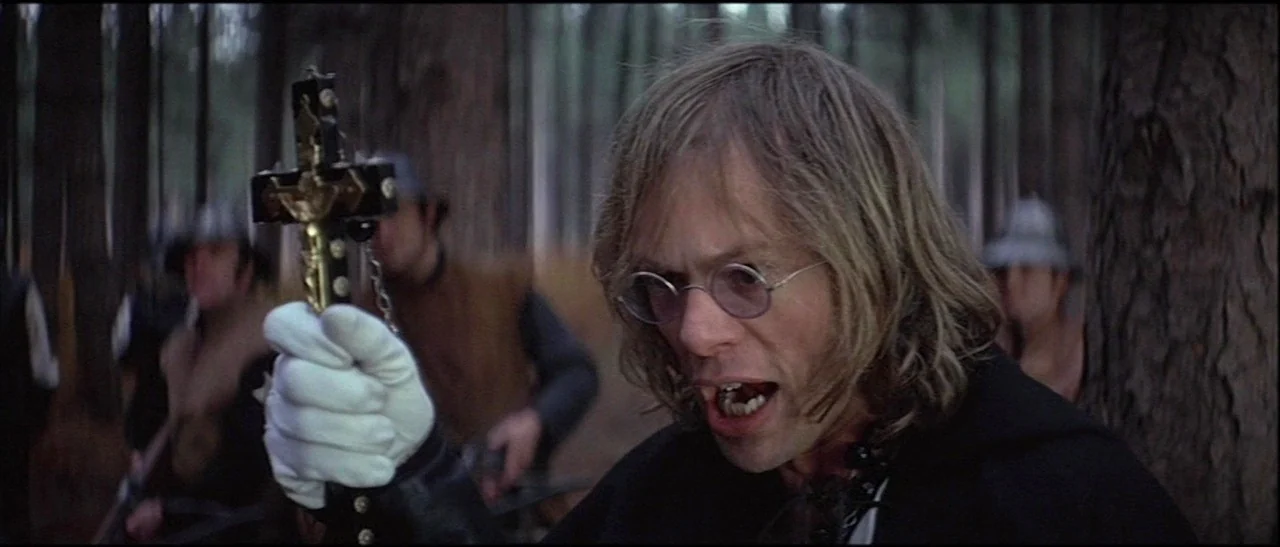
Michael Gothard as Father Barre, inflicting torment
“The Greatest Sinner Ever to Walk God’s Earth”
That The Devils has found its way back to theaters restored and uncut represents a triumph of transgressive art over censorship. Calling the movie controversial would be an understatement. To get the film released at all, Russell had to cut a lot of plot-relevant, thematically-vital material, including a sequence in which a group of debauched nuns perform sexual acts on a statue of Jesus while a nerdy priest gawks in horror and masturbates, and another scene in which the traumatized Mother Superior pleasures herself with the scorched bone of her executed crush. These cuts didn’t save the film from being branded with an X rating in the U.S. and the U.K. before it could hit theaters in 1971. (The NC-17 rating, meant to distinguish serious films with artistic merit and sexual content from mere pornography, did not exist yet.)
Upon release, The Devils sparked outrage from cultural gatekeepers and moral authorities. The Vatican demanded that the Venice Film Festival’s director resign for daring to show it, even in its truncated form. Critic Alexander Walker of the Evening Standard called the film “monstrously indecent.” Russell replied by whacking him with a rolled-up copy of his own newspaper. “I wish it had been an iron bar,” Russell later told The Guardian.
For decades, it was impossible to find the director’s cut with the so-called “Rape of Christ” sequence. Streaming services only carried the censored theatrical cut. Those of us who wanted to witness Ken Russell’s complete vision had to make do with pirated copies cobbled together by amateur restorers, patching in lost footage of the bone scene from low-quality VHS rips and scratchy 35mm scans. The film became a holy grail for a certain type of sicko cinephile, including Guillermo del Toro (who spent years campaigning to get the film restored in 4K), and U.K. critic Mark Kermode (who had to fight Warner Bros. to rescue the “Rape of Christ” from the company’s vaults).
Russell, alas, did not live long enough to see his greatest work heroically return to theaters. When he died in 2011, The Devils was still in limbo, with Warner Bros. treating it like a dirty little secret.
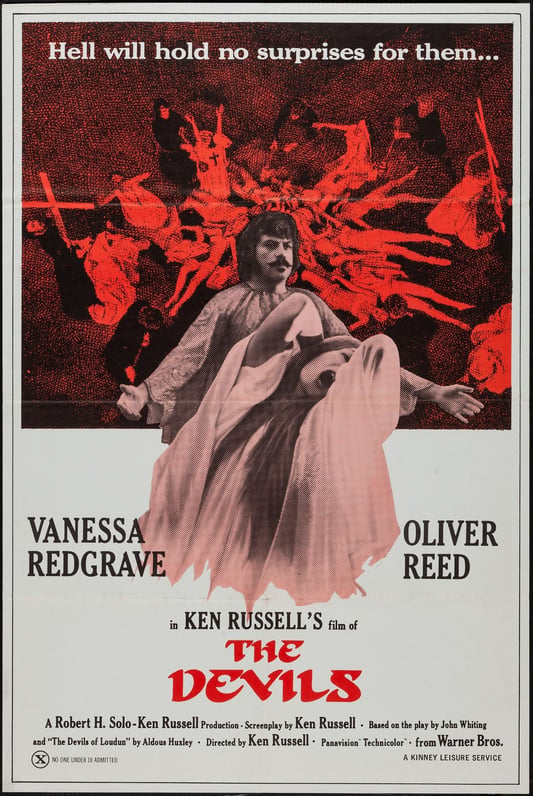
The film’s 1971 theatrical poster. note the “X” in the bottom-left corner.
“What Fresh Lunacy is This?”
Old movies can be tough to watch. Sometimes, the contemporary viewer has to work to get past the dated aesthetics, the outmoded social values, the corny dialogue, the hammy acting, the primitive special effects, or the Hays Code morality of a classic film to appreciate the beauty of it.
But The Devils’ visual and thematic boldness saves it from feeling like a Nixon-era relic. If anything, it feels far ahead of us, and we, in our era of entertainment monopolies and AI-generated slop, are waddling after it. Imagine, a film that respects its audience’s intelligence enough not to spell out every plot point or moral lesson! Imagine, a production that lets artists build actual sets and populate them with actual actors directed to act, rather than digitally assembling a handful of pre-recorded elements all shot with the same flat lighting in a green void.
Every frame is a feast for the eyes, stuffed with life and madness and beauty. Early in the first act, there’s a scene in which a promiscuous priest hurls a fraudulent physician’s medicinal crocodile at a nobleman who is trying to stab him for impregnating his daughter, all surrounded by piles of burning plague corpses. Somehow, this is not the craziest thing that happens in The Devils. (At this moment, RFK Jr. is probably trying to bully a hapless CDC official into recommending that Americans seek crocodile-based treatment for COVID-19, if he hasn’t already.)
The film’s themes of brainwashing, false idols, and authoritarianism resonate in 2026 just as strongly as they did in 1971. This is by design. In an interview with Inverse at the restoration’s Cannes debut, Kermode recalled something Russell had told him regarding the message of The Devils: “I’m not a political filmmaker, because if you make a film [about] the politics of the time, those politics will change in five years. But if you take a historical story, something that’s established fact, you can tell a story that has parallels with the modern world. And as the modern world changes, the parallels will change, but the story itself stays the same.”
Indeed, the parallels have changed. Throughout The Devils, the citizens of Loudun watch the spectacle of Barre’s tortuous exorcisms and Grandier’s sham trial, and even the invasion of their city, with excitement, as though it’s nothing but entertainment. They are a passive audience to their own destruction, shallow and stupid enough to abandon their staunchest advocate the minute his jailers give him an unflattering makeunder by chopping off his mustache and hair. In the 1970s, the spectators’ black masks may have symbolized the faceless blackness of a television screen, the device which Neil Postman denounced as the mind-killer undermining Western Democracy in his 1985 book Amusing Ourselves to Death. But since then, the television has lost ground in favor of the even more brain-melting medium of the internet. Watching The Devils in 2026, it’s hard not to connect the masked crowds to social media anonymity, where we doomscroll through atrocity after atrocity and respond by posting memes captioned “lol” or “lmao.”
In some ways, the film hits even harder. The long-running plot thread about the government, hand-in-hand with power-hungry religious fundamentalists, violently dismantling a sanctuary city’s autonomy in order to hunt a vilified minority in its streets (Protestants in 17th century Loudun, immigrants in present-day Minneapolis) is so grimly relevant it might have been called a little too on-the-nose if The Devils had been made this year.

“Destroy Me, I Love You.”
The thing that got The Devils into trouble with the censors the most, though, was not the politics, not the criticism of the Catholic Church, not the prolonged sequences of torture and execution by fire, but the sex. There is a lot of sex in this movie, and though it is transgressive, it is not gratuitous. Sex is essential to the story, at its most unhinged and blasphemous.
Today’s cinephile has been desensitized to depictions of sex by a steady diet of internet pornography from early adolescence, so the giddy nun orgies and mock-marriage ritual in the convent (with a lesbian groom in Father Grandier-style drag) are unlikely to shock us as much as they might have shocked our grandparents.
What shocks the contemporary viewer is not what is being shown but how. Much has been written about the dehumanizing trend in mainstream American film as body standards become impossibly strict while eroticism evaporates. Today, everyone is beautiful, and no one is horny. In The Devils, everyone is grimy, and everyone is insanely, murderously horny. Graham Armitage’s Louis XIII, who opens the movie prancing in a bikini, is unforgivably skinny by today’s Hollywood standards. Georgina Hale’s bratty Philippe is a grotesque bimbo in clownish makeup. The film’s central sex symbol, Father Grandier, played grandiloquently by Oliver Reed, is brash and barrel-chested, without a single visible ab. But their messiness, their nastiness, their human-ness, makes their sexuality feel raw and dangerous.
Russell released The Devils on the tail end of the Sexual Revolution, during the era of free love. Scenes of the debauched nuns swarming around Father Barre might have drawn from the bizarre spectacle of Beatlemania a few years before, as celebrity-worshiping, lust-mad girls screamed and tore their hair out and mobbed their favorite pop stars who had, infamously, bragged about being “more popular than Jesus.” Like many of us, Russell seemed to find himself lost somewhere between these hysterical orgies and the soul-crushing repression of human sexuality demanded by the church.
But ours is a more sexless era. Here, Vanessa Redgrave’s Sister Jeanne emerges as the patron saint of incels. Lonely, frustrated, touch-starved, branded terminally unfuckable due to her deformity and forced into a windowless anti-sex jail, Jeanne makes a false idol of Grandier with her desire, going so far as to give herself stigmata by gouging her own hand with a crucifix while fantasizing about the handsome priest. “Most of the nuns here are noble women who have embraced the monastic life because there was not enough money at home to provide them with dowries, or they were unmarriageable because they were ugly or a burden to the family,” she says through the bars to a young woman who inquires about joining the convent. If she hadn’t been locked up for having a disability, Sister Jeanne might have poured her passions into a man who matched her intensity. She might have been happy.
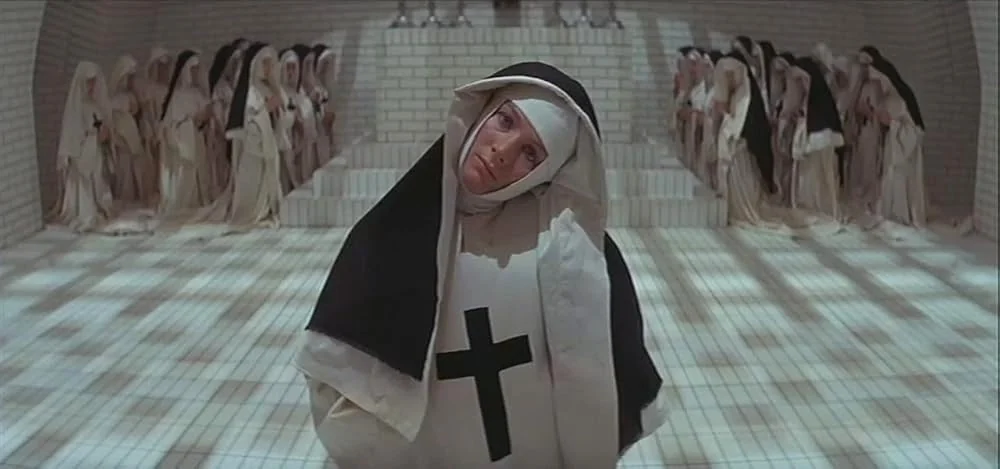
Vanessa Redgrave as Sister Jeanne, the “patron saint of incels”
The nun orgies in The Devils are not genuine acts of sexual liberation. It is Father Barre who takes the girls to the forest, threatens them with crossbows, and orders them to go wild. So even their apparent rebellion is still under the control of the same patriarchal authority that forced them to let their hymens grow cobwebs in the first place, and the whole thing is only permitted for the purpose of crushing a political dissident.
Notably, Grandier does not take part in this ecumenical debauchery. In an extended sequence, Russell contrasts the perverted circus in the church against Grandier’s moral, spiritual activities: petitioning for Loudun’s self-governance, breaking bread in communion beside a creek, and marrying his beloved Madeleine in a quiet private ceremony. This is the relationship that gets him punished: not knocking up his Latin student, but seeking the sublime through the love of a woman.
The present-day incel’s predicament is rather more self-inflicted than that of Sister Jeanne. No one is forcing you, under threat of crossbow bolt, to post on Reddit instead of going to the club. But the right-wing billionaires who chip away at society to make us all broker, more anxious, more isolated, and therefore less likely to get laid, are the same ones that drown lonely young men in propaganda designed to weaponize their sexual frustrations toward hateful reactionary politics. And so they sit at home, soaking up algorithmic-delivered content in which a thousand Father Barres bleat into podcast microphones about hypergamy and cultural Marxism and other demons, jeering for blood behind a black mask while the tyrant’s goons tear the city apart, as they did in Loudun, as they did in Salem, as they did in Minneapolis last winter. History does not repeat itself, but it rhymes.
“That’s why I wanted to make it,” Russell said in a conversation with Redgrave in 2010. “I thought it was a tale that needed telling every few years, because nothing changes.”
RS Benedict has a Master’s in linguistics. Their work has appeared in Current Affairs, Fangoria, Blood Knife, the New Haven Independent, and The Magazine of Fantasy & Science Fiction, among others. They live in Albany for some reason.