Under capitalism, artificial intelligence is helping bosses exploit workers more efficiently.
In a capitalist system, any new technology that can be deployed by bosses to exploit workers will be used to exploit workers. Profit-seeking firms are ruthless in their efforts to wring as much labor as possible out of their workforce, for as little money as they can get away with spending. (The fundamental injustice of this relationship is why I’m a socialist, and you should be too.) Unfortunately, as AI tools become more powerful, they are predictably being used by employers in horrible ways.
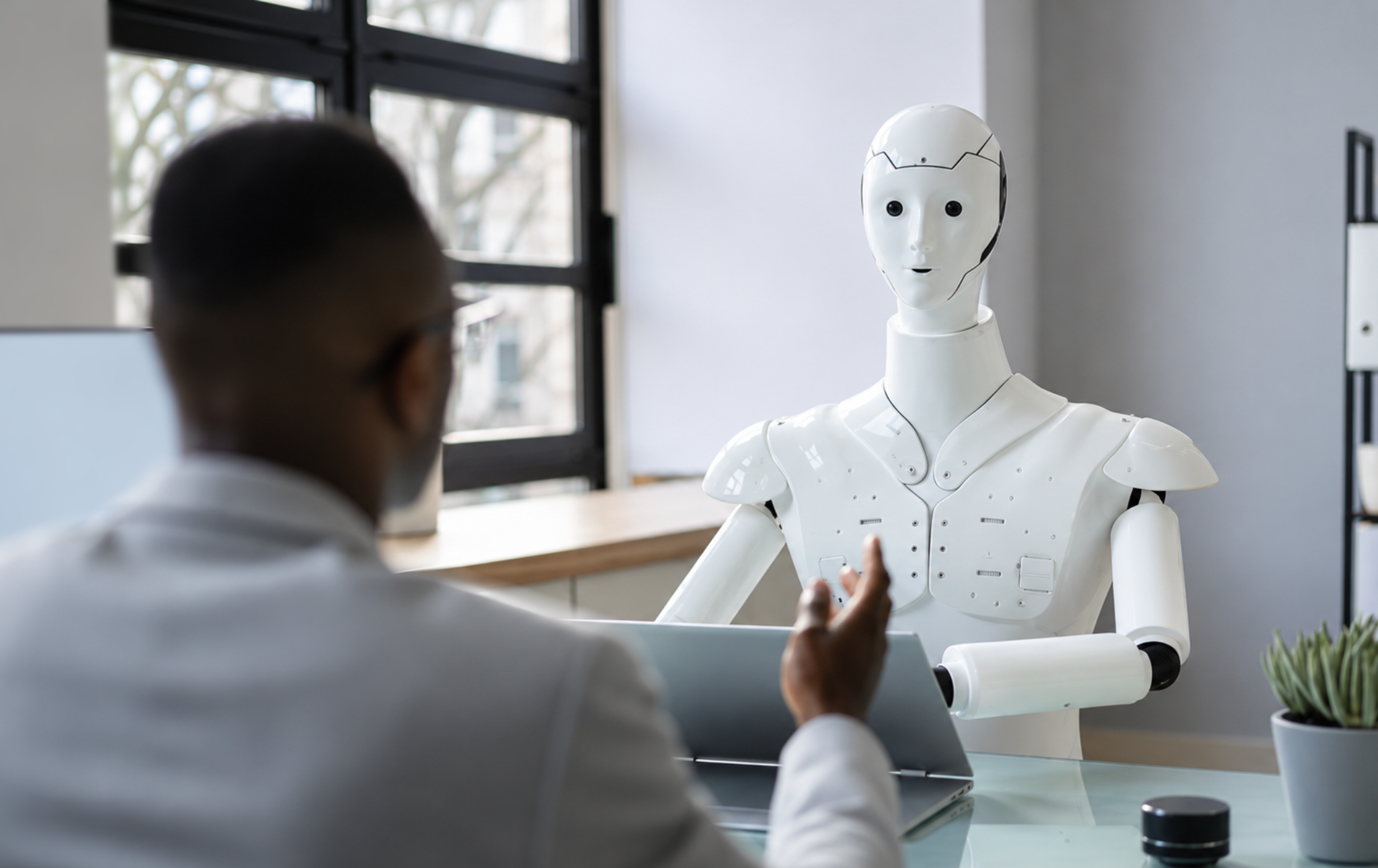
Increasingly, the New York Times reported last year, job applicants are having to interview not with people, but with AI simulations of people, encountering “faceless voices and avatars.” Applicants the Times spoke with described the experience as dehumanizing, even comparing it with something out of a horror movie (as the AI interviewer tried to appear more human by adding fake “ums” and “ahs”). This year, the Times asked members of Gen Z to describe their experiences of job-hunting. The responses were bleak, with phrases like “utterly humiliating,” “sucks,” “like throwing applications into the abyss,” “demoralizing, dehumanizing, and infuriating” being typical. Some applicants felt like they were trapped in some kind of sadistic Kafkaesque experiment, being asked to record video after video, and fill out form after form, and never hearing from a live person.
One of the worst aspects of the system, the Times reports, is that job-seekers “could not get a real, live human being to speak to them. Ever. About anything.” (The outlet quotes the chief executive of a company that develops robot interviewers saying, astonishingly, “it’s really paradoxical, but in a lot of ways, this is a much more humanizing experience because we’re asking questions that are really tailored to you.” So all the people who report that it feels like a profoundly dehumanizing experience must just be wrong!) People report being strung along through interview after interview and never even hearing whether they’ve been rejected or not.

This is all happening, of course, because corporations have no reason to care whether prospective employees have miserable, dehumanizing experiences. Under Milton Friedman’s infamous “Friedman doctrine,” a corporation’s only social responsibility is to maximize value for shareholders, and so if AI interviewers are cheap, it doesn’t matter how the experience is for the interviewee. It would be quite simple to pass a law that prohibits this practice: one that requires interviews to be conducted by human beings, requires decisions on job applications within a certain time, limits the number of successive interviews an employer can do before having to pay the interviewee for their time, et cetera. But when companies are not regulated, this is what you get. And because it’s both cheap and legal, it’s becoming ubiquitous; in the UK, a study found that nearly half of job-seekers had been confronted with an AI interview.
Robot job interviewers are not the only way in which new technology is exacerbating the existing exploitative and dehumanizing aspects of capitalism. “Bossware” is becoming increasingly sophisticated, with constant surveillance now the new norm in many workplaces. Employers can track workers’ keystrokes, read their emails, and listen to their phone calls. Now AI is making these tools more invasive. According to the Financial Times, “Microsoft has filed a patent to record body language and expressions in meetings, while Amazon has filed one to track emotions via voice and Nvidia to infer emotions from audio data.” At a call center in the Philippines, AI assesses every worker’s calls, giving them an automatic demerit if they stutter. “I have to please the AI,” said one worker. They feel like they have become the robots and the AI boss is given the freedom and control that a human should have. AI is certainly finding new horrible ways to satisfy Karl Marx’s description of the alienated hooker who “does not fulfil himself in his work but denies himself, has a feeling of misery rather than well-being, does not develop freely his mental and physical energies but is physically exhausted and mentally debased.” Marx, in his famous description of alienation, observed that workers had to essentially surrender their whole being to the employer, and could not be their true selves at work, because they had to operate as a piece of the machinery of profit rather than a free and independent person.
It’s going to get worse. We can imagine that employers will soon have real-time access to assessments of their workers’ moods, so they can monitor them as if they were characters from The Sims. This will, of course, be used for union-busting. I’m sure there will be a “most likely to unionize” score (even if it is not called that), and potential troublemakers will be terminated as soon as their score dips into the red.
Of course, that’s assuming that workers are still needed. Many across the world are now being forced to train their own robot replacements in humiliating ways. At a textile factory in India, workers were ordered to strap GoPros to themselves and put on smart glasses, so that their movements could be used to generate training data for future robot replacements. The workers know that if this ever happens, they will be destitute (“I only know how to do this job,” said one woman who earns $90 a month), but they simply have no choice. It doesn’t matter if you’ve spent years training for a position. What does the profit-seeking firm care about that? And it’s not just poor workers in the Global South who are being ordered to train their own robot replacements; the same is even happening at Google, where humans were asked to train AI and then laid off as soon as the technology could do their tasks. Of course, the entire AI industry is built on the vast theft of human labor, with systems hoovering up all of human knowledge so it can spit out a facsimile.
Skeptics of AI capacity may reassure themselves that robots could never replace certain kinds of work. But if these jobs are safe, it is only because the technology is difficult to develop; if it were up to the employer, they’d fire the whole workforce tomorrow. Workers are, after all, trouble. They have demands. They want dignity. They need to be paid. They have to take bathroom breaks. That’s part of why so many billions of dollars are being poured into a technology whose purpose is to make as many workers obsolete as possible. The capitalist dream is the wholesale elimination of the workers.
The only possible response to this that will save workers from being totally crushed is the building of a strong labor movement, because only organized laborers can dictate terms to companies. If the textile workers in India had a union with real power, they could refuse to put on the GoPros. The Google workers who trained AI had previously tried to unionize but their efforts were suppressed. A union contract could have guaranteed that they wouldn’t be replaced. (Current Affairs has a union contract that guarantees exactly this, although we are a nonprofit company so we don’t have an economic incentive to push labor costs as close to zero as possible, the way corporations do.)

There are ways of protecting workers from these abuses. China has banned food delivery companies from placing unreasonable burdens on workers using algorithms, the EU has a Platform Work Directive that gives workers the right to challenge algorithmically made decisions, and in the U.S. some unions have won important protections in their fights to protect their jobs from replacement by AI (although importantly, many of the victories have been won in the public sector where the pressure to cut labor costs is less ruthless).
We are, unfortunately, living through a technological revolution. Every day AI can do new things. Unfortunately, many of the things it can do are horrific, like producing lists of Palestinians to exterminate, launching devastating new kinds of cyber attacks, and even potentially creating new kinds of viruses that could lead to a pandemic worse than COVID-19. Leading AI developers warn that they think their products might end the human species altogether, even as they accelerate the technology’s development. We have not yet seen AI fulfill its promise to cure diseases, but we are seeing the worsening of the abuses enabled by bossware. Building the labor movement has never been more urgent, because bosses are salivating at the possibilities that new technologies will provide to surveil, exploit, and ultimately get rid of workers.