
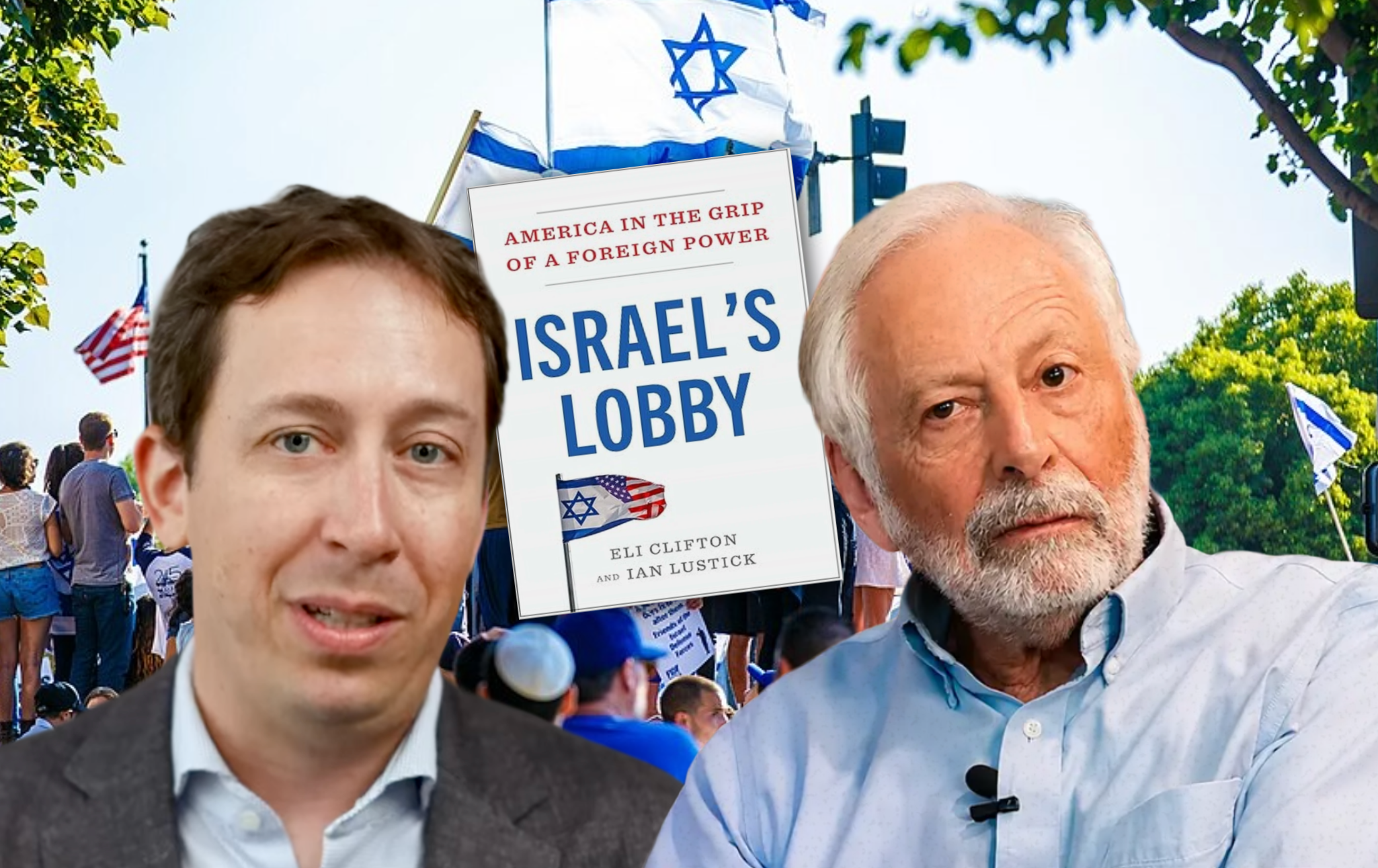
Ian Lustick and Eli Clifton explain how the Israel lobby amassed extraordinary political power—and why its hold over American politics may finally be weakening.
For decades, American support for Israel has been treated by Washington as practically untouchable. Presidents of both parties have supplied Israel with weapons and billions of dollars in aid, even when doing so conflicted with their own stated foreign-policy goals. But as Israel’s genocide in Gaza has transformed American public opinion, an increasingly glaring question has emerged: why has U.S. policy changed so little?
In their new book, Israel’s Lobby: America in the Grip of a Foreign Power, Political scientist Ian Lustick and investigative journalist Eli Clifton argue that answering that question requires confronting the extraordinary power of the Israel lobby. They trace how a network of lobbying organizations and enormously wealthy donors has spent decades making criticism of Israel politically costly—and how, as support for Israel has waned, those efforts have increasingly shifted from persuasion toward massive campaign spending, intimidation, and attempts to suppress dissent.
Lustick and Clifton joined Current Affairs editor-in-chief Nathan J. Robinson to discuss how the lobby acquired its power, the weaponization of accusations of antisemitism, AIPAC’s escalating intervention in American elections, and whether the lobby is finally beginning to lose its grip.
Nathan Robinson
Your book is, in many ways, an update or a sequel to the highly contentious, controversial 2007 book The Israel Lobby by John Mearsheimer and Stephen Walt, who have both praised and supported your work. A lot has happened in the 20 years since the release of that book. But before we go to the present, I'd like to go to the origins.
So, could you tell us a little bit about the origins of Israel's efforts to influence U.S. foreign policy? Where did this all start?
Ian Lustick
Well, as we show in the book, it started even before Israel was created. There was a very strong Zionist lobby in the United States, and much sympathy in the United States for the plight of Jews after World War II, and for the idea of Jews returning to a land that many American Christians felt is the Holy Land. To them it's important for Jews to be there, so there was a kind of Christian Zionism. But that lobby was not for Israel. It was a Zionist lobby, and it was very energetic in its pressures on President Truman to defy the recommendations of his national security and foreign policy advisers, and not to support a trusteeship for a united Palestine, but rather to divide the country into two states—even if it meant war—and Truman himself was caught in that dilemma and ended up going along with what the lobby wanted.
After Israel was created, the Israeli Foreign Ministry set out to to do what most countries do: try to influence American foreign policy in favor of Israel. But that evolved away from a direct Israeli operation to a lobby in the United States that was inspired and often guided by, or reflected the desires of, the changing Israeli governments. So that happened in the '50s and '60s. It didn't become the behemoth lobby that it did become until after the 1967 war.
Eli Clifton
The role of Israel's lobby has really grown alongside the the formation of the state of Israel. But I think the importance of it and its impact on American foreign policy has really only increased, although it's always had a significant role since 1948. But it has increased over time in terms of maintaining and pushing for policies that are increasingly extreme from Israel: covering for them, defending them, providing them cover in diplomatic forums—the UN and elsewhere—and continuing to provide largely unconditional military aid. Even as Israel's behavior becomes further and further afield of anything that resembles actions that would further a two-state solution, which has been the stated goal of successive U.S. presidents.
Nathan Robinson
One of the political science mysteries in discussing this story is: you have a lobby, a group of people who, in various organizations, are spending money to try and influence U.S. politics, who are trying to create negative political consequences for those who go against their favored policy.
But then you have to try to disentangle what is the influence of the organized lobby, and what parts of U.S. support for Israel come from presidents' own ideologies or beliefs that the alliance with Israel is in fact in the United States' self-interest. Are there key points over the course of this history, from 1948 through the the rest of the century—before we get to post-October 7, where I think it's quite clear that the U.S. and Israel's interests diverge—but are there points before where the lobby's impact is obvious? Because you discuss early in this book those who argue very strongly something like "Well, the lobby doesn't have much actual impact."
Even some on the left say this. Chomsky's argument has always been that the U.S.-Israel alliance is strategic, and Israel doesn't need a lobby. But are there points at which you think it becomes quite obvious that the the lobby has caused changes in policy that even by president's own values and metrics would be detrimental to U.S. national self-interest?
Ian Lustick
Absolutely, that's the case, and it's not that difficult to to prove. For one thing, anyone who's worked in the government knows that the standard way that people who interact on this issue through multiple administrations feel, is tremendous resentment that they have to keep to themselves what they actually think about the Israel/Arab situation, because it's politically so punishing to say publicly what they think.
But if we go back, for example, and we do in the book—let's go beyond Truman. Let's talk about President Ford. Republican. He came away from very frustrating negotiations that Kissinger was leading between the Egyptians and the Israelis, in which the Israelis were refusing to compromise on anything to move forward towards some kind of peace agreement based on withdrawal from territories they captured. Ford was so upset about this, and Ford had been a very big supporter of Israel, a darling of the Israel lobby, when he was in in the House of Representatives.
He said he wrote an angry letter to Yitzhak Rabin, saying we are going to reassess our policy in the Middle East completely—reassess it, especially our policy toward Israel, because you're being so intransigent. Kissinger convened a committee of what he called the wise men: people like Averell Harriman, like George Ball, John McCloy, Robert McNamara, Douglas Dillon—the wisest or most established statesmen in American politics still alive; they unanimously recommended that the United States join with the Soviet Union and impose a solution according to the Geneva Conference terms and with a solution to the Palestinian problem.
That unanimous decision was endorsed by Kissinger and by Ford. But as soon as it became known, the lobby organized 76 senators who signed a letter opposing the initiative. Ford, in his memoirs and in a letter to Sadat, said, "I had there decided I couldn't get reelected. I had to stop that effort. But I promised Sadat that after I was reelected, I would go back to a comprehensive peace and abandon this this step-by-step approach, which I'm being forced to adopt."
That's just one example. There are many in the book in which the national security advisers and and the foreign policy advisers and even the president's own impulses had to be discarded because of the threat of domestic damage to the president's agenda or to his re-election.
Eli Clifton
I think to even make it sort of distill this even further, because this is a frequent question that comes up: is well, don't these presidents have agency? Don't they ultimately make these decisions? You know, for their own reasons, including that perhaps they actually believe these things. And I think a key theme here is that the lobby has worked to set up incentives as well as potential punishments for politicians and presidents, were they to diverge in their policy from what Israel, its lobby, would like to see occur, so they raise the costs of dissenting from from the status quo policies that are in line with Israel.
Now, whether a president chooses to accept those costs or not is obviously an open question. At times, they have chosen to dissent. Most often, they do not. But the point is, is that those costs would not exist were it not for the presence of the lobby,
Nathan Robinson
Because there have been instances, haven't there, where the United States presidents have gone against what Israel wanted? Certainly, Eisenhower and Suez. The famous phone call from Reagan in 1982, and then Obama, of course, pushed through the Iran deal, even though the Israel lobby was heavily against it.
So, how do you account for these instances? Is it that they just decided to defy those costs?

Ian Lustick
There are a few classic instances that are always cited by the lobby to prove they're not omnipotent, which is weird for a lobby to have to prove. Well, we're not omnipotent, look at the sale of the aircraft carriers of aircraft to Saudi Arabia during the Reagan administration, or some of the cases you're citing. But all of those were pyrrhic victories. The lobby lost a tactical encounter, but then punished severely those presidents for doing so. George Bush the first, who withheld loan guarantees, successfully did it. But did not get reelected either, in part because the lobby shifted its support very strongly to Clinton, and attacked Baker and Bush mercilessly.
So yes, it's not omnipotent, but actually, presidents have learned that when their domestic political advisers tell them, look, we understand what you're trying to do. It probably won't be successful. It might be successful, but you will certainly pay a severe political cost in Congress with your agenda. Obama gave up the idea of getting a peace agreement between Israel and the Palestinians, which he had fronted. He had made it a key element of his first term, abandoned it in order to try to get the JCPOA, and in the face of opposition from the Israel lobby, what happened? He got the JCPOA, but at a great cost, and that was ultimately, of course, overturned very much because of the pressure of the lobby.
Eli Clifton
And again, these examples are so often cited, but they are the exception rather than the rule. And to use that last example of Obama with the JCPOA, it's very easy to draw the conclude. One could draw the conclusion from that that indeed it was in many respects probably a wasted effort. One could argue, since ultimately the lobby did get its way. They did destroy the Iran nuclear deal. They just had to wait until there was another president in place.
Nathan Robinson
Could you talk a bit about how these political costs are imposed? You discuss in the book a lot the mechanisms by which those politicians who do choose to defy what Israel are punished. Are there key examples that you point to of when politicians have kind of tested this and seen what happens when you cross a certain line?
Ian Lustick
Yes. Well, there's the famous Percy effect. Senator Charles Percy, who was at one time a moderate Republican from Illinois, who was considered a prime candidate for the presidency, and he broke ranks and actually publicly criticized Israeli policy. The Israel lobby made a decision to make an example of him, showing that they weren't just able to pick on small fry, they could go after the biggest politicians in the country.
And outside money defeated Percy in Illinois, replacing him with a senator basically picked by AIPAC. And that Percy effect has lived on for decades. President Carter, probably the least likely politician to be caving in to political pressure for some selfish reason: Look what happened to him. He came into office wanting to get a Palestinian homeland-based comprehensive peace. He sent his Secretary of State, Vance, to Moscow. They signed a communiqué with Gromyko to do that, and he was mobilizing support throughout the American foreign policy and national security apparatus throughout the Middle East, and he was going forward toward that.
And then Moshe Dayan came to the United States, met with Carter, Zbigniew Brzezinski, Carter's national security adviser, and Cyrus Vance, as Secretary of State, in a virtual all-night meeting in New York, in which—by multiple accounts of the people there, Dayan said, "If you go forward with this initiative, I will go to the American Jews. I will rally the lobby and defeat you.
And at that point, even though Carter had resisted the advice of his domestic political adviser Hamilton Jordan that this was going to cost him politically, he reversed course and the next morning announced, "No, we're going for a separate peace between Israel and Egypt." Not at all what Carter wanted. He told Sadat, "After I'm reelected, I'll try again." So that's a great example of a politician least likely to cave who had to cave.
Eli Clifton
And to be very clear, this pattern is continuing to this very day. All we have to look at was news earlier this week in Michigan. Ultimately, the unsuccessful attempt by AIPAC to defeat Abdul El-Sayed in the Michigan Senate primary, and to get Haley Stevens a victory that they failed in doing, so I think they're still going to try to defeat him in the general election by backing Mike Rogers.
And we can look to earlier in this primary cycle with their successful, very successful and very expensive, effort to primary Thomas Massie. So I think we're seeing this is ongoing. The cost of these efforts is going up. But what we saw, for instance, going on in Michigan was that was a $30 million effort, and they're not done yet with trying to defeat a candidate who they think will be harmful to their interests.
Nathan Robinson
I was in Michigan reporting on this for The Nation, and one of the extraordinary things was I saw all the attack ads that were funded by the United Democracy Project, which is this AIPAC-funded super PAC.
And the extraordinary thing was that they didn't mention Israel. They were all suggesting that "Abdul El-Sayed disparages wome "—that was the was the theme—and it didn't say sponsored by AIPAC. It said sponsored by the United Democracy Project. It's interesting how the lobby doesn't necessarily want to have a debate on the merits of the issues about Israel-Palestine, and in that case, is really kind of concealing its hand.
Ian Lustick
As Israel has become less a social democratic, reasonable state seeking peace among its neighbors, to a kind of crazy rogue state, it's become impossible even for the lobby to defend Israeli policies in front of audiences in the United States on any substantive ground. Therefore, what the lobby has done—and we trace it through the manuals, the changing manuals that the Israeli propaganda outfits and the lobby have used to try to train people how to talk: first, they engage substantively. Then you stop. You just try to spin things and appeal to the prejudices of your audience. Then you make accusations of anti-Semitism that arguments are anti-Semitic if they use a double standard and so on to try to delegitimize debate.
Then you move to attacking the actual people who are the critics as anti-Semites until you finally attack the institutions to produce those people, the universities, all in an effort to prevent discussion because arguments about Israel can't be won anymore by those trying to defend its policies. That's a key part of our book.
Eli Clifton
I think particularly what we're seeing now, though, is that it's not even about avoiding wanting to talk about the more contentious issues, like what is is it a two-state solution? Is it a one-state solution? How to talk about the Israeli-Palestinian conflict? Now, what we are avoiding is any mention of Israel itself.
And that's what you saw in those ads that were being run by UDP, and that's a pattern that actually already started a couple of years ago, when they were playing in the primaries. Particularly in in New York in Jamaal Bowman's race, where they were spending tens of millions of dollars on these advertisements that were talking about a host of issues, which they thought—probably accurately—voters in these districts cared about. Mostly domestic issues. But there was one issue that they did not want to talk about, and that was Israel. And I think that's very much a product of the the dramatic shift in public opinion that we've seen since the Gaza war began.
Nathan Robinson
You mentioned the strategic and bad faith use of accusations of anti-Semitism. I mean, obviously, we can all agree that anti-Semitism is a scourge. But, for example, here in New Orleans last year, there was a conference of mayors. It was the like the "mayors' conference against anti-Semitism," and they had mayors from all over the country coming to discuss how they were going to stop anti-Semitism—and one of the things that they were encouraging all the mayors to do was make sure your city has codified the International Holocaust Remembrance Alliance's definition of anti-Semitism, which defines anti-Semitism in a way that includes many pretty legitimate criticisms of Israel.
Could you maybe discuss a little bit, especially this effort, which seems on its surface—I mean, who could oppose the International Holocaust Remembrance Alliance? My God, it seems on its surface to be such a such an innocent thing, but it has a very strategic purpose in advancing Israel's interests.
Ian Lustick
We go into quite a bit of detail into what is really a hoax. It's a hoax perpetrated by Israel propagandists. The main person who was behind it, Kenneth Stern, who actually drafted the original wording, has now renounced, repudiated what he did, because he thinks it was completely hijacked for purposes never intended.
If you look at it as we show, it is not even a definition. It says it may be that X and Y people may be anti-Semitic. It's like saying a triangle may have three sides, but it could also have four or five sides, and it could still be a triangle. Anything can be anti-Semitism if you define it the way they do, and that was the purpose of it because it was developed by people who realized that they could not win arguments about Israel in the public square, so you have to actually prevent them from happening. And when the IHRA was a minor, irrelevant little organization. It was turned to by these propagandists when other European organizations, much bigger and more important, rejected their effort because they thought it was silly and preposterously political. So this is really a hoax that was used by the Trump administration and others in order to conflate criticism of Israel with anti-Semitism, and then join the struggle against anti-Semitism, which is a real problem, to their anti-woke, anti-black, anti-immigrant, anti-transgender agenda.
Eli Clifton
Nathan Robinson
I wanted to ask you more about the divergence between the American Jewish community and the Israel lobby. The Israel lobby presents itself as the organic outgrowth of the preferences of American Jews. I was just on right-wing cable news arguing with someone about AIPAC, and he said AIPAC is as American as apple pie, he said, "This is just the American Jewish community that believes in a strong relationship with Israel."
Could you could you talk about the extent to which the Israeli government itself is involved with or influences this domestic lobbying activity?
Ian Lustick
First of all, let's say there is no such thing as a Jewish lobby in the United States, even though, as Eli said, the arguments that AIPAC and other Israel lobby organizations use would promote the idea that there is that all Jews are somehow aligned with a state that operates in the name of the Jewish people, and that's what is causing the rise in anti-Semitism that actually exists. That Israel is doing things in the name of Jews, as if it's the collective Jew. That's actually a term that these propagandists use. That Israel is the collective Jew. So an attack on Israel is an attack on all all Jews.
Now that's one way because many of these people who promoted the IHRA definition, these were leading academics in Israel and operating in part with budgets from the Israeli government, but we don't make the argument that day to day the Israeli government is in charge of what the lobby is doing. That's unnecessary, and the fact is that the lobby has changed so that it's no longer controlled by or no longer run in connection with the mass opinion of Americans, whether they're Jewish or Christian, who support Israel. They are a function of the ideas and extreme commitments of a small group of ultra-wealthy donors, very attached to the extreme right wing in Israel. They're driving the lobby today more than the Israeli government, even though right now, because the government is so extreme, they're more or less aligned with it.
Eli Clifton
I think there's two really important data points that help illustrate this. One is that the Republican Party has become increasingly, certainly over the past 30 years, the more pro-Israel of the two political parties, for lack of a better term, and that has not coincided with any meaningful shift in the Jewish vote in this country. Jewish voters stay very consistently; roughly two-thirds of them vote Democratic, and that is more stable than pretty much any other ethno-religious group that gets polled inside the United States. So there simply has not been the shift to voting Republican that one would expect were that theory to hold true, that somehow Jews in this United States are voting to be purely with Israel.
I think the other important piece to look at is that historically, yes, the lobby has able to function separately and achieve the goals of Israel's government and its successive prime ministers with some degree of an arm's length, being able to at least raise its own money and run its own affairs inside the United States. That has actually changed within the past year, really within the past six months, where we see Trump's former campaign manager Brad Parscale now being paid directly from Israel under the direction of the Israeli government, and they are doing so to target particularly Christian evangelicals and the and the right wing in this country, where it is quite clear that certainly the Israeli government, let alone the lobby inside the United States, is very concerned that there is diminishing support in what was supposed to be really a very strongly pro-Israel segment of the United States.
Ian Lustick

Nathan Robinson
Eli Clifton
Well, I would argue that the Republican Party desperately needs Israel's lobby, but not quite for the reasons that that you're getting at. I think they need them simply to run their campaigns and to finance their campaign finance apparatus. Because if you look at who are the biggest donors overall within the Republican Party, and these are people who are giving money not just for presidential races or for individual congressional races, but that are really funding significant portions of the leadership super PACs within the party, which then disperse funds down to every down ticket candidate.
These are Israeli, these are American, in some cases Israeli-American billionaires, or plutocrats in many respects, who are very explicit that their motivation for financing the American campaigns has everything to do with advancing Israel's interests, and that's where people like Miriam Adelson and Paul Singer and Bernie Marcus, who's now deceased—that's the space that they are all in-and that's and that's something that would not have occurred had it not been for Citizens United in 2010. But the fact of the matter is that hundreds of millions of dollars every single campaign cycle are flooding in, and and a lot of it is coming from these individuals, as we show in the book. Something like nine individuals gave over 1.7 billion dollars since 2012, the first post-Citizens United election. These people have made very clear that Israel is the motivating reason for their political engagement.
Nathan Robinson
Eli Clifton
Ian Lustick
Eli Clifton
Nathan Robinson
Ian Lustick
Well, Biden and Trump are vastly different in the way they responded to the lobby. Biden was socialized into not being able to imagine that Israel was as much in the wrong as it has been. That's a reflection of decades of involvement with the Israel lobby, and therefore he failed to do what every president is expected to do by the Israelis. When Israelis start a war, they always think, "How much time will the Americans give us? We know that they're going to stop us. They need to stop us because we can't stop ourselves. But how much time will they give us?" And they they design their operations with predictions in mind, and Biden did not play his role. He didn't stop them, so they just went on and on.
I made a prediction for TIME magazine at the beginning of the war that I knew when it would end. It would end only when the United States told them to stop, and Trump did to an extent say stop, and they stopped a version of the war. Now you take Trump; he's the opposite of Biden—pure transactionalism. He wasn't attached to the lobby. He has no real ideological convictions. But when he was nominated, he decided "I need this this Israel lobby money," and he shifted his his political position, appointed Huckabee as ambassador, moved the embassy to Jerusalem, declared that the Golan Heights was part of Israel, and so on. So you have two different ways of kowtowing to the lobby, but one through socialization and one through transactions.
Eli Clifton
The major changes I would point to, in addition to what to what Ian has has outlined, is how the lobby has responded to cratering public support for Israel. What has emerged is this massive growing gap, or delta if you will, between where public opinion is and where policy is, and we have not yet seen policy meaningfully change, but the lobby's response to that and their ability to hold this together has been twofold.
One is to is to pour enormous sums of money into our elections in ways that they had not needed to do before. But the other way is that they have now fallen back or reverted to using forms of coercion that previously had existed, but had not been quite scaled to the point that they are now, and those points of coercion involve using the legal system, trying to deport green card holders who have been critical of a country that's 6000 miles away, or withholding or threatening to withhold funding to universities because they've allowed criticism of Israel to be voiced on their campuses.
Now these are steps that, in bits and pieces, we had seen developing over the years. But it's very clear that this is in response to a public relations crisis for Israel and its lobby, and they are no longer trying to persuade people in any meaningful form. They are seeking to money bomb our elections and talk about anything other than Israel, and they are seeking to threaten and intimidate and coerce through the powers of the state in many cases people who are voicing criticism of Israel.

%20(crop).jpg?width=352&name=wile-e-coyote%20(resize)%20(crop).jpg)