
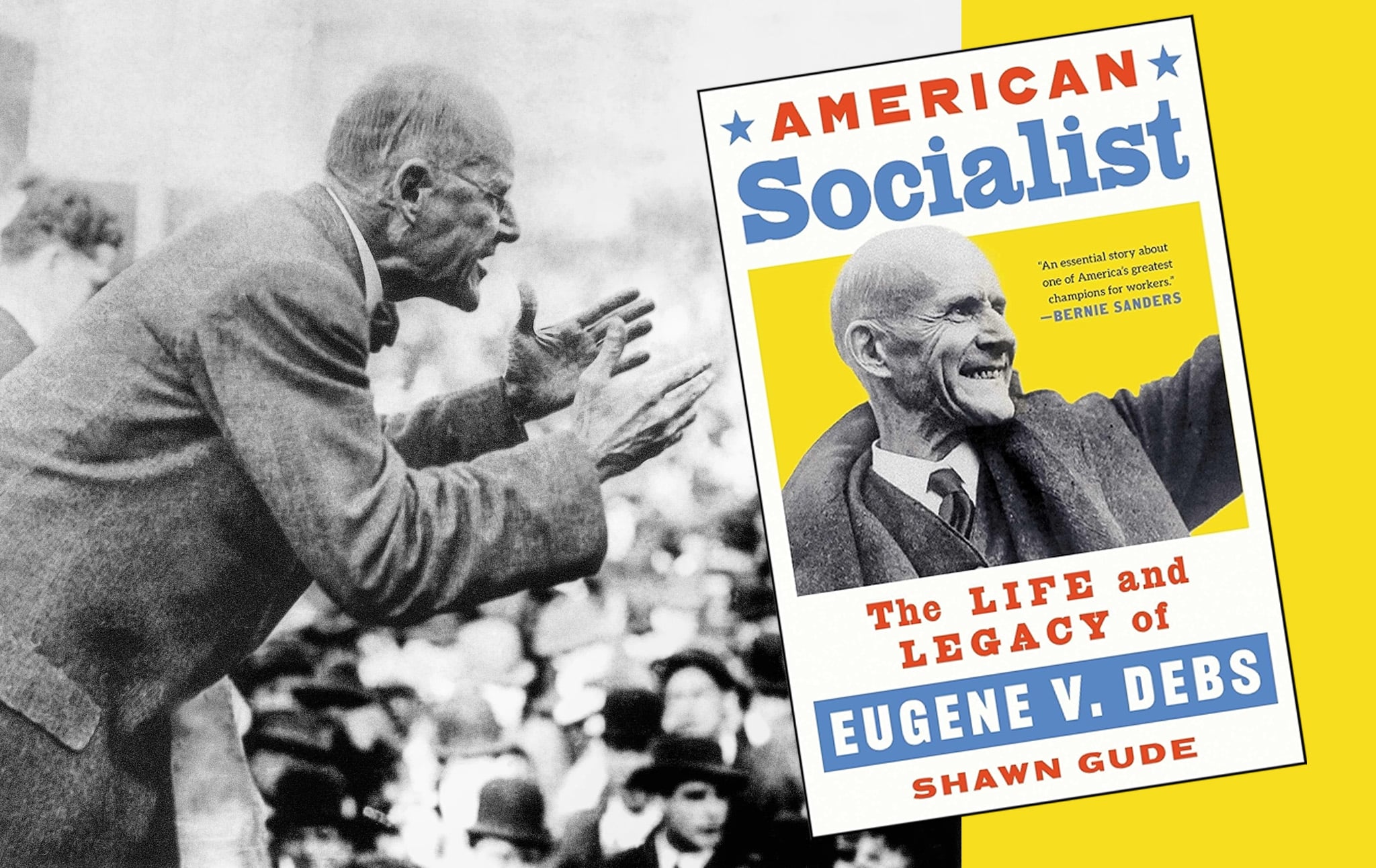
Historian Shawn Gude on his new biography of one of the 20th century’s most fascinating political figures.
Shawn Gude is a historian, a former senior editor at Jacobin, and the current proprietor of the Debs Dispatch Substack page. He is the author of American Socialist: The Life and Legacy of Eugene V. Debs, a new biography of one of the 20th century’s most fascinating political figures. Senator Bernie Sanders called the book “An essential story about one of America’s greatest champions for workers,” while Publishers Weekly calls it “a striking portrait.” Gude joined Current Affairs editor-in-chief Nathan J. Robinson to discuss his book, the research that went into it, and why Eugene V. Debs matters today more than ever.
Watch the video version here:
Nathan J. Robinson
You spent six years of your life writing this incredible biography of Eugene Debs, and I will say at the outset, I really do hope everyone picks up this book because it’s such an important story. It’s a fascinating drama and tragedy with many, many lessons for the present day. So, everyone, get Shawn’s book. I’m going to repeat that at the end. But you spent so long immersing yourself in the world and life of this man. Give me the first inkling as to why. What was so compelling about this story to you?
Shawn Gude
Well, it kind of depends on how far back you want to go. Because for me, I’m kind of, you could say, a sort of classical millennial socialist. I was involved in Jacobin pretty early on, 2012 or so, and I was politicized by Occupy. Really kind of coming out of Occupy and making sense of where my politics were, and what made sense to me, I really latched on to Debs as a figure, reading previous biographies. The way that he thought about socialist politics as the extension of democracy to all spheres of life really spoke to me, because that was central to how I thought about a kind of radical politics that I believed in. That was probably 2012 or 2013, and so I was inspired by that kind of vision, and then fast forward to 2020 or so, I knew I wanted to write something. I knew I wanted to write a book of some sort, especially after Bernie had lost, and I thought it was time for the left to kind of take a step back and think about some bigger questions and its own history. And I thought Debs was a really important figure to get at the rich history of democratic socialism in America that not everyone knows about, or very few people know about it, perhaps, and that this was a perfect way to actually tell it as a story, and not just kind of a recitation of facts or something, but a real story about a figure and the extraordinary movement around him. Because you really can’t tell the story of Debs without telling the story of the movement around him and the ordinary people that he inspired. So that’s the genesis of the book and how it came about, I guess.
Robinson
As far as I knew anything about Eugene Debs, as I was taught in high school until I picked up A People’s History of the United States—
Gude
I’m surprised you even learned anything in high school about him.
Robinson
Well, I think there was one line in a textbook that said, “And in 1920, the socialist candidate for president, Eugene Debs, running from prison, got a million votes.” This is an interesting historical tidbit. I feel like that’s the standard education about Eugene Debs: there’s this little curious thing that happened in 1920. That’s the culmination of your story. What’s kind of interesting is that’s toward the end of his life—that’s 300 pages into the book. But there’s so much else, and that’s after, of course, the peak of socialist power in the United States. That’s sort of when it’s on the wane. And so, let’s start with, where does this guy come from? What is this guy’s background? How does he become a radical socialist? He’s a very clean-cut young man when you see him in the pictures.
Gude
Right. No, it’s a great question because you’re absolutely right that he was not a red diaper baby. He was not someone who was born a socialist or anything. He doesn’t become a socialist until he’s about 40 years old. So who was he? He was born in Terre Haute, Indiana, where he lived basically his whole life, except for a few years, which was a western Indiana town, and raised by French immigrant parents. He joins the railroad when he’s 14 and becomes a locomotive fireman, in which he would shovel coal into the firebox to power the steam engines. So he’s doing that as a teenager, and pretty soon after that, he joins a union. I’m skipping over a lot.
Robinson
Look, people have got to read the biography!
Gude
They’ve got to read the book.
Robinson
There’s so much rich detail. I’ve asked you an awful question here because I’ve asked you to tell me the biography of Eugene Debs, and of course you’ve just written the biography of him. But yes, I’m interested in how this guy becomes radicalized, because he’s a labor organizer, kind of a moderate. He becomes the city clerk. He’s a very promising and talented person, and he’s a trade unionist. But where does the socialism come from?
Gude
Yes, you’re right. He really, when he’s a young man, thinks that workers basically just have to prove themselves as good workers, and then they’ll get a good deal from their employers. And he’s slowly kind of disabused of this somewhat naïve notion, I would say, and really has to grapple with the fact of corporate power and the power of employers over workers’ lives. And so, really, how that comes to happen is he’s involved in a couple of major strikes, and the first is a regional strike in the 1880s. The second one is the Pullman Strike, which is a national strike, and he’s head of the American Railway Union at that point, and it’s crushed by the government through judicial injunctions and just through brute force, through troops being sent in. And so that’s when he’s like, “Okay, perhaps I need not only a more radical vision of trade unionism, but I might need a more radical vision of a real alternative for American society.” And that’s basically when he becomes a socialist, and that’s not until the mid- to late 1890s.
Robinson
At that point, is there much socialism in America? Is he building a movement from the ground, or is he joining something that already exists? Where are things?
Gude
I’d say he’s very much building a movement at the ground level, because there are scatterings of socialists and trade unions, and there is a Socialist Labor Party, but it’s a small socialist party, and it’s very sectarian and pretty divorced from the realities of most workers. So he founds the Socialist Party of America in 1901 with some other socialists and trade unionists, and that’s really the party that he built and that he ran for president on several times.
Robinson
You use the word “sectarian” there to describe some other socialists. One of the remarkable things, and I think one of the inspiring things about Debs, as you look over the course of his life, is he had a remarkable ability to stand athwart various divides among socialists, where every socialist ended up respecting Eugene Debs, no matter what. He had rivalries and such—you talk about some of his rivalries, but ultimately, at the end of the day, people really respected this guy. And Eugene Debs had a really strong commitment to building a movement of the whole working class.
Gude
Yes, absolutely. He wanted to cross all sorts of divisions: race, ethnicity, and native status or origin. But yes, as you said, he also wanted to unite socialists across these lines of ideology that they often used in a way that was bludgeoning opponents of their ideology, rather than trying to figure out how to actually reach out to workers and build the party as a strong political force in society. And I think he was able to do that because he did kind of levitate above those divisions, and also he was just a really inspirational, personal figure that people could latch onto.
Robinson
One detail that comes across a lot in people’s recollections of Eugene Debs is that he’s just a really nice man. He’s just an extraordinarily personally warm and generous person who’s literally giving people the shirt off his back. He’s compared to Jesus a lot by people. I don’t think you have this in here, but when I read Leon Trotsky, at one point, he talks about meeting Debs and says he gave him a hug. And you can imagine Trotsky, who doesn’t seem like the hugging type. So tell us a little bit more about the personality of Eugene Debs, which seems to be a really key part of why he was able to get so many people who just would never say a word against him, and for whom he became a kind of secular saint.
Gude
Right. No, it’s a really crucial part of his appeal and political life, really. He was, as you said, someone who was compared to Jesus Christ quite frequently. He just had this kind of warm sense. He really got down to people on a human level, and socialism for him wasn’t this abstract thing. Obviously he believed in an alternative economic system that he thought would be more just and democratic, but socialism for him was more like a sense of solidarity with one’s fellow human beings. He was also a Christian socialist, which I think is part of this. There are all sorts of stories I could tell here, but one of the more remarkable ones is when he’s in prison for the second time.
Robinson
Oh yes, is this Sam Moore?
Gude
Yes.
Robinson
This is a great story.
Gude
He meets this man, Sam Moore, who’s been in prison for decades at this point. He was imprisoned for murder; he actually killed a white man in self-defense and then was convicted by an all-white jury. He’s been shown no sense of compassion really his whole life; he’s lived this rather dreary, oppressed life. And Debs meets him and just shows him extraordinary kindness, and they develop this really moving friendship. And he has this line that always gets me. Moore says, “Debs made me feel that I counted.” You can say that’s sentimental or whatever, but I think that really is central to Debs’s legacy and the kind of socialist politics that he believed in because it was about connecting with people like Sam Moore and building up their confidence and sense of humanity in themselves so they could actually band together with other people to fight for their freedom and their dignity in life. So he was an extraordinary person because he was able to connect with and inspire people.
Robinson
Part of the way people should read this is to try and put themselves back in this time. You can imagine that Sam Moore was tattooed with “Black convicted murderer” and was convicted of murder in 1891. So you’d imagine what life is like, and the kind of treatment that someone like that receives. Then Debs meets him in prison, calls him brother, and says, “Is there anything I could do for you? What do you need? Would you like some fruit?” Sam was flabbergasted. This was a new kind of specimen. He never had so much kindness shown to him by the whole world put together. And this is another important thing that you talk about. This is also important because Debs isn’t born a Christ-like figure; he evolves, and on race in particular, you track his evolution, where Debs in his early life displays some of the prejudices that you might expect of a white man in the 1800s in Indiana, and then he develops and grows and sees the importance of dismantling racism, and then gets the respect of people like A. Philip Randolph and [W.E.B.] Du Bois by the end of his life.
Gude
Yes, absolutely. It’s an important part of the book, I think, and it’s a thread that I hope resonates with people today. Because you’re right, it is a story of changing over time. To put it in the phrasing of today, Debs could have been canceled when he was a young man, but he really grew to develop a more sophisticated sense of how racism was used to divide workers. And in his mind, in the eyes of other Black socialists who I talk about in the book, people like George Washington Woodbey and A. Philip Randolph, you actually had to have a mass movement by Black workers to bring down Jim Crow and bring down the oppression of Black people in the country. It certainly wouldn’t be done by moderates, and it certainly wouldn’t be done by even African American elites. It had to be a mass movement of Black workers. And so that’s the perspective that Debs lands on later in life, and it was a pretty bold position to take for the time. It almost anticipates the kind of strategic orientation that he was pushing. Almost anticipated the Civil Rights movement, if I could be so bold.
Robinson
Well, you say he was quoted by Martin Luther King Jr. and was respected by him.
Gude
Yes.
Robinson
And also, you discuss a lot about Debs’s wife, Kate, and his relations with women. He was also a supporter of women’s equality at a time when there was obviously plenty of misogyny and anti-feminism on the left; Debs, at least politically, comes across looking pretty good. His treatment of his wife was not cruel—he respects her, but you do document his long infidelity. So again, I think it is important to acknowledge these things, just as we do with people like Martin Luther King Jr., that they are people who are human beings, and they are not, in fact, Christ-like saints.
Gude
Yes, I definitely tried. I hope readers will get the sense of Debs’ humanity, and part of that is his failings as a human being. The book is not just pouring praise on Debs. It really does show, as we all have, his flaws and foibles. It’s interesting that on women’s rights, it was the exception early on that even when he was quite moderate and conservative, he was a real champion of women’s rights. He brought Susan B. Anthony to speak in Terre Haute when he was a young man. But certainly, like later in life, he is very much supporting what we would call today’s socialist feminists in the socialist party. He was very much on their side.
Robinson
And when he was the city clerk in Terre Haute, he wouldn’t fine sex workers?
Gude
Right. Yes.

Robinson
Now, an interesting thing is that as you depict the world of socialism in this time, a lot of the places where all of this takes place, the scenes we’re in, are places like Oklahoma, Kansas, and Indiana. When we look at our classic red states today, places that seem like the least likely places for socialism to catch on, it’s interesting that a lot of the heart of socialist politics is there. You talk a lot about Milwaukee too, and obviously there’s still kind of a left there. But for people who don’t know that there were socialist newspapers in this time in Kansas and such, tell us a little bit about this vanished world of midwestern and western socialism.
Gude
I would love to. I’m from Iowa, and I have a lot of pride in where I came from, and certainly the tradition of agrarian populism and radicalism in so-called flyover country very much resonates with me, and animates me too. So Debs himself is from Indiana, and where the party is strongest, as you mentioned, are places like Oklahoma, where the party is especially strong among tenant farmers. Oklahoma had, in some respects, the strongest state party in the country. They would have these massive socialist encampments every summer, where tenant farmers would pack up their covered wagons and trundle across the plains to get to these socialist encampments, and there’d be thousands upon thousands of people. They’d have speakers like Debs. Debs was extremely popular at these. They would also have music, and they would have dancing. They’d have free food. It was really a hub of socialist culture, almost. It was a way for these tenant farmers who lived very bleak lives in a lot of ways to actually get some sustenance, both of the mind and of the body and of the soul. And so the Socialist Party was able to do things like that and really capture people’s imagination and sense that things could be different, and also we can sort of provide this sense of life and hope to people. So Oklahoma is just one example. There also, as you mentioned, was Kansas. The biggest socialist newspaper in the country was Appeal to Reason, which was as big as lots of mainstream newspapers, just massive circulation published out of small-town Kansas. Debs writes for them for a few years. I could go on with these stories, but they have what they call the Appeal Army, which is tens of thousands of volunteer salespeople, and they sell Appeal to Reason across the country. And there’s this Appeal Army column where people send in their exploits from the trail, and they talk about getting egged and stuff, and then they’re urged on by the person that collects these missives. And so it is like a wonderful world, a banished world that I hope I captured in the book.
Robinson
Many of our Current Affairs readers want to go out on the trail and get egged, trying to sell Current Affairs. I can assure you, we will encourage you in this pursuit. As a publisher of a socialist magazine that has a print circulation of about 5,000, when I look back at the Appeal to Reason with 400,000 or something subscribers—
Gude
More than that. Three-quarters of a million at its highest point.
Robinson
It’s extraordinary.
Gude
Special issues would be 2-3 million. Pretty amazing stuff.
Robinson
As successful as they were, they never captured the mayor of New York City’s office. So, in some ways, we are doing quite well these days. But you do look back at 1912—I guess that’s about the peak, 1911-1912, where they had 1,000 office holders around the country, and you think, “My God.” Even though they weren’t winning presidential elections or even coming close, it’s really, really impressive. And you have this great thing about the sewer socialists and the mayor of Milwaukee, and you say the sewer socialists added to nitty-gritty policies like sewer construction and public transit.
You say,
“They added culture and entertainment, free public concerts and lectures, neighborhood social centers that would honeycomb the city, brimming with children playing checkers and board games, and adults shooting pool and debating politics. They turned lakefront land slated to be sold to private industry into a beautiful public park for all to enjoy. [As they] later explained, we wanted a chance for every human being to live a life of happiness, and we wanted everything that was necessary to give them that: playgrounds, parks, lakes, beaches, clean creeks, rivers, swimming and wading pools, social centers, reading groups, clean fun, music, dance, song, and joy for all. That was our Milwaukee social democratic movement.”
Gude
Beautiful, isn’t it?
Robinson
Isn’t that amazing?
Gude
I love that quote.
Robinson
Yes, I wanted to read that because that really stayed with me. I was thinking about Mamdani doing his opera for all. He’s giving away 70,000 free opera tickets.
Gude
Exactly.
Robinson
And clearly drawing from this tradition.
Gude
Yes, I think there are a lot of lessons from that time. And I do think Zohran, in a lot of ways, is pulling—sometimes consciously and maybe sometimes unconsciously—from a lot of this stuff, because it is really about a real movement and not just a different kind of politics. And central to that is creating a sense of joy and hope for people, and cultural stuff like this is really important for that. And Zohran really gets that.
Robinson
I did want to ask you to elaborate a little bit on what socialism meant to Eugene Debs, because it isn’t just vaguely joy for all, like everyone has a nice public park. And even Mamdani, when he is asked about socialism, gives answers that are like, “Well, it’s just making sure everyone has the things they need.” Debs was criticized in his time, as you point out, for not explaining how a socialist economy would work. You emphasized throughout the book he’s more a rhetorician than a theorist, but I was hoping you could explain, at a time when there are all sorts of debates over what the meaning of socialism is and what the overthrow of capitalism would mean, when he said, “I am a socialist,” what was he conveying to people?
Gude
Yes, I think aside from the more kind of moralistic and sentimental version, it was a kind of classic conception of socialism. It was that commanding heights of the economy, certainly, should be publicly owned, so everyone has a stake in them and receives the benefits from them, and so we don’t have these islands of private tyranny, where a few oligarchs can control the rest of our lives. So it’s that. As you mentioned, I talk in the book about his vision, and it’s sort of unclear to what extent he wanted worker cooperatives as part of that vision too, and in smaller firms, what role markets could or couldn’t play. It’s a classic “we should socialize the means of production,” and what that means specifically is he thought it was going to be democratically determined. But also, it’s invigorating to read the sense of hope from this time—it’s in the US, but it’s around the world, really. This is the time of what they call the Second International, and so you have these rising European socialist parties to organize the working class, winning political democracy in European countries, and then fighting for socialism as an extension of democracy to the economic sphere, and so Deb is very much part of that. He believes in that vision. There was a sense that we all generally know what we’re going to do here. We just have to build the political forces to do that, and we’re going to get to what he called a cooperative commonwealth, which was basically socializing the means of production so workers can actually have a say in their workplaces.
Robinson
And clearly hated the existence of class.
Gude
Yes.
Robinson
Hated the existence of a class of owners and a class of workers—a class of owners who get rich off the labor of the workers.
Gude
Yes, he had different influences. He was a Christian socialist. He was what you could call a labor Republican. He was a Marxist.
Robinson
Bolshevik. He called himself a Bolshevik!
Gude
He did call himself a Bolshevik, yes. He had all sorts of influences, but he was a Marxist too. He had a pretty classical conception of what socialism would be in that way. So he certainly wanted to abolish class divides. He thought that it was unjust for people to privately own the means of production because it was undemocratic and oppressive.
Robinson
Your little epilogue of the book is very inspiring, and people should make sure that they don’t skip it. It’s about four pages, but it’s completely crucial in explaining the entire relevance of the book that you’ve just written. But before the epilogue, Debs’s life has the structure of a tragedy. We’ve mentioned that in 1912 they have offices all around the country. He’s built up this movement. There are triumphs along the way. You have a great part about the acquittal of Bill Haywood in the trial. We won’t get into that. But then it all really kind of comes crashing down right after 1912. The publisher of the Appeal to Reason commits suicide. World War One breaks out, and a few years later, Debs is in prison. So tell us a little bit about the tragic unraveling phase.
Gude
Yes, it is tragic. And it’s a combination of government repression and, I would say, sectarianism within the Socialist Party, and just really fierce factional battles that end up destroying the party. So first, the government repression. This is during World War One, and the party fiercely opposes the war and is fiercely repressed for it. Socialist newspapers are effectively closed down. Just scores and scores of newspapers across the country. As you said before, the socialist press was a very vibrant thing and was really essential to the movement. And so the socialist presses are shut down. Leaders are thrown in jail, including Debs. Socialists are literally tarred and feathered on the streets, and not surprisingly, it really saps the movement of its strength. It still has some electoral success, because in many corners the war is still unpopular, but the repression really just destroys the movement.
And out of this, at the same time, you have the Russian Revolution, which is a beacon of hope for a lot of radicals around the world and most people in the Socialist Party too, the vast majority. The parties, you could say, were split between the so-called right and left. Even the most conservative socialists very much support the Russian Revolution as a step forward for humankind because it destroys Tsarist Russia. It ends Russia’s participation in World War One, and it really holds out the hope of a socialist society. And so Debs is very much part of that. He wants the Russian Revolution to succeed as well, but there’s extraordinary factionalism that develops around that, because a good chunk of the party thinks that the Russian Revolution is the template for revolution around the world and thinks that it has all sorts of lessons for the United States. And there are other people, including Debs, who, even though he’s sympathetic to the Russian Revolution, don’t think it’s as relevant to the United States because it’s an advanced capitalist country. It has some level of political democracy despite this repression. And so the second part of this tragedy is when the party tears itself apart. There’s a split; two communist parties actually are formed out of the split, and then the socialist party itself is vastly diminished in size. So by 1921 or so, all three parties—the socialist party and those two communist parties—have 30,000 members or something like that. Whereas a few years before that, the Socialist Party had over 100,000 members. So that’s the tragedy that happens. And by the time Debs is nearing the end of his life, the Socialist Party is in pretty rough shape. Obviously, I gave the book to people to read beforehand, and everyone was like, “You have to write a more hopeful epilogue because this is so depressing.”
Robinson
Yes, that’s why I instructed people specifically to make sure they stick around.
Gude
Please do, please do.
Robinson
The epilogue is beautiful. As I say, it’s four pages. When he got out of prison, he declined. Prison had destroyed him physically. You mentioned that the spirit of Debs is present in the Civil Rights movement through those who were inspired by him. But the organized socialist movement in America basically disappears from political relevance for nearly 100 years. And if you had written this book any time in the 100 years before the last five years, you couldn’t have written a very hopeful epilogue. But you’re writing this book at a time when suddenly the spirit of Debs is back. To conclude here by bringing our story up to the present day, Bernie Sanders early in his life was a deep devotee of Debs, to the point where he tried to get schools in Vermont to show his movie about Eugene Debs that he made. Mamdani, you point out, began his victory speech by quoting Eugene Debs. All of a sudden, 100 years later, we’re beginning to see this. So, tell us a little bit about the spirit of Debs in our own moment.
Gude
Yes. I am fortunate with the timing of this book, I have to say. I think Zohran really captures the spirit of Debs well in the way that he brings socialism down to a human level. Obviously, Bernie’s been carrying the torch for many decades at this point. But yes, I think people are looking to socialist politics and to people like Debs because the world that we live in is in many ways quite similar to the sort of world that he lived in in the Gilded Age. We have our own Gilded Age; we have our own oligarchs. Think about AI.
Robinson
Can I not, please?
Gude
I’ll just say we’re all sort of along for the ride, just because a handful of people are saying, “We should just pour trillions and trillions of dollars into this thing that’s having enormous effects on everyone’s life, and no one else is going to have any sort of say about how this is deployed.”
Robinson
“You’re going to have the AI future, whether you like it or not.” Oh, okay. I guess we have to deal with that now.
Gude
Exactly. And so Debs would say, “This is absurd. We live in a society. We don’t live in these little private fiefdoms for these oligarchs and despots to just order us around.” And so I think that, along with extraordinary levels of inequality and people’s inability to afford housing and healthcare, all of that together makes Debs’s legacy very relevant, and the kind of prescriptions that he was offering are very relevant.
Robinson
And the reason I want everyone—everyone—to read Shawn’s book is because, by going back and revisiting that first socialist movement and understanding what they did that succeeded and how they ultimately were crushed, you learn the lessons of history, and hopefully you prevent yourself from undergoing some of them again. And also, you could see how hard Eugene Debs worked. This man exhausted himself on this train travel across the country. He really put everything into this, because he believed in building a better future. And I just want to close here by reading a passage from your epilogue. I know it’s a spoiler—still buy the book. Okay, listen.
Shawn writes at the end of the book,
What will it take to bring about the future Eugene Debs foretold? It will take thousands of UPS drivers and union nurses and public school teachers running for state houses of Congress on a working class agenda, and many hundreds of thousands of Jimmy and Jenny Higginses”—read the book—“door knocking and phone banking for them. It will take Walmart stockers on the late night shift and Amazon warehouse workers on the early morning shift standing together against their bosses, a labor movement that has their back going all in, even when organizing drives are risky and major strikes could fail, because the alternative is irrelevance. It will take deep working class organization in DSA chapters, in community groups, and beyond, armed with political education that turns ordinary people’s nagging sense that the deck is stacked against them into a rich understanding of how society operates and their shared interest with every other worker, from pipe fitters and farm workers to software engineers. It will take”—and this is the part that I’m pleased to play a part in—“a flourishing socialist press across all mediums and a socialist culture that makes workers believe in solidarity because they feel it when they go to the cookouts, the singing clubs, the dance parties, the sports leagues, the game nights. Feel that democratic socialism isn’t just an economic system, but an entire ethos about the joys of living and laughing and finding oneself together today.
I have to say that that is really just a gorgeous piece of writing there that you close the book with, Shawn.
Gude
Thank you, thank you. I really appreciate it.

Robinson
Any last details or anecdotes or little things about the life of Eugene Debs that you learned over the course of researching the book? I’m sure there’s plenty in researching the book that you didn’t know about Debs going in that was an interesting discovery.
Gude
I think one of the things is how much he really loved nature. He spent time outdoors as a kid. He would go on these long walks and mushroom hunting with his parents or with his father at least and his brother. But later in life he ends up going to sanitariums often to just recover from these terribly arduous journeys and speaking tours that he’s on, and there are these long letters that he sends back to his brother in particular, and he’s just extolling the wonders of nature and that you just have to forget everything and just get out into nature. He writes one from Estes Park in Colorado. I think he writes one from Elmhurst, Illinois, which is actually the sanitarium where he ends up dying. But he really becomes this kind of evangelizer for nature as well as socialism. So I didn’t know that. I certainly agree with that too. I think it’s a sense of, in this crazy world, it gives you a sense of balance.
Robinson
Eugene Debs, eco-socialist.
Gude
Yes, yes.
Robinson
All right. Well, about this book, friend of the magazine Greg Grandin, the great Pulitzer Prize-winning historian, says
“It’s propulsive. It’s more than a biography. It’s an inspiration, a reminder that if such a humane mass movement was possible once, it can be again.”
Shawn Gude, thank you for joining us on Current Affairs today.
Gude
Thank you so much, Nathan. It was great.
Transcript edited by Patrick Farnsworth.