
Paul Verhoeven's classic depiction of a militarist fascist society helps demonstrate how propaganda works and what it conceals.
Last month, Donald Trump posted the designs for a new set of dress uniforms for the United States Space Force—the newest branch of America’s military, which the first Trump administration created in 2019. A text accompanying the AI-generated concept art described the regalia as “inspired by the discipline and functionality of the Starship Trooper Uniform.”
As often happens when the president opens his mouth, the announcement was met with some well-deserved ridicule. In the press and online, many pointed out the absurdity of the president simply ripping off a movie—1997’s Starship Troopers—with deliberately totalitarian aesthetics. If there was any doubt, Paul Verhoeven, who directed the film, chimed in to confirm that the characters “are fascists without knowing they’re fascists.”
“That’s the point,” Verhoeven emphasized, adding that the uniforms were “precisely, clearly Nazi.”
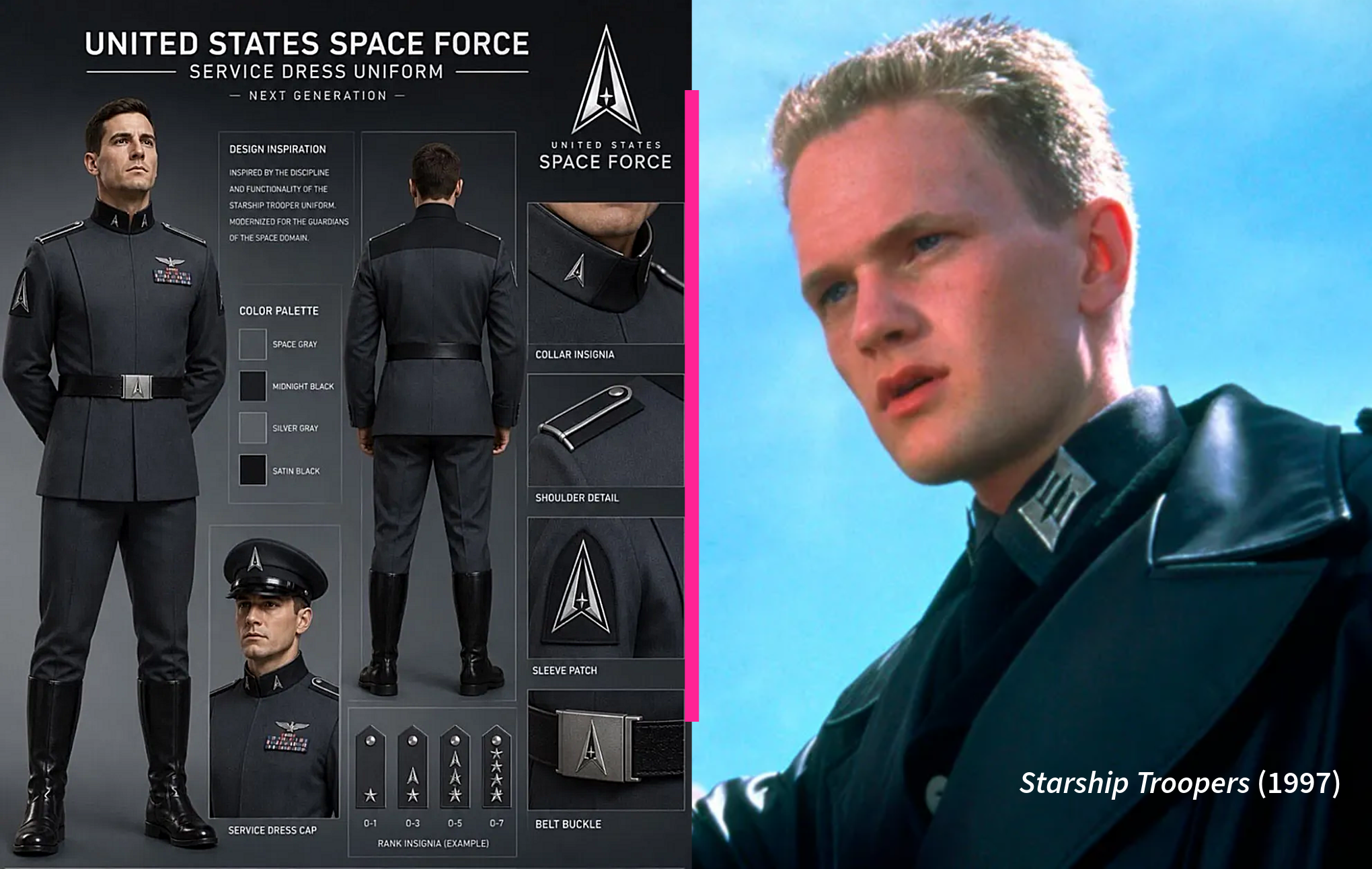 Donald Trump's newly proposed uniforms for the U.S. Space Force (left) are inspired by those featured in the 1997 satirical film Starship Troopers (right).
Most of the online commentary has focused on mocking the president for missing the punchline. Luckily, Trump is not literary enough to read Jonathan Swift, or he’d be posting recipes for Irish babies.
I love dunking on Trump as much as any other terminally online Millennial, but let’s not pretend that he’s going to be embarrassed by liking a Nazi-inspired uniform. For a president who loves nothing more than military parades and triumphal arches, and who plays footsie with Putin, the jackboot aesthetics are kind of the point.
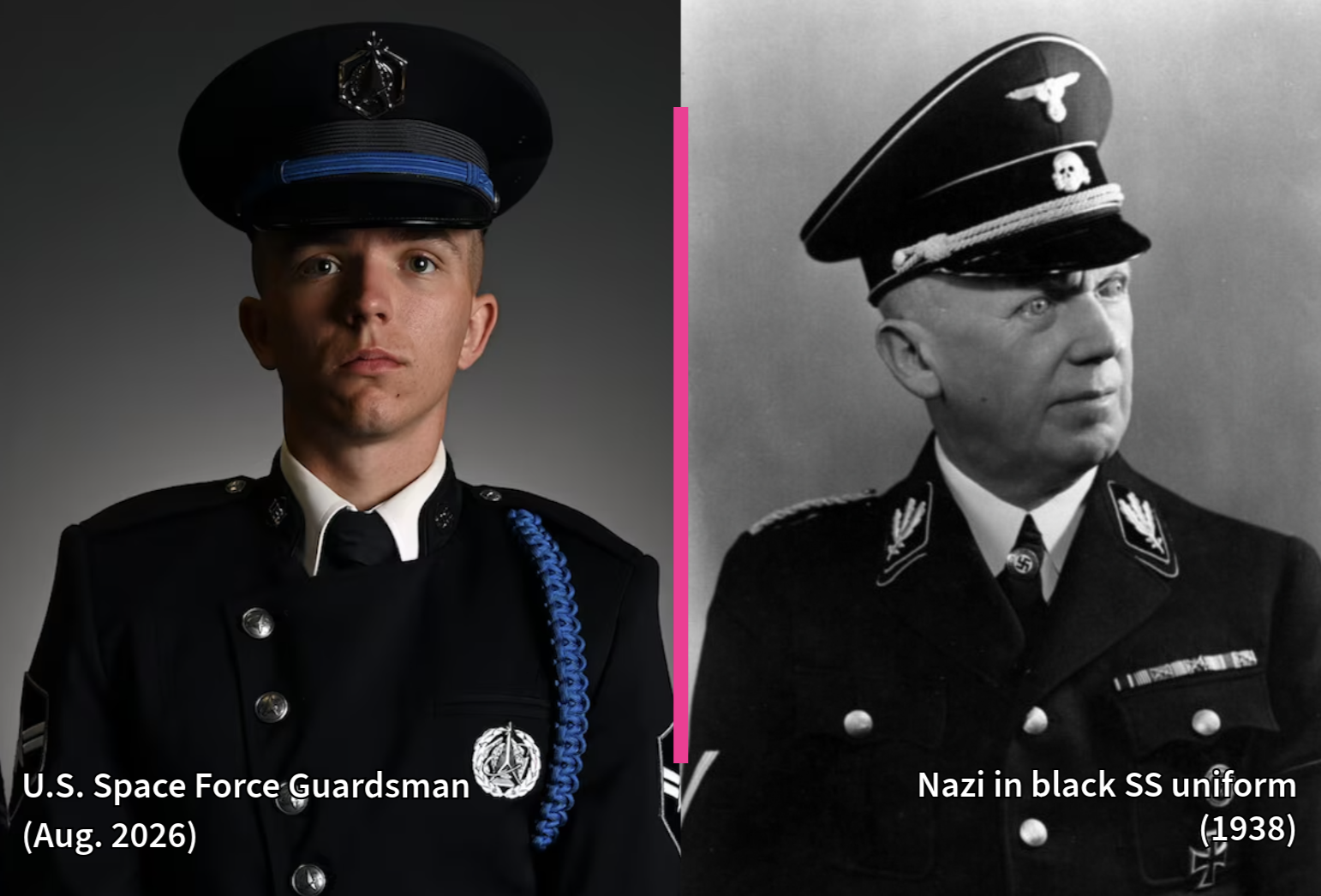 The existing uniforms for the U.S. Space Force (left) have also drawn Nazi comparisons.
The totalitarian mind has no room for irony, as Christopher Hitchens pointed out, so it’s no surprise that some of the people who missed the point of the movie also think it would be a good idea. Earlier this year, a poster on Hacker News—the discussion board for the tech accelerator YCombinator—argued that Starship Troopers didn’t work as a satire because the society it depicts is simply too awesome. “When you present a society that's more ethical than real life, nobody's going to care if some people wear uniforms that look a bit like Nazi uniforms,” one poster argued. A conservative blogger for the pro-Trump American Greatness wrote that “Starship Troopers Is Not a Satire,” even if someone as ignorant as the director seemed to think so. It could not possibly work as a satire, the author wrote, because the United Citizen Federation, the fictional government in the movie, is “obviously superior to our contemporary gay liberal ‘democracy.’”
For those who haven’t seen the film, Troopers is set in a martial future society where citizenship is tied to armed service. It starts with a high school indoctrination class, where a gruff schoolteacher explains how democracy failed under “social scientists” (thankfully, the word “woke” doesn’t exist in the future) until the military took control, and “imposed the stability that has lasted for generations.” You get glimpses of that stability through short propaganda reels that extoll the virtues of the military (“Join the Mobile Infantry and Save the World!”) or show soldiers handing out guns to delighted children. Another tells viewers when to tune in for a public execution.
That vision of public violence appeals to a certain kind of conservative. The late Charlie Kirk was an advocate of televised executions and thought that children should be made to watch them. He would have been pleased when the Department of War’s Pete Hegseth announced the livestreamed termination of the Fort Hood shooter Nidal Hasan. That, apparently, was too much even for Donald Trump—or, perhaps, he simply realized that shooting a disabled man on camera would not help during the midterms.
Then there’s the idea of earning citizenship through military service. As an adolescent, I assumed the Starship Troopers world was supposed to be a sort of spacefaring Sparta, but there’s also something a little Israel-like about the idea of combat as a rite of citizenship. One of the contested issues in this month’s Israeli elections is the number of Palestinian citizens of Israel and ultra-orthodox Jews who are not doing their part for the destruction of Gaza and Lebanon.
Thankfully, Republicans haven’t (yet) floated the idea of a military-only franchise, but the idea of restricting the vote isn’t a new one. Steve Bannon once privately discussed the benefits of restricting the vote to property owners, and Vivek Ramaswamy wants to raise the voting age to 25. Pete Hegseth’s favorite preacher believes women shouldn’t vote at all, and Elon Musk has amplified calls to limit the vote to taxpayers. (Which is ironic, considering that Tesla pays nearly no income tax.)
The common thread is that ordinary people cannot be trusted with voting;someone in the government needs to decide who gets that privilege. That makes very little sense from a small-government perspective, but a lot of sense from an authoritarian one. No one seriously believes that undocumented people are voting in large numbers—the real threat is that the wrong Americans are voting. No wonder the Trump administration is planning to send out a thousand “election monitors” for next month’s election, and attempting to denaturalize a Somali-American Congresswoman. Meanwhile the president has used government money to pay for Cold War-style election ads. The only thing missing is the kid in battle armor shouting, “I’m doing my part!”

Starship Troopers follows Johnny Rico, an enthusiastic but unintelligent jock who joins up to impress his girlfriend and gain the prestige of citizenship. Halfway through the story, a race of extraterrestrial insects wipes out Rico’s hometown and sets humanity on a struggle for survival, where Rico and his friends learn valuable lessons about service and sacrifice.
At least, that’s the movie I remember watching in theaters, nearly half a decade before 9/11. Perhaps the joke didn’t quite land because I didn’t yet recognize what it was making fun of: ’90s kids had no reference point for endless wars or the constant sense of national peril. I was confused when the children in the movie joined the fight by stomping on bugs, which made no sense because they were just regular Earth roaches. (Narrator: “The war effort needs your effort!”) That scene would make a lot more sense to me four years later, when Sikh and Hindu Americans had to worry about being attacked because they looked a little too Muslim. At the same time, it became unpatriotic to ask what a bunch of Saudi hijackers had to do with Afghanistan and Iraq—because critical thinking is just for gay liberals and social scientists. “They hate us because of our freedoms” is as close as we got to an actual motive.
This is the point in Starship Troopers where you start to realize the twist: you are not really watching a satire about a fascist future, but a propaganda movie from one. In other words, Starship Troopers is the movie that the Federation would make about itself.
That brings the disjointing realization that the “facts” in the movie are coming from an unreliable narrator. (There’s a serious fan theory, that becomes more credible the more you think about it, that the alien attack was actually a false flag by the human government). In any case, it’s obvious that the humans and bugs were already fighting. Before the war starts, the kids are dissecting giant insects in biology class, and one of the newsreels alludes to a massacre of “Mormon extremists”—in other words, settlers—who had tried to colonize an alien world.
You get the same sense of disorientation from the United States’ latest war against Iran, which has lasted either 47 years or 38 days, depending on who’s counting and which constitutional deadlines they’re worried about. If, indeed, there even is a war, as the Vice President recently mused aloud during an unusually hair-splitting press conference. In any case, it was certainly started by Iran, which has been inches away from a nuclear weapon since 1992. Oceania has always been at war with Eastasia.
Calling Trump a “fascist” might be a bit generous, as it suggests a certain level of competence and coherence. But he would probably like to be one. One of the genetic features of fascism—as Umberto Eco, an Italian philosopher who grew up under Mussolini pointed out—is a commitment to constant violence and struggle. “Pacifism is trafficking with the enemy,” Eco wrote. “It is bad because life is permanent warfare.”
That explains why this administration has such an erotic fixation on cruelty. There’s something almost pornographic about the way the “Department of War” revels in blowing up Colombian fishing boats and unarmed Iranian ships. George W. Bush committed his share of war crimes, but at least he had the modesty to cover them up properly. Chelsea Manning spent seven years in jail for leaking an airstrike on a group of reporters; Hegseth would have probably shown the video on Fox News.
Speaking of Fox News—there’s a talking head segment of Starship Troopers that could have come straight from the Murdoch network, complete with the constant interruptions. “Brain bugs?” scoffs an obnoxious host, in an exquisite Tucker Carlson impression. (He even has a bow tie.) “Frankly, I find the idea of a bug that thinks offensive!”
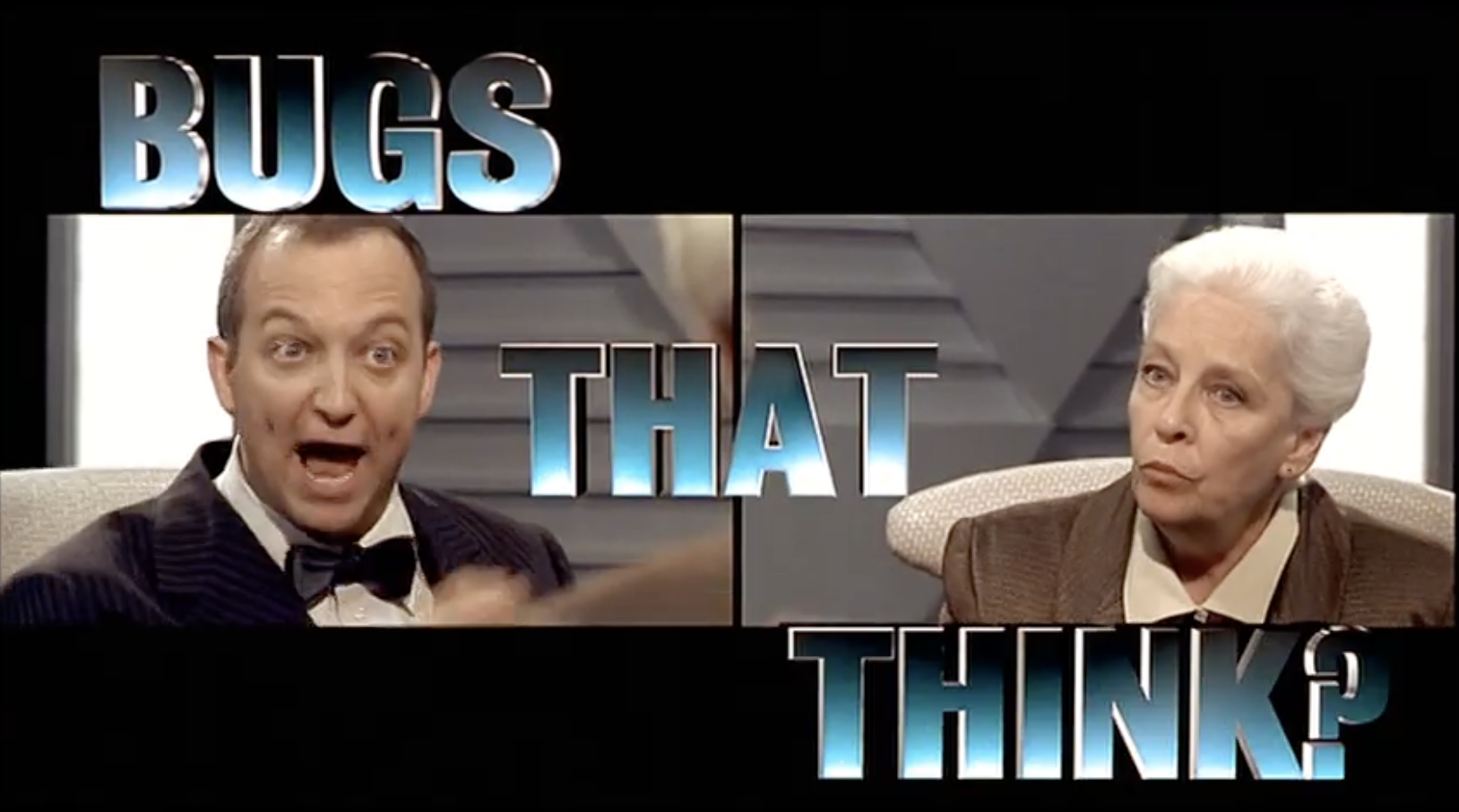 In Starship Troopers (1997), a news commentator scoffs at the idea that bugs are capable of thought.
I thought back to that clip several times over the past year, as government officials became visibly offended by questions about how a supposedly medieval theocracy can still bullseye American bases. (Suggesting that Iranians can be rational is as heretical as saying that they’re winning).“The central issue here is Iran is run by lunatic clerics, okay?” said Marco Rubio, who had presumably not noticed the unhinged religiosity of his own colleagues. This was after his boss had threatened to eradicate an entire civilization, and J.D. Vance had mused aloud about enacting the “End times.” Hegseth himself has long believed the U.S. should wage a religious crusade against Islam.
There’s one more detail in Starship Troopers that I never noticed until I had it pointed out to me. Throughout the movie, Rico is steadily promoted through the ranks, as one officer after another gets killed. By the end, he is in charge of his own contingent of soldiers. “Who are all these kids?” he wonders, surveying a batch of new recruits. “We’re the old men.”
I assumed this scene was supposed to show how Rico is becoming older and more experienced as he steps into the role of a commander. It’s not until you pause the screen that you realize that the new soldiers really are kids, and much younger than the high schoolers who signed up at the start of the film. Evidently, the United Citizen Federation is so desperate for soldiers that it’s sending children to the front lines, like the Hitler Youth in the defense of Berlin.
That seems to be the final lesson—the war is going so badly that the army needs children for the meat grinder. But, because the movie is meant as a two-hour recruitment ad, it can never say overtly that the humans are losing the war, any more than a Pentagon spokesperson can admit how many U.S. aircraft Iran has taken out, or how many soldiers have been killed.
But at the very least, they will have very imposing uniforms.