
HBO's wildly entertaining docuseries turns petty disputes into a revealing portrait of modern life.
“Love thy neighbor” may be a central commandment of the Bible, but you’ll find no such law in the Constitution. For many Americans, bubbling beneath the surface of our collective psyche is a fear that our neighbors—whether next door or several miles away—are constantly poised to harm us. If not for our guns, fences, and extensive armies of Ring doorbell cameras, the very people living on our street may try to take what’s ours. As the subjects of HBO’s latest docu-series Neighbors know well, our nation’s real ethos may be: keep your friends close and your enemies closer.
Each half-hour episode of the show spotlights different pairs of neighbors locked in an all-consuming dispute. The reasons vary: someone built a garishly ugly fence; another encroached on a property line by six inches; someone took a sledgehammer to said garish fence; the man next door moved four screaming pigs onto his property. Co-produced by A24 and Central Pictures, a production company founded by Josh Safdie of Uncut Gems and Marty Supreme, the series takes on a surreal quality at times. It’s both hilarious and horrifying—a perfect microcosm of America, where paranoia, hyper-surveillance, and an obsession with private property have convinced ordinary people that their worst enemy is always nearby, standing on the other side of some imaginary line.
Unsurprisingly, much of Neighbors takes place in Florida, a state known for its wacky residents and laws that basically allow you to shoot anyone who steps onto your porch. In episode one, we are launched into sunny Walton County, where beachfront homeowners are engaged in an ongoing battle with the regular townsfolk. The latter group wants access to the ocean despite not owning a multi-million-dollar property on the shore. The former group says fine, poor people can go to the beach—but do they have to be poor on MY beach?!
To help residents understand their rights, local beach-access advocate Sara Day has teamed up with an anonymous activist known only as “the Shoreline Defender.” This mysterious man (?) runs a popular Facebook account dedicated to fighting the privatization of Florida’s beaches. Although his activism is perfectly legal, he spends the entire episode concealed behind an absurdly terrifying mask and wearing rubber gloves. You can’t really blame the guy—it’s often risky making enemies of the rich—but the visual is undeniably funny. It's especially funny because Day, his closest collaborator, has no qualms whatsoever about revealing her full name, face, and daily whereabouts on national television.
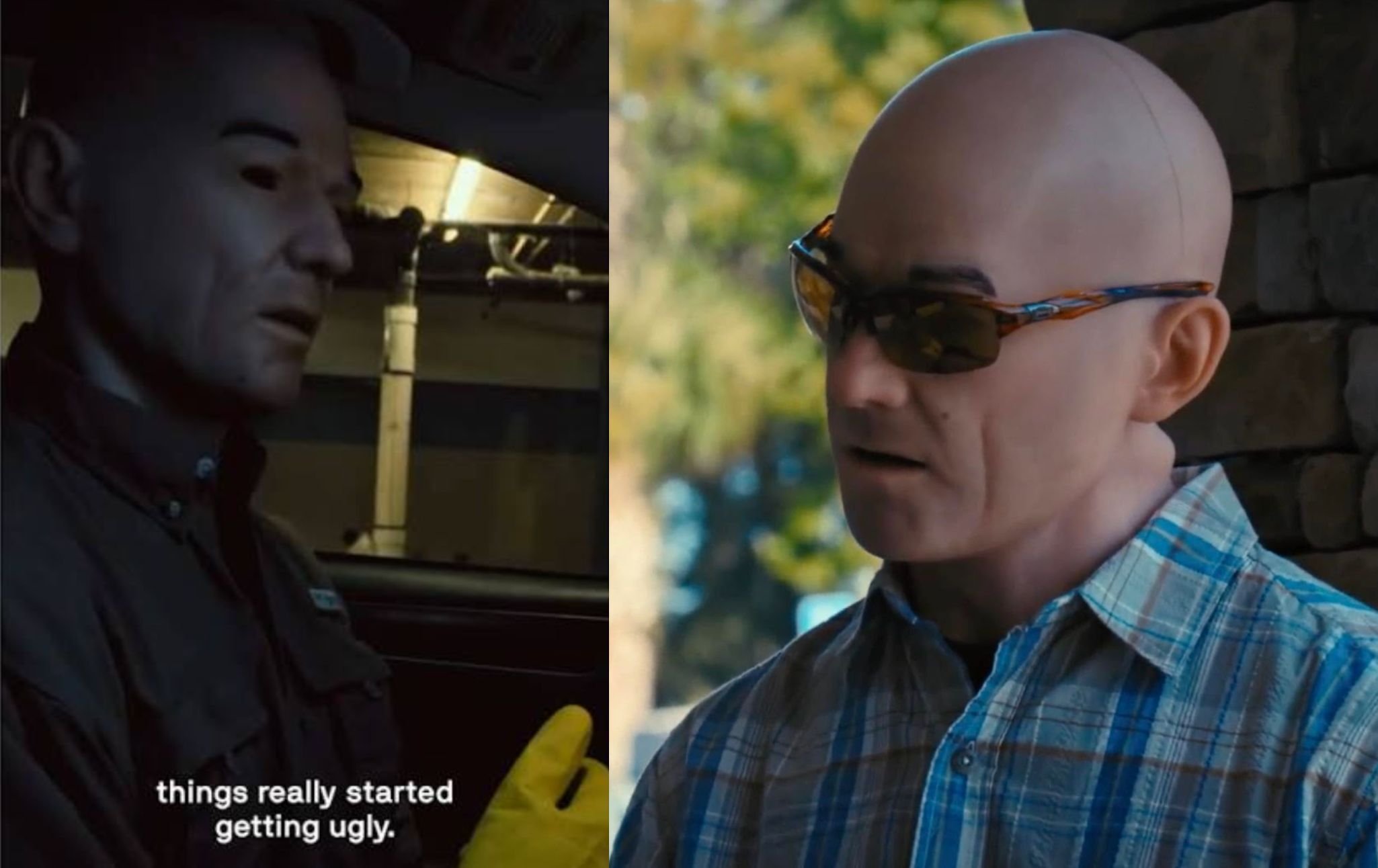 The anonymous "Shoreline Defender" protects his identity with a rubber mask.
In one scene, the Shoreline Defender speaks from the front seat of a dimly lit parked car. His voice has been distorted like Batman's. “These celebrities and elites are so terrified of regular people, they'll hire (security) who are basically beach Nazis,” he says. One of the producers asks about a phone app he's developing with Day to map public beach-access points, and he whips his head around as if he's just been questioned about a pipe bomb in his basement: “How do you know about that?!”
The scene cuts to Day demonstrating the app to strangers on the beach, enthusiastically shaking hands and introducing herself. Meanwhile, the next time we see the Shoreline Defender, he’s added sunglasses over the top of his disguise. More power to him.
For a little context into the dispute, in Florida, all wet sand below the high-water line is public land where anybody can walk, run, or swim. The dry sand in front of somebody’s house, however, is often private, which makes accessing the free-for-all zone a little tricky. To get there, people in Walton County are generally allowed to use a 20-foot “transitory zone” leading inward from the shore, where sunbathing is also permitted between the hours of 9am and 4pm. If this sounds annoying and complicated, that’s because it is. Private homeowners often take advantage of the confusion by drawing arbitrary lines in the sand, literally, and claiming large swaths of the shoreline that don’t belong to them. They can also invoke a right to “relocate or remove beachgoers if they are not complying with the rules.”
The whole issue could be solved if Florida followed in the footsteps of places like Oregon and surprisingly Texas, where the entire coastline belongs to the masses. Instead, the “Sunshine State” attracts charming investors like Backstreet Boys member Brian Littrell, who is currently suing the Walton County Sheriff for failing to keep “trespassers” off his beach. Littrell told Fox News that he bought a home “on the Gulf of America” to enjoy peace and quiet, and said the alleged trespassers are “people who believe that anyone who has succeeded and managed to live the American Dream must be bad people.”
Taking matters into their own hands, we learn that several Walton County homeowners have hired a tough-guy security guard named Brett to patrol the beach all day and shoo away pesky visitors. Brett has been nicknamed the “Sunburnt Scarecrow” by the Shoreline Defender, and he fucking loves private property. He says as much, adding: “I love my job… I’d do it for free.”
Eventually, after having Brett sicced on her one too many times, Day arranges to meet one of the homeowners for lunch. (This is the same man who earlier left an angry comment about her on Facebook, calling her an “uninformed socialist ranting of coveting others’ property, blatantly false cartoons by baffoons who… clandestinely lurk behind the lies.” It almost reads like a poem.)
The talk does not go well, and Day ends up leaving before the entrees arrive, even more committed to her cause. It’s a recurring theme throughout the series: Neighbors explores many aspects of the human experience, but reconciliation is rarely one of them.

The Walton County Beach saga is one of the more cut-and-dried feuds of the show. In most episodes, you’ll likely find yourself switching allegiances halfway through, or abandoning that instinct altogether after realizing that both opponents are off their rocker. It’s part of the beauty of Neighbors: even when a character is clearly being unreasonable, or even detached from reality, the show has a way of revealing their vulnerability so nakedly that you can’t help but feel for them.
In one episode, for instance, we meet a pair of grown men in New Jersey—Nelson and Otis—whose friendship has been torn apart by their neighborhood’s annual Halloween decorating contest. As the two rivals wait to hear who won, longtime champion Nelson stares at the judges’ livestream on his phone, wearing head-to-toe MAGA merch. Naturally, I wanted him to lose. But then he actually does—and the camera pans to his crestfallen face, poorly masking tears behind a half-hearted smile. All his earlier bravado is stripped away, and Nelson is now crushed under the proverbial weight of thousands of dollars worth of plastic cobwebs and Spirit Halloween merchandise. Like many Americans who worship at the altar of Trumpism, he has clearly tied his sense of self worth to winning, to being a winner, and proving his dominance over those around him. Worse still, the neighbor who beat him used to be a friend. You get the sense that after everything, Nelson is now not only a loser but lonely: the real root of much of the show’s conflict.
Although the feuds in Neighbors rarely fall along strict ideological lines, politics are a recurring theme. In Episode 4, we travel to San Antonio, Texas, where former state Senator Jeff Wentworth is appalled that his neighbor has constructed a nine-foot wall around her house.
85-year-old Wentworth is the kind of old-school Republican who largely went extinct with the Bush era—and he has the framed photos with George “Dubya” in his office to prove it. During a tour of his home, he also points out a giant painting of an elephant in his foyer: “The far-right of my party decided I wasn’t really Republican enough; that I was really a Republican in Name Only, a RINO,” Wentworth says. “So to counteract that, I bought this painting and hung it in my state office.”
It’s true that Wentworth was once the only pro-choice Republican in the senate, but make no mistake: like a rare-cooked Texas sirloin, he bleeds red all the way through. He’s a conservative, dammit, which means keeping his neighborhood perfectly uniform and absolutely no building anything that reminds him of Al Qaeda! The woman across the street has broken both rules by constructing a fence that he says “reminds me of Osama Bin Laden, the compound he had in Pakistan,” and also “looks like a Mexican cartel compound.” Wentworth launches a campaign of complaints through the city council to force his neighbor to take it down.
It’s the kind of stupid hill that only a wealthy, retired man with far too much time on his hands would choose to die on. The absurdity of the situation is compounded when Wentworth tries to commiserate with his grandson Warren, who can’t be older than eight. They’re sitting at a table playing chess when Wentworth—after checkmating the boy—asks what he thinks about the fence.
“I didn’t really mind the wall, because that was none of my business,” Warren yawns, speaking with that adorable childish affect that turns Ls to Ws. “I just remembered that you didn’t really like it.”
Wrong answer. They go outside to the driveway so Wentworth can remind this future tax-paying American what freedom really means. “Are you going to take them to court?” the elementary schooler asks, chewing on the plastic straw of his orange sippy cup.
“Yes,” his grandfather responds solemnly. “Yes, I will.”
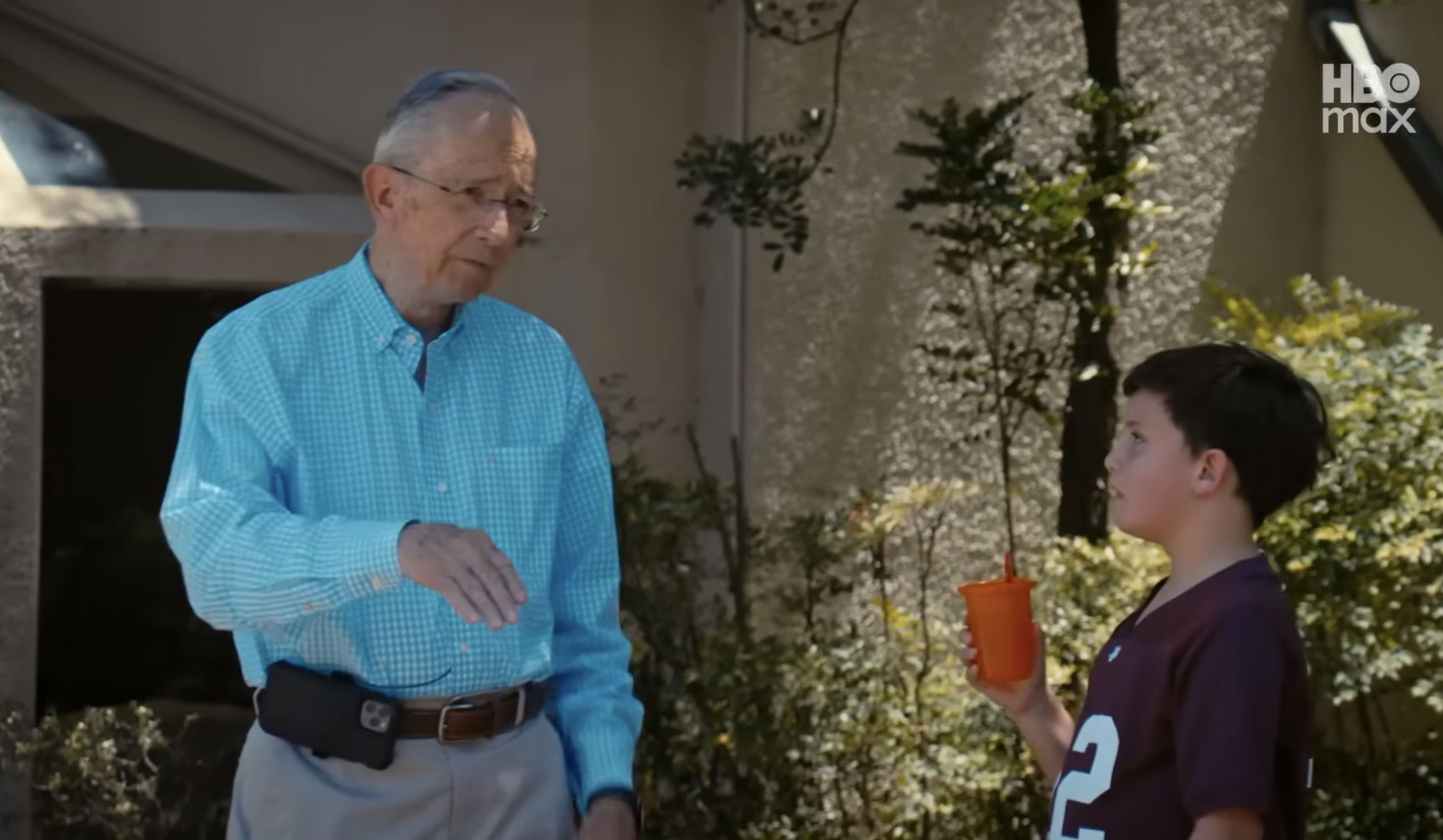 Jeff Wentworth and his grandson Warren discuss the offending fence across the street. (HBO)
Wentworth is clearly in the wrong here. Sure, any giant wall is bound to be a little displeasing to the eye, but at least this one seems to match the neighborhood color scheme. His actual concern is that his neighbor might be doing something nefarious over there, behind the wall, where he can’t see; really, it’s a complaint about his ability to keep an eye on everyone and everything. And frankly, like the child said, it’s none of his business. (It’s even more ironic because Wentworth is the very senator who authored Texas’s “Castle Doctrine” bill, a law that expanded Stand Your Ground laws to allow Texans to use deadly force against intruders. What is a wall if not a fortress to protect your castle from invasion?)
Using the process of elimination, we naturally assume that Wentworth’s neighbor, Alexa Person, must be the reasonable one. She pokes fun at her neighbor’s “organized crime” accusations by driving a blacked-out Escalade and wearing a floor-length fur coat to grab the mail, and we think: Hell yeah, show that uptight old guy who’s boss! Then she starts talking. It turns out Person is a self-described “alchemist” who genuinely believes she is a blue-skinned alien sent to Earth. As a motivational speaker and the author of several self-published books, including The Zero Point: The True Story of A Woman’s Cosmic Journey with Star Beings, she’s dedicated her life to “helping Starseeds activate their earthly mission by remembering who they are.”
Person doesn’t want the fence to protect her privacy after all, but to ward off the “dark spiritual energy” of her neighbor Wentworth, who she believes is a devil-worshipping Freemason.
Ultimately, bureaucracy prevails, and the local City Council orders Person to demolish the wall. She is distraught, weeping in agony when the bulldozers arrive. As the viewer, you know that her fears are unfounded: the fence was only a slab of concrete, not some spiritual shield, and Wentworth has no desire to steal her organs or direct a cabal of baby-eating elites into her yard. He’s just a nosy old man who feels strongly about HOA regulations.
But Person is clearly unwell, in a way that her wealth provides no relief from, and her torment is visceral and hard to watch. She finds the world terrifying, so much so that she truly believes she is not from this planet; a lost soul cursed to walk Earth, surrounded by evil entities out to harm her. The fence was merely a Band-Aid, and whatever ails her will require much more serious treatment.
We see this again and again in the show: people whose obsession with security and safety is merely a byproduct of their apparent mental health issues. Were Person preaching her blue-skinned-alien theories from a street corner, most people would dismiss her. But she clearly has access to money, and when the fence falls, she pays a nurse to come to her house and deliver an I.V. transfusion of “Vitamin B12, Toradol, Benadryl, Reglid, Zofram, Pepcid” and magnesium to ease her anxiety. As the dubious cocktail is injected into her veins, Person tells the young woman: “I’m clearly under a spiritual attack.” In America, the mentally-struggling poor are left to fend for themselves, while the wealthy can pay to have their delusions confirmed. Often, neither receives the help they need. Shortly before the show premiered, Person put her now-fenceless house on the market for just under $4 million.
The final episode of Neighbors offers a fleeting glimpse of hope. We meet 72-year-old Danny, a lifelong San Diego resident whose neighbors are horrified by his habit of jogging around town in a yellow thong bikini. Fed up with the constant complaints, Danny embarks on a cross-country journey to Florida, where he's been invited to a place that might finally accept him: the clothing-optional Eden RV Resort.
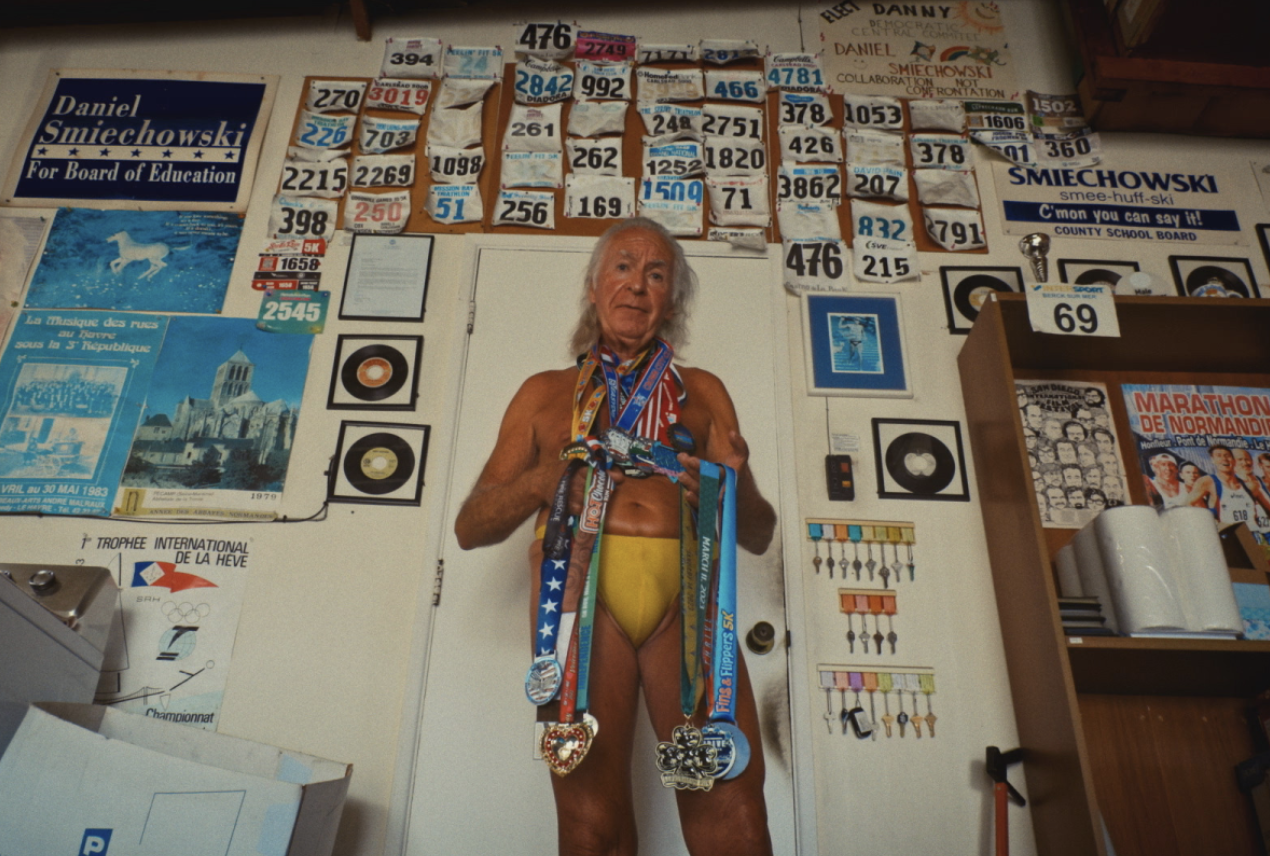 Danny Smiechowski, wearing his signature outfit, shows off his marathon medals at his San Diego home.
He arrives, and it’s heaven. The California outcast is immediately welcomed into the community. He practices archery with other residents, dives into the pool, and sings nude karaoke, all while people pat him on the bare back saying, “We’d love for you to move here!” Danny even gets to jog completely naked, which appears to be his life's calling. Watching him frolic, I was genuinely happy for him—at long last, somebody on this show had found a place where they belonged.
I was also struck by an amusing sense of déjà vu. Two years ago, while reporting a story about a nudist park in Louisiana, I spent a weekend among a remarkably similar crowd. The details were almost identical, from the karaoke night and the golf-cart tour of the grounds, to the full-time residents watering plants in the buff. At the end of my article, I even reached a similar conclusion, writing: “I’d expected to find a group of free-wheeling hippies. What I encountered instead was a group of people who’d found an unorthodox solution to the epidemic of adulthood loneliness.” For a moment, it seems as though Danny has found the same thing. It doesn’t take long, though, until he banishes himself from Eden.
One afternoon at the pool, Danny introduces himself to a young woman named Amanda: a college student who later tells the camera that she’s searching for a sugar daddy. Smitten, Danny takes her on one single dinner date, where they split a bowl of spaghetti and Danny proposes that she move into the RV park with him. Amanda says she’ll think about it, and within hours, he floods her phone with increasingly erratic messages. She ends the short-lived romance over FaceTime.
Danny responds by running dramatically into the street and cursing his own stupidity. Then he’s back on a plane to California.
You want to grab him by the shoulders: What are you doing?! That was the perfect place for you! Go back to the park! Of course that girl didn't want to marry you, she was 25! But what about all the other people you made friends with? What about the cute, perfectly age-appropriate older woman who sang a duet of "Take it Easy" by the Eagles with you?!
But his mind is made up: Danny is staying in San Diego, and this time, he's done playing Mister Nice Guy. He's going to keep jogging in his yellow thong, and he's going to take it a step further by going full-nude in his backyard. It's a frustrating ending, but also an honest one. Throughout Neighbors, people repeatedly choose stubbornness over connection, and resentment over reconciliation. Over and over, we watch characters so consumed by defending their little patch of territory—whether it's a beach, a fence line, or a Halloween crown—that they lose sight of the people around them.
Americans have been taught that what we own defines us. Without our property and possessions, we might as well not exist. That also means we’re never really safe: what can be purchased can be stolen, and very well may be, unless we defend it to the death. More than once in the show, a character is seen pacing the floor of their home, saying something like I know my neighbor would kill me if he could—all the while, they’re the one holding a gun. The series is compelling because it doesn’t suggest these people are monsters. Many are frightened, or simply desperate to feel seen. While their feuds are absurd, the desires lurking beneath them are familiar.
By the end of the show—out of spite, or unrequited horniness for a college student—Danny walks away from his shot at paradise. But for a brief moment, we get a glimpse at another possibility. In a show filled with fences, surveillance cameras, lawsuits, and imaginary enemies, the nudist park offers a chance at a different kind of life. Perhaps, one day, he’ll return.


%20(crop).jpg?width=352&name=wile-e-coyote%20(resize)%20(crop).jpg)