The esteemed TV naturalist has been widely celebrated as he reaches his 100th year, but his warnings about climate and biodiversity loss are being ignored.
Sir David Attenborough is beloved. The esteemed natural historian recently topped a list of the U.K.’s favorite “national treasures,” people who are so respected for their contributions to the country that the individual is no longer considered a mere person, and has become a kind of institution. At his recent 100th birthday celebration, tribute was paid to Attenborough by Barack Obama, King Charles III, Leonardo DiCaprio, and even Paddington Bear. His centenary received coverage across international media, with the New York Times noting he is “perhaps the world’s most celebrated naturalist.” (Never mind “perhaps.” What other naturalist comes close?)
Attenborough has earned that love largely by producing a remarkable series of television programs and books which all serve a single purpose: showing how extraordinary the natural world is, and teaching people about how it works. Attenborough has been staggeringly prolific, having served as a writer, presenter, narrator, or producer in over 150 wildlife documentaries, some of which contain dozens of individual episodes.
These films cover every aspect of the living world. His breakthrough series Life on Earth (1979) covered everything from fossils to bivalves to conifers to caterpillars to plesiosaurs to wombats to cheetahs to humans themselves. It debuted the first-ever footage of a living coelacanth and featured a now-legendary scene of Attenborough being cuddled and played with by gorillas. Since then, there have been series on mammals (The Life of Mammals), oceans (Blue Planet, Blue Planet II and the forthcoming Blue Planet III), plants (The Private Life of Plants, The Green Planet), birds (The Life of Birds), reptiles (Life in Cold Blood), vertebrates (Triumph of the Vertebrates), the polar regions (Frozen Planet), dinosaurs (Prehistoric Planet), and insects (Life in the Undergrowth). There are films on particular aspects of animal life, such as how animals use color (Life in Colour), the role of animal songs (Attenborough's Wonder of Song), evolutionary anomalies (David Attenborough’s Natural Curiosities), the stages of life (Life Story), the origins of life (First Life), adaptation (The Living Planet), hunting (The Hunt), raising young (Parenthood), behavior (The Trials of Life), and bioluminescence (Attenborough’s Life That Glows). There are series that go continent by continent (Africa, Asia, or Seven Worlds, One Planet, which covers all of them) and others that zero in on interesting places (Galapagos 3D, Madagascar, Wild Karnataka, Great Barrier Reef, Tasmania, Wild London, Wild Isles on Britain and Ireland, or Wild City on Singapore). There are documentaries that focus on particular species (The Penguin King, Superfish: Bluefin Tuna, Attenborough’s Ant Mountain, Humpbacks: From Fire to Ice) and one-offs like Attenborough and the Giant Egg (the egg of an extinct elephant bird). And of course there are the big sweeping epics, like Life, Our Planet, and the great Planet Earth (I, II, and III). His latest, Secret Garden, is on a smaller scale, looking at wildlife in British people’s backyards. (It’s charming, and you will be on the edge of your seat watching to see if Doris the duck successfully keeps all her ducklings from falling into the clutches of the river otter, or if a pair of blue tits can evade sinister neighborhood cat Mr. Fluffy.)
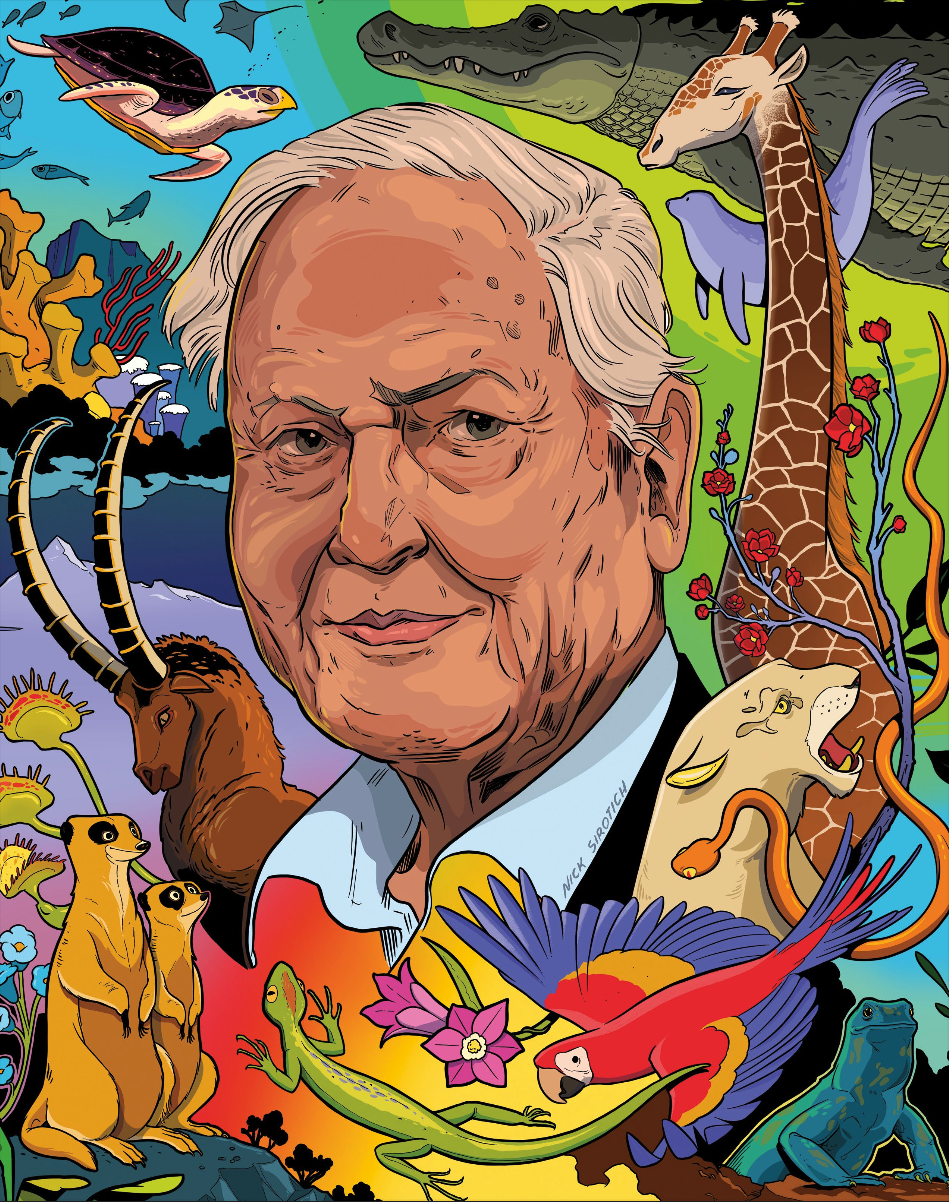
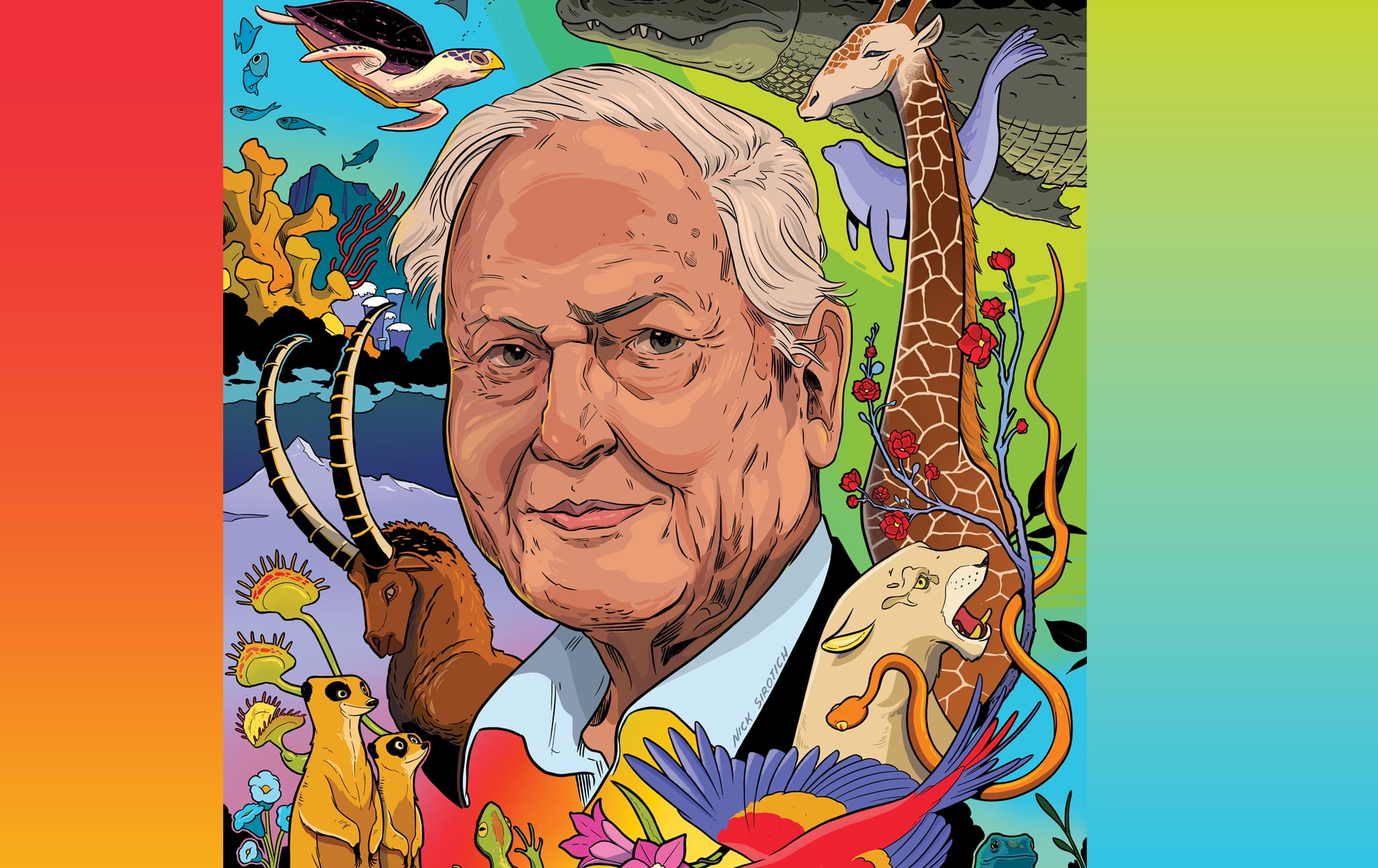
Art by Nick Sirotich from Current Affairs Magazine, Issue 60, July-August 2026
Of course, Attenborough’s degree of involvement with each film varies—some he only narrated, while others he also wrote and produced. But any way you look at it, it is a stunning filmography, especially considering that all those I mentioned have been released since Life On Earth, which itself came out when Attenborough was 52 years old. The amount of labor that could go into a single series is staggering. Life on Earth was filmed across 100 locations over 3 years, requiring input from 500 scientists. A retrospective on its production shows that one camera operator waited for hundreds of hours to catch a single second of footage of a Darwin’s frog releasing its offspring from its mouth. Planet Earth II required 117 different filming expeditions to 40 countries, with 42 different camera operators shooting 82,000 DVDs worth of UltraHD 4k footage.
At their best, Attenborough documentaries absolutely take your breath away, making you weep at what a miraculous, complicated, beautiful, terrifying, strange world we live in. The suspense of watching iguana hatchlings try to evade racer snakes matches the tension of any Hollywood spy thriller. Nothing can make you want to both laugh and cry like watching the tragicomic failure of a bird of paradise’s bizarre energetic mating display. And nothing will make you “aww” like seeing polar bear cubs take their first steps.
But Attenborough fascinates even when the subject matter is less explicitly dramatic. I recently watched the three-part Kingdom of Plants (2012), which takes place entirely at Kew Gardens in London. It’s a relatively low-key offering in the Attenborough catalog—he doesn’t traverse the globe, he just shuffles around his local botanical garden, 86 years old at the time, pointing out interesting things about plants. And yet it’s utterly breathtaking. The time-lapse footage of growth makes plants seem almost like a strange kind of animal, one that creeps and grasps and probes. He introduces us to genuinely stunning flora, from the mouse-eating giant pitcher plant (nepenthes attenboroughii, which is named after him) to pebble plants that are virtually indistinguishable from rocks. He shows us the century plant, an agave that stores up energy for years, then at the end of its life produces a giant, flowering 30-foot-tall spike before dying. He lets us witness the flowering of the colossal titan arum, which stinks like a corpse and uses a kind of heated smokestack to spread the stench for miles. He demonstrates the ingenious tricks that plants have developed for getting themselves pollinated, like spring-loaded devices that slather pollen onto insects, or the orchid that has a part that looks and smells like a female bee, so that male bees will, well, try to impregnate the orchid (not the descriptor Attenborough uses) and get covered in pollen. We go down into Kew’s fungarium, where Attenborough tells us the absolute horror story of the fungus that gets into an ant’s head and then bursts out of it, speeding up the footage so that the emerging fungus looks like a terrifying brain-eating monster (which it is). Even more nightmarish is the close-up footage of insects struggling to escape from the clamped leaf-jaws of the infamous Venus fly trap.
Attenborough is one of the few people to successfully use the medium of TV to make us more, rather than less, intelligent. He was trained in zoology and geology at Cambridge, and considered a career in the sciences—at one point he even resigned from the BBC to pursue a degree in social anthropology at the London School of Economics. He fell into television rather by accident. In 1950, while working as a children’s science book editor, he had applied for a job at BBC radio. He was rejected, but was asked if he might be interested in television instead. At the time, Attenborough had never actually seen a TV show before, and only became an on-air presenter after a show’s host became ill and needed a replacement. (After his first TV appearance, an internal memo said he was “not to be used again as an interviewer” because his “teeth are too big.”)
Attenborough spent much of his time at the BBC as an executive behind a desk, where he excelled at producing innovative, high-quality television. He commissioned legendary series from Kenneth Clark’s Civilization to Monty Python’s Flying Circus (he also, to his lasting shame, ordered the wiping of tapes containing the only recordings of some historic BBC programs). He oversaw the introduction of color television shows—in fact, weirdly enough, it is thanks to Attenborough that tennis balls are now yellow, after he suggested figuring out how to make them show up better on television. But Attenborough was horrified at the prospect of spending his entire life in management, and when it became clear that he would be offered the position of Director-General of the entire BBC, he decided to resign and make natural history films instead.
Thank God he did. These documentaries really are one of humanity’s great cultural treasures. Without them, millions of us would be totally ignorant of so much of the diversity and wonder of the natural world. Despite having gone through 25 years of schooling, and reading prolifically all my life, I never watch an Attenborough film without at least a few gasps of “How did I never know that existed?” or “My God, it can do that?” (For instance: the lyrebird that can convincingly imitate a chainsaw, a car alarm, and a camera shutter. Or the hawkmoth with a nearly foot-long tongue adapted for sucking the nectar from the bottom of a tube in an orchid.) This is genuine educational television, successfully (and entertainingly) getting audiences to appreciate and understand the planet they live on. Attenborough loves the drama in nature—hunting, striving, mating—but he returns over and over to Darwinian evolution and explaining how life became the way it is. He’s not just concerned with showing you a bunch of fascinating creatures, but teaching an understanding of the processes by which life develops and adapts. His interest in fossils borders on the fanatical, and upon revisiting Life on Earth, one is struck by how much the series focuses on evolution and changes to life over time rather than simply documenting the natural world as it is. Attenborough explains his interest in the science underlying life by saying:
I believed from a very early age that the most important knowledge was that which brought an understanding of how the natural world worked. It was not laws invented by human beings that interested me, but the principles that governed the lives of animals and plants; not the history of kings and queens, or even the different languages that had been developed by different human societies, but the truths that had governed the world around me long before humanity had appeared in it. Why were there so many different kinds of ammonites? Why was this one different from that? Did it live in a different way? Did it live in a different area? I soon discovered that plenty of other people had asked such questions, and had found a lot of the answers; and that these answers could be put together to form the most marvelous of all stories—the history of life.
In addition to teaching science, Attenborough also models a way of relating to nature that is infectious, admirable, and possibly even radical. He overflows with love and appreciation for animals and plants. “It seems to me that the natural world is the great source of excitement: the greatest source of visual beauty; the greatest source of intellectual interest. It is the greatest source of so much in life that makes life worth living,” he has said. As he began to present nature programs in the 1950s and ’60s, the naturalist’s own home in London became a menagerie, as he accumulated lemurs, parakeets, chameleons, and bush babies as pets. (He did have to get rid of the bush babies eventually, explaining: “They have an unfortunate habit of peeing on their hands, rubbing their hands together, and patting everything around to make [it] smell good. Friends coming to dinner would arrive and open the door and you could see them dilate their nostrils and think ‘that’s not Mulligatawny soup.’... I would regret to say that it was bush baby urine. After a bit my wife thought this was not compatible with domestic hospitality.”)
A cameraman for Attenborough recalls a moving moment in a rainforest at night, watching the octogenarian Attenborough play with a peripatus—the “velvet worm.” “You could see he adored this creature, this weird little worm crawling on his arm… He was clearly in awe of this thing.” Attenborough models understanding, appreciation, and respect for nature—all too rare in our era, when the Trumpian values of dominance and endless acquisition have displaced humility and awe.

Because he does genuinely love the natural world, as human activity has imperiled its survival, Attenborough has been forced to become more and more “political.” He did this with great reluctance. “I would much prefer not to be a placard-carrying conservationist,” he told Time magazine in 2019. “My life is the natural world. But I can’t not carry a placard if I see what’s happening.” He thought: “How could I look my grandchildren in the eye and say I knew what was happening to the world and did nothing?"
In fact, Attenborough films were long criticized for not emphasizing environmental destruction and the loss of biodiversity, with writer George Monbiot accusing him in 2018 of “knowingly creating a false impression of the world” by spending so much time on nature’s majesty rather than its collapse. Monbiot said he was “astonished by [Attenborough’s] consistent failure to mount a coherent, truthful and effective defence of the living world he loves,” accusing him of purveying “escapism.”
Perhaps Attenborough read the critique, because in the years since, his warnings about the catastrophic human destruction of the planet have become progressively more urgent. Monbiot called Attenborough’s 2025 Ocean “the film I’ve been waiting my whole career for” because it demonstrated the fishing industry’s decimation of marine life. Attenborough’s 2020 book A Life on Our Planet: My Witness Statement and Vision for the Future quickly dispenses with reminiscences about his long career and is mostly dedicated to explaining the terrible danger the planet is in and how we can address it. He calls the book the story of how we came to “make our greatest mistake” and “how, if we act now, we can yet put it right.” Attenborough explains:
The devastating scale of the catastrophe now forecast by mainstream environmental science is a direct result of the way we are currently treating the planet. Beginning in the 1950s after the war, our species entered what has been termed the Great Acceleration. Measures of impact and change across a host of parameters demonstrate a strikingly similar pattern when plotted on a graph against time. The trends in our activities can be expressed in terms of gross domestic product (GDP), energy use, water use, the building of dams, the spread of telecommunications, tourism, the spread of farmland. You can analyse the change in the environment in many ways—by measuring the rise of carbon dioxide or nitrous oxide or methane in the atmosphere, the surface temperature, ocean acidification, loss of fish populations, tropical forest loss. But whatever you measure, the line on the graph will appear to be much the same. From the mid century, it will show a sharply accelerating rise, a steepening mountain slope, a hockey-stick. Graph after graph after graph, all the same. This runaway growth is the profile of our contemporary existence. It is the universal model of the period of history that I have witnessed on Earth—the great underlying explanation of all the change that I report. My testimony is a first-person narrative of the Great Acceleration.
The die-off of living creatures has been horrifying. In North America, the bird population dropped by 3 billion individuals (nearly 30 percent), in just 50 years—half of Attenborough’s life. Across that same period of time, the average wildlife population dropped by nearly 75 percent. We are facing a global “insect apocalypse,” with catastrophic implications for plant life, and nearly 40 percent of insects may be facing extinction within a single human lifetime.
Attenborough explains what we are facing in stark terms. Within the next decades and century we could see: the irreversible dieback of the Amazon rainforest, droughts and water shortages across the globe, the total disappearance of Arctic sea ice, permafrost collapse, massive landslides, floods, and river rerouting, the destruction of almost all coral reefs, ocean acidification triggering catastrophic decline, a pollinator collapse destroying food crops and triggering a food production crisis, a quarter of humanity trying to survive in uninhabitable heat, up to a billion people displaced, more pandemics, sea level rise imperiling major cities, and the escalation of a mass extinction. It is a dire picture.
But Attenborough is not a pessimistic “doomer,” nor is he anti-human. “We must not give up hope,” he writes in his 2020 book. “We have all the tools we need, the thoughts and ideas of billions of remarkable minds and the immeasurable energies of nature to help us in our work.” But he makes clear that we are facing the most significant challenge in human history, and need to take it much more seriously than we are taking it. “We won’t be able to do enough to mend everything,” he says. “But we can make it a darn sight better than it would be if we didn’t do anything at all.”
Attenborough has made it clear that part of the problem is that there are powerful economic interests encouraging the continuation of destructive endless growth. “Perhaps the most formidable obstacle we face is the abstract force we
might call vested interests,” he writes, warning that the power of fossil fuel companies is a major obstacle that needs to be surmounted. Attenborough has even pointed the finger at capitalism itself, saying that “the excesses that the capitalist system has brought us have got to be curbed somehow,” which earned him the ire of the libertarian Cato Institute. While “many individuals are doing what they can,” he says, individual lifestyle changes can only get us so far, and “real success can only come if there is a change in our societies and in our economics and in our politics.” In A Life on Our Planet he recommends what some of those changes can be, including abandoning a growth-focused measure of human well-being in favor of something like Kate Raworth’s doughnut economics, which recommends trying to keep economic activity compatible with “planetary boundaries.”
In recent years, his language could not be more severe. “A crime has been committed” against nature, he says. And worse, “Even the biggest and most awful things that humanity has done, so-called civilizations have done, pale to insignificance when you think of what could be around the corner, unless we pull ourselves together.” Attenborough has asked: “Are we happy to suppose that our grandchild may never be able to see an elephant except in a picture book?” He says it over and over: “If we have not taken dramatic action within the next decade, we could face irreversible damage to the natural world and the collapse of our societies,” and “People who are going to be around in 10 years’ time, in 20 years’ time, will blame us profoundly if we don't do anything about it,” he said in a conversation with climate activist Greta Thunberg.
Yet no matter how many times, or in how many ways, Attenborough says that we have to get serious about the climate and biodiversity crises, his message hasn’t taken hold. In fact, there has been a marked decline in global attention to climate change, even as the time for action slips away. The Wall Street Journal hosts “experts” who say they have “stopped worrying and learned, if not to love, then at least to accept the limited cost of climate change.” Even many of those who once urgently pushed for a Green New Deal have backed off. Matt Huber, the author of an excellent 2022 book on how to combine class politics with climate policy, recently wrote for the New York Times that Democrats should just stop talking about climate altogether, while the influential blogger Matt Yglesias says that liberals need to embrace the fossil fuel industry. (Good news for the Matts: Democrats have already done both.) And even when there is attention paid to climate change, usually it is the costs to humans that are discussed; the loss of plant and animal life is considered virtually a non-issue.
Attenborough is beloved as a cuddly guide to nature’s wonders. When he starts with his warnings, he is still respected, but not listened to. Barack Obama is supposedly a huge fan—he invited Attenborough to the White House in 2015—but in office Obama essentially ignored the warnings of scientists and treated climate change as a secondary issue. The New Yorker published a pleasant tribute to Attenborough for his 100th birthday, but it devoted only a single paragraph to his central current concern, and noted that there have been “murmurs of complaint against this change of moral emphasis.” In 2023, his own BBC declined to broadcast an episode of an Attenborough series that focused on harms to the natural world, reportedly “because of fears its themes of the destruction of nature would risk a backlash from Tory politicians and the rightwing press.”

The combination of endless adulation for Attenborough and widespread indifference to his concerns leads me to think of him as being, from one angle, a rather tragic figure, who could almost be the subject of a myth or fable. I realize “tragic” may be a strange word for someone so successful. But consider: Attenborough has truly had everything a human being could hope for: an incredibly long, healthy life full of fantastic experiences. He has fame, wealth, and knowledge. He enjoyed good looks, a sense of humor, the love of the public, a sense of creative accomplishment, and produced work that will endure after his death. More than 50 organisms have been named after him! His life has also been well-timed; he happened to arrive at the BBC right after the invention of television, and so had the chance to be a pioneer in using the medium. If you asked a genie to give you the best life it is possible for a person to have, you might find yourself turned into Sir David Attenborough.
But in addition to all the joys, the genie’s gift of a perfect life would come with a terrible curse. If you become David Attenborough, your curse is that you would fall in love with the natural world, with all of its marvelous creatures and striking plants, and then you would watch as your fellow human beings slowly destroyed it all before your eyes. And you would realize that despite your celebrity and influence, on the one issue that had come to matter most to you, stopping this rampage, you were utterly and completely powerless.
Seen this way, it’s hard to be envious of Attenborough. He has watched as the thing he has devoted himself to protecting is erased bit by bit. And he is beloved by all, but his warnings themselves are waved away. Which raises the question: do those who purport to love Sir David Attenborough really love him? Or do they only love him as a kindly narrator about tree frogs, and tune him out whenever he starts talking about climate change and habitat loss?
If we respect David Attenborough, and I think we should, then we have to take him seriously. And what he has been saying is plain: if we like what he is showing us in his films, all the fantastic animals and fascinating plants, then we have an obligation to act to save them from the ravages we are inflicting. We humans are deadlier to our fellow beings than any invasive species has ever been, but we are also unique among species in that we have the capacity to choose to undo some of the damage we have done. Attenborough is pleading with us, at the end of his long life, to take the knowledge he has given us and use it to change our economic system so that it doesn’t exterminate the rest of life on Earth, and possibly ourselves as well. He believes we have the capacity to do this. “In my lifetime I’ve witnessed a terrible decline. In yours, you could and should witness a wonderful recovery.” But, he says, which path we take will depend on our choices: “The final chapter is ours to write. We know what we need to do. What happens next is up to us.”