
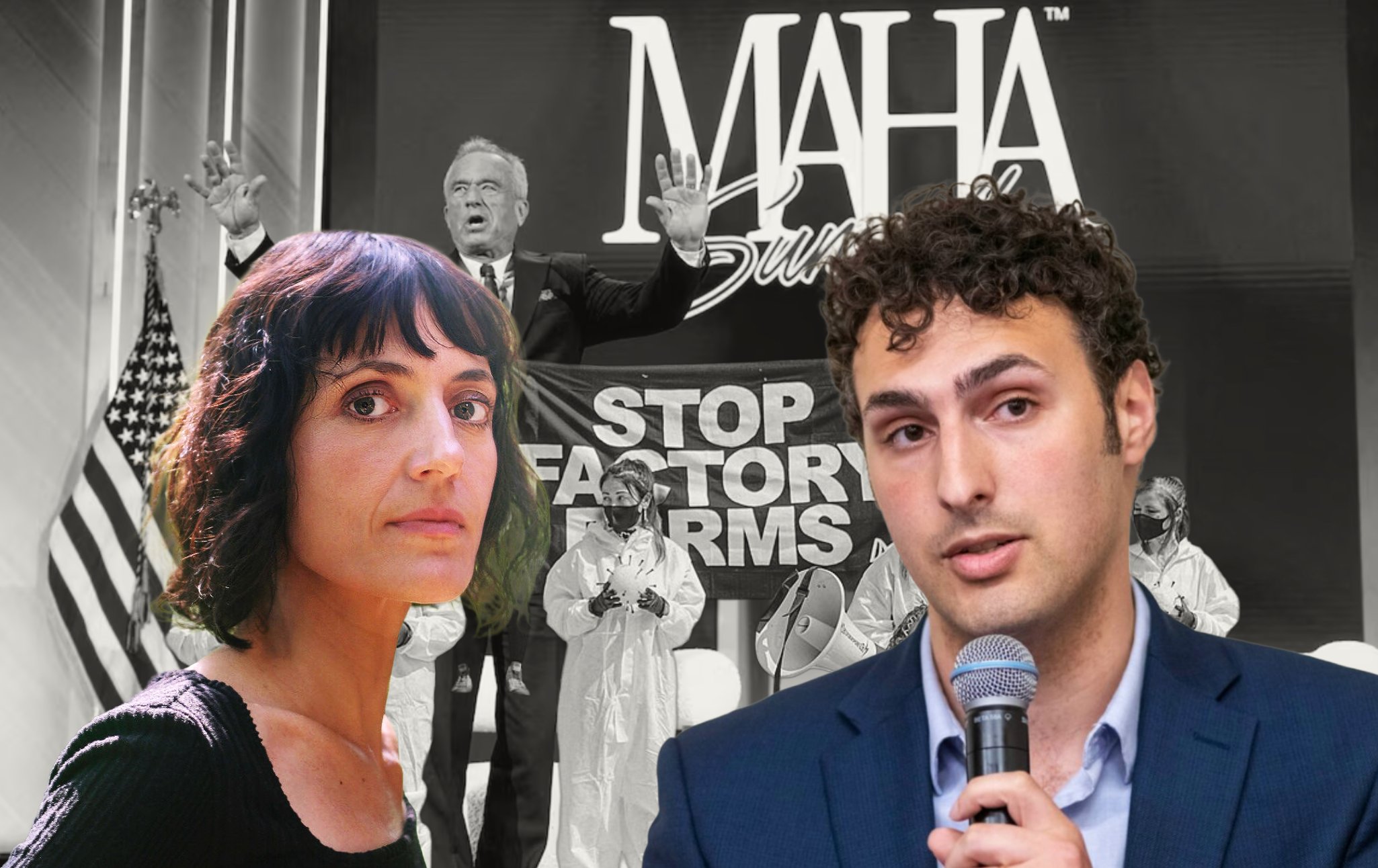
Astra Taylor and Aaron Regunberg explain how MAGA is weaponizing compassion for animals, and why the left needs to take the issue seriously.
As the climate crisis reaches new catastrophic heights—fueled by endless extraction, livestock agriculture, and corporate greed—it seems that animal welfare would be natural territory for the left. So why is the right increasingly claiming it as its own?
The journalists behind a recent piece in The New Republic titled "How MAGA Stole Animal Rights from the Left" might have the answers. Aaron Regunberg is a climate lawyer and contributing editor at The New Republic, while Astra Taylor is a writer, activist, and co-author with Naomi Klein of End Times Fascism. Together, they explain how the American right is seizing on a political vacuum created by liberals.
The authors joined Current Affairs to discuss factory farming, MAHA, the Green New Deal, and the politics of appearing “weak"—culminating in the frightening prospect of a far right that responds to a burning planet not by denying the crisis, but by embracing a new form of eco-fascism.
Watch the full conversation on YouTube below:
Nathan J. Robinson
We at Current Affairs cultivate a reputation as the most pro-animal of the major socialist magazines, and since there are only two major socialist magazines, all we have to do is write more articles about animals than Jacobin. But I should make it clear why we're here. We are here because the two of you have co-authored an article in The New Republic magazine called "How MAGA Stole Animal Rights from the Left and How We Can Steal It Back."
And so I think first, what we have to do is establish your premise here because people who don't pay attention to animal welfare fights and the internal discussions going on within MAGA might not know what you're talking about. You begin with the Ridglan Farms Beagle rescue, so maybe you could each start by telling us a little bit about what you noticed was going on with the right and how that led you to think there was something here that you needed to write about.
Aaron Regunberg
Astra's and my conversation actually started with some complaining about the left. And I think the initial sort of kickoff to our conversation was—if folks remember, a few months ago—this whole kerfluffle around Billie Eilish. She said some very great things about how it's not good to kill animals and faced this onslaught of negativity, including what felt like a bunch of left-leaning arguments about respecting cultures—just bullshit that felt annoying to us.
And for me, as I started thinking about this and looking into it, it just became very clear that there is this lack of taking seriously the suffering of non-human animals and the urgency of these fights in the left movement, as I've experienced it. And then Astra was really noticing something very different happening on the right.
Astra Taylor
Yes, I've been in this debate for quite a while. I've written a few pieces about why the left should care about animals from different perspectives. The Eilish moment—I had actually forgotten about that because she went so viral. And the response from people I ostensibly feel like I'm on the same side of was so negative.
Just to reiterate what Aaron said, it was like saying that actually caring about animals or being vegan or vegetarian is racist, is classist, is ableist, and is wrong-headed in a lot of ways. And I guess I felt like, "Just say you like eating meat. You don't have to like gussy it up so much." But meanwhile, I have been really following far-right politics because of the book I finished with Naomi Klein. So my whole feed is...fascism.
Robinson
Yes, the algorithm knows. This is what you want.
Taylor
The algorithm is like, "Let me be your research assistant." And what I was seeing, very surprisingly, were all of these sort of pro-animal tweets. It was a bit of a shift because I had written a piece a couple of years ago with my sister and tracked the way the right was engaging with animals, and it was much more the era of "the soyboy"—this era is not over, but carnivory and the kind of classic Americana red meat, milk-drinking machismo. And that felt kind of easy to track. That's right-wing politics.
Well, what I was seeing instead was people cheering on the end of animal testing. I was seeing prominent right-wing influencers talking about how the Republican-sponsored Save Our Bacon Act was actually going to harm sows in industrial pig farms. I remembered how before the 2024 election, Vivek Ramaswamy said something like, "Animal rights will be the next big issue for conservatives." And I remember at the time going like, "Ha ha ha, that won't happen," and essentially, I was like, "Oh my gosh! Maybe there was something there." And of course, I just want to say before I pass it back to you, I know they're hypocrites.
I know ultimately the fascists are fucking the planet, and that the things they're going to do are going to deregulate industrial farming and deregulate fossil fuels. They're getting rid of the Endangered Species Act. I'm not naive, but they do not have to be coherent to be effective in terms of their politics. And what I and Aaron saw and started going back and forth about was they are speaking to ordinary people's general concern and compassion for animals. They're kind of having their cake and eating it too, and that's not new.
Regunberg
And just on the hypocrisy front, the most obvious comparison here that we're drawing is with MAHA, and obviously, it's pure hypocrisy at this point. The Trump administration got legal immunity for pesticide company producers, sort of the apotheosis of everything MAHA was supposed to be against.
Robinson
Also, everyone has cyclospora now.
Regunberg
Right. But that doesn't that doesn't change the fact that political dynamic happened. Crunchy moms who hate Monsanto became a part of the Trump coalition that helped elect him. And what we're saying here is that there's a lot of signs that among people who care about animal rights and animal welfare, and that is a significant portion of the population, there could be a similar dynamic that could help the fascists and hurt both the left and the chances of the Democratic Party that we often have to to tie ourselves to and try to get over the finish line.
Robinson
Do you want to mention to us who P'Nut the squirrel was? Because this was a very prominent case in which the political lines got scrambled, and many figures on the right made a cause célèbre of a tiny squirrel in New York.
Taylor
This was as the presidential election was heating up in 2024. Some people in upstate New York had rescued a squirrel—I'm not sure under what circumstances—and he became a viral star and probably quite a big money maker for the people who had him. P'Nut the squirrel. And animal control came and took the squirrel and euthanized it, saying that it was a rabies risk and also that people shouldn't have wildlife as pets. I'm not sure what their position was on people having wildlife as social media stars. I haven't looked deeply into the machinations of that. I don't think people should have wild animals as pets as a principle. He became a cause célèbre. JD Vance said something about it. It was sort of like a trial run, or akin to "the Haitians are eating your pets and dogs" stuff. He was like, "The Democrats want to take your pets and your squirrels and invite immigrants in," and Elon Musk was like, "Vote for P'Nut," and he became the symbol of government overreach. Again, there were those echoes because of those lies Vance was telling about the cats and the dogs, which were overt dog whistle politics—this racism against Haitian immigrants.
I think it's important to note here that actually this concern for animals and even some concern for the environment actually has a deep history in fascist politics. It's true that if you go back and you look at the Nazi regime, they passed what were for the time some of the most effective animal welfare laws. So in their hierarchy of life, in their hierarchy of beings, some people matter. Heritage Americans and their heritage pets, the cats and the dogs—those animals and those people matter more than everybody else. And P'Nut the squirrel had been elevated to this category of mattering. And again, on the one hand, it's easy to say, "God, that's incoherent. They're full of it. They're hypocrites."
But what Aaron and I try to argue in the piece is that, especially with more recent developments, they're actually very strategically reaching people who care about animals. It is true most people are not vegan and not even vegetarian, but most ordinary people do want to mitigate harm to animals. They do feel empathy with some creatures. And the right is tapping into that because they know that they just have to sliver off small categories or subsets of people to win some tight races. It's a way for them to pass themselves off, I think, as compassionate in some ways. The last thing I'll say is in relation to the left, maybe they feel that they have such an excess of toughness that they can spare a little compassion for the animals, whereas I feel like sometimes some leftists are like, "Oh gosh, we're already the side that cares about the workers and trans people. If we care about animals, we're just going to seem even weaker and more like the soyboys they call us."
Regunberg
I keep bringing it back to MAHA, but it's worth just noting that phenomenon was able to happen because there was a vacuum that the right could step into. It is true that Democrats are not confronting Big Pharma in the ways they should. We're not standing up to shitty food manufacturers. There's a sense by people that this side's not doing it, and so they came in. And again, in our discussions for this piece, we noted that feeling big time in the animal rights and animal welfare movements. There are people who are feeling betrayed by the lack of prioritization for years and years that they've seen both from the left and again from the more institutional Democratic Party.
We talk some about the reasons that we think that could be happening. Astra mentioned the concerns about seeming weak. Even in our movement, I think there's a sense that caring about animals is this sort of individualistic life choice, and it doesn't get at the structural things that we should be caring about, like capital and labor and these more systemic things. I think one thing that people should understand is that these fights are completely systemic. They're completely structural, and in fact, taking on these fights fits in perfectly with the sort of populist anti-corporate agenda that we know is going to win us a supermajority, if anything can. These are big corporate bad actors that we're up against, and there's no inconsistency between fighting for working people and fighting against Big Ag folks like Tyson and others who are hurting people and animals.
Robinson
I was speaking with someone I can only describe as like a 60-year-old hippie woman; she had dream catchers and stuff. It was like I was speaking to one of the country's great clichéd hippie ladies. I love these people, and yet, it sort of scrambled my brain when she started talking and it turned out she was pro-Trump. I was like, "Something has broken in American politics."
But of course, she was an anti-vaxxer. She was a MAHA person. And I thought, "If we're losing the old hippie ladies, we've got a serious problem here." We published an article a couple of years ago called "How a For-Profit Healthcare System Generates a Mistrust of Medicine" that was arguing precisely this: that the failure of Democrats to take on corporate healthcare made it so that people distrust vaccines not because vaccines don't work but for reasons that kind of make sense given their own experiences with the healthcare system. That is to say, they don't trust anything experts tell them because oftentimes they've been told a pack of lies. So perhaps you could first expand a little bit on that because the MAHA analogy is so important here.

Regunberg
There's a similar dynamic where you have people who care about an issue, and that's both people for whom this is their number one issue and people for whom it's not their number one, but it's big. And by the way, I just saw some polling that over 50 percent of Americans associate themselves with or approve to some degree of MAHA and those ideas. "Make America Healthy Again" sounds pretty good. But again, you have constituencies that care about this stuff, and you have a similar situation where the side that is usually associated with it has not been doing the work and has not been showing that they're fighting and prioritizing these issues.
And so the far-right has just proven again and again they're really good at seeing a vacuum and filling it. We all saw it happen with Gaza. Trump was never going to be not awful and just as genocidal or more so than the horrors under the Democratic administration. But they saw this vacuum, and they're smart enough to step into it, and it was effective. It's hard to blame the people who were persuaded by that because their frustrations were very legitimate. And so again, what we are seeing is RFK Jr. has been a big voice in this. Astra mentioned the Ridglan protest. We think that's a really good example, and I can let her share more of the details around that. But we're seeing folks like RFK Jr. leading the charge and saying we're going to try to get rid of animal testing. We're seeing major right-wing influencers raising these issues much more prominently than we're seeing anyone on the left. And so, if you're someone who is out there and cares a lot about animals, where are you hearing about this issue that you care about? Who's being loud and out front on it? You're not going to be really associating with folks on the left or the Democratic Party right now.
Robinson
Yes, and I think we should obviously distinguish between the centrist wing of the Democratic Party and the left. But neither one of them has prioritized animal rights. We wrote a thing in Current Affairs in 2022. It kind of surprised me—I guess I shouldn't be surprised at this point—when California had passed some of its protections for pigs in pork farms, the Biden administration had gone to the Supreme Court and filed an amicus brief, trying to get the Supreme Court to overturn California's right to put in place regulations that would protect animal welfare. That was the Biden administration siding with the pork producers. You think, well, that really does open up a lane for for the right here. And then on the left, I don't tend to see people siding with pork producers, but I do tend to see a kind of deafening silence on the issue of animal welfare.
Regunberg
We talked before that Current Affairs is a leading voice on the left here, but for this piece, we want to be getting it out to left audiences. We're all very used to to criticizing centrist Democrats and knowing about all the ways that they suck, but we think this is one area where the left legitimately needs to do better. Again, we can talk about what the rationales are. But I've been in a lot of situations where it has felt almost embarrassing for me to state what I believe to be the importance of valuing and prioritizing non-human animals in left spaces.
Robinson
If we're going to make the case to leftists that this is really important, maybe you you could elaborate. You gave us a little bit before of why you think animal welfare should matter as an issue for the left. Why is it that leftists should see this as one of the things that we prioritize?
Taylor
There's always a political question: what should we prioritize of many policy issues or policy fights? I think I'm going to answer a bit more broadly, which is, why is this something that should be in our ethical universe and our circle of concern? I think there's actually a moral case, and then I think there's a really hard-nosed political economy case for this. One is just, I think, other beings suffer. That's kind of what the classic, almost utilitarian argument for animal rights is, or considering animals as beings with their own interests. I broadly see the left as the side that wants to mitigate suffering and doesn't believe in causing unnecessary harm. The science is constantly backing up the reality that animals are much more like humans than we think because we're animals. We're species that evolved alongside each other. I think there's just something wonderful about other kinds of consciousness and other kinds of life. So I think there's just a moral case.
I also think that part of being a socialist is criticizing commodification and criticizing capitalism. On what grounds can we commodify other life? Why should an animal be property? And you see that in our legal regime. Animals are things; they are owned, and they are commodified, as opposed to being recognized as beings with rights. And so, as people who are critical of property relations and private property and capitalist exploitation, I just feel like it makes sense to bring that lens to industrial agriculture and to our relationship with the natural world more broadly. I also just think we are in a climate crisis. We've entered a world where temperatures are outside the window of human civilization. That's reality right now. And one consequence of that is the fires we're seeing, the heat, and catastrophic biodiversity loss. We're in another great extinction moment. This is just materialism: we are not separate from the web of life that we need to sustain ourselves moving forward.
So I think there's just something deeply self-defeating about not putting other life forms in our moral universe. I could go on and on about this. I also think if you care about corporate concentration, you should care about these factory farms and these massive conglomerates that exploit animals, exploit human labor, and pollute the environment. Industrial agriculture and meat production are accelerating the climate crisis, which we absolutely have to pull back and slow down. And so, I just think there are all sorts of arguments. If you're coming at it from all the sort of angles that leftists kind of generally claim to care about, there are so many ways to tie the issue of non-human animals in there.
And just like I said, there's a deep tradition of fascists caring about some animals. There's actually a really deep tradition of socialists—the early socialists were often vegetarian. Troy Vettese has written some stuff for Current Affairs, including a great piece called "How the Left Has Failed Animals." I really admire the way he's always kind of reviving that early socialist history and saying these folks were intersectional before we used that word. They were like, "We're going to remake society, and that includes remaking our relationship with animals," and that history has been suppressed, but it's actually really deep. And so I see myself as on the side of reviving that and expanding it for this age of climate calamity, biodiversity loss, mass extinction, and a right that is threatening to steal our thunder.
Robinson
Yes, I do want to just plug Troy's article for our Animals Issue. We did a whole special Animals Issue last year, and it's available free on our issues archive. People can read the whole issue, but Troy's article in particular goes into the entire history of the left's relationship with struggles for animal rights, and it is, as you say, really fascinating. This whole debate has not just been in the last few years. He starts with France in the 1980s and the socialist parties' total lack of interest in animal welfare. And you mentioned there that socialists were often vegetarians. But then, of course, there were the macho socialists like George Orwell, who said, "Oh, these vegetarian cranks are undermining socialism," and we need to get what I think he called "the fruit juice drinkers" out of the socialist movement. And so there's always been that, and I think it's tied to toxic masculinity a little bit and tied to the lack, as you said, of the intersectional approach.
That is to say, there's always been a danger of socialist politics being reduced to the class struggle and to just caring about the factory workers and not paying attention to feminism or anti-racism. You can have a version of leftism that warps itself into being anti-immigrant, as the United Farm Workers had that problem. I think it's so crucial that the left recognize the interconnectedness of our various struggles and animal welfare because they can't speak for themselves; because they are the most voiceless of all the oppressed creatures in the world, it's so easy for them to slip out of our consciousness. Even though, Astra, as you said, anyone who thinks about the moral issue—when philosophers think about this—there are very few strong moral cases justifying at least the factory farming system as we have it today. Which is why it's put totally out of sight so you can't see it. Because the moment you think about it, it's just a horror.
Regunberg
They literally legislated it being out of sight. We've got these ag-gag laws because they know that when people see this shit, they have a problem with it. Because people care about this stuff! People are good!
Taylor
And again, I'm someone who thinks there's just lots of common cause to be made with people who want to end factory farming and concentrated animal feedlots and those things—the most extreme horrors. And to go back to the MAHA example, there's a real risk in leaving those vacuums. Ultimately, even if people aren't persuaded by the moral argument or by the climate argument or whatever, I think there is also just a hard-nosed political argument that if we aren't—"we" being broadly the democratic liberal left coalition—expressing concern about these issues, the right will, in its twisted way, fill that space.
I do want to say I was heartened this morning to see a news clip from James Talarico in Texas, who I'm sure people know. He was kind of on the back foot because he might have been a vegan at some point or something. The rumors are flying. Or maybe he's friends with a vegan. So he's running for Senate in Texas, which is a red state, and people like their red meat. And there was quite a kerfuffle because he went for a breakfast taco and ordered a potato and egg taco, and that wasn't the manly meat-eating order. But in this clip today, he was attacking his opponent Ken Paxton over Paxton's record of supporting animal testing—unnecessary, torturous animal testing. And Talarico was just like, "I stand up for all Texans, including the four-legged ones." And I thought it was a refreshing way to fill that space. He's positioning himself as a compassionate person, and I was impressed that he wasn't running away from those attacks and trying to prove his bona fides by never saying the word "animal" or "dog" or "animal testing" or something like that. So he's pointing a way forward that I think has some promise.
Regunberg
It's just so much more effective to say you believe in something and you're going to fight for it than to run away and make yourself seem weak and untrustworthy—as someone you can't trust to stick with whatever they're going to do. That was exciting.
We are seeing in this cycle the inverse a lot as well. The Republican Party has been attacking, dishonestly, Abdul El-Sayed for euthanizing too many dogs in in Detroit, which is bullshit. But again, they're doing it because they see political hay out of this issue, and so our side should see political hay out of the issue too, as Talarico hopefully is doing.
Robinson
Abdul's record in the Detroit animal control is actually something he should be forward with because he put a former director of the Humane Society in charge of this broken animal control department precisely to bring down euthanization rates and get more pets adopted. He changed the name to Animal Control and Welfare and totally reoriented their approach. So it's something that he's got a lot to be proud of.
But I do think there are ways in which even he, not on this issue, can be defensive when the right makes accusations on issues that we should be confident and aggressive on. So when he was accused of wanting to ban gas-powered cars, he'd be like, "I love cars." We can make the case for electric cars. We don't have to accept the right's framing. Otherwise the right is going to have electric cars. They've got the Cybertruck! Their macho electric car. We really need not to let them put us into a defensive position on issues where we're correct. And animals—yes, praise to James Talarico on this thing. But I know a lot of vegans were very disappointed when he had a statement where he said, "I deny all accusations of veganism. Our campaign runs on barbecue."
Taylor
Oh, you're right. I forgot about that.
Robinson
And that's the sort of thing where it's like, what? That's totally gratuitous.
Taylor
I agree with you.
Robinson
You don't have to do, "How dare you accuse me of being vegan? I'm a real Texas man." Don't let them define you that way!
Taylor
To this point of consistency, I think we're in a moment of backlash. But then the question is, well, how successful is the backlash going to be? And it's less successful when you hold your ground, and also people trust you more, as Aaron said, when you're morally consistent. Show people who you are over time and that your values don't change. And so there have to be better ways of threading that needle and saying, "Yes, we're ultimately going to have to go to electric cars."
Regunberg
They're better fucking cars!
Taylor
How about no cars?
Robinson
Actually, we've talked a lot about this animal welfare issue, which I think is incredibly important, and I do think the left should lead on it. A case that we sort of hammer over and over and over in Current Affairs is animals matter. But since we have you here, Aaron, you're a climate lawyer—and actually this relates to a lot of stuff you've written too, Astra—I wanted to mention that there has been a little bit of a frustrating drift on climate on the left. The animal welfare issue really never appears in the pages of Jacobin or whatever, but climate is still fairly important to people. But the last few years have been very disturbing. The climate crisis has escalated in ways that I think were anticipated by anyone who was paying attention to the scientific reality. What we've seen in Europe over this summer has horrified a lot of people.
But even in the left press, the climate is almost treated as a kind of secondary thing, and the Green New Deal is never spoken of as the top issue anymore. And so I wonder if we could talk about this parallel here. Now, this is not an issue that I think the right is going to lead on necessarily, but can we talk about the need for the left to adjust a little bit on climate as well?
Regunberg
The climate hushing push is so infuriating and so bullshit, dumb, and dishonest. The folks who are doing it—and most of these folks are corporate-funded centrist think tanks like Searchlight, Third Way, and WelcomePAC. But there are voices on the left. I've gotten into lots of fights with Matt Huber.
Robinson
Oh God. He wrote a whole book on climate change as class war.
Regunberg
Right.
Robinson
Two years later he's like, "No, don't talk about it."
Regunberg
Climate's popular. Most people want climate action. People are increasingly concerned about the realities of climate change. They're making the connections. There's a big disconnect between how people feel and how people feel the rest of everyone feels. Most people care about climate, but when you ask them, "Do most people care about climate?" most people say "No." And so there is so much potential on this issue. We're talking about powerful corporate interests that lied to us to make trillions of dollars, knowingly fucking us over, and we are now experiencing it in very material ways. Last month there was the crazy hazy orange sky from the smoke from the Canadian wildfires, which used to be an unheard-of thing—that was something that had never ever happened before, and now it's happening every year. People notice that change.
I just remember having this conversation with my five-year-old son, who's like, "Can we go outside?" and having to be like, "No, you can't go outside today. It's not safe for you to breathe outside." And you think about how many millions of parents were having those kinds of conversations, and the idea that it is not politically useful to prioritize that—
Robinson
To mention the thing that's keeping you from going outside!

Regunberg
Right! And to say that their side is behind this? To say that these cucks for big oil want to sell off your kid's future? You talked about electric cars. We also have this very great affirmative case now. The cheapest way to produce electricity is to point a piece of glass at the sun. The nice thing about sunlight is that it doesn't have to go through the Strait of Hormuz. Nice thing about wind is no one ever started a war for it. The clean energy transition is good for everyone except for Big Oil and their politician puppets, and so the idea that we would back off this and would accept Big Oil's and MAGA's frames on all these issues is morally disgusting.
Even if this stuff weren't popular, we should be prioritizing it because it's literally a question of, can this planet maintain organized human civilization? But we don't have to worry about that because all of this stuff is politically advantageous. We just need to actually talk about it in the right ways and lean into it.
Robinson
To conclude, you've talked there about why climate is a winning and important political issue and why it's insane, given that this is the defining issue of our historical moment here on this earth, to not make it like one of your top priorities.
But Astra, I haven't gotten a chance to read your book yet because it just arrived. We often say it's "socialism or barbarism," and I take it that a lot of what you write in this book and in your analysis of the right is that they're not going to suddenly embrace solar power, wind power, or the Green New Deal. Instead, the right-wing reaction as the world continues to unravel is probably going to be a lot more dangerous and terrifying and apocalyptic. And maybe you could give us a little preview. We'd love to have you and Naomi Klein on at some point to discuss the book. But maybe you could give us a little preview about if we don't do what Aaron says, what we might be facing on the other side.
Taylor
I think we're already facing it. Our argument is you cannot understand the contemporary manifestation of fascism without taking into account all the crises that are roiling our world. Climate being one of the top ones. There is an idea that we need to really update, which is this idea of the climate denialist, who's like, "It's not happening." That is still very active. You see it in the Trump administration when they're erasing climate from websites, scrubbing that language, making it illegal to say certain words, getting rid of institutions that allow us to track changes, and destroying science.
So that's all there, but I think there's another thread, which is essentially ecofascism. It is real, and it's quite pronounced in Europe at this moment, where you see a real acknowledgement that the planet is burning—an explicit statement. So, for example, the new leader of France's National Rally has said, "The border is our climate policy."
Robinson
Good luck with that when the whole country's on fire.
Taylor
But the point is that what they see is, yes, the climate is changing. We are going to actively deregulate the fossil fuel sector. We're not going to respond by trying to mitigate harms. We're going to respond by pouring gasoline on the flames and then wage war on immigrants and try to bunker down and fortress the walls. And so that barbarism is already happening. We call it end times fascism. Ecofascism is part of it. It's gaining a foothold. And 10 to 15 years ago, it was a bit speculative. It was like, what if the response from the right to climate change is actually an acknowledgement of it? And it was quite a fringe phenomenon.
My parents live in North Carolina, and I remember—it was sort of COVID times-there were these small right-wing groups in the state, and one of their slogans was "green futures for white babies." This was real but very marginal. I think there's a world where that becomes much more mainstream politics, and it's incredibly terrifying to think of it. These crises are just going to embolden the far right. I really do think the choice before us is eco-socialism or fascism or barbarism, and that's why I think it's incredibly important that we actually say, "No, the Green New Deal was the right idea." We're not abandoning that framework because it was a holistic framework that provided green jobs that would decarbonize, democratize, and decentralize the power industry. That's right. That's the vision, and I think we have to stay consistent, stay true to it, and expand on it because it's what our times call for. We have to meet the scale of the crises we're in; if we don't, the right's only going to get stronger.
Robinson
I've been excited by all the victories of left candidates over the course of this year. In many ways, it's the most encouraging political moment of my life. I was delighted to see Mamdani win, but I have to note that the word "green" did not appear in the Mamdani agenda. The same is true with Abdul's core platform. I like Abdul. He's written for our magazine. We've watched his rise with excitement. But the climate silence is, as you say, not just coming from Matt Yglesias. AOC kind of stopped talking about the Green New Deal too, and it's been a little weird. Jacobin has been publishing less and less about it. This is the defining challenge of our time!
Taylor
Sixteen thousand Europeans died in a single week this summer from excess heat. As Aaron said, millions of parents had to keep their kids inside. It's irrepressible, and so it's better to face that fact. This is not something that can be repressed, and if it is, it will come back in a really dangerous fascist way.
Regunberg
And I think it's worth saying that because there's a strain of this argument that we should do climate policy, not climate politics.
Robinson
Sneak it in there.
Regunberg
Yes, we can solve the problem without talking about it. To be fair, we have the wind at our backs now. As socialists, usually we can't trust the free market system to help us with problems. The economics are so good. Clean energy is just a lot cheaper now that there will be some improvements just sort of naturally from that. But the idea that we could possibly have the pace of transition that we need up against the power of the entrenched incumbent industry and other players who are trying to stop it—the idea that you could achieve that without explicitly building a political constituency that's demanding these things is not based in reality.
And so, again, if we want to maintain organized human civilization on this planet, we need to talk about this shit. We can talk about it in ways that are maximizing how politically potent these messages are, but you're not going to solve the biggest problem ever obliquely or silently. It's just it's never happened.
Robinson
It's a very paradoxical idea that you can solve a problem while never talking about it.
Taylor
Yes. Organizing is about framing issues and meeting people where they are and presenting credible alternatives. So I think the moment for climate populism, for connecting the dots between climate resilience and affordability, and also for tying it to the anti-war politics that are very strong in this moment—there are so many ways to connect these in a way that ties to people's immediate lives and immediate concerns and their anger at the establishment. It just seems ridiculous to not do that and also condescending, as though you slip it in there—as though a kind of back door technocratic politics is what this moment calls for when people can see with their own eyes that places are literally on fire.
Regunberg
If we're not saying it, if we're not doing that, then their side is. No prominent voices in the Democratic Party were upfront talking about the smoky skies and the fires from Canada, and so what was the main discourse about? It was Trump and MAGA saying it's Canada's fault and Canada needs to rake the boreal forests. And we saw that with the LA fires. No one was stepping forward to fill that vacuum with the reality that Big Oil did this—let's be mad at them. And so the right filled it with "it's DEI" bullshit. And so, if we're not doing this stuff, they're going to.
Robinson
It's such a winning issue because Trump and his cronies are literally destroying your children's possibility of a livable future. I don't think it's a good idea to just not mention that.
Regunberg
To line their own pockets and make you pay more than you could otherwise. It's just across the board.
Transcript edited by Patrick Farnsworth.

%20(crop).jpg?width=352&name=wile-e-coyote%20(resize)%20(crop).jpg)