By pairing scientists with “mentors” from the industry, beef producers distort the field of climate research and foreclose any possibility of limiting their growth.
There is a word the beef industry uses constantly, in its promotional materials, in its research funding announcements, in its government lobbying, and increasingly in the peer-reviewed literature produced by the scientists it mentors: “sustainability.” It appears in the name of the Canadian Roundtable for Sustainable Beef. It appears in the title of reports assessing the sustainability of Canadian beef production. It appears in editorials co-authored by government researchers arguing that the beef cattle industry has a “crucial role” in “ecosystem sustainability.” But the industry means something specific by “sustainability.” It means the sustained profitability of the beef industry. The project of the last decade of industry-funded climate research has not been to make beef production environmentally sound. It has been to redefine sustainability itself, so that the continued growth of the industry counts, automatically, as a sustainable outcome. It has made one question nearly impossible to ask: Should we raise fewer cattle? Here is one part of how they are doing that.
“Mutually Beneficial”
Why is there a program where the beef industry mentors scientists studying animal agriculture's effect on the climate?
The Beef Cattle Research Council (BCRC) is an industry-led research-funding organization operated as a division of the Canadian Cattle Association. Despite the name, it is not governed by scientists. It is governed by a council of cattle producers. Its money comes from the beef check-off, a mandatory levy on cattle sales—a government-mandated fee that doesn't go to a public body at all, but to private organizations whose job is to grow the industry. The check-off raised more than $18 million in each of 2019–20 and 2020–21.
The BCRC runs a mentorship program that pairs early-career researchers with feedlot operators, industry executives, and the directors of cattle trade associations. The program is broader than the cases examined here. It also pairs researchers with academics, veterinarians, extension specialists, and conservation professionals. My concern is narrower: what happens when scientists studying cattle’s climate impact are mentored by people whose businesses and organizations depend on cattle production?
The program does not hide its purpose. By its own description, it exists to "align research interests with those that are practical and beneficial to Canada's beef industry." That is not my characterization. It is the first goal listed on the program's webpage. Here, see for yourself:
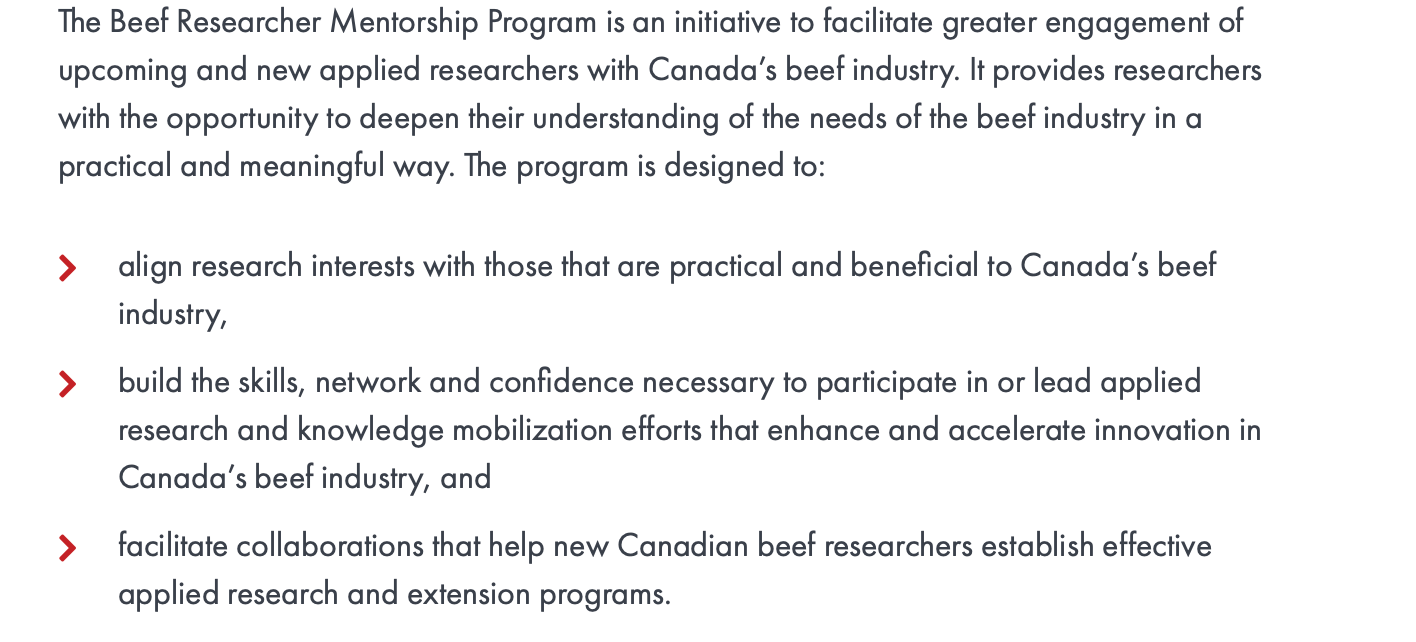
[Figure 1. The stated goals of the Beef Researcher Mentorship Program. Source: Beef Cattle Research Council. (n.d.). Beef Researcher Mentorship Program. Retrieved February 15, 2024, from the Beef Cattle Research Council.]
To be clear: this is not a program where climate scientists advise the industry. It is the reverse. Feedlot operators and trade association directors are the mentors. Government climate researchers are the mentees.
Andrea Brocklebank, executive director of the Beef Cattle Research Council, explains the appeal in the program's promotional video. Researchers who become "part of the family," she says, get “a really big leg up.” And the effect is visible: “When they are applying, we see it in their proposals.”
This is not corruption in the ordinary sense. No one is taking a bribe or falsifying a number. The researchers named here may be doing careful, honest work—that is actually the point. What's at work is something subtler and more durable: a system that rewards researchers who frame their work in the industry's terms, and quietly strands the ones who don't.
The BCRC calls this arrangement “mutually beneficial.” Beneficial to the cattle industry because it shapes the research agenda of the next generation of scientists. Beneficial to the academics because it opens doors to funding, facilities, and professional networks. One participant, Robert Gruninger, a government research scientist at Agriculture and Agri-Food Canada's Lethbridge Research and Development Centre (AAFC), is quoted on the program's own webpage: “For me, the knowledge that I gained from the mentorship program has been invaluable not only for me being able to get the job that I'm in, but also to be successful in securing funding that has relevance to producers.” Note what the BCRC chose to feature. Not funding relevant to the public, or to the climate. Funding relevant to producers.
A government research scientist is publicly crediting an industry-funded mentorship program with helping him get his government job—and the industry is featuring the quote in promotional material. Ask yourself: would a scientist at the Environmental Protection Agency say publicly that a petroleum-industry program helped him get hired? (Well, maybe in Donald Trump’s EPA.) Would an FDA researcher say the same about a mentorship program run by tobacco companies?
One possible defense is that the AAFC openly acknowledges that its research centers work to benefit Canadian farmers and industry. But AAFC also identifies climate change and the environment as priorities. That dual mandate is the problem, not an answer to it: the same government department that conducts research intended to assess and reduce agriculture’s environmental harms is also charged with promoting the industry’s competitiveness and growth. Call it the presumed innocence of animal agriculture: A conflict of interest that would raise immediate concerns in tobacco or fossil-fuel research is treated here as ordinary.
No one seems to see a problem with the same government organization funding research into an industry’s harms while promoting that industry. No one seems to see a problem with an industry-funded mentorship program helping researchers obtain government employment. No one seems to see a problem with the BCRC stating on its website that the program’s goal is to “align research interests with those that are practical and beneficial to Canada’s beef industry.”
At the state, academic, and policy levels, what would be viewed as a conflict of interest in other contexts is presumed innocent when it involves animal agriculture. The underlying assumption seems to be that, of course, everyone should be working to grow animal agriculture.
Collaboration between researchers and practitioners is common and often unobjectionable. Health researchers work with clinicians, and no one minds, because whether medicine should exist is not the question under investigation. Beef production is not in that position. Whether Canada should raise cattle at current levels is exactly what the climate literature is asking. A mentorship program premised on the industry’s growth does not answer that question. It excludes the question from the research agenda.

Telling the “Good News”
The mentorship program does not falsify data. It doesn't need to. It selects which researchers get access, and the access does the rest. The pattern is not subtle: Industry-mentored researchers have argued that brown coal belongs in feedlot manure for environmental reasons, that performance-enhancing drugs in cattle—including steroids—are a net positive for environmental sustainability, and that Canada should raise more cattle, not fewer.
Research produced inside this system can be technically sound. The problem is the frame. The work is organized around one question (how can cattle production continue while becoming more efficient?) and that question settles the possibility of producing less beef before any research begins.
Take Stephanie Terry, a research scientist at the Lethbridge Research and Development Centre who studies greenhouse gas mitigation in beef production. In 2021, the BCRC paired her with two mentors: Christine Rosser, a ruminant nutritionist, and Ryan Kasko, CEO of Kasko Cattle Company, a feedlot operation with 45,000 grain-fed cattle. Kasko is also a former chair of the Alberta Cattle Feeders' Association.
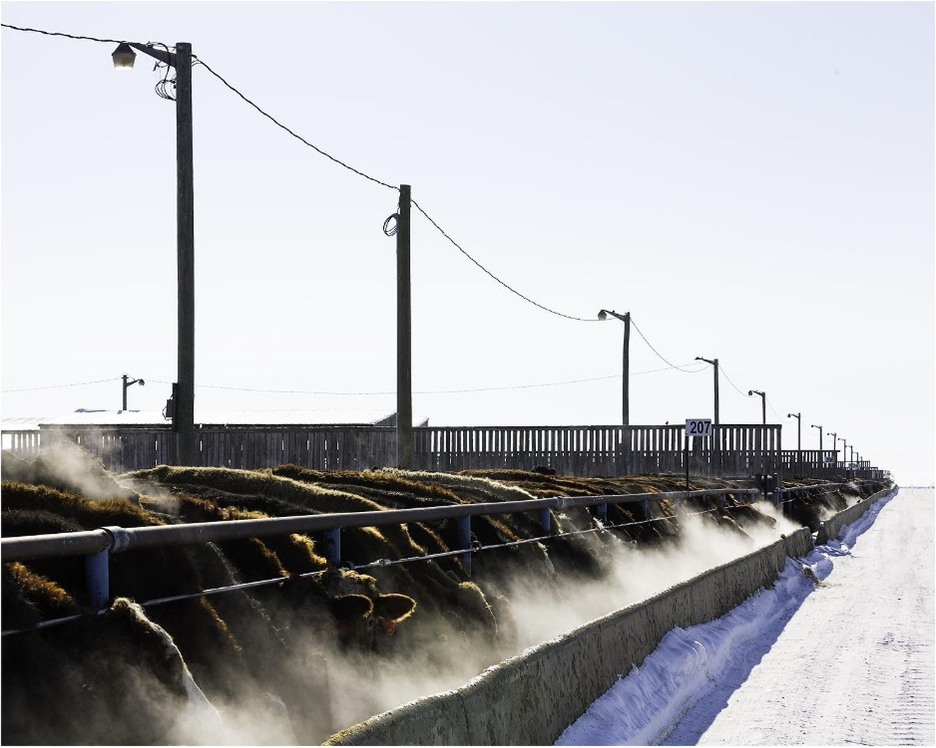
[Figure 2. Kasko Cattle Company feedlot showing cattle at a feed bunk. Source: Kasko Cattle. (n.d.). Photo gallery. Retrieved February 2023 from Kasko Cattle Company. Photographer not identified.]
In 2022 Terry co-authored a paper on methane variability in feedlot cattle. It opens with the Global Methane Pledge: more than 120 countries and other parties committed to cutting methane emissions 30 percent below 2020 levels by 2030. It then invokes the goal of limiting warming to 1.5 degrees Celsius. Neither is an emissions-intensity target. Both concern the total amount of warming produced.
Then the paper turns to solutions. “The main mitigation solutions proposed,” the authors write, “are intensification of animal production, dietary manipulation, alteration of rumen fermentation using feed additives, immunization, and genetic selection of low CH₄-producing animals.”
Every item acts within cattle production, by lowering emissions from individual animals or producing more beef from each unit of methane. None addresses the scale of production. The paper begins with an absolute climate problem and then surveys a solution space in which the number of cattle is fixed.
Terry was also a co-author on a subsequent editorial affirming the “crucial role” of ruminants in “ecosystem sustainability” followed immediately by the nutritional case for meat and dairy. In place of any decrease in the number of cows raised for slaughter, the editorial framed feed additives as the route toward the beef industry's own carbon-neutrality target for 2050, including options such as feeding palm kernel cake to buffaloes.
Terry also served as rapporteur at a workshop on reducing greenhouse gas emissions from livestock production, held under the Canada-European Union trade agreement and funded by the EU. The outcomes report runs to 14 recommendations. Not one of them involves raising fewer cattle. It did recommend better messaging: Industry stakeholders, the report says, “need to develop clear and positive messaging regarding the use of new products and technologies, such as feed additives … Messaging must be deliberate and highlight the environmental benefits.” Feed additives are Terry's field of study.
Under a heading marked “Public Messaging,” the report calls for telling consumers the “good news” stories about the industry, and it specifies where to start. “Outreach on the benefits of the livestock industry,” it states, “can begin in the school system by teaching students more about the sources of their food.” The formal recommendations call for embedding lessons on livestock production, including “the environmental benefits of the industry,” in public-school curriculums. The workshop on cutting emissions ended with a plan for what to teach schoolchildren.
It wasn’t hypothetical: Guardians of the Grasslands, the documentary the report held up as a model of good-news storytelling, comes with a classroom package. It includes a true-or-false worksheet.
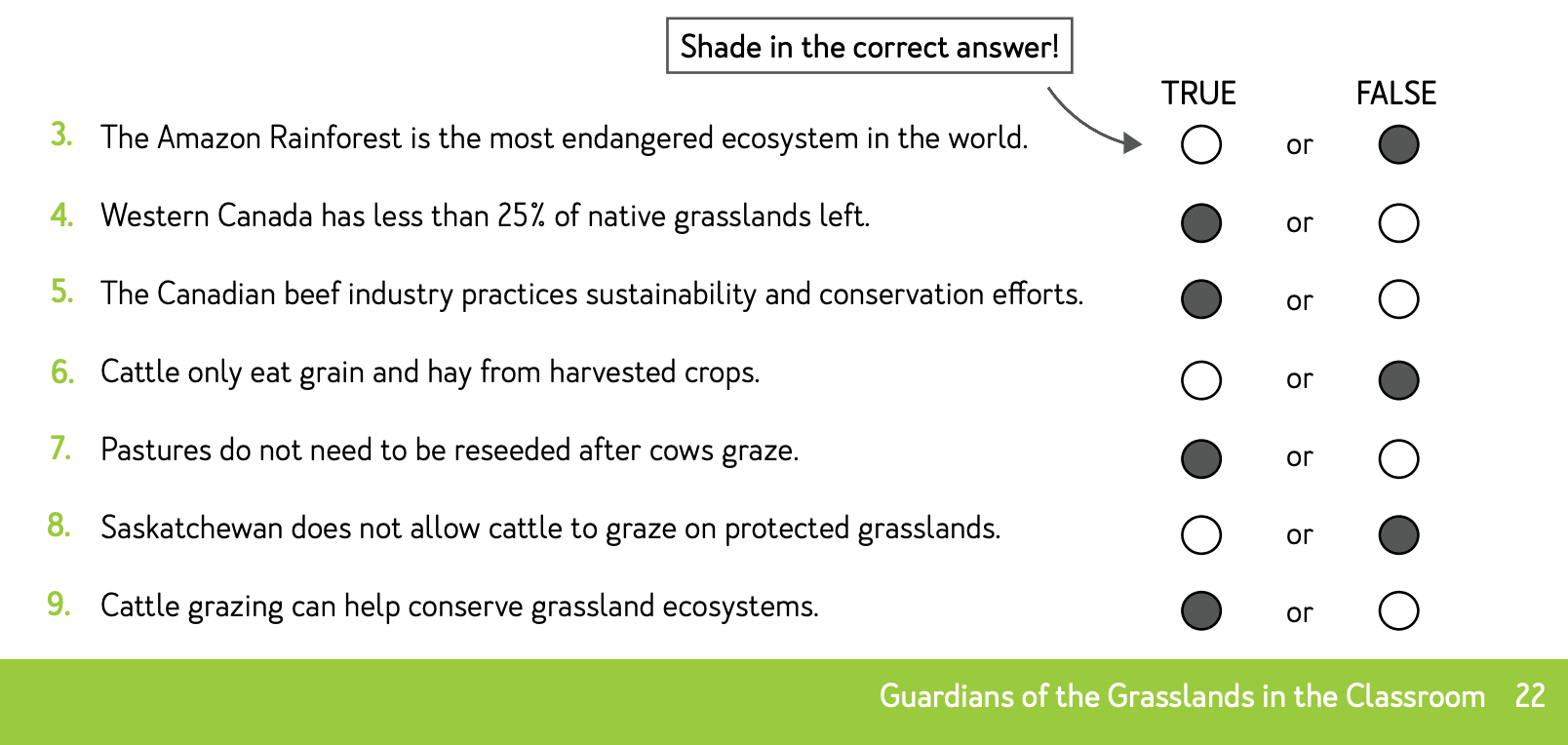
Figure 3. True-or-false activity from Guardians of the Grasslands in the Classroom, p. 22. Source: Agriculture in the Classroom Canada. (2021). Guardians of the Grasslands in the Classroom.
Question 5: "The Canadian beef industry practices sustainability and conservation efforts."
The answer key says TRUE.
That is not a fact. It is the industry's contested claim. A student who disagrees does not get a debate. They get a red mark.
The worksheet is not the end of it. Agriculture in the Classroom Canada hosts an exercise that assigns students a farm, then hands them their critics. “Now that you know more about the animals you raise and the housing required, you can respond to the first criticism: ‘The way they house their animals is inhumane and like a factory farm!’” Note: the animals you raise. The student is not even learning about the industry. The student is the industry.
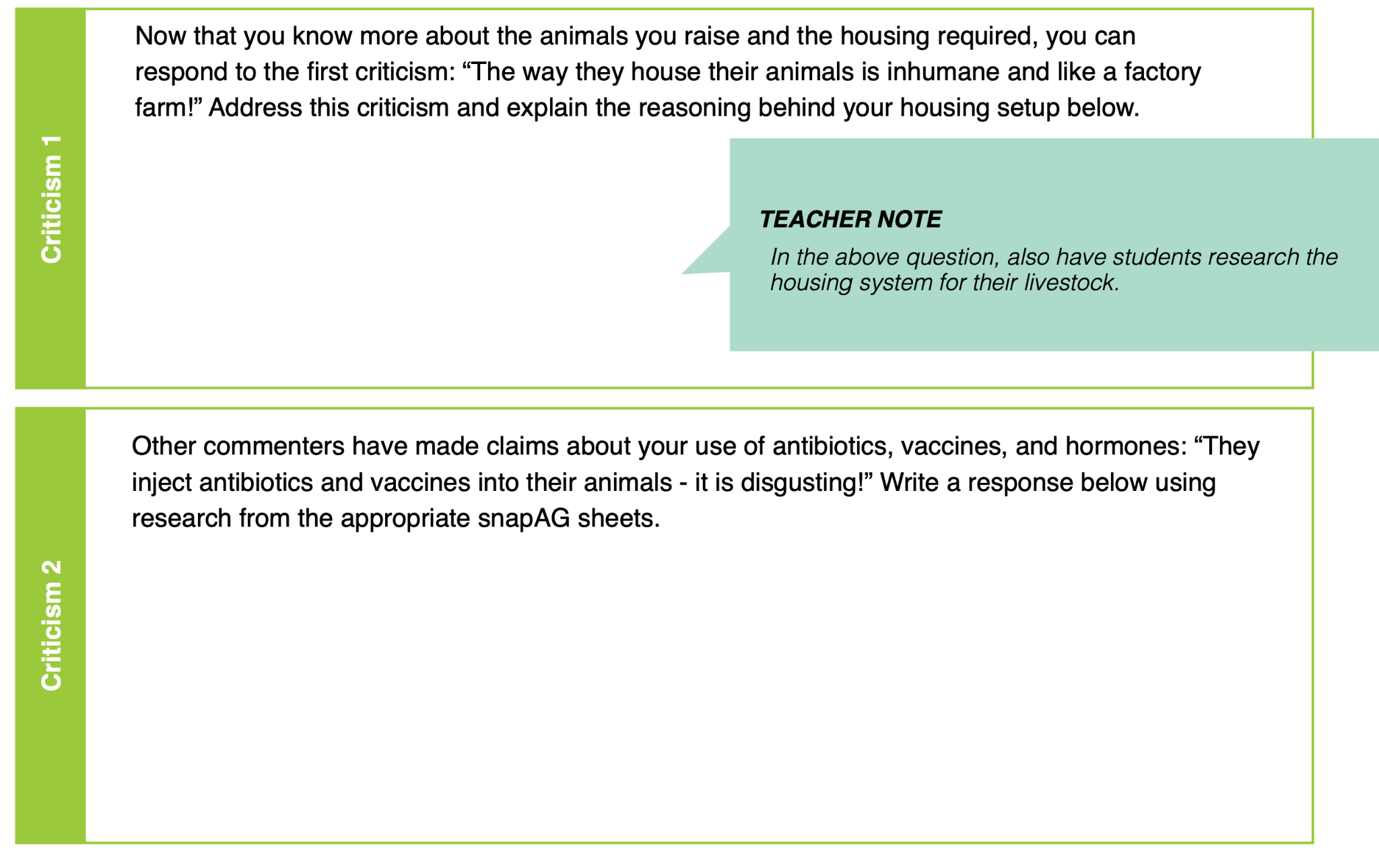
Figure 4. "Criticism 1/2" classroom exercise asking students to respond to criticism of livestock housing and production practices. Source: Agriculture in the Classroom Canada & Farm & Food Care. (n.d.). The Real Dirt on Farming in the Classroom. p.8.
The Environmental Case for Coal
Then there is Trevor Coates, another junior researcher at Lethbridge, mentored in 2020 by Rich Smith, the recently retired executive director of Alberta Beef Producers. Coates’s second mentor was Kendra Donnelly, whose family runs three feedlots, including Korova and Rimrock, capable of finishing up to 70,000 cattle a year. Rimrock produces more than 80,000 tonnes of manure annually. In 2022, it drew roughly 250 odor complaints. That was only the beginning. By October 2024, Alberta’s regulator had logged 4,622 complaints against Rimrock from 660 people. The mayor of the nearby town said residents described the smell as so strong that “you can almost chew it.”
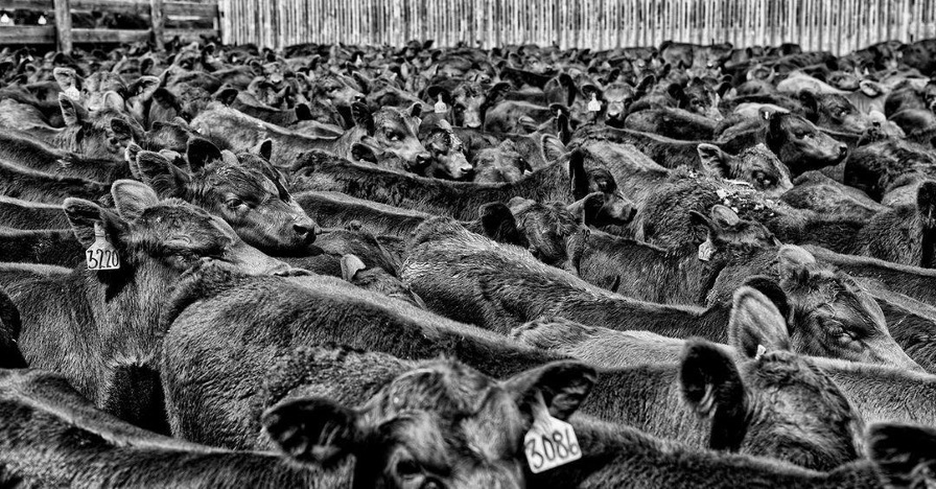
Figure 5. Korova Feeders showing the density of cattle within its feedlot pens. Source: Korova Feeders Ltd. (2018, March 13). Echo Sand Ranching Simm/Angus bull sale [Facebook status update]. Retrieved February 2023 from the Korova Feeders Ltd. Facebook page. Photographer not identified.
Coates co-authored two studies on brown coal, or lignite, as an additive for feedlot manure. The first study found that brown coal cut ammonia emissions during composting by 54 percent. It raised total greenhouse gas emissions 2.6-fold. The authors concluded that the ammonia benefit “could justify the trade-off of increased GHG emissions.” The study framed its purpose in industry terms: “increased production efficiencies and profit potential for cattle producers.” It added coal to feedlot manure. It made the climate problem worse. The paper recommended it anyway.
Later that year came a follow-up. In a laboratory with continuous forced aeration, brown coal reduced both ammonia and greenhouse gases. Both studies were funded by Meat & Livestock Australia, which is to Australian beef what the check-off is to Canadian beef.
Both studies assume existing levels of cattle production will continue and ask only how the resulting manure can be managed.
In 2023, Coates appeared on Cows on the Planet, one of the outlets the workshop report held up as a model of good-news storytelling. Asked whether the lower carbon footprint of plant-based proteins might reduce meat demand and livestock populations, Coates replied that there was “more than enough room in the market to accommodate all sources of protein.”
The episode was called “Too Many Cows and Excess Nitrogen?” The excess nitrogen was seen as a problem; too many cows were not.
Less Gas
The most telling case is Getahun Legesse, who was paired in 2016 with Charlie Christie, a feedlot owner who became chair of Alberta Beef Producers in December 2017, and Brenna Grant, then manager of Canfax Research Services, which provides research and economic analysis to the Canadian beef industry. Grant now leads Canfax and chairs the Climate Science Committee of the Global Roundtable for Sustainable Beef, an industry-funded body. Despite chairing a climate science committee, Grant is neither a climate scientist nor an academic, and she does not hold a PhD.
One widely cited study, led by Legesse, compared Canadian beef production in 1981 and 2011. Its abstract reports that emissions per kilogram of live weight had fallen by 14 percent and declares that “a significant reduction in GHG intensity” had occurred. Both statements are true. But intensity is not simply one of the paper’s measures; it is the frame through which the paper presents its findings, and the frame does the work.
Every headline comparison in the abstract holds output constant. The breeding herd, the land, the methane, the nitrous oxide: each is measured against “the same amount of slaughter weight,” against “the same amount of liveweight for slaughter as in 1981.” The abstract is not comparing 1981 to 2011. It is comparing 1981 to a 2011 that never happened, one that produced no more beef than it had 30 years earlier. The real 2011 produced 32 percent more beef, and the abstract never mentions it. Neither the abstract nor the conclusion reports total emissions at all. The paper reports the actual change in emissions one time, in the results: “Total GHG emissions from the production of Canadian beef cattle were 28% higher in 2011 than they were [in] 1981 (28.3 Tg CO₂e vs 22.1 Tg CO₂e).” Twenty-eight percent higher. Not lower.
The choice of denominator is not a technical preference; it is the finding. Per kilogram is the only measure of this industry’s emissions on which the last three decades look like improvement. The quantity that actually matters here— greenhouse gases emitted— rose. Each kilogram looked cleaner, but the climate still got worse. The acknowledgements state, “We gratefully acknowledge the financial support of the Beef Cattle Research Council and Agriculture and Agri-Food Canada through the Beef Cluster Project.” They also “express their appreciation to all of those individuals who provided their expert insight and comments on various aspects of the study, in particular the Canadian Roundtable for Sustainable Beef Production and Breanna [sic] Grant with CanFax.”
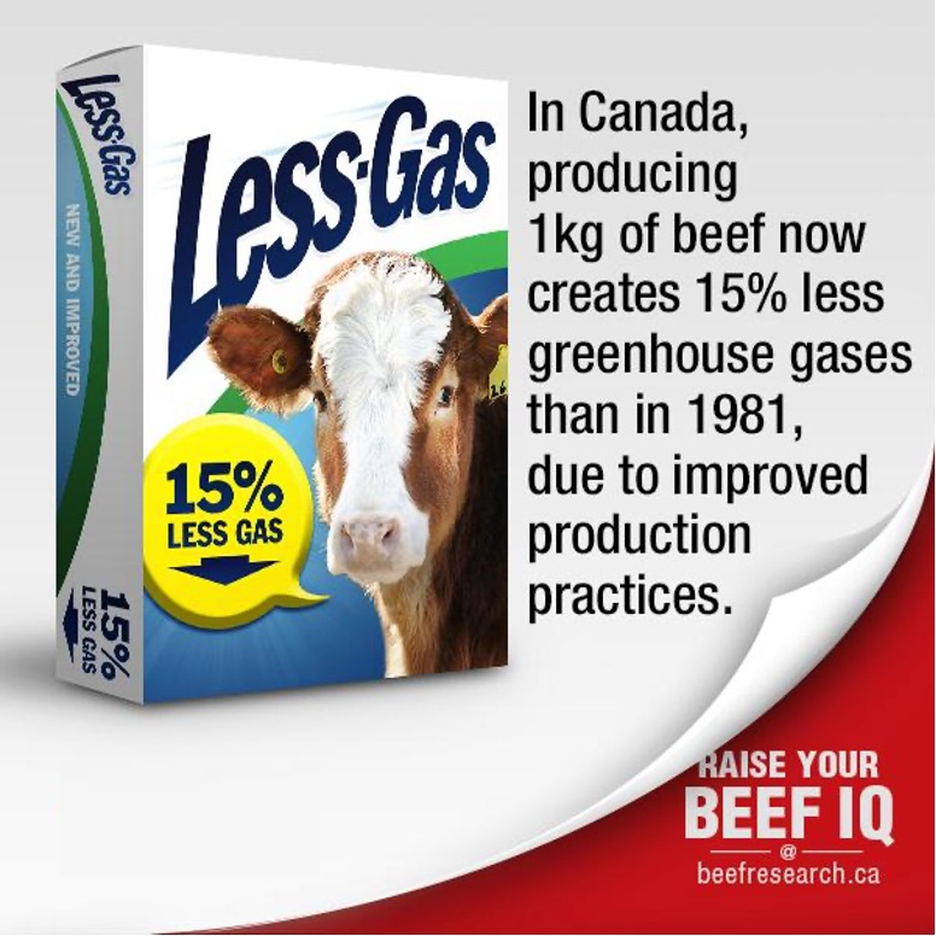
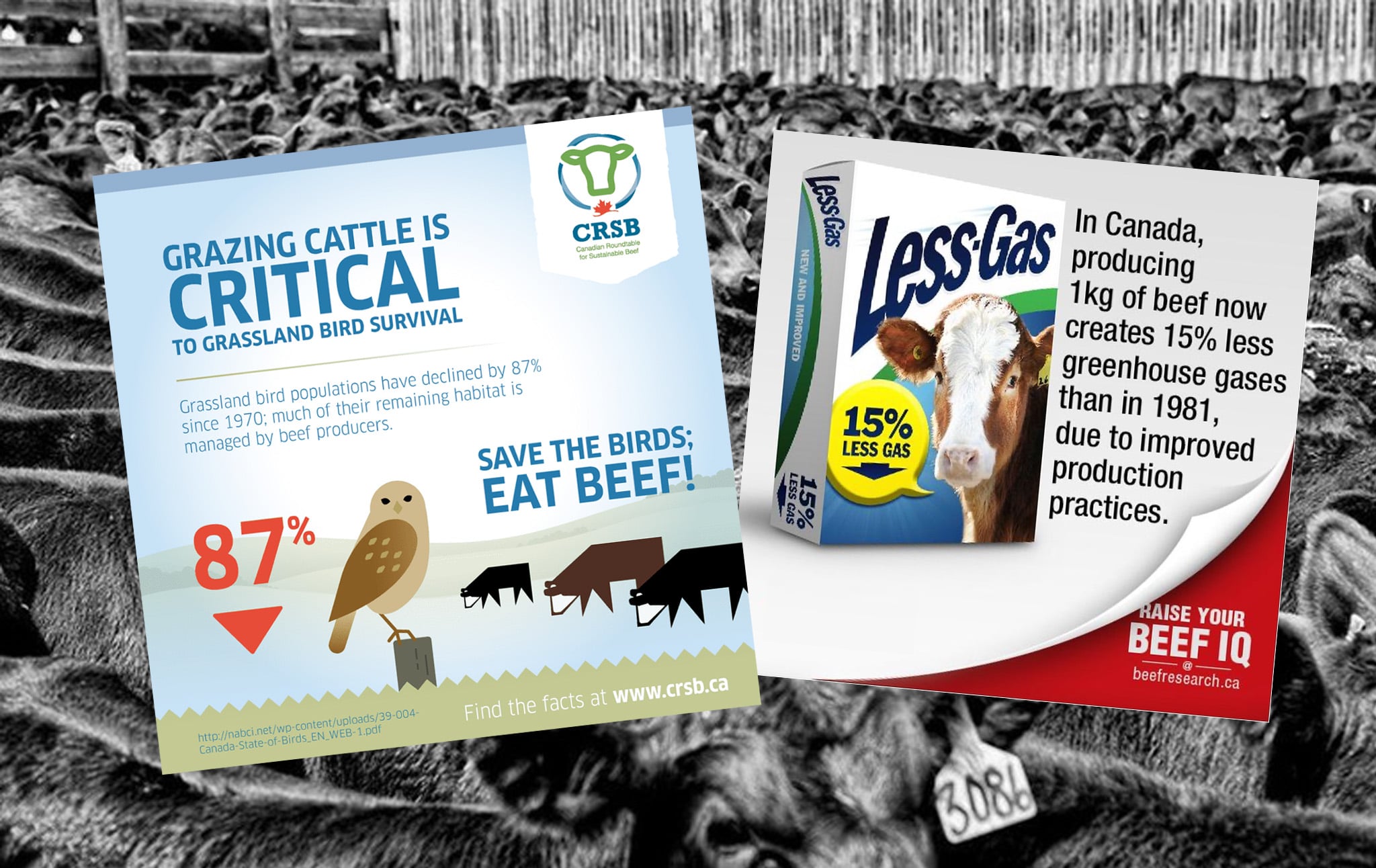
Figure 6. Beef Cattle Research Council promotional graphic claiming reduced greenhouse-gas emissions per kilogram of beef (“Less-Gas”). Source: Beef Cattle Research Council. (n.d.). Producing beef with lower greenhouse gas emissions and using fewer resources. Retrieved February 15, 2024, from the Beef Cattle Research Council.
Here is the trick at the center of all of it. Industry-mentored scientists point out that emissions per kilogram of beef are declining. This sounds like progress. But it isn’t. The atmosphere responds to total emissions. It does not grade on a “per-kilogram” curve.
Economists call this the Jevons paradox: efficiency gains get swallowed by growth. The beef industry deploys emissions-intensity targets, measuring emissions per unit of output rather than total emissions. These targets allow the industry to claim reductions even as overall emissions rise and make expanded production look like the environmentally responsible choice. Less gas per kilogram means we should raise more cattle. Sustainability means growth. The language has been inverted.
The BCRC then takes these industry-funded studies and repurposes them for public relations. One BCRC graphic, titled “Less-Gas,” was derived from a study the organization itself funded. It advertises 15 percent less greenhouse gas per kilogram of beef than in 1981. Any normal person reading it would conclude that the industry's emissions during that time went down. They went up.
And notice what is never discussed: A study in Environmental Modeling and Assessment found that a major reduction in animal-product consumption in Canada would cut greenhouse gas emissions from Canadian agriculture substantially. A study in Climatic Change determined that even with changes in technology or efficiency, reducing consumption of meat and dairy would be indispensable to preventing two degrees of warming. A study in Science found that projected emissions from global food systems alone would put the 1.5-degree target out of reach even if all fossil fuel emissions were eliminated immediately.
Grant every finding: Suppose the feed additives work. Suppose breeding lower-methane cattle works. Suppose brown coal does what the paper says it does. Every one of these could be true and the problem would remain, because none of them answers the question of how many cattle there are. An industry that cuts emissions per kilogram by 15 percent and then produces a third more beef has not reduced emissions; it has produced a better number to put on a graphic. The purpose of BCRC funding is less to control what scientists say than what they do not say: that no feed additive, no breeding program, and no method of treating manure makes it sustainable to raise and kill cattle at this scale.
“Becoming Part of the Family”
When Sentient Media asked Coates about the arrangement, he described it as a positive experience, and the networking in particular. “Discussions with my mentors were an important part of that experience helping me gain a better understanding of some of the challenges facing the industry and where my research interests would best fit.”
That defense is the accusation. He is describing the process and calling it a benefit. Learning from feedlot operators where your research interests best fit is not a rebuttal of my case. It is my case.
Sentient also asked Coates about his current role at the federal agriculture department. His job, he said, is to “help find solutions to problems producers may be facing, including those due to weather or climate challenges.” Read that again. A government climate scientist describes his own mandate as serving producers, with the climate arriving in a subordinate clause. Nothing in that sentence is about reducing emissions.
The other objection I hear is that I have not shown the mentorship program changed anyone's research. True. The program does not need to change researchers. It promotes them. The BCRC selects researchers whose questions already suit the industry and gives them access to the people who fund research and shape careers. Gruninger says plainly what that access is worth: it helped him secure funding and get his government job. A researcher asking whether Canada should raise fewer cattle is offered none of it. Nobody has to control an answer. You only have to control which questions arrive with a network attached. The BCRC's mission, in its own words, is to invest producer funds “to support growth in beef demand, increase productivity and earn public trust.” Growth in beef demand. That is the mandate of the body paying for the climate research.
And on how that works, the website is equally direct. The Council “has influence over the questions that get answered with scientific rigor and does not question the integrity of the university- or government-employed researchers who conduct the studies or the peer-reviewed journals that publish their results.” Read the second half as the defense it is meant to be. We shape the questions. We do not touch the answers. That is also exactly my critique. The BCRC and I agree completely about what the program does. We disagree only about whether it is a problem.
That is the oddest part of this research: everyone agrees about what is happening. The BCRC states on its website that the program aligns research interests with those that benefit the industry. Gruninger says it helped him get the job he is in. Coates explains that it helped him learn where his research could best fit what the industry wants. It is not a factual question of what is occurring. It is a political question of what we choose to make of it.
Call it “lying by telling the truth.” (There’s a whole term for this: paltering.) You say something that is technically correct (for example, that per-kilogram emissions went down) while omitting what actually matters (for example, that emissions overall went up). The tobacco industry perfected the art: they funded honest research into every cause of lung cancer except the one that mattered, and let the volume do the work. Nothing false ever has to be said. The false thing is what the true things are arranged to suggest.
Feed additives really might lower methane. A new manure treatment might really lower ammonia emissions. These are still not reasons to grow the herd. Emissions per kilogram really did fall by 15 percent. “Less-Gas” is still false. None of these claims makes “The Canadian beef industry practices sustainability and conservation efforts” a true-or-false question with a right answer.
The BCRC offers a defense: Researchers, Brocklebank says, have valuable technical skills, but “ensuring these technical skills work within our industry wasn’t always happening”. Agreed. Extension work has real value. Research should inform practice. On that point, the BCRC and I agree: the industry should follow the climate science.
But if that were the goal, the program would run the other way. Senior climate researchers would mentor feedlot operators and trade-association directors on what the evidence requires, and the industry would adjust. Such a program would still need safeguards, but its basic structure would make sense.
This program does the opposite: feedlot operators and industry executives mentor early-career researchers, including government climate scientists. That design makes sense only if the goal is to bring research into line with the industry, rather than the industry into line with the research.
You can tell what a program is for by looking at which direction the arrows point.
The program's declared purpose is on the BCRC's website. It seeks to “align research interests with those that are practical and beneficial to Canada's beef industry.”
They wrote that down. On their website.

We Have to Stop Them
The procedural fix is obvious. Universities and government research centers should prohibit arrangements in which the industries their scientists study also serve as the mentors of those scientists. A government researcher's career should not depend on the profitability of the beef industry. But the real fix is simpler: abolish the livestock check-off. There is no good reason for the state to compel a levy whose stated purpose is to grow an industry whose growth the climate literature sees as a problem. And note what the check-off is not: it is not a trade association passing the hat. It is a mandatory fee, imposed by the government, handed to private organizations whose job is to sell more beef.
Or keep the levy. Same rate, same payers, no new taxes, the fiscal conservative's dream. Just stop routing it through the Canadian Cattle Association. Put it through an arm's-length body that funds independent research. Same funding for research, no industry control over the research agenda. If the beef industry wants to fund research to grow the industry, it can. The government should not be part of it.
The importance of this research extends far beyond Canada. The United States has its own federally authorized Beef Check-off, funded by a mandatory levy collected each time cattle are sold. As in Canada, its goal is to "maintain and expand domestic and foreign markets and uses for beef and beef products." The program has already helped distort public understanding of climate science. Here, too, the government compels payments to a program explicitly designed to grow the beef industry.
This matters because, in the United States, we are currently fighting simply to have a government that acknowledges that climate change is real, much less that animal agriculture contributes to it. But this research demonstrates that achieving those goals could make the problem worse, not better, if all that recognition produces is reverse-mentorship programs for scientists and true-or-false questions teaching public-school students that animal agriculture is, already, sustainable. That is not change; that is state-supported greenwashing. Yes, we need a government that acknowledges climate change, and yes, we need a government that acknowledges animal agriculture as a major contributor. But those acknowledgments help only if they are coupled with a commitment to reduce the fundamental problem: the number of animals raised and killed for human consumption each year.
Australia follows the same model. Its government imposes a mandatory cattle transaction levy, part of which supports Meat & Livestock Australia's research and marketing programs—including investments explicitly intended to grow demand for Australia's beef industry. For example, Trevor Coates's study promoting the use of brown coal was itself funded by Meat & Livestock Australia.
The same warning applies to the European Union. The workshop that called for telling the "good news" stories of animal agriculture and beginning that outreach in schools was part of the EU–Canada CETA Agriculture Dialogue, not a Canadian initiative alone. The fact that the specific classroom materials documented here have so far appeared in Canada does not make the danger uniquely Canadian. It may mean only that the model has not yet spread further. Canada, in other words, is a warning of what could come next everywhere else.
The most common question I have received since I started this research is "Why Canada?" But the question rests on a troubling premise. To ignore what is happening there is not only to ignore one of the world's leading beef exporters; it is also to ignore new mechanisms of greenwashing being pioneered in Canada that may soon be exported to the rest of the world. The simple truth is that the animal agriculture industry already works internationally. To have any chance of responding, we must think, and work, internationally as well.
But procedural fixes alone are not enough, because the problem is not only procedural; it is definitional. Sustainability cannot mean the sustained profitability of an industry. It cannot mean only palm kernel cake and emissions per kilogram and brown coal in the compost. It also has to mean asking how many cattle we should raise and being willing to hear the answer.
The answer is not a secret. The IPCC assessed the evidence and found that eating less meat is one of the largest reductions available. The most comprehensive study of its kind concluded that avoiding meat and dairy was the single largest contribution an individual could make to environmental sustainability. Study after study after study has reached the same conclusion.
Behind all of it, one fact remains: more than 80 billion land animals are killed for food every year. That number keeps rising. It keeps rising in part because the researchers who might ask whether it should are instead being mentored by the people who need it to rise. It keeps rising because the questions that would challenge it are being excluded from the research agenda of a generation of scientists. It keeps rising because an industry running the fossil-fuel playbook has understood that you do not need to change any scientist's research. You just need to make sure the scientists asking whether the industry needs to shrink are not the ones getting heard.
The beef industry is deciding which climate questions get funded, and therefore which get answered. To have a chance at stopping climate change, we have to stop them.
Vasile T. Stănescu is an associate professor in the Department of Communication Studies and Theatre at Mercer University and a research scholar with the Climate Social Science Network at Brown University, which funded the underlying research. His peer-reviewed article on this topic, "Becoming Part of the Family: Greenwashing, Animal Agriculture, and the Strategic Capture of Climate Research," was published by Oxford University Press in June 2026.

%20(crop).jpg?width=352&name=wile-e-coyote%20(resize)%20(crop).jpg)