The fate of “endlings”—the last animal of their kind before extinction—is a strange and lonely one.
In the Snail Extinction Prevention Program lab, behind a green door in a small green trailer, little mollusks move across differently-shaded green leaves four times their size, their translucent antennae wiggling and flicking. Extinct in the wild, the snails play at survival in the trailer, eating and reproducing, practicing for their reintroduction back into their habitats. As a greyish yellow snail almost slides off the leaf it sits on, the large, white pad of a finger gently moves it back. The snail wiggles its antennae enthusiastically, finally reoriented to the leaf; its whole body spans the finger’s tip.
How do you know when a snail dies?
According to various sources on the internet:
- The odor. The odor of a dead snail is distinct and impossible to miss.
- The trapdoor (operculum) located on the rear of the snail’s foot, and everything else, will be hanging out, or the shell will be empty.
- “The shell will be uninteresting and light.”
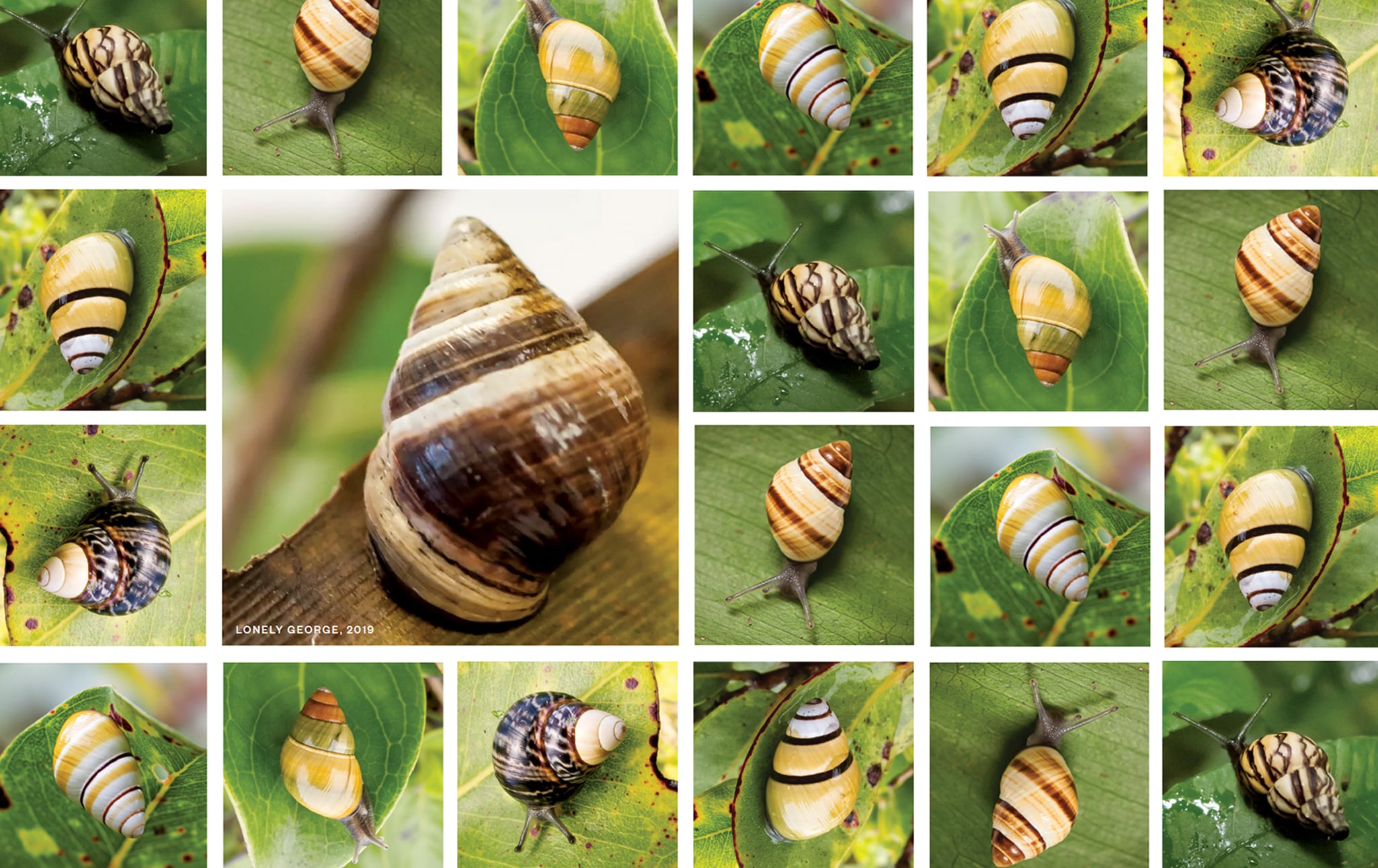
In the lab, brown cardboard boxes labeled “Snail Morgue” are stacked atop each other in the cupboards. A snail named Lonely George’s remains sit in a small test tube next to the boxes, the brown spirals of its shell dulling. Labelled with messy handwriting, I can only make out “4.8 x 11 cm” written in the final row—George’s size.
Lonely George, the name given to the last member of the species Achatinella apexfulva, once abundant in the forests of O’ahu Island, is placed separately because no other snail is like it. Not anymore. Not in the future.
“The last member of a species is a ghost,” wildlife biologist and Snail Extinction Prevention Program coordinator David Sischo, keeper of the snail hospital and the snail morgues tells me. “It might as well be dead. It’s already gone.”
On New Year’s day of 2019, Lonely George passed away at 14 years old. In National Geographic, Christie Wilcox writes that “For over a decade, researchers searched in vain for another member of the species for George to mate with, to no avail.”
I learned from Sischo that every researcher who was seeking one small glimmer of hope, one saving grace, cried in the field.

George and I don’t share a language, not in the way of companion animals. My cat and I have learned each other, built a language between us. I know when she feels comfortable and happy, when she is nervous, and when she is scared. I can, to an extent, speculate about her interiority. In this way, George is a blank slate. At this distance, I have never seen George perform a social gesture beyond the recorded evidence I have that they were, at one point, alive.
I did not know George or care about him during his life, whereas others did. I am at a distance many other people aren’t. I’m not native Hawaiian and kāhuli are not culturally significant to me. I am unsure what it means for a snail shell to be “uninteresting,” nor have I smelled the unmissable odor of snail death. I’ve never seen the brown and yellow spirals of Achatinella apexfulva’s shell in person.
And yet, the face cream I use every night before bed contains snail mucin, which allegedly moisturizes the skin, aiding elasticity. It is referred to as an “anti-aging” ingredient because it may prevent wrinkles.
There are many wrinkles in regard to speaking about Lonely George’s life and death; many inevitable, but unexplainable aspects of my attachment to this snail. One such wrinkle is that with the name Lonely George, you might assume the last member of Achatinella apexfulva was male. In reality, Hawaiian tree snails are hermaphrodites with both male and female reproductive organs. Two adults must mate to produce offspring. They give birth to live young and they have a low reproductive rate, at most ten offspring annually, only coming to reproductive age between four and seven years old. For a creature suffering a mass extinction crisis, this slow method of reproduction is not ideal. The cruelty of the world contrasts with these snails’ nature.
Method of reproduction aside, it doesn’t feel like a coincidence that a creature without a binary sex, let alone a gender, was given a name associated with men. Everything about the title “Lonely George” is made to appeal to our emotions. We see men as more universally human, as the default. Researchers often refer to George with “he,” but I will refer to George with “they” to try and represent their experience more accurately, albeit still on human terms and still in English.
In this cultural and political context, our societies view white people as more universally human too, and our ideas about gender are shaped by colonialism—all the more reason not to refer to George as “he.” The Indigenous name for the O’ahu Tree Snail is kāhuli. Ōlelo Hawaiʻi, the Indigenous language of Hawaii, like every species of kāhuli, is critically endangered. In 1896, a new law mandated that English be the medium of instruction in schools, with the goal of English displacing Ōlelo Hawaiʻi. This law stayed in place until 1986, by which time the language was nearly extinct. By 2012, it was estimated there were fewer than 1,000 native speakers. Indigenous activists have successfully begun revitalizing the language and there are currently an estimated 5,000 to 7,000 speakers. Just as there are programs in place to revive the population of kāhuli, there are language immersion programs in place to revive Ōlelo Hawaiʻi. If this essay were written in the Indigenous language of the place George inhabited, the pronouns I used for George wouldn't be a wrinkle. There are no gendered pronouns in the third person in Ōlelo Hawaiʻi. Everyone is referred to as “ia.” It is the same in Bangla, the language of my family. Everyone is referred to as “o” (these are, of course, imperfect Latin alphabet representations). I am frustrated by the restrictions English puts on my body and identity, and on George’s.
The biggest cause of the rapid decline of kāhuli were invasive predators—every type of tourist and colonizer. Their habitat was threatened by non-native, invasive plants (including strawberry guava, Christmas berry, silk oak, shrub verbena, and Koster’s curse). They were also preyed on by invasive species like rats and the carnivorous rosy wolfsnail, which was ironically (horribly, sadly) introduced in 1955 to control another invasive snail species—the giant African snail—but found native tree snails more appetizing.
The word for an animal that is the last of its kind is “endling.” There is something cute about this, something that almost evokes fiction. A loneliness in the reverberating bell of a life. Life in the face of ever-present threat.
George was named after another endling, Lonesome George. Lonesome George was the last Pinta Island Tortoise—another Indigenous species that couldn’t survive because of colonizers, who introduced feral goats to the Galapagos Islands, which devastated their vegetation. Unlike Lonely George, Lonesome George’s sex was male—though he was still given this European name despite not being European. He lived for 102 years, many of them spent wandering around alone, looking for others and getting filmed by humans while eating papayas.
I try to find out more about the snails that produce my moisturizer. There are not many academic articles about the use of snail mucin in cosmetic products, particularly in regard to how the snails are treated. Some people on Reddit say that snail mucin is harvested ethically. They say that snails on snail farms need to be happy and healthy or they won’t produce mucin, or would produce highly irritating mucin that is bad for the skin. The Klog, a popular K-Beauty blog, states that “because snail mucin products are applied topically, only edible snails are used in skin care products,” a fact that feels grotesque for some reason. It makes me wonder whether the same snails that labor to make my face cream eventually end up on someone’s dinner plate—trapped in a cycle of endless production. Cosrx, the brand that distributes my face cream, claims that their snails are kept in a dark room on a net, where they are left alone to relax and produce the mucin to be put into products. Other sources, mostly competing skincare companies, say that the snails suffer and are harmed to retrieve a large amount of mucin. From a general Google search, every source I look at is trying to sell something—trying to sell me snail mucin products or discourage me from using snail mucin products and to buy other, similar products they are selling instead.
The first academic article I found about snail mucin in beauty products was a 2024 piece from the Journal of Cosmetic Dermatology, titled “Snail extract for skin: A review of uses, projections, and limitations” by researchers Nupur Singh, Angela N. Brown, and Michael H. Gold. According to the authors, snail mucin has been used for centuries and across cultures. Hippocrates lauded its ability to soothe inflamed skin. Snail farmers in Chile found it could aid in healing lesions without scarring. People living in Han Dynasty China documented its use in relieving insect bites and hemorrhoids. The authors say it has anti-microbial properties that can treat acne, though where in the snail the mucin is secreted from affects how antibiotic it is. The article also has a section that discusses snail mucin’s “antiaging benefits.” This once again makes me suspicious that I am being sold something, but I am no expert.
In the last section before the conclusion, I read that there are several ways to harvest mucus from snails. One method puts no stress on the snails, placing them in a special cage or a glass slide and letting them secrete mucus at a natural rate of production, resulting in a relatively long collection time. To increase the yield in a shorter span of time, the snails might be stimulated with electricity. This stresses them out, so they must be fed and hydrated before this process. Another common method is hitting the snail with a blunt force object (such as “glass rods, cotton swabs, syringes, droppers, sticks, or needles”), spraying it with a water jet, cracking its shell, or placing it in a salt solution to osmotically draw out its hydration—thus doubling the amount of mucus produced and causing a great deal of trauma. This makes my stomach drop. For what? For vanity? To try and reverse the natural marks of time? I decide I am never rebuying this face cream unless I find sufficient proof that all cosmetic companies that use snail mucin are not hurting the animals—or forcing them to do anything other than live happy snail lives—where they secrete mucus at their own pace, regardless of the human demand for it.
Dave Sischo’s friends will buy him snail beauty products (ethically produced—hopefully) as a joke. Most of his adult life has been spent caring for critically endangered tree snails. He tells me, “They have given me my entire career, my livelihood.” He keeps his phone on full volume all the time, like a doctor’s pager, in case something goes wrong at the lab and he needs to rush there. In Ed Yong’s viral 2019 article about George in the Atlantic, this fact also came up: “He never silences his phone, even when he sleeps. When he gets alerts at odd hours, his stomach aches.” It was devastating details like these that gave George a literary second life, inspiring the writers Maria Reva and Jasmin Schreiber (and me).
Often, the emotional dimension of climate change is delegitimized as unimportant. When I first wrote about my attachment to Lonely George, the ways in which I identified with them, a man told me, “Your feelings are not as important as a mass extinction crisis.” People don't know what to do with it—the sadness. But according to Dave Sischo, sadness can be quite useful when faced with disaster. He tells me invertebrates are largely overlooked next to more charismatic, cuter animals (like tigers and elephants), though they are incredibly important for the ecosystem to function. When George died, it was heartening to see how many people cared and how much international news the story generated. He took that lesson, that it was important to show people the last snails. It takes the death of the last member of a species to wake people up.
When I asked about the emotional dimension of his work, Dr. Sischo did not respond the way I was anticipating. I hoped that he, being so close to the effects of climate change, would have a more common-sense approach to it, less dread. I suppose my own idealism caused me to hope that he would have some good news, but there is little good news to report. I asked if it has gotten easier since he has started his work to contend with the devastating information that he is faced with every day. He tells me it has only gotten harder, because “it's just getting worse. Everything is getting worse.” If I have time for a story, he says, he can tell me about how in 2015, they did a genetic study on two wild populations in relatively small areas of the field. There were tons of snails, but by the time they got the lab and the funding for the equipment, there were only three individuals remaining. These were some of the most depressing days he has ever had, and this has happened over and over again. They can’t hesitate anymore. He and his staff never get a break.
Everything about keeping hundreds of species of endangered snails in one lab is precarious. Dr. Sischo described the laboratory feeling like a hospital: sterile and clean. He oversees a facility that maintains approximately 10,000 kāhuli—40 species from five islands—many of which are extinct in the wild. He says the chambers in the lab make clicking noises, similar to someone in the emergency room on life support, an apt comparison because the snails literally are. Anything brought in from the outside world could be a threat. Because kāhuli feast on the fungus that grows on native trees and shrubs, which need to be brought into the lab, there is always the risk of introducing nematodes and harmful pathogens with the leaves. They could have a mortality event from these pathogens, or a fire, or an equipment failure. Sischo evacuated the snails in his car during Hurricane Douglas in the summer of 2020, driving them from the lab to higher ground. I wonder if it ever feels futile, saving them then releasing them back into a cruel world that is less hospitable than ever. I wonder if he can let himself think about this.
He tells me everyone held George carefully, like they understood the weight of what was in their hands. He is often devastated by the fact that he saw things working in the field just ten years ago that his fresh out of college colleagues will never see.
Many forms of life were assisted by the existence of kāhuli and impacted by their rapid disappearance. Kāhuli evolved a diet to only eat the fungus that grows on native trees and shrubs, cleaning them and improving their health. Though the snails are small in size, their numbers gave them immense power in the ecosystem, cleaning native plants of algae and bacteria and fungus. The nutrients from the snails’ poop, in turn, fertilized the forest.
Kāhuli were once so abundant that collectors made their shells into lei. This cultural artform collapsed as the snails began to disappear. Speaking to the National Wildlife Federation, Jonee Peters, a Native Hawaiian and the head of operations for Conservation Council for Hawai‘i, states, “The kāhuli, or tree snails, are a part of our oral history, handed down through the generations through songs and chants[...] One of the first hula songs we learned as children was Kāhuli aku, the song of the tree shell.”
Another Hawaiian name for kāhuli is pūpū kani oe—“shell that sounds long.” I watch a video about their songs from an Indigenous Hawaiian singer named Eddie Kamae. In it, a musician blows into a shell to mimic what it might sound like if the wind whistled through a kāhuli shell as it rested on a leaf. It sounds like the conch my mashis blow into during Durga Puja as the goddess is worshipped. The noise is devout.

I try to understand Dave Sischo’s love, the devotion of his life to this. I try to understand the root of my own obsession. Dr. Sischo tells me his favorite species of kāhuli, the one he feels most urgently about saving, is whichever one he is holding in his hands.
I ask my entomologist friend, who I grew up minutes from, but now live 11 hours away from, whether snails could feel loneliness. I text her, “I just want to know if they could tell whether they were the last of their kind or if I’m projecting that loneliness onto them.” She responded, “That’s tricky because they’d definitely be able to detect a lack of fellow snail ‘scents,’ like trail pheromones, but applying a consciousness to snails is a whole other thing.”
She tells me key search terms that might be helpful to learn more about the socialization of snails. Communication, aggregation, intraspecific, conspecific, gregarious. Through our conversation, I learn that the mucus trails snails leave, the ones in my face cream, are how they communicate with each other, because their sensory modalities are otherwise extremely limited. I wonder what these codes that I massage into my face every night say. I wonder if the language has been processed beyond recognition.
Human babies need skin-to-skin contact in order to develop properly. Ma’s method with me was called “kangaroo care.” I was an underweight, premature baby, and she held me to her bare chest, me only in my diaper. She says I never wanted to be put down—I would wail if she tried. I needed her warmth, the knowledge that someone was there.
Perhaps this origin story makes me uniquely horrified at the condition of endlings. From the start, I was cuddled and coddled. I grew stronger and calmer because Ma pressed me to her skin, right above her heart. Maybe I have a brain so formed by love and care from the people around me that the other end of the spectrum, living a life where I couldn’t feel the comfort of anyone else because they’re all gone, is the stuff of nightmares.
Then again, an interiority that balks against abandonment and isolation is not particularly unique. The existence of solitary confinement is proof: a form of torture devised to devastate someone by putting them in a cell alone for extended periods with no access to other people or the outside world. Solitary confinement is known to shatter the psyche. I can’t help but draw a connection between the incarcerated people tortured in these conditions and endlings. It feels like the closest human equivalent to being that alone.
I am worried that there will eventually be a human who is Lonely George, that humanity is on a trajectory approaching George’s condition, that this fate is unavoidable. I worry about the physical reality of being the last of one’s kind, the amount of suffering ahead to create this loneliness. The way the world will grow smaller and smaller, less and less habitable before our eyes.
I ask Dave Sischo if the snails can feel loneliness. If they’re social. If they have personalities. The way I talk about them, he says, is too anthropomorphizing.
What he has observed is social behaviors in the snails that are evolutionarily beneficial. It helps for snails of the same species to stick close together for breeding opportunities. He tells me the mostly blind, nocturnal snails always seek to navigate away from the light, because light means sun, which means drying out. They follow each other’s slime trails with appendages on their faces that allow them to taste and smell, sensing the snail in front of them. This is their entire concept of the world. What is in front of them.
In the lab and the field, Dr. Sischo observed the snails cuddling up together during the day, while they are asleep. When he and his team clean their cages, they will observe all the snails clustered together on one leaf. One of his colleagues did a study tracking how far the snails move over time in the wild. They left one of the colonies they were observing in a cage with the lid off and a night vision camera suspended over them. When darkness fell, they formed two lines that followed each other out of the cage. It was incredible to witness—the mystery of how they spoke to each other, to decide who would lead and tell the rest where to go.
George probably knew there was no one else left like them—their familiar home dwindling and all their friends gone. I don't know whether snails have friends, but that loneliness must be innate—the feeling that you have no one in this world. They must have somehow known. Just like I know what it is to cling to life like a stubborn barnacle, to cling to others like a tick.
I need to listen to podcasts while I walk. The familiar, disembodied voices comfort me. I need to watch television shows made by other people and read books written by other people, sometimes simultaneously, so there is no chance I will be left alone with my thoughts. If I couldn’t feel myself surrounded by those other voices, their words keeping me company, seeing me… well, I actually can’t even imagine what that would be like. Though I suppose I can. I suppose I already am. As I rub snail mucin onto my face every night, I wonder if there's a cognitive dissonance in working to look young in a world where growing old is increasingly a privilege rather than a right, a world in which it feels like the creatures I love can be taken from me at any moment. I imagine the Ganges river swelling and swallowing up my extended family and their home. I continue to moisturize my skin anyway.
I visited Maui once, when I was 12 years old on a family vacation. This was before I knew about the devastating impact tourism had in Hawaiʻi—depleting resources, not leaving sufficient access to food, shelter, or clean water for the people who lived there. I didn’t know then about the environmental harms of tourism or the exploitation of hospitality workers. I’d never read theory about tourism as pseudo-colonialism, nor guides on how to be a responsible tourist. I was 12 and everything was beautiful. The ocean, the coral reefs, the trees, the flowers. At that point, kāhuli were critically endangered, but not extinct.
Eleven years after this trip, Ma and I sat in a Thai restaurant in St. Louis and I watched coverage of the wildfires in Maui playing on the news channel on their television, the sound muted. I wondered how guilty I should feel, where my family’s 2011 trip to Maui fell on the scale of blame. This is a common question I ask myself. I know I am causing harm, but how much harm am I causing compared to others? Does intention matter? Does hyper-awareness of my failures change anything? I donate to a mutual aid fund for victims of the fires and post the link on my Instagram story, a performance, because what else is there to do? I fight the feeling that my life will never get better than this because we’re past the point of no return.

Every snail is a universe. I see this because for some reason I can’t exactly pin down, I made an emotional connection with this animal that was the last of its kind. An animal that could sit on my thumbnail comfortably.
In the Snail Extinction Prevention Program, all kāhuli are revered. Riley Nakasone is a Laboratory Technician who attends to the captive snails: cleaning their terraria, growing native plants, and cultivating fungi for the snails to eat. In an article from NPR about the protection program, he states, “Their cultural significance, ecological significance, they are just pretty to look at[...] Once you meet them it’s hard not to fall in love with them.”
Nakasone’s team sniffs out rosy wolfsnails with specially trained dogs. They build “predator fences” to keep out threats and check them periodically. They comb through the forest and every leaf is overturned to find carnivorous mollusks and their eggs. Humans introduced invasive species and now humans are taking it upon themselves to get rid of them. They curate this patch of the forest to give kāhuli the best chance of survival.
“Keeping them on earth is what we are trying to do,” David Sischo says about the goal of the Snail Extinction Prevention Program. This means stabilizing populations of kāhuli so they can live in forests free of the snail hospital, free of the snail morgues. He feels an ethical responsibility to keep these animals around because their decline is a human crime. He tells me every year his work gets a little harder because the world continues to get worse at an unrelenting pace: “I have anxiety. It’s relentless.” He says, “What I’m better at now is learning how to mitigate it. I probably drink too much, but I also have a lot of hobbies that bring me joy. I have pet dogs who bring me joy. And I have a wonderful team of people—my own staff and the partners we work with all care deeply and are bearing witness. The relationships I cultivate with my colleagues and friends help offset the burden we have to bear.”
I imagine there was another George, one no one was able to find. I imagine this snail lived a long, peaceful life in the forest, unaware that anything was wrong or that anyone was sad, shedding tears of frustration because of their absence. After years of never finding anyone to mate with, this snail figured out how to reproduce asexually, and now many of them peacefully occupy the earth in little neighborhoods, untouched by us and invisible to our eyes. They are under leaves, under dirt, in the sky.
That’s not the truth though. The truth is, George is still dead. The extinction of Achatinella apexfulva is a human crime, but a group of humans still celebrates every time a species of kāhuli has a new birth. Until their final, tiny breath, Lonely George had David Sischo. They had all these people who devoted their lives to keeping them alive. And now, retroactively, they have my grief.
I wonder if the rest of my life in this world, with the Chekhov’s gun of climate change, will be spent oscillating between hope and despair. Often, I feel scalded by the pure amount of information we are exposed to every day. I never know what’s going to make me cry. The videos of starving, battered cats in Gaza, whale songs, flowers growing in the North Pole. Sometimes, I get overwhelmed. Once in the car, while my partner was driving, I took off my glasses. The street lamps turned impressionist—blurring into floating pom-poms—orange and yellow and red. They were all I could see—not the road in front of us, not where we were going. I heard somewhere that there will eventually be so many satellites orbiting earth we won’t be able to see the stars, but at least in that future, people are still there to look up.
I imagine George floating. Rising above the trees where they used to live, growing smaller and smaller, before blinking out like a bright planet.
Monmita Chakrabarti is a writer currently based in St. Louis. Their work can be found in Joyland Magazine, Split Lip Magazine, Roxane Gay’s The Audacity, and elsewhere.


%20(crop).jpg?width=352&name=wile-e-coyote%20(resize)%20(crop).jpg)