
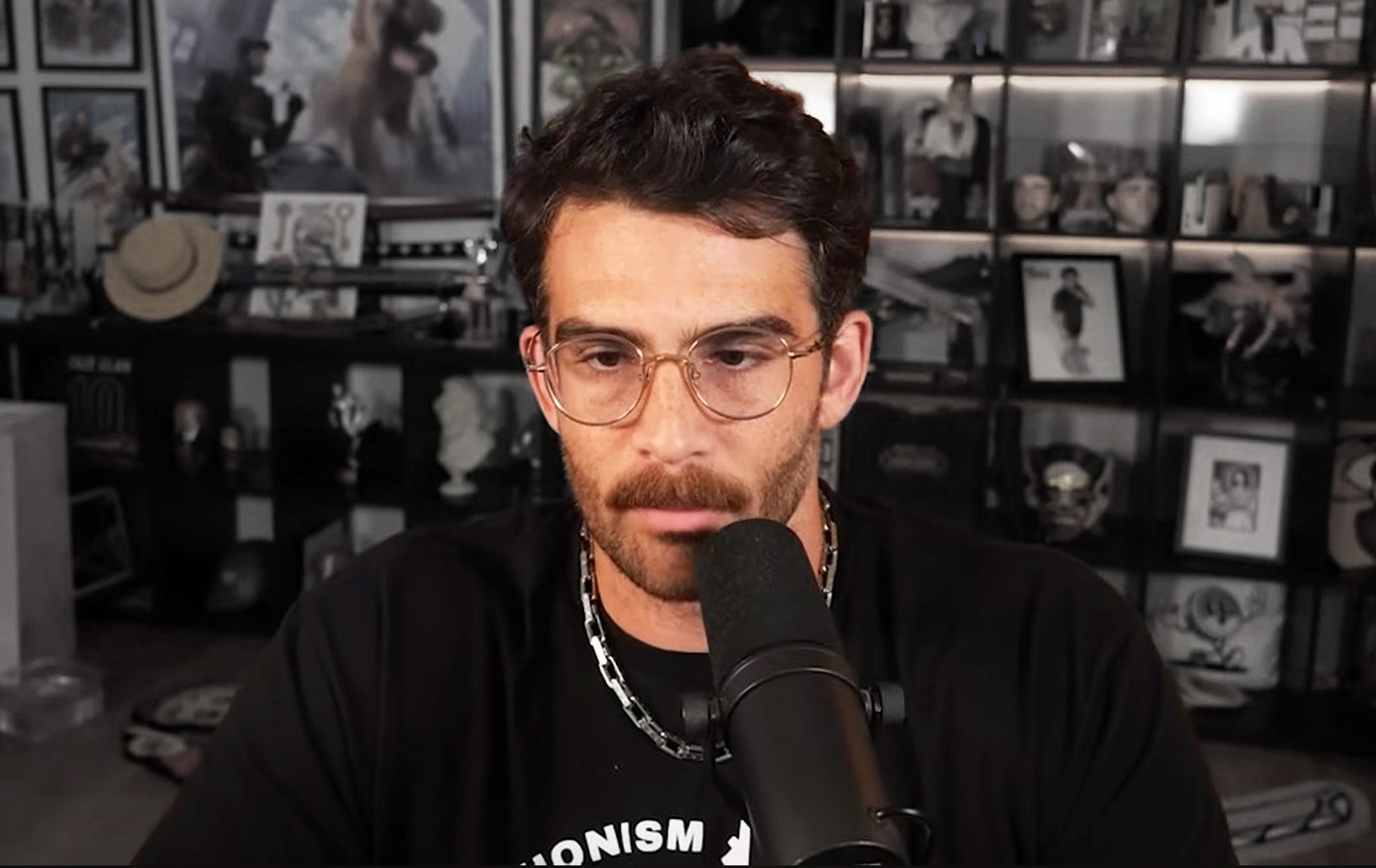
Twitch’s most popular political streamer joins Current Affairs to talk activism, Palestine, the failures of the Democratic Party, and the path forward.
Hasan Piker is one of the most influential political streamers in the world, with more than 3 million followers on Twitch. He’s interviewed Bernie Sanders and AOC, been profiled in GQ, and recently contributed an op-ed to the New York Times. He joined Current Affairs editor-in-chief Nathan J. Robinson to discuss the failures of the Democratic Party, the inspiring rise of Zohran Mamdani, the faltering Israeli propaganda around the Gaza genocide, and the future of the socialist left.
Nathan J. Robinson
Nice to finally talk to you. I’ve seen much of you. I think you’ve seen a fair bit of our magazine. I’ve seen you very kindly read out some of our tweets and articles before.
Hasan Piker
Have we not done an interview before? I feel like we have—we’ve corresponded in the past.
Robinson
I think it’s been discussed. I think it’s never come to fruition. You feel like someone I’ve met, but I don’t think we’ve ever actually met.
Piker
I can’t remember. I cannot remember right now, but I am almost certain.
Robinson
I’m sorry if I’ve forgotten.
Piker
Yes, you’re a busy guy. You’re too busy being right all the time, with your early calls on John Fetterman.
Robinson
Oh, that guy. That asshole. I’m writing an article tonight about his former chief of staff, Adam Jentleson, who’s just started this think tank. And I don’t know if you looked at the first paper their think tank put out. It was on climate change, and it said, how can Democrats talk better about climate change? And their recommendation is, stop talking about climate change.
Piker
Well, I think the Democratic Party really needs to drop more issues. If they just become more like Republicans, obviously, eventually, in one of these elections, they’ll trick the Republicans into voting for them, and then they can just be Republicans.
Robinson
You say that sarcastically, Hasan Piker, or you sound like you’re saying it sarcastically.
Piker
No, I’m actually dropping my career as a successful podcaster to become a Democratic Party analyst.

Robinson
That genuinely seems to be the approach of this think tank. There’s the Abundance Institute now, and they seem to converge on these ideas.
Now, let me just introduce you for people like my parents, who don’t know who you are—most people probably will. Hasan Piker is one of the most popular political streamers in the world. He is about to hit, I think, probably within a month or two, three million followers on Twitch. He has done interviews before with people like Bernie Sanders, AOC, Rashida Tlaib, and friend of the magazine Abdul El-Sayed. You may have seen his op-ed in the New York Times recently, “I was supposed to debate Charlie Kirk. Here’s what I would have said.” You may also have seen his speech at the People’s Conference for Palestine, or he’s also the guy that journalists go to when they want to answer the question, how do we speak to the young men? And so you may have seen his profile in GQ, “Hasan Piker thinks America might be cooked.” They have some weird titles: “Hasan Piker: A Progressive Mind in a MAGA Body” in the New York Times and “Hasan Piker: a ‘himbo gateway drug’ to the left?” in NPR. How do you feel about the various monikers that have been applied to you?
Piker
Fantastic. What’s really interesting about it is that the media will come to me in the aftermath of elections for an autopsy, and then they just avoid listening to anything I have to say.
Robinson
I hear you go on Pod Save America, and they go, “Hasan Piker, tell us why we lost.” And you go, “Well, it’s because you’re not speaking to the things that normal people want out of their politicians.”
Piker
And then they immediately go, “Yeah, that’s not it.” And we saw a version of that with Zohran too. I’m eternally grateful for Zohran Mamdani, not because he too is a 34-year-old Muslim socialist, but also because every single thing that I said leading up to the election about all the issues the Democrats were facing, in terms of their inability to address these material harms that people were experiencing—the cost of living crisis and their willingness to compromise on a lot of these issues—instead of fighting and developing a sophisticated counter-messaging operation around immigration and numerous other problems that the Republicans were highlighting, that all came to be the reality. That was the reason why Kamala Harris lost, which, if you ask Kamala Harris, she has 107 different reasons, apparently.
But at the time, in the aftermath of the election, they were like, “Okay, you said a lot of these things, and many of them came true. What do you think is the problem with the young men becoming MAGA?” And I kept repeating these things over and over again to people, but now it’s much easier. I can just point to Zohran and be like, well, there’s a guy who’s doing it. That’s proof of concept right there. And yet, I have noticed that the media overall still very much refuses to reckon with that and will still say, oh no, it’s because he’s handsome or he does good social media. And then they try to redo the Zohran thing, but for centrist politicians, and it’s just going to be a demonstrable failure.
Robinson
Yes, you see a lot of them directly imitating his video style but without the policies, and seeing if you can run that. As you say, it is a kind of proof of concept, because we talked to Mamdani pretty early on when he was considered to have absolutely no chance. And I said to him, how are you going to, as a democratic socialist, appeal to New Yorkers? And he said the same thing he told every single person who asked: relentless focus on affordability. And then if you ask the people who supported him, they will not say, “I supported him because of his nice smile.” They say, “I can’t afford to live in this city.”
Piker
Well, don’t you know those people don’t know what’s good for them? They only voted for him because of his nice smile, actually. It’s good. Andrew Cuomo had a bad smile. That’s why he lost.
Robinson
Well, people say the same thing about you, Hasan. In all these profiles I noticed the same thing. I think it was the New York Times profile that was all like, well, people like a handsome man.
Piker
Yes.
Robinson
And I was like, well, that’s true. But I was watching your speech at the Palestine conference, and one of the things I was struck by there was that your message relentlessly was that life is difficult, this is hard, but we have to keep pushing, and we have to hope.
If I were going to watch you for a long time, it would, in part, be because of that giving of meaning and hope. And I’m sure you think that that’s a big part of why you’ve managed to attract so many people.
Piker
I think so too, because there are a lot of hotties out there, a lot better looking than myself, I would say. And I don’t think many people are tuning in for their political opinions with regular frequency. So I do suspect it might have something to do with the content. But I take it with grace. It’s not terrible. My haters and my lovers alike, when they write these profiles, will talk about my looks, and I guess that is a part of it. Having said that, I think the way I look at a lot of these media hits is as terrorism insurance. I jokingly call it terrorism and antisemitism insurance, because it’s not a secret that the ADL has been after me for the past two years now, viciously smearing me and trying to actively deplatform me for my committed anti-Zionist stance. And I think a lot of these articles are written by like-minded journalists that can make their way through the editorial censors without actually pointing to the policies or the ideals that I represent, but simply still saying, we see it. It’s almost like a nod. It’s almost like, we want to give this guy some positive coverage, but we can’t do it over the contents of what he’s talking about. So we’ll just talk about it from an entry point that is more liberal-facing. So, it’s good. It’s ultimately great. I’d much rather have the New York Times write about me in that way than the million other Fox News articles that come out every other week about how I’m somehow responsible for 9/11 or whatever they’ve cooked up.
Robinson
You said terrorism insurance. People who are not familiar might think that was rather extreme, but just yesterday we spoke with members of the Gaza Sumud Flotilla, who were talking about how Israel has escalated its description of their peaceful flotilla. They’ve gone from talking about them as the “selfie cruise” to talking about them as a “terror flotilla.” And we know that the United States and Israel have both been pushing the boundaries consistently, with Trump’s strike on the Venezuelan boat, just trying to figure out how much violence they can get away with without being punished for it. And your op-ed in the New York Times was about the American culture of violence around Charlie Kirk. You get a lot of death threats. These profiles make it seem fun, but we’re living in very frightening times.
Piker
Yes. There are two different forms that I’m worried about. You’ve got the decentralized avengers who have a false sense of vengeance that might want to take matters into their own hands, which is always an imminent threat. But then you also have the government persecution—prosecution—no matter how illegal it may seem right now, given the First Amendment. It’s very obvious that the administration is taking the initiative. The executive order that came down yesterday designated Antifa as a domestic terrorist organization, which has never happened before, not for the Klan, the Three Percenters, the Oath Keepers, the Proud Boys, or any other group in this country that is far right and much more organized, but instead this vague definition of Antifa, which is simply an action. It’s not an organized unit whatsoever. It’s just an action that people take against fascism, and I suspect that they will be very aggressive in their pursuit of combating any sort of political dissent and eroding the First Amendment as they started to do under the Biden administration, and certainly continue along in the Trump administration, with pro-Palestinian activists on college campuses.
Robinson
Well, what we saw during the recent Jimmy Kimmel thing was how easily private corporations can be intimidated by the government into deplatforming people just with a phone call or a word. You stream on Twitch. You’ve had suspensions before. Am I right that you got a suspension for reading a terrorist manifesto while denouncing it?
Piker
I have read manifestos of all the shooters and acts of domestic terror in general, because a big part of what I do is to try to combat the misinformation environment that is immediately built in the aftermath of high-profile incidents like this, whether it be a school shooting or a mass shooting. And I think one of the best ways to arrive at the ideological profile of a shooter or a domestic terrorist or any sort of suspect whatsoever and understand their motivations is by looking at their manifestos. And in the past, I’ve never been punished for this, but it is a terms of service violation. Technically, that is a part of their TOS. I don’t agree with it, but it’s a part of their terms of service regardless. But the first time it was ever used against me was in the aftermath of the Israeli embassy staffers that were shot. I went through the manifesto that Ken Klippenstein had actually released to get a better understanding of what the motivations were here, and that was the first time I got a suspension for doing that, even though I’d read many profiles and many manifestos in the past.
Robinson
I try to think how to approach this delicately and carefully, but it is true that when you read the words of those people who are official enemies without agreeing with or even sympathizing with their acts, whether it be October 7 or reading the words of Osama bin Laden—when you read their explanations for their actions, it at the very least humanizes them, and that is dangerous to the ideology that says we just have to exterminate them. Osama bin Laden’s letter to America went viral on TikTok a couple of years ago. I don’t think it’s because people concluded that Osama bin Laden was right to carry out terrorism, but because he explained his grievance against the United States, and it was rooted in U.S. foreign policy and not a hatred of our freedoms. Drop Site News has been publishing a lot of interviews with Hamas, and when you listen to the people from Hamas, they certainly seem human. Again, just to reiterate, not to justify the October 7 attack, but certainly to say that America’s enemies are human beings as well. And that is a dangerous idea.
Piker
Yes, it’s not only that, but also, I think the media environment of omitting any sort of rationale behind designated state enemies is the reason why, when people do actually find out about whatever the rationale was behind Osama bin Laden, for example, they go, “Oh my god, I can’t believe this person also had a logical through line between his opinion and the actions that he committed,” no matter how heinous, no matter how atrocious they may be. And I think it’s important to understand that, especially if the goal here is to end violence in general, even if it’s retaliatory violence. And I think the censorship structure designed around this is done so in a way to, I guess—I don’t know if it’s a sincere effort to stop the potential humanization of a shooter or a bad actor or anything like that, but more so I think it’s done to correspond to State Department interests. And obviously these things are not always the same, and in most circumstances, I think it’s up to us as adults to parse through those words and to explain what the rationale is and then talk about why it’s silly or ridiculous, especially when compared to the heinous acts of violence that are committed.
What you described with Hamas’s rationale, for example, is a perfect demonstration of this censorship regime. Because a big part of the reason why most Americans are completely oblivious to the many years of Palestinian liberation struggle is a direct consequence of this, where there’s no time spent on those who take up arms against the Israeli violence that has been committed against Palestinians for almost 100 years at this point, and certainly officially for the past 80. And because of that, they will go along with the official narrative, which is that they are antisemitic animals, they’re barbarians, they’re monsters, they just wanted to behead Jewish babies or something, and they have deep antisemitic genes in them, as Joe Biden once famously said. This is untrue. This is completely untrue. And I think a lot of people are fearful of making the might-is-right argument openly in liberal society because it doesn’t correspond to the way that liberals have presented and have identified themselves as peace-loving people that are interested in human rights and whatnot, and therefore the easiest way to deal with that is to simply shut off the communications of the other side that needs to be in a permanent state of perfect victimhood. And even then, we still don’t listen to their plight.
Robinson
And for saying things like this, Hasan, you had at one point, about a year ago, I think, a Democratic member of Congress, Ritchie Torres, write to the chief executive of Twitch, your platform, and say, “You’re platforming an antisemite. You need to purge antisemitism from your platform. You need to take his living away and make sure that nobody hears what he has to say.” Even though, as I understand it, every single time you have ever mentioned antisemitism, you have explicitly denounced antisemitism.
Piker
I’ve been someone who has combated antisemitism for my entire professional media career, and have been a committed anti-Zionist that entire time as well. But I think that is the reason why I am seen as a more prominent, dangerous critic in the eyes of the ADL or Israel’s very own attack dog, Ritchie Torres. Because obviously someone like [white nationalist] Nick Fuentes is incapable of changing the hearts and minds of young American Jews, who will obviously listen to what he has to say and hear that he denies the Holocaust, recognize that he’s a fascist, and go, “This person hates Israel because he’s antisemitic.” In many ways, someone like Nick Fuentes being a prominent critic of Israel is actually quite appealing to the interests of Zionism in this country, because you can always present critics of Israel as antisemitic and then point to guys like him. But when you point to someone like myself who has actively fought back against antisemitism and also argues against Israel and against Zionism from an empathetic point of view, empathetic to the plight and the struggle of the Palestinian population as an antifascist, all of a sudden that’s a lot more complicated. Liberals are obviously a lot more open-minded to the way I argue about this issue because it’s a more honest assessment of the situation.
Robinson
There’s a paragraph I just want to read from the New York Times profile of you, because I think it is a fascinating exercise in the manufacturing of consent, the way things are referred to.
“Mr. Piker is similarly unfiltered with his viewpoints. Some can be extreme.”
Okay, note the word “extreme” there.
“A vocal critic of U.S. foreign policy in the Middle East, Mr. Piker has been labeled anti-American by people across the political spectrum for saying the country ‘deserved the September 11th attack.’”
No context there. And has been labeled by whom? We don’t know.
“His recent accusations that Israel is committing ‘genocide in Gaza’”
—which, of course, afterward, was found by the United Nations to be true—
“and his diatribes against the Zionist movement have led many supporters of Israel, including liberals like Representative Ritchie Torres, to call Mr. Piker antisemitic.”
And then it quotes you, “I find antisemitism to be completely unacceptable.”
But let’s present both sides of that. So I feel like just within that paragraph, there were about 10 different fascinating framing choices.
Piker
Well, what’s really interesting about that is that you also brought up the fact that I wrote an op-ed for the New York Times after Charlie Kirk was shot and killed. And in that op-ed, which, of course, went through many editorial controls and was a very interesting process in and of itself, the accusatory tone I take towards Israel’s genocide is now actually hyperlinked to yet another New York Times op-ed written by a prominent Jewish Israeli scholar of the Holocaust, if I’m not mistaken, or a genocide scholar, who also said Israel is committing a genocide. So now at this stage, as time passes, mainstream publications, even ones that have been primarily invested in defending Israel and laundering Israel’s reputation, such as the New York Times, have opened themselves up to the idea that maybe Israel is committing a genocide, and they do let you write that in the newspaper now. So I guess that’s a sign of progress in some ways, even though the amount of death and destruction that it took for the paper of record to get there is incalculable.

Robinson
We published an article about a month ago called “The Left Is Always Right Too Early.” As leftists, it’s one of the serious frustrations that you have. The same happened with the Iraq War, which is what I grew up protesting, and with Vietnam. It’s the same with what you now see in Gaza, where there’s a consensus of human rights groups, and you could even print it in the New York Times, as you say, that it’s a genocide. But for a long time, even calling for a ceasefire—very mild things in October, November, and December 2023—
Piker
Karine Jean-Pierre and the Biden administration said it was gross to even bring such a thing up, if I recall correctly. They said something like that. That “ceasefire” is a gross word to bring up right now. How dare you?
Robinson
Yes. Don’t you find that one of the frustrations of being on the left is finding people come around to agree with you when it’s too late?
Piker
Yes. Look, I’ve been doing this for quite a long time, as you have as well, and one of the things that I’ve realized is that ultimately, it’s not about I-told-you-so, and anyone who comes and joins the battle on the right side, no matter how late, as long as they recognize the error in their ways and actually critically examine how they arrived at the wrong positions early on, I’m perfectly open to having them on my side. But having said that, one thing that I have noticed in my experience is that a lot of people actually forget what you have said, but they do remember how you made them feel. And I think, at least in my experience, I’ve seen a lot of people who, instead of going through the motions of recognizing that Israel is committing a genocide, don’t actually end up going, “You know what? Actually, you were right. I’m so sorry that I called you a terrorist. Maybe I was being a little Islamophobic there, calling a prominent Muslim critic of Israel a terrorist and an antisemite, despite the fact that he has been pretty clear on his opinions, constantly separating Judaism from Zionism.” They just kind of find different ways of saying, “Well, you were still wrong.”
Actually, one version of this that I saw was—I think it was “Mattie” Yglesias. Not to me in particular, but it was just so hilarious that he was like, “Well, it was obvious what Israel was doing was wrong, but it’s just that the left was so annoying about it that it took a long time for us to get there.” And it’s like, no, dude, you’re a piece of shit, first and foremost, and secondly, you look like an egg. Why do you look like that? Fix it, please. And last but not least, he’s been professionally wrong on everything throughout his entire career, and it has nothing to do with how people made you feel. This is a real issue of consequences, a real significant issue. There are babies being charred on livestreams every goddamn day, and you’re going to let a bunch of campus freshmen piss you off to a degree that you’re going to shut yourself off from the truth? It’s ridiculous.
Robinson
Well, yes, not only professionally wrong. I did a big article about that guy a few months back called “Matt Yglesias Is Confidently Wrong About Everything,” and what was striking to me was his only rebuttal was, actually, it’s not everything, and he listed three things he was right about. But one of the striking things to me was how little he knows about Israel-Palestine. He literally does not know what is actually going on. And there was just an interview today with Cass Sunstein in the New Yorker. I think he’s the most cited legal scholar in the country, or close to it.
Piker
I love that.
Robinson
He was a friend of Henry Kissinger. Isaac Chotiner is a great interviewer and asked him about this, and he said, “Well, I don’t really know anything about Kissinger’s foreign policy, but he was really nice about my book on Star Wars.” And what was striking to me was not just how morally indifferent to the fate of the people of Vietnam and Cambodia he is, but he didn’t even seem to know anything. He seemed so stupid.
Piker
That’s a lie. Nathan, that’s a lie. And it’s a lie in the case of egg boy, “Mattie” Yglesias, and it’s a lie in the case of the legal scholar married to Samantha-fucking-Power. It’s a lie. They know. They just don’t want to admit it, because it feels like ignorance in that moment is seen as a shield. “Mattie” Yglesias, if I’m not mistaken, wrote extensively about the horrifying nature of the apartheid when he visited Israel a very long time ago. I have to go back to the archives here and try to figure this out, and maybe you can correct me if I’m wrong, but I’m fairly certain that he actually saw it with his own two eyes and even had that wake-up moment, I believe, where he talked about the apartheid many, many years prior to the numerous sieges that had taken place. I think these guys know what they’re doing. I think everybody understands that Henry Kissinger is the most appropriate vector of American imperialism that everyone, universally, can yell about, even though he’s not all that different in the grand scheme of things from Antony Blinken or numerous other State Department heads, including Marco Rubio and everyone else who pretty much has the same amount of blood on their hands as Henry Kissinger did. But he was an appropriate vector for anger for liberals for a very long time, and I believe that it’s more so just a reputation laundering to act as though you don’t know his crimes, just so you can continue being friends with this person who, in your mind, is a very powerful individual.
Robinson
I want to ask you about moving forward. You’ve built this enormous following of people and have been very successful in many ways, but I’m sure you find it very frustrating how actually quite powerless you are against the horrors of our time. You can speak, and you can be listened to. We started Current Affairs in 2015-2016, and we were warning that Trump was going to get elected if they didn’t nominate Bernie. They didn’t nominate Bernie, and Trump got elected. Then we were warning that Biden would be a terrible president, and then he was a terrible president. We said that Trump would come back because Biden would be so terrible, and then that’s exactly what happened. And then they didn’t learn anything in 2024, and now they’re talking about Kamala Harris coming back in 2028, or Pete Buttigieg or whatever. And it does feel like with the left, you have these kinds of moral victories. We have a devoted following at our magazine, but building power is another thing. But when I listened to your speech to the People’s Conference, it was very hopeful. It was very determined. So, why?
Piker
It’s always darkest before the dawn. I feel after a decade of advocacy for the Palestinian plight and the Palestinian emancipatory movement, I’ve seen tremendous amounts of pain, but I’ve also seen so much progress in terms of broad awareness in the Western world. Obviously, if you live in the Global South, you’re pretty aware of what was going on with Israel and Palestine. But the Western nations and their populations have been able to parse through the incredibly sophisticated influence-peddling operation that Israel has designed for quite a while with no restrictions and no setbacks, and I think that has led people to get very angry. That’s led people into taking action, taking to the streets. It has led to at least some conciliatory moves from states, even if they offer a symbolic victory, I guess, to build an off-ramp or to offer a pressure valve to the growing demands being made by the public, like the conditional state recognition of Palestine. But that is a sign of progress, I think.
It’s understandable to feel discouraged when you see things like that. But when judging where we’re at now, as opposed to where we were 10 years ago, it’s impossible not to feel hopeful. I guess a part of the reason why I always do feel hopeful is that I have more faith in my neighbors and in the people that I know, like regular people that are simply working and not super tuned into what’s going on, than others do. And that hope is revitalized every time I attend a protest or a rally and see the expression of solidarity for people thousands of miles away and for our neighbors from very different walks of life and very different backgrounds. When people are protesting against ICE deportations happening in their neighborhoods, that reminds me that we do have the numbers. It gives me hope that there is discontent out there, and people are willing to put their bodies in harm’s way in an effort to make the government meet their demands and hear them out.
Robinson
Public opinion has certainly shifted pretty radically on Israel-Palestine. You now have Democratic candidates like Abdul El-Sayed, who you’ve interviewed, and Graham Platner in Maine, who are openly running on, as a point of pride, rejecting AIPAC money. For so long, the last thing you could do was offend AIPAC. And now there are people who really see the shift in public opinion and understand that the space has opened up to tell the truth. As I said, we were founded in 2015, so right at the beginning of the Bernie moment, and Bernie’s losses were very crushing. I feel like we’re seeing in some ways the seeds that Bernie planted in the next generation of candidates coming up. In many ways you and I are products of that. There was Occupy Wall Street, there was the Bernie campaign, and then there’s this generation of young progressives who are rising up. And then I see Kat Abughazaleh’s campaign in Illinois, and I’m like, okay, something is brewing here.
Piker
Absolutely. I think if the Democrats won’t do their very best to save this country, then I hope that the socialists will drag them kicking and screaming. It’s going to take time. And I think that human life is finite and it’s very short. Our lifespans are very short, so we have a very narrow perception of change; we only see it within our lifetime, and we have no capacity to envision a future and how long and how much effort it takes to build even the foundation for a better tomorrow. I always try to remind myself that the best possible thing you can do is put your best foot forward and keep trucking, no matter how many hurdles are thrown in your direction. And I try to remind people to do the same, because as long as your cause is just, and as long as you’re working tirelessly to ensure a better future for the next generation, and you take steps to materially improve your immediate circumstances through organizing, through solidarity, through joining different organizations, through engaging in activism, direct action, mutual aid, and the like, you will develop a better future for yourself, and you will also experience the same solidarity that I was talking about and experience the same hope that I see.
Robinson
We are fortunate to live in a time when we can look around and see people who are deeply inspiring. There are, of course, the journalists risking their lives every day in Gaza. You recently interviewed at the DSA convention Rashida Tlaib, who is someone who has faced just horrific threats and racism as the only Palestinian-American member of Congress and who kicks ass. She’s so cool and so humane and just full of life and determination. You see people like that, and it can help you move forward.
Piker
I think for people like Rashida Tlaib, there’s no other option. She’s forced into this position. She doesn’t have the same privileges that a white Christian person would have in a country like the United States. She has to advocate for her own humanity every day, and her existence in that regard is almost a form of resistance as well. So I’m glad that we do have some advocates in Congress, and I hope that we have even more advocates in Congress and also in positions of power as well. I’m not so nihilistic when it comes to exhausting every avenue of power, and no matter how much they’re worried about maintaining the same hierarchies, using anyone and everyone that I can to our advantage to build a movement. So I don’t shy away from participating in electoral politics in that regard as well.
Robinson
What do you think about the question of how much you should be willing to compromise? Someone like AOC, who’s been deeply inspiring to me—who you have talked to as well—has come under immense criticism for perceived accommodation with the Democratic Party leadership. Bernie Sanders, the same. Zohran Mamdani recently was pressured to renounce his statement calling the NYPD racist, and he agreed to apologize for that. I kind of think that he shouldn’t have done that, because I don’t think they give you much credit for doing things like that. But I also understand the pressures that they come under. How do you think about this question of pragmatism when you see people really going after one of these politicians who are supposedly selling out?
Piker
You shouldn’t be led by fear. I think that if you know your cause is just, you shouldn’t shy away from assuming the role of leadership. And what you’ve described, like with AOC, are missteps in my opinion. Or at least that’s the way I read it. And with Zohran Mamdani, especially, I think he has a long-standing critique of American foreign policy that is a lot more fully fleshed out than I would say AOC’s foreign policy commitments looked like in her first campaign, as opposed to where she’s at now. So I see that as a wrong move, like the kind of pragmatic approach. Some people assume a more cynical intention behind that sort of thing, where they think they’re getting completely captured by the Democratic Party, and they won’t actually reflect radical change that is an absolute necessity right now. Having said that, only time will tell with respect to AOC and also with Zohran as well. I’m not so certain. I hope I’m right. I hope they don’t actually become corporate Democrats who have marginally better politics in terms of moving this country in the direction of social democracy or something. But then again, I’ve been hurt by Bernie Sanders’s inability to call what Israel is doing a genocide until after the UN decision. So, who knows?
Robinson
He’s definitely not led on this. He declined to endorse a ceasefire early on. He’s really had to be pushed at every stage, and AOC had to be pushed. They chased her around a movie theater trying to get her to say “genocide.”
Piker
That one is interesting, though. AOC has been more confusing for me because, in many instances, she has been a lot more bold on the floor of Congress, calling what Israel is doing an ethnic cleansing campaign very early on, but then also simultaneously making decisions against Marjorie Taylor Greene’s messaging provision that she added—no “offensive” versus “defensive” weapons going to Israel. And I think that distinction is important, and I said at the time, AOC should be the leading voice on this in Congress. She should be the one making these provisions on bills and not letting Marjorie Taylor Greene, who is a silly person in general, outflank her on this issue on Israel.
I guess my point is, I want politicians on the left to be way more on the “fuck Israel” tip than they have been so far. I think that that is not an area that you will be punished for, no matter how fearful you are of corporate donors and lobbying interests. The people will back you, as we have seen with the primary victory for Zohran. I think a lot of Americans are very frustrated with Israel, and there is an expanded permission structure that many Democrats, who are supposed to be on the right side of history on this issue—or at least they have been—are too afraid to lead on this issue. I’m endlessly frustrated by it because it’s not pragmatic. It’s actually the opposite of pragmatism. I think it’s silly to not lead on this immensely popular position that will single-handedly communicate your earnestness to as broad an audience as possible.
Robinson
Well, it’s like how not endorsing universal healthcare is portrayed as the pragmatic position, but actually, that’s a disaster. You need to give people something. You need to fix their problems. Now that all the mainstream human rights organizations have said this is genocide and the United Nations has released this report, Americans are actually, despite our reputation for violence, fairly humane. They don’t like genocide. So taking the “I think genocide is bad” position is, really, the electorally and morally sensible position.
To conclude here—we had our kind of inspiring discussion about determination and organizing, and we discussed moving forward with boldness and courage. But I want to return to the dark side, which is the forces that we’re up against. Every day you imbibe a lot of horrible news, and you, more than anyone, understand the gravity of what it is we are facing in this country, which, if people have tuned out, if they don’t like picking up the newspaper because it’s full of horrible news, they might not grasp just how pivotal and just what the stakes of this historical moment are. So maybe you could speak to that a little bit, the path that we are on if we don’t succeed.

Piker
There’s tremendous hardship ahead, and there’s already tremendous hardship for many working-class Americans right now. The cost of living crisis has not been addressed at all. And there’s a genocide going on, obviously. There are numerous conflicts taking place. America is losing its grip on power as the hegemonic superpower, the world police that was unconditionally the leader of the free world or whatever. And I think that as we move into this multipolar world, our leadership has two different options. Either they try to quietly cede ground on the global stage to China and other great powers, or they harden their positions and become increasingly more belligerent, increasingly more militant, and demand tithing from our vassal states.
I think it’s not a secret that Donald Trump has chosen the second option there. And while doing so, unlike even the initial attempts by the Nazis when they were seizing control and seizing power, there has been no improvement, at least in the short term, for the economic circumstances of the base. And I guess that’s somewhat of a positive situation, because as long as there’s still economic discontent, it does feel that this is not an organized fascist movement that can completely destroy what remains of the American guardrails on theoretical democracy. But they’re going to keep trying, as they have. I think that it’s very obvious that this administration has a serious distaste for the First Amendment and for free speech, and they started punishing critics of Israel because I think that was the easiest avenue to start this project with, with Project Esther under Project 2025. They’re very clearly communicating the steps that they will take, using immigrant enforcement as a primary vehicle to deal with people to create a chilling effect on speech, with the likes of Mahmoud Khalil and numerous others.
But because they’re so disorganized and so incompetent, and because they’re so worried about hiring people who have the utmost loyalty to Donald Trump but are also belligerent and incompetent people themselves, they’ve kind of failed on a lot of these initiatives, but that doesn’t mean they’re not going to keep trying. The designation of antifascism as a terrorist organization and the numerous attempts to even utilize the FCC to try and silence critics of the president, no matter how silly their criticisms may seem, no matter how timid their discontent may look, are clear-cut attempts to silence dissent and to cripple organizing in this country and to destroy what remains of any sort of pushback that could exist against a growing fascist wave. So we’ll see where that goes.
But I don’t think that the liberals are aware of the dangers, or at least the [Democratic] party apparatus is aware of the dangers, or they just don’t care. It seems like they’re in full appeasement mode. They’re obeying in advance. And corporations are obviously, as they have done so historically, also toeing the line and moving along with the Trump administration, responding to the demands that they’re making to sanitize culture, or at least move culture in the direction of a rightward shift. Not exactly certain how well that will go for them. But all that spells for the immediate American future is more censorship and more punitive measures for expressing any sort of anger or resentment towards anything that’s ostensibly on the right. And so we just have to organize, and we just have to keep showing up to the best of our ability, and hope that this administration recognizes their unpopularity and caves, as they have done so already. But we can’t rely on corporations, and we can’t rely on the Democratic Party.
Robinson
My hope is that Zohran Mamdani will become the socialist mayor of New York, he’ll do a fantastic job, and everyone will realize that they want to be governed by democratic socialists.
Piker
That’s the real fear. That is definitely a real fear the Democrats and the Republicans both have. It’s very obvious, but I think that he has a lot of hurdles, whether it be the real estate developers, Wall Street, or perhaps more consequentially than both, the militant police force that is a standing army in New York.
Robinson
Yes. Well, Hasan Piker, we really appreciate the work that you do. They say that you are the one person saving the young men from the clutches of Nick Fuentes or whatever. But I think just generally, you give people every day a sensible left analysis on the news. You break through the bullshit, and you do it for a very long time. If people aren’t familiar, I still cannot believe the number of hours that you do this. And you were criticized at one point for saying how soul-sucking full-time streaming can be, but I think you’re totally right. I could not do your job. You do eight, nine, or 10 hours. It’s a lot.
Piker
There’s a lot of work to be done, and someone’s got to do it. But, obviously, it is nowhere near as awful as working a construction job. I have every opportunity to stop what I’m doing and go work there if I wanted to.
Robinson
If people don’t watch you all day and comment in real time on your performance on the job.
Piker
No, it is definitely frustrating. It definitely melts your social battery, for sure. That’s what I was saying. As opposed to other jobs that I’ve had.
Robinson
And wait to clip any flub or slip-up for them to send to the government.
Piker
Oh, and they do. They do.
Robinson
You’re walking a tightrope out there, my friend.
Transcript edited by Patrick Farnsworth.


.png?width=352&name=Screenshot%202026-09-04%20at%204.00.52%20PM%20(1).png)
%20(1).jpg?width=352&name=miasma-1%20(1)%20(1).jpg)