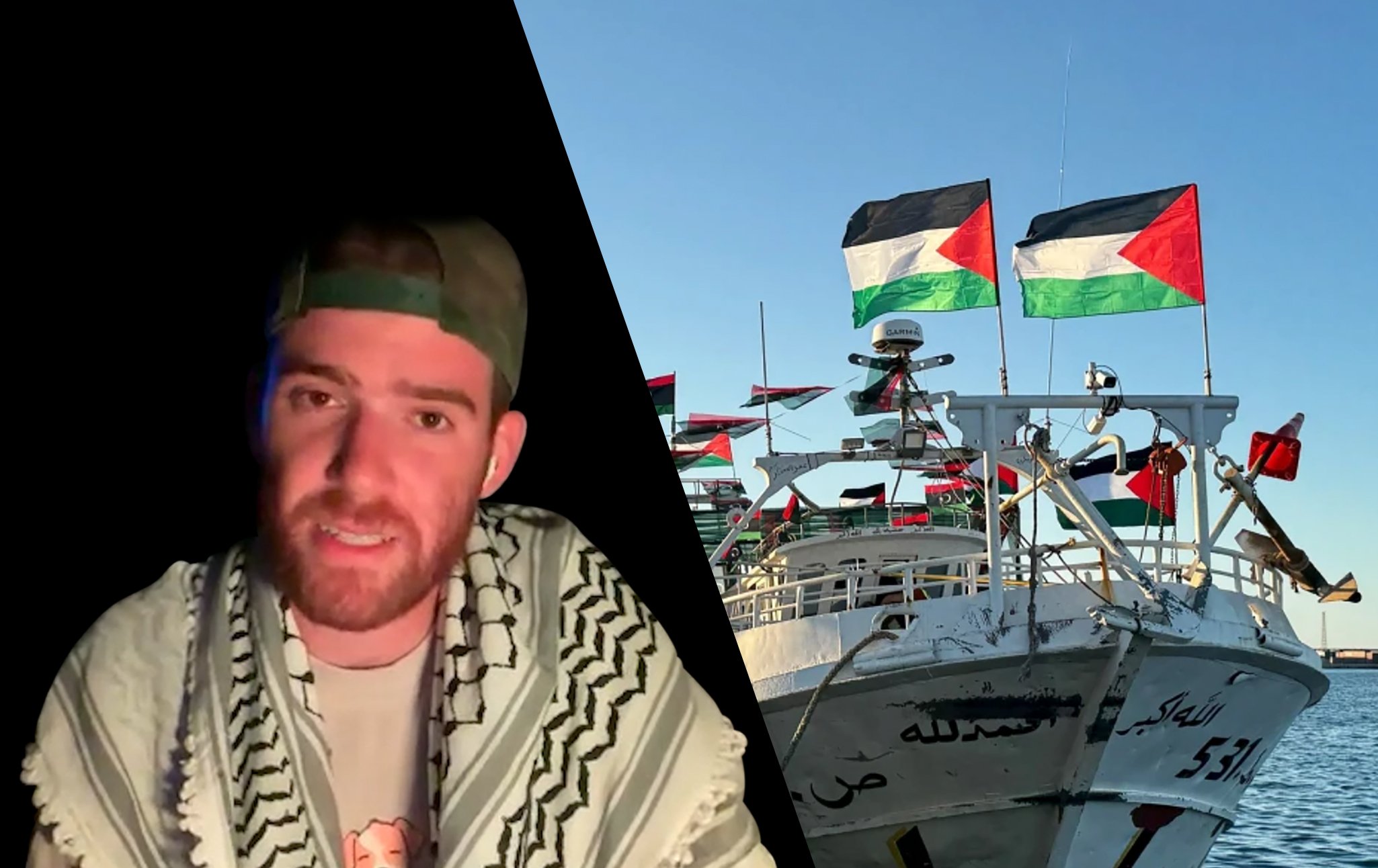
We are joined from the Sumud Aid Flotilla by Tommy Marcus, better known as “Quentin Quarantino,” who explains why he and hundreds of others are sailing to Gaza and how Israel has responded to their mission.
Tommy marcus is an activist and online influencer, better known by the Instagram handle “Quentin Quarantino.” He’s worked to get refugees safe passage from Afghanistan, used Airbnb to funnel cash to civilians under attack in Ukraine, and raised over $30 million for a variety of humanitarian causes. Now, he’s on his most ambitious mission yet: to break the Israeli siege of Gaza and bring life-saving humanitarian aid as part of the Global Sumud Flotilla. Live from the deck of a boat in the Mediterranean Sea, he recently joined Current Affairs editor-in-chief Nathan J. Robinson to explain why he's heading for Gaza.
Nathan J. Robinson
Tommy, I hoped you could start by telling us a little bit more about what the flotilla is. What does it consist of? What are you bringing? Where are you, and where are you going?
Tommy Marcus
Absolutely. The Global Sumud Flotilla has a very simple mission. We are over 40 boats of people from over 44 countries around the world: activists, actors, politicians, and everyday humanitarians who are fed up watching worldwide inaction at the genocide in Gaza and have realized that if we don’t put it into our hands, nobody will. So our overall mission here is to deliver aid to Gaza. Every one of these boats is carrying aid, from food to baby formula to medicine, and it’s a completely peaceful mission. We have no weapons. We are completely defenseless. And currently, location-wise, we are in the Mediterranean Sea somewhere below Greece, over halfway from Barcelona to Gaza. We’ve been at sea for close to three weeks, and we’re expecting to reach Gaza sometime in the next five to seven days.
Robinson
Now, let’s just go into a little more detail about why your mission is so critically important. At the moment, parts of Gaza are still in a famine. There are severe restrictions on what can enter. It’s a terribly desperate situation. You are basically trying to fulfill the obligation that Israel, as the occupying and besieging power, and the international community writ large, have failed to do that has resulted in a terrible humanitarian crisis. So tell us a little bit more about the urgency of getting to Gaza and bringing this aid.
Marcus
Well, first, as most viewers would know, people in Gaza are starving. Israel is forcing starvation on the entire population of Gaza. And the truth here, Nathan, as you know, is we’re carrying a lot of aid. We’re carrying as much food and baby formula as humanly possible on these vessels that we have put together as civilians. And this aid is not going to feed all of Gaza. That’s the harsh reality. But the goal here is to set a precedent to allow for large cargo ships to go through this humanitarian corridor that we are hopefully opening and to create this corridor where people can continuously bring aid to the people of Gaza, as Israel is doing everything they can to starve everyone to death.

Robinson
And what is extraordinary here is that the Government of Israel officially denies that it is trying to inflict starvation or perpetrating a genocide calculated to bring about the destruction of Palestine. However, when people have tried, as you are doing, to simply and peacefully bring aid—who have sort of called their bluff and said, “Well, if you’re not trying to destroy the people of Gaza, surely there’s no reason not to let humanitarians just bring as much aid as they’re willing to do”—the response to that from the Israeli government has not, in fact, been, “Sure, you’re welcome to bring whatever you’d like to feed the people of Gaza.” It has been quite the opposite.
Marcus
Yes, for the first time in my life, I’m being referred to as a terrorist. And at the beginning it was Itamar Ben-Gvir, who, even by Israel’s extremist standards, is an extremist in that society, which says a lot. But recently, we’ve seen the rhetoric really amp up to the point where the Israeli government is publishing official statements calling our entire flotilla a “Hamas-led jihadist propaganda terror boat,” ironically, with photos of Greta Thunberg.
They’re doing everything they can to convince the world that we are terrorists, which is fascinating, as we’re not carrying weapons; we’re not carrying anything but ourselves and food and medicine. But I think that it goes to show that they do feel threatened by our mission, not because we actually are a threat, but because the mere thought of this humanitarian corridor opening in the world, being able to feed Gaza, disrupts what they’re trying to do. They’re very intent on starving children. The photos of skin-and-bones children are not an accident. The children who are being blown to pieces are not just an accident. This is part of the goal.
Robinson
So you and I were talking earlier about how that rhetoric about the flotilla being a “terror flotilla” may be laughable to us, but it is not a joke. The Israelis have a very long, well-established history of painting peaceful protesters, in the case of the 2018 March of Return in Gaza, as a violent threat, which they then used as justification for getting trained snipers to shoot them, and over 200 people were killed. Also, Israel has used the same tactic of portraying journalists as part of or affiliated with Hamas, or academics in the case of Refaat Alareer. It’s not just empty rhetoric. What is done is that they are painted as terrorists, and then they become an actual violent target. So the shift in rhetoric on your flotilla, from just seeing this as a nuisance to treating it as a terrorist threat, matches a pattern we’ve seen of establishing someone as a threat and, therefore, as in the case of Anas Al-Sharif, a journalist, using it as justification to then kill them.
Marcus
Absolutely. And to your point, when Ben-Gvir was first calling all of us terrorists and making those threats, it was genuinely funny. I was laughing, and so were all of us. But seeing the transition from it being the very extremist portion of Israel calling us terrorists to the whole government’s official stance on us being a terror boat, taking out sponsored ads, making tweet after tweet about how we’re jihadists, and making false links—just doing everything they can to convince their believers that somehow this peaceful boat is a threat of violence—it’s, as you said, right out of their playbook.
To your point, on our boat, while we have people like me, an American citizen who has only ever done humanitarian aid work in my career, we have politicians—European parliamentarians and the former mayor of Barcelona—on the boat. We also have members of the press, who, as we know, are viewed by Israel as threats. We have Al Jazeera journalists on this boat. We have Middle East Eye journalists on this boat. So yes, to answer your question, it has been a little bit rattling, to say the least, to see this shift, especially when you see it happen so quickly.
It also, I think, reinforces the fact of the importance of what we’re doing. Because at first they were laughing at us. It was the “selfie boat.” As you know, most of my social background in my life are Zionists, and for the first couple of weeks, I was getting lots of texts: Oh, I hope you’re enjoying your cruise with Greta on the selfie boat. And those texts have died down recently because I think they see that the hasbara has changed. Now we’re the “terror boat,” and they’re not sure what to say to me anymore because they know I’m not a terrorist. But the leaders of their thought, the ones who [they listen to], are telling them now that Tommy Marcus is a terrorist. So for Zionists who know me, or even just know me from my Instagram, where all I’ve ever done is help people, I think there’s a bit of confusion. How exactly am I this person? How am I associated with Hamas? How are any of these people terrorists? It doesn’t make any sense. But unfortunately, as we know, sense isn’t really something that is necessary for Israel to have a successful PR campaign.
Robinson
I think one of the things that people might not understand is just the level of risk that you are now facing, and that is escalating. We recently saw the Trump administration blow up a boat carrying 11 people coming from Venezuela, killing them. They said it was a drug boat. They provided no evidence. The U.S. has been getting more and more brazen in just killing whoever it wants around the world. And Israel certainly has a history of killing humanitarian aid workers in Gaza. We mentioned they have a history of killing journalists. And in fact, this flotilla has already been violently attacked. We’re not, in fact, talking about a hypothetical future threat. You were already hit twice by drone strikes, as I understand.
Marcus
That is correct. When we were docked in Tunisia, in sovereign Tunisian waters, there were two separate drone attacks. And Bellingcat, one of the foremost, most respected—sorry, how would I describe Bellingcat?
Robinson
An independent research firm.
Marcus
Yes. Bellingcat is a source that I’ve used in war for many years because they’re so trustworthy. And a few days after the Israeli government and Zionist media ran with these lies that, first, it was started by a cigarette, and then when video came out of a fireball hitting the boat, it became, “They actually did this to themselves for attention.” And then Bellingcat actually was able to analyze one of the incendiary devices that was dropped on our boat, actually the boat that I’m sitting on currently, and was able to trace it, or at least identify it as very similar to a type of explosive that the United States and Israel manufacture.
Robinson
Yes, it was extraordinary. You posted footage after this attack, and immediately there was a wave of denial, saying this was a fire that broke out on the boat, but you could tell. You had footage where you can literally see it dropping from the sky onto the boat. But there really was such an effort to say, “Well, don’t believe your lying eyes.” But it’s remarkable. You very clearly came under attack, an attack that is totally illegal and for which there would be no accountability, no responsibility. And my interpretation was that it also seemed to be a kind of trial run for potential future attacks. They could have attacked you harder, but this felt like a kind of warning or an effort to see if they could get away with it.
Marcus
I totally agree. If those drones were instructed to cause death, I think they would have been able to. So I think the best way to look at them is that it was a sort of psychological intimidation. But of course, if you combine all the explanations, you go to the Times of Israel and the Jerusalem Post and just kind of throw those all into one, all I can say is, that’s one hell of a flying cigarette, Nathan.
Robinson
No kidding. That’s clear from the footage.
Listen, you mentioned that your background is among people who have been very pro-Israel. And growing up, you were certainly not as critical of the Israeli state as you currently are. You went through an evolution. We’ve talked about how when you used to read Current Affairs, you were like, “This is very good, except for the crazy anti-Israel stuff.” But you’ve undergone an evolution. And I wondered, to help open other people’s eyes, if you could tell us a little bit more. You are to the point where now you are putting your life on the line, I think it’s fair to say, to deliver aid to Gaza. You’re going beyond running fundraisers on social media, certainly. Explain a little bit more about that personal transformation in yourself that has brought you to this point.
Marcus
Yes, there are a lot of things that I can point to. The whole world is seeing the videos of dead children, and quite frankly, I’ve covered war for so long and been involved in so many different conflicts that involve many people dying. I can’t say just seeing some videos of people dying is what changed. I would say scale is a big thing. For a while, embarrassingly, with the help of educated Zionist friends who were contributing to my brainwashing, some of whom we both know, I was able to be like, “Okay, this is horrible, but October 7 was horrible, and what can you expect?”
And then I started to learn more about Israel. There was a gap in my historical knowledge of why Israel was created. To me, it was something that I never even had to really Google. I thought it was just that the timelines added up with the Holocaust, and I just thought Israel had to exist and that there were certain necessary evils. That was what I was raised believing. So I would really point to smaller things. I would point to, first, Palestinian American activists who are my friends, and also a couple of friends that I had from before October 7 who just happened to be Palestinians, who helped educate me.
But mostly I have Israelis to thank, and Zionists. Because when what I considered to be a war started to really get ugly in mid-October 2023, I started to put out some milquetoast statements, just kind of softly mentioning the fact that maybe this is a bit much. And every time I would do that, and in a language that I now look at and I’m disgusted by, I would get 100 messages immediately from Zionist and Israeli followers, like, “Hey Tommy, I know you mean well, but you don’t understand—this post quoting Bernie Sanders saying that too many people, too many civilians, are being harmed actually puts Jews around the world at risk.” And as someone who’s always been very proud of my Jewish heritage, it scared the shit out of me. Hearing that language, telling me that I’m promoting antisemitism and putting Jewish children on the Upper West Side at risk, it really scared me when I listened to people. And then I continued watching. And the reason I say I have Israel to thank is that, rather than scale down, it just continues to scale up. They started killing more children. They started starving people more transparently. They started being much more opaque in their language on what they intend to do. And I think there was also a level of me being a lifelong—Bernie Sanders got me into politics, but I think Trump kept me in politics, my hatred for Donald Trump.
Robinson
Yes.
Marcus
And so for a long time for me it was just like, okay, the Democrats are the good guys. So if Joe Biden is saying that it’s imperative that we defend Israel—I don’t really understand, but there must be some sort of reason. And if all the Zionist friends I’ve ever had are very deeply passionate about the fact that we need to support Israel, to the point that some of my friends change their vote from a 2020 Biden vote to a 2024 Trump vote in the name of protecting Israel, I embarrassingly listened to them. But then I started watching—I can point to this one documentary, Tantura, that at the beginning I actually thought I was watching the wrong thing because the opening credits are all Israeli and Jewish names. And it turns out it’s just a very straight up documentary interviewing the soldiers from the Nakba in 1948 about how they colonized Palestine with the violence that they used, and they very gleefully discuss the mass murders they committed, and even rapes and killing children. I started to realize that was a pattern that wasn’t established as a result of October 7. It’s something that’s always been happening. And then I started to look more deeply, and I started to talk to my two closest Palestinian American activist friends, who kind of turned into my educators—Alana Hadid and Jenan Matari. They really educated me on the history. I started to realize that October 7 is just another date in a long history of violence that is mostly propagated by Israel and the Zionist regime.

Robinson
You talked about how you got lots of messages from pro-Zionist acquaintances, friends, family, et cetera, saying, “How could you say this stuff?” I remember during that period even saying we should have a ceasefire—in fact, Bernie Sanders, I think, was reluctant to even come out for a ceasefire for a long time. You would get such blowback just by lamenting civilian deaths. Not to ask you to speculate or psychoanalyze, but you’ve talked to many such people. Obviously, what is it that you think gets people continually stuck in this propaganda and unable to see the reality of the situation that seems now so obvious to you? How can we break people out of this prison of propaganda?
Marcus
I wish I had a perfect answer to this, but to be honest, for a lot of this year, I’ve been changing people’s minds. When I started to get very intense about it and that the genocide was the thing that I needed to speak about the most, that it was the most important thing in the world, I made this transition and very transparently told my audience, “Look, guys, I handled this wrong, and I need you to understand why.” I changed a lot of people’s minds for a long time. But the reality is, in these past few months, the devastation has gotten so much more transparent. In a post earlier today, I called it the most watched genocide in the history of humanity. And I think that’s very true.
I’m getting a bit pessimistic about if we can open any more people’s eyes. I feel like it’s hit a limit where you’re either going to see a dead child with her intestines spilling out, gasping for her last breaths, and think something bad, or you’re going to see that and think, “Wow, Hamas is so bad,” even though Israel is the one that dropped a bomb from a quadcopter above this little child’s tent, killing her infant brother and her parents and making her grandfather lose all five of his children. There are too many people, Zionists, who see that and only think about excuses, and to that I don’t know how you can change that mind. I don’t know how you can change it, when there are polls that were conducted in Israel saying 79 percent of Jewish Israelis are unbothered by starving children. I don’t know how you fix that. And that’s, I think, the saddest thing that I’ve had to come to terms with.
There’s a video that I posted about two months ago that, when I watched it, scared me and made me cry. It took me almost the whole day to post it on my page because of how sharp it was. And it was Miriam Margolyes, a 90-year-old actress who was in Harry Potter and was born in Poland during the Holocaust, very sadly saying that “Hitler turned us into them.” I think the sad reality is, when you look at the way that not just the Israeli government, not just Netanyahu, but Israeli society as a whole talks about Palestinians and [abuses] Palestinians, and I’m including the ones who protest the war, calling for the hostages to be released while waving Israeli flags, I don’t know how you fix that. I wish I had an answer. I wish I understood why I personally have received tens of thousands of death threats, why people have been sending me my address since I was very softly calling it a genocide at the beginning of this year. It’s unthinkable to me, but I think that’s kind of the whole point, that this whole thing is devoid of any sort of rationality.
Robinson
It’s a sensitive thing to talk about, because under some definitions of antisemitism, just comparing Israel to Nazi Germany is considered antisemitic. But there is the phrase “those to whom evil is done do evil in return.” We know that abused children often grow up to be abusers. I do think a lot of what Israel does occurs in the long shadow of the Holocaust, which creates a sense that anything you do to protect yourself after the immensity of that horror must be justified. Certainly, October 7 awakened a lot of fears, a lot of Holocaust rhetoric. The idea that if we don’t take very extreme measures, which can be up to and including the extermination of the people of Palestine, which is openly justified on Israeli television—the suggestion is the Palestinians are Nazis, and if we don’t destroy them, they will destroy us. And once you’re in that mindset—when you see Israelis interviewed and basically saying, “I don’t care if the whole place burns; the children are going to grow up to be terrorists and killers.” That’s so normalized in Israel that it feels like a sickness or a cancer in the culture that I don’t know how you can get out.
Marcus
Yes. And you made me think of something, a conversation that I had around December or January of this year when I was really starting to feel my opinions change, and it was, quite honestly, a bit scary to me, because the thoughts that I was starting to have were thoughts that I was told are dangerous. I reached out to someone who I disagree with on American politics very significantly, always have, but we’ve always had kind of respectful and funny arguments. And I texted him very seriously. He’s a very proud Jewish person and has cousins in the IDF, and I sent him a text like, “Hey, man, I’m starting to feel I might be a little radical now, and I want to hear your opinion on this war”—I was still calling it a war—and he wrote me this very long thing. And for the first few paragraphs, I remember being like, “Okay, this is a bit much, but I get where you’re coming from.” And then there was this big paragraph about what needed to happen to Gaza after, and he used the word “denazification” and sent me a Wikipedia link to how Germany was denazified following World War Two.
And I realized then that his view of what needed to happen in Palestine, in Gaza, and, quite frankly, the West Bank, was killing all Palestinians, or at best, killing a lot of them and throwing the rest on some sort of train, if that reminds you of anything, and getting rid of them that way. But I realized then that I think the official Zionist belief is that we have to get rid of Palestinians, and that is what woke me up. And small things as well. I remember this video from the West Bank that I watched this past fall. It’s so minor, but it really stuck with me. It was a bus full of Palestinian women clearly just going from point A to point B, maybe to work—I don’t know where they were going, but they were harmless Palestinian women. And you watch this Israeli IDF truck smash into the bus, and some women fall out, and they’re yelling. At first I thought maybe that was an accident, or maybe just one bad apple. And 10 seconds later in the video, another IDF truck comes and smashes into it even harder, and the bus topples over. It’s little things like that, and settler violence in the West Bank. And just the small things, like these quotes from soldiers that really have stacked up over time. It’s not just one-offs. The amount of genocidal quotes and horrible things that I’ve heard Israeli soldiers say—it’s not a bad apple, it’s the entire system.
Robinson
Yes, there was a sniper from Chicago quoted recently just talking casually about how he shot a Palestinian who was trying to retrieve his brother’s corpse. He just didn’t even think twice. He was just like, why was he retrieving the corpse? The humanity of the victim was just so totally erased. There are all these quotes from soldiers around the Gaza Humanitarian Foundation’s sites who say, “We use tank shells as crowd control—we just throw grenades into crowds to corral the crowds.” That’s the level of dehumanization, and then it goes all the way to the top. And not just Ben-Gvir and Smotrich, who are in the government, but Israel’s security intelligence chief after October 7 said, we need to kill 50 Palestinians for every Israeli who was killed on October 7th, even if that means children. And I don’t know how you deal with that level of dehumanization; the only thing you can do is put a stop to it via force. So I want to talk about U.S. complicity, and then I want to conclude with what the world needs to do. Because we’ve talked about Israel, but you’re an American, I’m an American, and everything Israel does is backed by the United States. We have a responsibility. It’s not just that your background is Jewish and that ties you to this issue, but the fact that our taxpayer dollars are funding it. So maybe you could talk about the role of the United States here briefly.
Marcus
Yes, it’s shameful. I’ve always been critical of the United States. Most of my political action has been criticizing domestic American policies over the past five to six years, as I gained prominence for what I do. But nothing is more despicable to me than our complicity in this genocide, and knowing that it comes from both sides of the aisle, it almost breaks my heart in a way. I campaigned for Kamala Harris; I did everything I could to try to get her elected. And the reality is, when I think about it, I’m not sure that things would be any better in Gaza right now if Kamala were elected. Maybe a fraction, but at the end of the day, there’d still be a genocide ongoing. Maybe she’d be putting out a little fluffier statements about how sad she is.
Robinson
Maybe sadder about it. That’s the difference.
Marcus
No, seriously. And that brings me to another thing—it’s all about the vocabulary being so different. On October 7, Jews were murdered, but in Gaza, Palestinians are sadly dying, and that’s a difference in terminology that I see so often from Democrats, from every Democrat. And coming back to this flotilla, I live in Los Angeles now, but I actually haven’t changed my address. So my representative, if I were to be held by Israel or worse, is Cory Booker.
Robinson
Oh, good luck.
Marcus
Yes. I have no faith in our country. And I think the saddest part is that I’m really good at helping people get elected. My posts were actually studied by Super PACs this past fall on the effectiveness of me getting on-the-fence moderates deciding between voting for Trump and Harris to vote for Harris, and I was ranked one of the most effective people on social media at doing that. But I have to be honest, I’m not willing to do that if we parade out in 2028, and in the midterms, people who are not calling this a genocide and calling Israel what it is. To me, it’s the moral question of our time. Will you call it a genocide, and will you call out Israel? Will you stand up to Israel? Will you turn down their dollars? To that point, I burned so many bridges that I have to be a little bit vague on this podcast. But recently, I was approached by someone who, inherently, I should be rooting for to win an upcoming election because they are up against a MAGA opponent, and I do hope they win. And I was offered a paid opportunity to try to help them, and I would be good at helping them, but that person has received a lot of money from AIPAC. After I found that out, quite honestly, I said, go fuck yourself. And it’s sad, because America does need this person to win—
Robinson
Yes, we need to fight MAGA.
Marcus
—but I’m not willing anymore to sacrifice my [morals]. That’s blood money on my hands. And the funny thing is, I don’t think anyone would ever have learned about me doing that. I could have done it very quietly. Watching this every day and watching people excuse it—and now, I talk to so many people in Gaza every day. I talk to almost all the remaining living journalists. I’m even collaborating with children, which is so depressing—10-year-old children who, on a daily basis, I’m talking with their parents and putting up their videos, pleading to my American audience to care about them. And it’s just so depressing. It’s on a level that I can’t be complicit in any way, and that includes helping people that objectively help America. So in that sense, I think the ball is in the Democrats’ court. I think it’s time for them to listen to the people because I think we have seen a major shift. You probably have the statistics more on hand in your encyclopedic brain than I do, but there’s been a massive shift this year in 2025 of people realizing what is going on and not being okay with it anymore.
Robinson
No, that’s right. Because, especially among Democrats, an important point is that when Democrats continue to support Israel and continue to not speak out against the genocide, they are, in fact, defying the opinion of their own constituents, who now overwhelmingly are more sympathetic to Palestinians than to Israel in the conflict. And if you can’t speak out on the genocide, it means that you’re rejecting the conclusions of Amnesty International, Human Rights Watch, B’Tselem, Doctors Without Borders, Oxfam, and the United Nations [Independent International Commission of Inquiry], all of whom have concluded definitively, with voluminous evidence, that this is a genocide, all of which are pretty moderate organizations. They’re not radical. They’re not socialist, leftist. And so if you can’t even accept the conclusion of the mainstream human rights community, you’re failing to clear what I consider a pretty easy, low moral bar.
Marcus
Yes, and then Bernie Sanders, who I truly love and adore—and I probably wouldn’t be talking to you right now if it wasn’t for his existence—we saw him finally say the word genocide. But even then, his statement went right into Hamas and using the word “war” in the first sentence of his statement. It was like he was angry that he had to finally write it. And I’m still processing that. In November, I was very angry with people who were abstaining from voting. Truly. A lot of the people that I’m collaborating with now and listening to are people who, in October and November, were like, “Listen, I can’t morally go to the voting booth and vote for Kamala Harris.” And in that moment, even though I think deep down I had decided it was a genocide, I was still so focused on Trump that I was so angry at them. And I’m realizing now that my anger was misplaced. My anger should have been at Kamala Harris shutting down the pro-Palestinian protesters and not listening to her Arab and Muslim constituents. I think that there really was a window for her to win, if she wasn’t so staunchly in favor of the war in Gaza or mentioning that it was sad that people are dying in Gaza.
Robinson
The Uncommitted Movement said, “We’re trying to help you, and we want you to win, actually, but to win, what you need to do is let a Palestinian speak, meet with the Gaza families, and pledge to break with the administration—we want to be able to support you.” But she wouldn’t do it. And judging from her new memoir, she still doesn’t understand that. Listen, I know it’s getting late there, and people don’t know that you’ve been enduring a lot to be here. You are in rough seas, and you have been very, very ill, and you’re holding it together really well so that our audience doesn’t know.
Marcus
Honestly, Nathan, this conversation has significantly helped my seasickness. I have the scopolamine patch on my neck, and our emergency doctor on board, hopefully only needed for stuff like this, is pumping me full of drugs. But the most helpful thing has been this conversation with you. So if you do want to continue on, I’m more than happy to.
Robinson
I wanted to conclude by asking you about the message to the world, because a lot of people will hopefully listen to this conversation and will admire what you are doing. I think the first instinct people will have is, “How can I get a boat, and how can I come to join you?” So what do you say to people who are like, “Should I give money? Should I call my member of Congress?” It’s very important for people first to understand what you’re trying to do, what is going on in Gaza, and the threat that now faces, first off, everyone who’s surviving in Gaza, and also the flotilla activists. But if you could speak to people who, let’s assume now, are completely on your side and outraged.
Marcus
I think we need people to be loud. I think Palestinian people are desperate for people in America to be loud, louder than they already are. And seeing what happened in Italy today, the Italians have truly shut down Italy in support of Gaza, calling for an end to the support of what they call the terrorist state of Israel. It’s really inspiring. And, sadly, despite our Constitution and everything, people will be arrested for that. So I don’t want to encourage that, but I want to really encourage people to call their representatives, to share as many things online, to talk to their friends who are still somehow Zionist, and to honestly beg. And to the people who are asking, how can we get on the boat? I’d say maybe wait this one out and see how we fare, because, to be quite honest, we’re a bit scared right now. I wish I could just put on a total badass I’m-scared-of-nothing face. But the truth is, as we approach Gaza, we’re preparing for the worst. We’re running drills about potential lethal force being used upon us as we enter Israel’s waters.
Robinson
As it had before. There was a famous incident where Israel killed nine people on one of these aid flotillas long before October 7.
Marcus
Correct. And many other of these flotillas have been sabotaged in other ways. So we don’t really know what’s going to happen. Quite frankly, the Palestinians, first and foremost, need you to be loud. But we also, on the flotilla, regardless of whether it’s me from America or the people on board here who hold slightly less valuable passports, need your help too, because we really feel that Israel is laying the groundwork to excuse themselves to the world for using violence on us when it’s completely unnecessary and without any grounds. But as you can see, in Venezuela, it almost feels like they’re preparing the world for, like, okay, I guess this is the thing we do now. So, we’re a bit scared, but we’re not going to be deterred.
Robinson
There’s what’s going to happen to you, and there’s also what is being prepared for Gaza right now, because as horrific as this genocide has been already, the plan is for it to continue to get worse. Every moment matters. Israel is currently destroying Gaza City, building by building. We know, because of statements at the highest levels of the Israeli government, that the ultimate plan, which Donald Trump has endorsed openly, is the full ethnic cleansing of Gaza and basically divvying up Gaza’s valuable beachfront real estate. Yes, this is a genocide, but it is not a completed genocide, which means that there is still opportunity to change U.S. policy, to cut off arms to Israel, to sanction Israel, and to make Israel an international pariah. And now that this is a declared genocide, there is actually a legal obligation for the countries of the world to militarily intervene against Israel. That’s fairly unlikely, but if we’re taking our obligations seriously, we have an obligation to prevent an ongoing genocide from being completed.
Marcus
Yes, and on the Gaza City front, every day they’re leveling it more and more. They’ll drop their little leaflets that they use to convince people that they’re doing it morally, but in reality, they’re giving families 10 minutes to sprint out with all of their possessions and leaving many behind to die. And they’re cutting off internet, which I think is really important to mention. For two days every one of my contacts in Gaza City was unreachable, and as the internet started to return, it was a slow roll. So some of the people I’ve become very close to were checking in with me, and some of them weren’t.
I should have mentioned earlier, but one of the things that really touches me in an emotional way is when journalists my age are killed. Anas Al-Sharif’s murder, I think, was actually the most impactful thing that happened in my brain. Because when I look at people like that, I imagine myself if I hadn’t been born in New Jersey and lived a pretty lucky American life. I hope that if I were born in Gaza, I would have had the bravery and courage to be someone like Anas Al-Sharif. So as that blackout continued, for some of the people that I platform, speak to, and genuinely consider my friends, I started to hear the worst. For all of us on this flotilla, I think we go on and off on kind of our sanity, quite frankly, and while I wasn’t able to reach a few of my closest contacts who I really care about, I became convinced that they were dead. And really, just seeing the one check mark on WhatsApp in the past, in some of my other humanitarian work in Ukraine and Afghanistan, that one check mark has meant death. And I sat there just staring, contacting other people who had gotten their Internet back, asking, Do you have any idea?
Luckily, they all ended up being alright. But I know that one day, I’m going to get a message that one of these people, one of these brave journalists who are risking everything to show the world what is happening—and they know it too, which is why I don’t feel bad saying it—Israel is going to kill them, at least some of them, and that’s a really hard reality for me to bear, especially as someone who’s giving them a larger platform. When Israel entered Gaza City, I sent each and every one of them a message. I even had someone here who spoke Arabic that translated for me just to make sure that they understood. “I need you to know that my page is really prominent and has a lot of eyes on it,” [I said.] “And I, personally, believe that you being on my page puts you in more danger.” And every single one of them responded, “I know.” They know that it’s very likely that death awaits them, and even possibly their families, but they know that the world has abandoned them, and they know that their Instagram posts are some of the only things reaching the masses. So I hope one day that those people, the ones who have been martyred and the ones who are alive, are recognized on a larger scale for their bravery.

Robinson
Tommy, when I read the words coming out of Gaza, they can’t help but remind me of testimonies I’ve read about the Warsaw Ghetto in 1939-40. It didn’t happen all at once. People would be killed one by one. There’s a slow realization that it’s a matter of time before everything is destroyed. But as we look back upon that kind of horror, we think, wasn’t there a moment here when the world should have intervened? Well, wasn’t there a moment here? Couldn’t it have happened at some point before everything had been destroyed and everyone was gone? So many people are already gone in Gaza and knew they were going to. When you watch those interviews with Refaat Alareer, you can hear the bombs behind him, and he knows that the one with his name on it is coming. And then it did. But there are still people alive. They’ve destroyed so much of Gaza City, but they haven’t destroyed [everything]. There are still more people who can be saved. That’s not a hopeful message. It’s a very bleak situation. But people can’t resign themselves to despair, because they have to understand that at this moment in history, we have such an obligation to act. And you’re doing the small thing that you’re capable of with the reach that you have, and with the little boat, doing everything you can. And if everyone took their obligation seriously like that, we would have a chance of saving lives.
Marcus
The people of Palestine are begging the world to do everything that they can to stop this. Like you said, there are a lot of people alive. God knows what will be the reality in the coming weeks, as we watch every single day hundreds of innocent Palestinians be slaughtered for Smotrich to get his nice little patch of real estate and the Israelis to be rid of the nuisance that are the Palestinians, who they consider to be lesser than them. It is our moral obligation, and possibly the greatest moral obligation of our time, in my opinion, to rise up against the complicit governments like the United States and do something. And that’s why I’m standing here on this boat. That’s why, even though I truly am scared for my safety at this point, it’s not a guiding emotion in my brain right now.
There’s that quote that has gone around for a long time: what you’re doing right now is what you would have been doing in the Holocaust. And I really subscribe to that. I really want to, one day if I have children and grandchildren, be able to say that I did everything that I could. So am I personally going to stop this genocide? No, I’m not. I wish I could. But I’m just one person. I can make effective posts. I can raise $2 million. I can feed some children with that money. I can give some children new limbs from that money, which I have. I could bring some aid on this boat and bring more attention. But the reality is, we need as many people in the world. And it’s so urgent. To give you an example, a few days ago, we were approaching a storm on this flotilla, and there was some talk about if we should slow down. Because, actually, everyone’s going to get sick. And as you know, I’ve been sick as hell for the past few days, but I think the consensus was we don’t have time. Every minute matters. They’re doing it so fast. They’re escalating so quickly, it feels exponential at this point, with the incursion of Gaza City, that there’s no more time. We’re running out of time, and the people of Palestine are begging the world to stand up for them.
Robinson
Yes, and I would hope our audience, everyone hearing this, would take that very seriously. And you don’t have to have the physical courage of someone like Aaron Bushnell, who self-immolated in front of the Israeli embassy to protest this because he took seriously the idea that you have to think about what you would have been doing during past historical injustices and act accordingly. You don’t have to head for Gaza on a flotilla boat. But you do have to think seriously: what do I have the capacity to do and the obligation to do, and given my power and whatever resources that I, personally, have, what is it I can do? And you’ve done that. We at Current Affairs try and do what we can with the little magazine that we have, and we would just encourage everyone else not to view this as a spectator who says, “Oh dear, isn’t that sad?” Lives are being lost. People in power want you to think you’re powerless. That’s a very important part of how they get away with things: convincing you that you can do nothing. And so you have to resist that. You have to reject it. You have to understand that you are capable of action.
Marcus
Yes, and I want to add one more thing, because I’ve talked a lot about myself on this flotilla, and the reality is, while I am making a big sacrifice personally, [and] I am putting my safety at risk, there are people on this boat within 20 feet of me who are putting themselves at substantially greater risk. For example, my friend Kieran Andrieu, who’s a Palestinian British citizen. His entire family lives in the West Bank. He knows not only will he likely be subject to harsher treatment if they do try to intercept us, but he’ll also never be able to see his family in Jerusalem again. Or Rima Hassan, the French MEP who was born in a refugee camp in Syria and is fully Palestinian, and on the last mission was held in prison for five days. At the end of the day, I’m an American, I have Jewish blood, and I have a lot of privilege compared to other people on this mission. So I want to acknowledge that while I am also scared, who the hell knows what’s going to happen to me as well. But I want people listening to this to also understand that there are people making some of the largest sacrifices I’ve ever seen human beings make. And I know a lot of people watching this will be my audience, and I just want them to understand that.
Robinson
Well, we wish all of you the best of luck on your absolutely crucial mission. Nothing could be more important right now. As we’ve emphasized, your safety is at serious risk. You’ve been followed by a drone. You’ve already been under attack, and the groundwork is being laid for potential further violence. And of course, we would always emphasize that even that pales in comparison to what is currently unfolding and being done to the people of Gaza. So we thank you for speaking to us today, Tommy Marcus, aka Quentin Quarantino, from somewhere in the Mediterranean aboard the Global Samud Aid Flotilla.
Marcus
Thanks so much, Nathan. It’s truly a pleasure to call you my friend, and I’m sorry for once calling your opinions on Israel kooky, but I blame my Zionist friends who introduced me to you for that.
Robinson
It wouldn’t be the first.
Marcus
And it’s a pleasure to be educated by you. You’ve sent me books, I’ve read them, and it’s an honor to be on this podcast.
Robinson
It’s our great privilege to be your friend, Tommy.
Transcript edited by Patrick Farnsworth.