
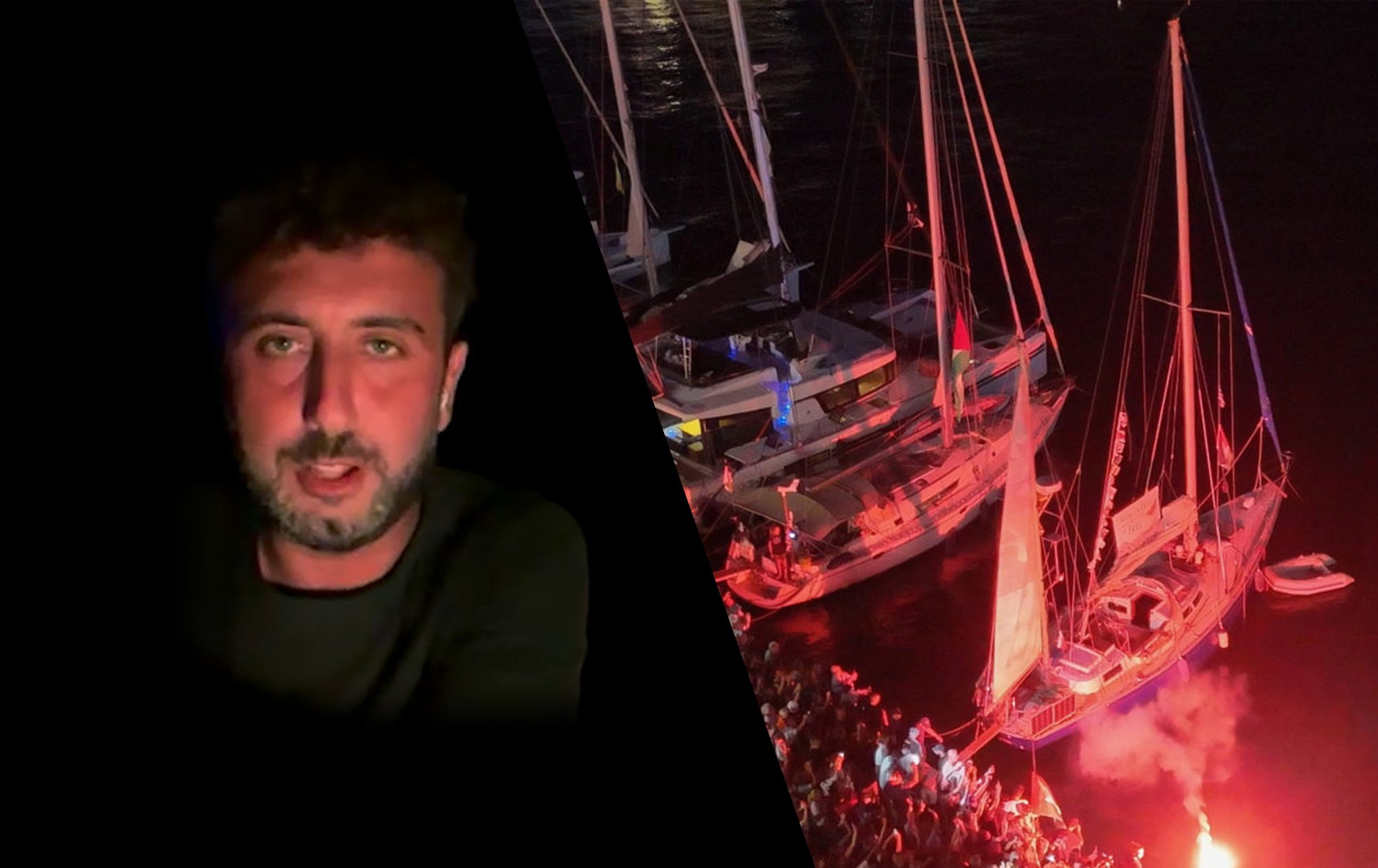
Live from the Mediterranean, Novara Media journalist Kieran Andrieu tells us why he joined the effort to break Israel’s blockade and bring aid to the people of Gaza.
Kieran Andrieu is a British-Palestinian journalist, activist, and contributor to Novara Media. He joined Current Affairs Editor-in-Chief Nathan J. Robinson to discuss his decision to join the Global Sumud Flotilla, the risks involved in confronting Israel’s blockade of Gaza, and why he believes powerlessness in the face of genocide is an illusion.
This is the second part of our series of dispatches from the flotilla; for the first, see this interview with Tommy Marcus.
Robinson
Can you tell us your background and your journey to the flotilla, how you ended up on this boat somewhere in the Mediterranean, en route to Gaza?
Andrieu
Yes, absolutely. Okay. So my family is Palestinian, my dad’s family, and I can talk to you briefly about their predicament. They’ve lived in East Jerusalem, in the Mount of Olives, for at least 150 years. They can trace the family ancestry back that far. Where it starts to come more into focus as a kind of family history is around 1948, the Nakba. My grandfather, my dad’s dad, was shot in the head by the Palmach, one of the terror gangs that later formed the IDF, and miraculously, he survived. By some insane alchemy, he didn’t die. But basically, he was transferred to a field hospital that the Red Crescent was operating just outside Jaffa. And there they ambushed the hospital, and they tried to kill him again, and he escaped again.
So that’s my grandfather. He was, as I say, shot in the head. It must have been a pretty crappy gun, I don’t know, because it just didn’t kill him, but it did create a big kind of chasm in his skull. I never met my grandpa, but my dad told me a few years back that the resources that they had at the Red Crescent field hospital outside Jaffa were so primitive that they had to stitch a bit of plastic under his skull, and you could see it moving every time he breathed. He lived another 50 years—he died in 1998—but it moved every time he breathed.
So then my dad’s generation, one of my uncles was part of the kind of secular Palestinian resistance movements in the 1970s. I say secular—they were Muslim, but their movement was political. One day, he was disappeared by Mossad, and nobody ever heard from him again. So the strong assumption, of course, is he was murdered. He was my dad’s oldest brother. It’s really heartbreaking, and again, I never met him; it’s the early ’80s, and I was born in the late ’80s. But I met his son years later, and I said to him, “What was our grandma like?” Because I never met my dad’s mom. They said, “Whenever I was around her, all she would do is cry because I reminded her so much of her eldest son,” his dad. Well, my own generation—I suppose I should bring the story up to today—my brother was thrown in prison when he was 12 for throwing stones at tanks as part of the Second Intifada in 2000. Locked up, and subsequently, he barely ever made it out of Israeli jail. He comes out, and they throw him back in for something arbitrary or something political. He’s developed schizophrenia. He’s very, very ill, and they won’t treat him. So most of his life has been spent inside Israeli prisons. And he’s 32 now, and he first went in when he was 12.

Robinson
Well, so what’s your background then? You’re clearly British, to some degree.
Andrieu
Everyone on this boat keeps saying to me, “You are the most British-sounding Palestinian I’ve ever met.” So okay, in a nutshell, my mum is French, but she moved to England when she was really young, before I was born. She left and went traveling to the Middle East. She met my dad. They had a relationship. I’m a bastard child. It was completely out of wedlock, but actually, the whole community at the Mount of Olives, she says, really welcomed her. Then she didn’t want to stay. He didn’t want to leave. So I was raised in England by my mum, basically. My dad went on to have six more children, and that’s why I have this kind of strange diaspora story.
Robinson
I think what’s interesting is the degree to which the entire course of your family’s life, of your existence, is shaped and determined by events in 1948. People talk about these things like their past, like they’re over. Obviously a lot of the Israeli rhetoric is, why can’t the Palestinian refugees just get over it? And it’s like, the way in which people’s lives are so molded by this moment in history.
Andrieu
Right. Absolutely. And for any Zionist who says that, they ought to consider the irony of their own situation, which is that they claim that the Torah is a land deed.
Robinson
They didn’t get over it for 2,000 years.
Andrieu
Exactly, they didn’t get over it for 2,000 years. So my own family, who still live there, for God’s sake, are supposed to get over it and move away or something. The irony shouldn’t be lost on anybody.
Robinson
But the flotilla. So you are raised as British Palestinian, but obviously, as we’ve mentioned, you know you can choose to be British. You can choose to look away. But obviously you have felt called, as Tommy [Marcus] felt called as a Jewish American who felt a responsibility. And now the two of you are together here, a Jewish American and a British Palestinian, on this flotilla. You obviously knew when you signed up for this that this was a risk to your life. Tell me a little bit about the decision that brought you here.
Andrieu
Well, first, there’s a beautiful kind of synergy with Tommy, and I think it’s because of the kind of parallel track to the same place.
Robinson
Yes, I noticed that immediately.
Andrieu
We’ve arrived at the same destination from opposite directions. It’s very poignant to me, and I think it is for him too. I think I found myself, Nathan, day after day after day throughout the genocide, feeling increasingly like I wasn’t doing enough, and I have a smallish public platform. I’ve worked for an organization called Novara Media.
Robinson
I love Novara.
Andrieu
Well, there we go, and we love you back. But I started to feel like it’s great to speak, it’s great to speak in public, it’s great to talk. I’m privileged because I have a platform. I get to air my opinions. But I was feeling a great deal of frustration that I wasn’t able to do more. I kind of thought, well, what’s the next thing I need to do? I probably need to put myself on the line. I need to put my body on the line. I need to take myself physically and put myself, not exactly where Gazans are, because I’m not doing this to be reckless. None of us wants to be killed. All of us want to go back safely to our loved ones. But I think there are multiple functions to what we’re doing. Obviously, bringing aid. That’s one. There’s the symbolism of drawing attention via the flotilla to Gaza, but there’s something else that is a bit more abstract. So bear with me.
It’s like you sit down and you watch the most inhuman violence being meted out against a defenseless population. Day after day after day. And among the many things that it induces in the human psyche, one of them is tremendous disempowerment, a sense that the world is so deeply unjust, we can see every nook and cranny of the hypocrisy operating behind these actions, but we can’t do anything. Not only can we not stop it, we can’t do anything. And so there’s a great danger in that scenario that people just retreat further and further into themselves and into atomization and apathy and nihilism. And I think by showing that actually Gaza isn’t just this abstract place that we hear about only in the context of suffering and trauma and horror, it’s a real place in the world. It’s a real place that we can physically get to. I think there’s something in that, almost phenomenologically. It connects the dots for people that there are things that you can do beyond the standard things, which are still really important, like marching, signing petitions, and so on. There are other things.
Robinson
It would also explain why your fleet of little boats with a motley assortment of people is seen as such a threat. If you can penetrate that sense of powerlessness, if you succeed in your mission—I think Israel is fairly determined to make sure that nobody manages to land on the beaches of Gaza and bring aid, but if you did—the moment that resulted would be such a thing of beauty and humanity, where the people of Gaza met with these people who had come to them to deliver them aid. It would be so obvious what right and wrong in this conflict are. And I suspect that’s a big part of what Israel is trying to prevent. They understand what it would look like if all of these people from all over the world managed it and came to give baby formula and to bring food. You’re attempting something that, if it succeeded, would be such a powerful moment of humanity.
Andrieu
Absolutely, and Israel, for a very long time, could subsist and survive and indeed thrive on the notion that it was more than just a nation-state that had the right to exist. Israel had managed to convince the world for so long that it was a romantic and an idealistic place. It was a kind of Hasbara dream factory that worked so well. Israel almost didn’t need to resort to being a big, bad bully in public. It just did its lynchings or whatever of Palestinians behind closed doors, and then it projected this wonderful image to the world, a liberal beacon of democracy in a Hobbesian part of the world. But that obviously fell to pieces, starting in the 1980s, and now the wheels have completely come off. Of course, there are still outposts—there are still hardcore Zionists—but the whole world understands what Israel is about now, and as a result, the flip side of that, the corollary of that, supports, broadly speaking, some form of Palestinian statehood and control of their destiny and so on. And so you’re right when you say that us landing on that beach and bringing teddy bears and baby formula and medicines and food to these genocided people, Israel knows it’s beyond the final nail in the coffin for it.

Robinson
Yes, that’s right. The flotilla is so important. And I want to just return to this idea of what you were talking about: people’s sense of powerlessness. Tommy and I were discussing this too, the way in which powerful people need to convince you you can do nothing. It’s a very convenient way for them to get away with everything, because there’s no opposition if everyone just feels hopeless. So I would assume that the people who are listening to our conversation, who have heard what I discussed with Tommy, roughly share the moral stance that the genocide needs to be stopped and that the flotilla needs to succeed and not be intercepted. But let me ask you, what’s your message? Because I asked Tommy this: what is your message to people who feel powerless? What do you want them to do? When they ask you, Yes, I totally agree with you, but all I feel like I can do is leave a supportive comment under the video. What do you tell them?
Andrieu
I tell them, first, supportive comments are very welcome. Every drop makes up an ocean, but genuinely, powerlessness is an illusion. You’ve written brilliantly on this, Nathan, many times. It’s a trick of the light that’s performed over and over again by very powerful forces. No one doubts that that power exists and it’s concentrated and that people are limited in what they can do in given situations. And of course, there are collective action problems and all the rest of it. But I would say now that there is a pretty large pro-Palestine infrastructure in most countries in the West. Pretty large, and it’s growing. Be part of that infrastructure in some fashion or another.
Not everybody can get on the flotilla—not everybody can do that and I totally get it. I don’t think that’s the litmus test, that if you don’t do that, you can’t look your children in the eyes and say what you did during the genocide. No, everybody has a different role to play. My mother, for example, could never get on the flotilla. Her health wouldn’t permit it. However, she is one of the most dedicated. She’s French, not Palestinian, but she’s one of the most dedicated pro-Palestine activists I’ve ever met in my life, and I’ve met many of them. And what she does is she organizes with her local pro-Palestine caucus in our hometown. She has, for 20-odd years, led campaigns to boycott shops that are stocking Israeli goods and so on. So I think being part of BDS [Boycott, Divest, and Sanctions], being part of those caucuses, and taking an active role in as many of those things as you possibly can are wonderful contributions to a growing international civil society movement, which might seem frivolous compared to Israel’s war machine and the kind of meat grinder that it feeds Palestinians into day after day. But it’s not. It’s the reason that we see so much pressure being put on governments. And governments, however [small] it is, are being forced to recognize the Palestinian state. And if they’re doing that today and if we keep putting pressure on them, tomorrow they’ll suspend arms licenses and so on.
Robinson
Well, I keep thinking, all right, if that’s what they’re willing to do with a movement this size, what if it was 10 times larger? What if it was 20 times larger? What if the pressure increased? As you say, obviously, recognizing a Palestinian state doesn’t require any material commitments to do very much. Nevertheless, it was resisted for so long, and it is a remarkable shift. And you can tell that it’s not totally meaningless by the fact that Israel is so angry about it and denouncing it with such absolute vehemence. So we shouldn’t see it as nothing. It is a victory to have the Western countries finally join the rest of the world in recognizing the basic fact that, can we at least agree that Palestine exists?
Andrieu
Yes, exactly. And it’s the byproduct of social pressure. First of all, Palestinians refusal to vanish. Very easily, we could have various permutations of history or various contingencies arraying themselves slightly differently. Palestine could have vanished as a kind of viable polity, a viable entity. It could have happened. We could have gone into the ashcan of history, but we didn’t. We refused to, and that’s first and foremost tremendous credit to Palestinians.
But Palestinians couldn’t do it alone, and so it had to be a kind of ripple effect, which then very slowly spread to countries and civil society around the world, and that’s what we’re seeing now: exerted pressure from below on powerful institutions, which has signally failed to prevent the genocide and, in many cases, aided and abetted it. Nonetheless, they are feeling that that pressure is feeding up and translating through from civil society. We need to build on that. We need to keep pushing, because that’s the only way that things are going to get better for Palestinians on the ground. You know the term “facts on the ground.” The facts on the ground dictate that everything has gotten worse for Palestinians. If you just look at that unit of analysis, you’re going to see it’s just the most traumatizing, depressing trajectory. However, if you look outside, the picture is completely different. It’s a complete inversion of that, where 25, 30, or 40 years ago, nobody knew that Palestinians existed and thought that Israel was this beacon of romantic idealism. That has completely shifted, and that will start to bear tangible results.
Robinson
And in the United States, Tommy and I were discussing massive shifts in public opinion on Israel of the kind that we’ve never seen in my lifetime. I’ve been sort of shocked to see Democratic candidates who are fairly mainstream coming out and touting as a point of pride that they don’t accept AIPAC money. That’s unimaginable to me. In Maine, Graham Platner’s biggest applause line he receives at his event is when he says, “I won’t take a dime from AIPAC.” And I’m looking at this and going, this is a new political reality.
Andrieu
Yes. It’s amazing. You can tell me far more than I can tell you, Nathan, about the inner workings of AIPAC. Of course, in Britain, those of us who are committed to Palestinian justice, and so on, are very familiar with AIPAC. We’re very familiar with the kind of poisonous influence it exerts on American politics, but the sort of dealignment between AIPAC and politicians—sort of public dealignment—is now something that is quite unprecedented. And it’s almost becoming a mark or badge of honor for politicians in a way that maybe it wasn’t 10-15 years ago.

Robinson
I think we have to conclude here. Obviously, I would love it if you’d contribute to Current Affairs in the future. And let’s check in: How long is it now until you hope to arrive in Gaza?
Andrieu
Well, in five days time, if we carry on going at this speed, which isn’t particularly fast because we’ve got to stay with the whole thing—but if we carry on going at this speed, in five days time, we’ll arrive at the so-called Orange Line. Now, the Orange Line is 150 nautical miles out from the coast of Gaza, and it’s called the Orange Line because beyond it, Israel has been known to intercept boats in international waters. Kidnap. It’s obviously a violation of international law. I don’t know if your listeners or viewers know, Nathan, or if you know—I didn’t until yesterday—but national waters extend only as far as 12 nautical miles from the coast. So that gives you an idea of how far Israel is willing to stray outside its national waters to kidnap boats in international waters. So to answer your question, five days to the Orange Line. And if we were to make it to the shores of Gaza without interception from Israel—it’s a big if, but if—it would be about seven days from now.
Robinson
Well, we will certainly be monitoring your progress closely, and we would encourage our listeners and readers to do the same. US media, obviously, is not going to do much good coverage of the flotilla. Is there somewhere people can get updates? How should people follow for updates?
Andrieu
Okay, so I don’t want to plug myself, but I have been giving very regular updates. People can go to my Twitter. I promise that’s not a personal plug. My girlfriend is on my back all the time telling me I need to put three or four tweets up a day. So I’m doing my best, but the other thing you could do is, Tommy is giving pretty regular updates as well. And then also, Global Sumud Flotilla has its own Twitter page and its own Instagram page, and you can get regular updates from them as well. Novara Media as well.
Robinson
Novara is excellent. You’ve got such a great team of people. You’re really one of the only little beacons of hope there in British media, which is generally pretty dire.
Andrieu
That means a lot coming from you. Thanks so much.
Robinson
All right. Kieran, it’s great to meet you. Thank you so much. Best of luck. Stay safe out there.
Andrieu
It’s been an honor. Thank you, Nathan. Cheers.
Transcript edited by Patrick Farnsworth.