.png)
If he wins in November, this could be end of the road for AIPAC and the Democratic establishment.
The amount of money put toward defeating Abdul El-Sayed in the Michigan Senate Primary was staggering:
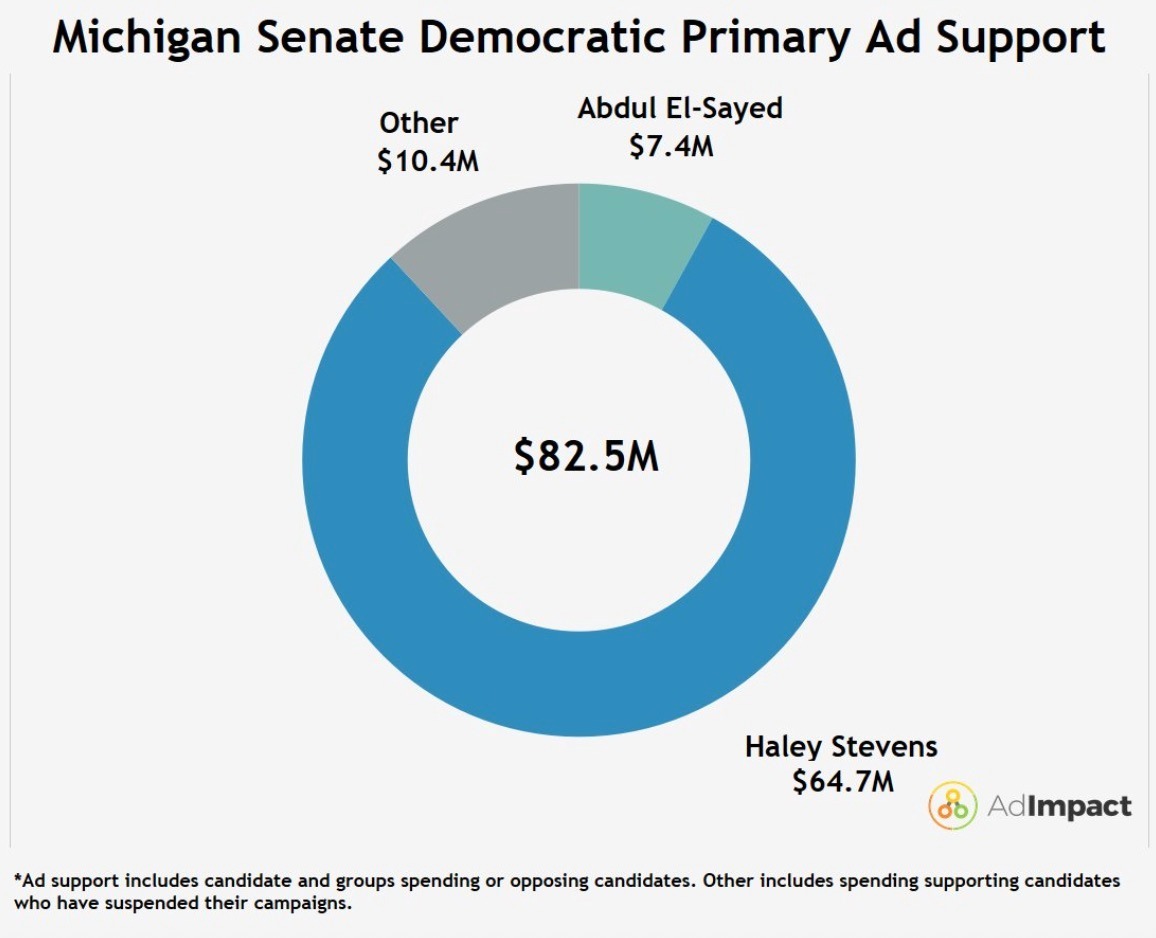
Tens of millions of dollars in outside spending were funneled into pushing vicious, untrue ads about El-Sayed that blanketed the Michigan airwaves. When I was in Michigan last month reporting on the campaign, I couldn’t believe how often the ad accusing El-Sayed of sexism was airing on local TV. It was in practically every commercial break. Sponsored by the “United Democracy Project,” an arm of AIPAC, the ads were also pushed all over social media and in glossy flyers that filled Michiganders’ mailboxes. Haley Stevens’ own fundraising was anemic (El-Sayed raised twice as much), but AIPAC was so determined to ensure El-Sayed’s defeat that they spent more than they ever have in a single race.
It didn’t work. In fact, it may have backfired. AIPAC’s vast spending in the race essentially made El-Sayed’s case for him. The Democrat nominee is running on a simple slogan: “Money out of politics, money in your pocket, Medicare for All.” What better demonstration of the insidious impact of money in politics than malicious attack ads on behalf of the U.S. lobby for a genocidal foreign government? People do not like to be treated as idiots, and the Haley Stevens campaign essentially tried to manipulate voters through misleading advertising. She didn’t have much of an on-the-ground presence. There were very few public appearances or volunteer opportunities. While El-Sayed was having huge rallies and taking every interview opportunity he got, Stevens was refusing to speak even to friendly media outlets like Vox, which concluded that “the moderates are in hiding.”
From one perspective, El-Sayed’s victory is not surprising. Stevens was a weak campaigner who was running as the establishment choice—touting endorsements from figures like Rep. James Clyburn, Michigan Governor Gretchen Whitmer, and incumbent Senator Gary Peters—in a year when Americans are sick to death of the establishment. She was all but telling voters: “If you’re dissatisfied with the existing Democratic leadership, don’t vote for me, because I am the candidate favored by that leadership.” She gave El-Sayed precisely the opening he wanted to run a campaign built around changing the old guard. But El-Sayed's victory also was surprising, because it should have been impossible for him to defeat the amount of money that was spent to stop him, and the unified opposition of the entire party establishment.
What has this election proven? First, that progressives’ political commitments (Medicare For All, an end to support for Israel’s crimes against humanity, an end to corporate dominance of the Democratic Party, a focus on kitchen table issues like wages, building unions, the cost of college, etc.) are not just “New York City” concerns. Many Michigan Democrats are just as fed up with the party leadership, and their concerns can’t be silenced through flooding their televisions with propaganda. I also suspect that this election will diminish AIPAC's influence within the Democratic party. AIPAC’s financial support will no longer necessarily be seen as an asset. If El-Sayed wins the general, and his brand of politics continue to ascend, Democratic politicians, even those personally supportive of Israel (and thereby out of alignment with the majority of Democratic voters) will increasingly see AIPAC as a politically toxic organization that they should have nothing to do with.
But that is assuming that Abdul El-Sayed wins the general election. One of the main cases that Haley Stevens made was that El-Sayed was an electoral risk against Republican candidate Mike Rogers, and that a centrist, rather than a progressive, is more “electable.” I have previously discussed at length why I do not think this argument holds, and the “electability” of centrists is far from self-evident. But some people, even those sympathetic to El-Sayed, are concerned by polling showing that Rogers would narrowly edge out El-Sayed if the election were held today. Jonathan Chait of the Atlantic says that honest leftists should simply admit that running a more progressive candidate is an electoral risk they’re willing to take.
But I am less worried by these few polls than others. This is because I have been following El-Sayed since 2018, and I know that he has yet to actually begin his full anti-Rogers campaign. El-Sayed has already previewed the strategy against his Republican opponent: He will be portraying Rogers as the prototypical example of a politician who does the bidding of corporations rather than voters. “I’m going to put a figurative tattoo on your forehead. And every time people see your face, they’re going to say ‘corporatist shill, opioid-epidemic starter,’” El-Sayed told New York Magazine. Indeed, as Bridge Michigan documented, during his 11 years in Congress Mike Rogers was a “leading advocate” for increased access to opioids, receiving “hundreds of thousands of dollars in campaign contributions from the same drug companies that now are paying billions of dollars in national opioid settlements for their roles in causing the epidemic.” Meanwhile, El-Sayed is a medical doctor who has served as the public health director for Wayne County, giving him a unique authority to speak on the crisis and its aftereffects. Having been focused on winning the primary, El-Sayed has not yet begun the work of running his anti-Rogers playbook. We don’t yet know whether it will work. El-Sayed claims he’s going to beat Rogers by seven points. We’ll see.
I do think El-Sayed is not to be underestimated, and there is much that the polls do not capture. Rogers so far appears to be flailing in knowing how to deal with his new opponent. He recently posted an AI-generated ad depicting El-Sayed as Odysseus bringing the Trojan horse of communism across the Ambassador Bridge from Canada into Michigan. The ad gave El-Sayed the opportunity to bring up an issue he has made a major plank of his policy platform: corporations sticking data centers in people’s backyards whether they like it or not.

If Rogers thinks El-Sayed will be easy to beat, I would suggest he doesn’t quite understand who he is dealing with. El-Sayed is an uncommonly talented speaker and organizer who just beat tens of millions of dollars in outside spending and the entire Democratic party establishment, including his state’s own governor. He’s running on a populist platform that emphasizes giving people affordable healthcare and ending corporate domination of politics. If Rogers thinks that he can win by screaming “communism,” he is in for a rude awakening. Republican president Donald Trump is historically unpopular and is likely to drag other Republicans down with him. Republicans do not have solutions to the problems people care about. Trump’s Iran war is dragging on and sending gas prices up, the climate crisis is clogging the air with wildfire smoke, and Trump is dismissive of “affordability” as an issue.
As Slate’s Jim Newell notes, since Bernie Sanders ran in 2016, progressives have been arguing that the “Bernie program” (Medicare For All, free college, ending corporate influence on politics) is an effective way to fight Republicans, but Sanders did not make it out of a primary and so was not able to test that theory. Now El-Sayed will “have a chance to test-drive the progressive theory of electability in a prime swing election” and “we’ll finally get an answer.” As Newell points out, the answer could be “no”: El-Sayed could lose. If that happens, it will be disastrous for the progressive left. The argument will be that Stevens was right: what Democrats may want in a primary is different from what works in a general election. El-Sayed will be seen as handing a winnable Senate seat to Republicans. But I think El-Sayed understands the stakes here, and knows that now he has succeeded in the primary, he must win the general election. If he does win, the theory that you have to run establishment candidates to win swing states will be dead. If he loses, that theory will live on, and El-Sayed will be treated as a devastating lesson in where anti-establishment politics could lead.
Either way, this election has enormous implications for the future of the Democratic Party, as every media outlet has now realized. If El-Sayed beats Rogers, conventional wisdom will have been overturned for good. Of course, that outcome gives the Democrats who opposed El-Sayed good reason not to support him in the general election, so expect to see him doing a great deal of work to pivot and court the supporters of Mallory McMorrow and Haley Stevens. I suspect that most Democrats are opposed enough to Trump’s Republican Party that they will fall in line behind El-Sayed, especially since his agenda actually isn’t terribly radical, and is popular among the Democratic base. And the fact that so much money could not stop El-Sayed shows conclusively that Democratic politics are changing everywhere, not just in New York.