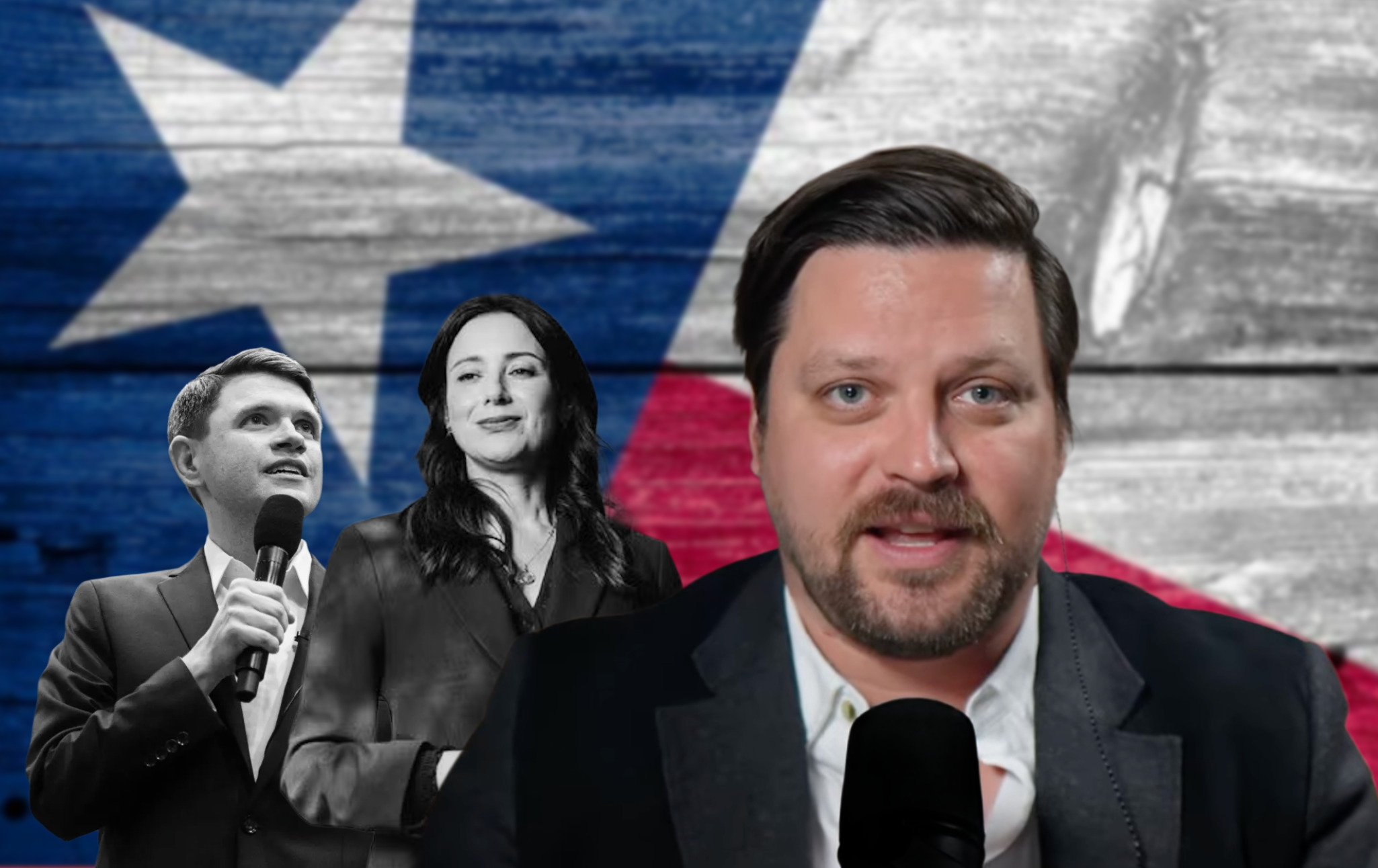
David Griscom, author of “The Myth of Red Texas,” unpacks the election results that shocked America.
David Griscom is a democratic socialist, a writer, and the co-host (with Matt Lech) of The Jacobin Show and Left Reckoning. More relevant to today’s news, he’s also the author of The Myth of Red Texas, which argues that the supposedly “conservative” state is more radical and left-leaning than most people know. (For more on David’s book, check out this review in Current Affairs by Emily Carmichael.) Griscom joined associate editor Alex Skopic to break down the recent “blue wave” in Texas, what he makes of politicians like Gina Hinojosa and James Talarico, and where the Lone Star State goes from here.
Alex Skopic
We’re recording this about a week out from the midterm results, and by now everybody’s seen the blue wave, the blue tsunami, the blueclear apocalypse. The epicenter of that is, of course, in Texas, where you’ve had the governorship change hands. You’ve had the first Democratic senator from Texas in, I believe, over 30 years, James Talarico—or as Trump calls him, “James Talafreako.” Texas has matched his Tala-freak. And I believe one of your state legislatures has changed hands too.
David Griscom
Yes, and also lieutenant governor. They won every statewide race. It was beyond anything that folks could imagine. And as somebody who wrote a book about reclaiming certain Texas traditions and Texas populism, it would be kind of like watching a football game and saying, “We need to run the ball,” and then on the first play, they run the ball and run it 85 yards down for a touchdown. It has been a really incredible week here, and I think a lot of political opportunities have come through. And the Senate is probably going to be within range in ’28 for the Democrats as well. They won the lieutenant governor race, attorney general, and AG commissioner across the board. So really, I think it’s just a kind of sweeping victory for Democrats in Texas.
Skopic
And I’ve seen the footage [of celebrations] coming out of places like Austin and San Antonio, and people have said it looks like Iraq after Saddam Hussein left.
Griscom
Yes, I was out there in the streets. It was funny because obviously we’re all gutted about not winning Florida, and I don’t mean to belittle how serious of a critique that is, but I also want to remind us it’s kind of an awesome moment that we’re in right now, where we’re frustrated that we didn’t pick up more. But I was on the Majority Report, and I was over the moon as I started to see some of the results from Tarrant County and Denton, and it wasn’t necessarily a surprise to me that Democrats were in the lead, but it was the size. It was looking really, really bad for Republicans. So, anyway, when I finished the Majority Report, I got in a car and went right downtown. And James Talarico was supposed to show up at this really great honky tonk called the White Horse. He didn’t end up showing up, but they did cover everybody’s door charge there, so it was completely packed, filled with a lot of DSA elected officials here in Austin and all sorts of folks. We were celebrating. I, for one, was celebrating late into the night and didn’t get home until the wee hours of the morning, not really even expecting what Wednesday would end up being for me, just the amount of interest and excitement from so many people after this huge win.
Skopic
Yes, and I’ve got to say we appreciate you making time for us here, because we know you are now hugely in demand as the author of The Myth of Red Texas. People should go back and check out our review of David’s book by Emily Carmichael in the magazine a little while ago. And you really did call this months before it happened. Your book’s whole premise is that there’s been this myth built up, that Texas is inherently conservative, and it really isn’t. There is all of this wonderful socialist history and radical labor history, all waiting under the surface to be reclaimed. And if Democrats actually try, they could do well in Texas. So how vindicated do you feel right now, having made that argument?
Griscom
I feel extremely vindicated. Look, I’m a socialist, and we should have no illusions, for example, that we just elected a democratic socialist government here in Texas. In fact, one thing—sorry to be pessimistic—that I am kind of frustrated about, and it’s obviously easier to say than to do, but I do wish that we had gotten some more people running for legislature, or running even for some of these congressional districts that unexpectedly went to the Democrats, because we probably could have snuck a few folks in there, frankly, on this wave. All that being said, I think especially when you look at Gina Hinojosa, our incoming governor, literally on my birthday, they released an interview in the New York Times, and not only does she call herself a populist, Alex, but she also starts talking about the Farmers Alliance. Everyone’s using the word “populist” now, but she’s literally talking about the Texas tradition of agrarian populism. To me that means, and I think it really shows throughout her campaign, she really was switched on to what I think is the kind of populist ethos, let’s call it, of talking relentlessly about inequality and unaffordability, talking about reclaiming democracy for everyday people, and talking about issues that really did matter for folks.
One thing that I’ll tell you that really was on a lot of people’s minds, and it might be one of those issues that consultants and even I sometimes dismiss, not as an unimportant issue, but maybe not one that would move folks: Flock cameras. And I’ll tell you, I talk to a lot of folks, and especially apolitical folks; they are all worked up about this. Gina made a big point of opposing Flock cameras, as a freedom argument, when she was running for governor. One of the co-chairs of her transition team is Ryan Pollock, who is a union and labor leader right here in the Austin area. So I’ve just seen a lot to be excited about from her. This was such a success, and I think it really does vindicate the argument that I’ve been making for a long time, that this idea that Texas is automatically conservative is totally wrong. And if you appeal to people on class levels, if you appeal to people on economic populism, you really can get a lot of people into your coalition.
We have a lot of work to do now in taking advantage of this moment and actually building up that populist movement, or more, hopefully a democratic socialist movement in this state. Because right now we have a lot of populist rhetoric, and we really need that movement to make sure that these things happen. We are going to go into a government, and they’re going to be able to do a lot. Because power has been concentrated in Republicans’ hands for so long, just taking them out of executive power is going to immediately improve people’s lives. But to do the things that we want to do, we’re going to need to have a long-sustained movement that really brings in everyday working class people, not just as fans of major politicians, but as active participants in this political revolution.
Skopic
Yes, for sure. And this is kind of the situation everywhere. I believe they’ve now called it for Scott Colom in Mississippi.
Griscom
Unbelievable.
Skopic
So you would say Gina Hinojosa is, if not a socialist, then a progressive, a populist, in terms of economics?
Griscom
I would firmly put her in the populist camp—she rejects “progressive” as a label in favor of populism.
Skopic
Okay, that’s interesting, because it seems like everyone’s a “progressive” now.
Griscom
Yes. Well, I think what happened here, too, is they saw progressivism as being engaged in “culture wars.” And again, I don’t think they did that in a way that was demonizing or giving space necessarily to the right on those issues, but it was more saying, “Hey, the things that really matter to folks are questions of affordability and of a government that has been working for you.”
Dealing with the corruption in the state—you go to South Texas, and Elon Musk has completely taken over Brownsville in that area. There was a story that came out that they were going to give him one of our parks. Big Bend being bulldozed. All these kinds of things. It’s just daily humiliations. And populism—really, I think folks forget—was a movement of dignity for people who were left out of the political system back in the day. And what we’re seeing here is a reclaiming of dignity for working people in the state of Texas. It really is a new dawn, a new horizon. And again, we don’t want to lie to ourselves and think that the victory has been won. What we have right now is a political opening that, frankly, I’ve always hoped and argued for, but in my darkest moments, thought would never happen. And now we have this opportunity, and I think we need to, first, be able to celebrate it and take that collective deep breath of relief, but recognize that there’s a lot of work and opportunity in front of us. Think about it: they don’t have people with a lot of experience running government. There’s a lot of opportunity for people to get involved directly in these administrations in the government right now. Texas has a lot of appointed positions. And Texas, despite having been run by Republicans for so long, Alex, if you go to the cities, if you go to Austin, if you go to Houston, or San Antonio—I’m not going to list all the towns in the state—you will see there has been this very strong progressive populist movement that grew out of the Bernie Sanders movement. A lot of really switched-on people. A lot of people fighting against incredible odds who laid the groundwork, and those are the people who I’m hoping can really reap the benefits and have more say and influence over our politics in the next few weeks, months, and hopefully years.

Skopic
This is one of the things I wanted to ask you, actually. Since this result has happened, and since there’s been a week or more for everybody to get their takes out, there’s been a real ideological conflict over who gets to claim the victory.
Griscom
Yes.
Skopic
You’ve probably seen Neera Tanden has been out there saying that this election cycle was a victory for, as she puts it, “normie” Democrats, not the left. In the Atlantic, the worst magazine in America, Jonathan Chait has been saying that, really, all of these candidates except for El-Sayed are pretty much standard issue Democrats; they’re not left. But it sounds like you think pretty much the opposite.
Griscom
I think there’s this weird thing in American politics where talking about the economy is coded as “moderate.” I find that to be extremely juvenile. Look, I think especially Gina is talking about doing things like reining in extremely high electricity prices, where Texas is supposedly the energy capital of the country. The amount of money that we have to pay just to keep our lights on in our homes is astronomical. A big part of that, by the way, has been a privatization scheme pushed by the Republicans to destroy the public power system that we built here. She’s talking about reining in those costs. Talking about distributing money—Texas has a huge surplus. Talking about distributing money directly to the people. Look, maybe you disagree with me on this, Alex, if they want to call this moderate, and we all agree now this is the way that we’ll do politics, that’s good in my book. But there’s just no doubt about it. What we are seeing right now is people talking about billionaires. They’re talking about class. It’s a major shift.
And look, we can always continue to want to push them and to call things out. There are some things that I’m worried about for sure. But there’s just no way to look at this victory that we’ve seen and just not see the long march of this Bernie Sanders revolution that started in 2016. And again, what they mean by moderation is that the Democrats in Texas didn’t run an identity politics campaign. Gina Hinojosa is a historic candidate for many reasons. One is flipping the state, but obviously, she’s a woman from the Rio Grande Valley. But it just wasn’t a Hillary Clinton kind of campaign: “It’s my turn.” It was very much about the people, and bringing power back to Texans who have been left out. So these folks are going to try to justify the nonsense that they’ve been peddling for years. But the mainstream argument, Alex, about flipping Texas, and I’m sure you’re probably got tired of hearing it just as much as I did, was demographics as destiny. “Now that Texas is no longer an Anglo-majority state, it will automatically become Democrat.” That was a totally failed argument and, in 2024, really was exposed as a failure, as we saw many Hispanic voters go to the right. The way the Democrats were able to reclaim Texas wasn’t by leaning into this moderate, centrist DC strategy of “demographics as destiny.” It was by returning to a very particular Texas version of politics, and that is this style of economic populism. So, look, if they want to claim it, go for it. You know what I mean? If you all want to say that this is standard politics in America, I’m very happy to be living in that country.
Skopic
No, same. I think we pretty much are of the same mind. The right has spent so many decades pushing the window further and further right. So if we can claim that somebody like Talarico is the center, that’s a pretty good start.
Griscom
Yes, exactly. And Talarico is an interesting figure. I’ve been writing about him for a long time. I was fairly bullish on him when he was in the primary. I wrote for Jacobin about how his campaign really kind of built out of the Bernie Sanders presidential campaign in 2020—no doubt about it. And he used populist language. He was talking about billionaires. He was talking about class. He was using “it’s not left versus right; it’s top versus bottom.” These are all things that I’ve been wanting to see. He did that weird event with Mark Cuban a couple of months ago that I found to be kind of silly. So there’s going to be stuff like that. James Talarico has done something that people thought was impossible. So he’s going to be very influential in Texas politics. Right now, sitting here in Austin, the thing that I’m most excited about trying to have people gravitate toward is what’s going to be happening in our state government and trying to build around the campaign that Gina Hinojosa put together.
Skopic
Yes, and you mentioned the role of the DSA. Everybody kind of knows that the New York City DSA is huge. They elected Mamdani. The Los Angeles DSA is pretty big. They’ve just put in Nithya Raman as mayor, which is a little controversial. But I don’t have much of a picture, and I know you would know better: what is the size and the strength of the Texas DSA, and what might they be able to build there?
Griscom
Texas DSA, from the chapters across the state, has been fairly vibrant. I’m sitting here in Austin. We have a DSA City Council member, Mike Siegel, who’s definitely worth keeping up with and following if people haven’t already. He’s been an incredible leader. They may elect another DSA candidate, Misael Ramos. San Antonio has, I believe, three city council members who are DSA members. More DSA members in Corpus Christi. So there’s been plenty of victories in recent years for the DSA in Texas, and it’s a growing part of the political scene here. I’ll say this as a member, as a supporter: I think that there is an importance of trying to seize this moment in a lot of ways that we’re going to need to see from Texans and from democratic socialists here, because we do have a strong movement. But I think that trying to find ways to really connect to the everyday needs of people in the same way that Mamdani has, the same way that the New York City DSA has, really is the kind of political challenge of our movement today. And frankly, while we were all enjoying shots and beers and celebrations, I was talking to a whole host of people from DSA on Tuesday night, and that was the mentality going into it. So fairly optimistic, but there is a lot of work that needs to be done just finding ways to connect our politics to people’s everyday lives. And for me as a democratic socialist in Texas, my ability to speak to folks, to speak to the mainstream, has just opened up dramatically, and I’m hoping that we start to see that across the board, not just from folks who do media, but more importantly, people who are wanting to run for office and build political power for working people.
Skopic
And what has the response been from the Texas right wing? Because they’ve been so accustomed to power for so long. This has to come as a shock to them.
Griscom
Yes. Look, there are multiple factors here. So the way to think about the Texas right, and I’ve been writing about this for a while, is that is has been engulfed in an incredible civil war over the past few years. As I write in the book, The Myth of Red Texas, you have factions of the Texas right who are claiming that members of their own party had been corrupted by the siren song of communism and were basically acting as sleeper agents for the Chinese Communist Party. So there is a kind of paranoid version of Republican politics that certainly got defeated. Alex, it’s going to be interesting to see what the response is, because what I’ve been saying to a lot of my friends—what I’m hearing from a lot of my journalist friends here has always been that you think Greg Abbott’s right-wing, there’s this whole horde of barbarians, frankly, who are just waiting for the opportunity to say, “Look, these fake RHINOs got us into this situation.”
You have somebody like Bo French, who I’m sure people heard of as the guy who was complaining about Indian-American students at the Texas football game when Texas beat Ohio State. It was one of my favorite sports memories of all time. I couldn’t imagine wanting to be such a bummer as Bo French, and finding something to get mad about. But that is the Republican Party today. These guys have tried to pivot a little bit. Bo French was even tweeting, “Well, it’s time for us to start talking about affordability.” And it’s just like, no, you need to kind of ride off to the sunset, honcho. But some of them have tried to claim fraud. It’s hard to do. It’s hard to do when it was such a sweeping victory like this.
I think the most interesting thing has been a reframing and reclaiming of what it means to be a Texan. You have all these folks who have moved here in the past decade, and they associate being a Texan and life here as being under Republican rule and being a Republican. And you’ve seen all these folks who say, “I’ve moved here from California. I’m going to have to move to a red state.” Well, by the way, good luck finding one, because they’re seeming fewer and farther between. But you’re seeing this shock from those folks. And frankly, again, it’s a total cultural victory for us in a lot of ways too, that these folks now get to be seen on the outskirts. And I know social media is not real life, but it made me really happy to see a bunch of Texans on Twitter and things like that, reacting to videos of somebody who moved here in 2018 saying, “Well, Texas failed, and they’ve turned their back on their traditions.” And people are saying, “No, this is who we are,” which I totally agree with. It’s absolutely true. And this is something that, just like for me, has been very vindicating, seeing so many people in the state being able to say, “No, no, this is us. Deal with it.” And I’ve been having a lot of fun reminding all those folks that if they don’t like our politics, they should move to a red state.
Skopic
I’ve seen several of those posts from you.
Griscom
Well, after years of being told that by people who just moved here, I’ve got a lot of score-settling to do.
Skopic
No, it’s great, and we almost made it in Louisiana, and now probably all of your Joe Rogans and Elon Musks and Comedy Mothership people will be coming across the border, and they’ll be our problem. But you mentioned Bo French—there was him, and the one that I was really pleased to see go down in flames was Brandon Herrera.
Griscom
Oh yes, thank you for bringing that guy up.
Skopic
The gun nut.
Griscom
Total lunatic. And he was one that really scared me. Look, I’m talking to you and the Current Affairs audience. Obviously, we don’t have any imaginings of how much honor you have to have to be a congressman in this country. But if you wanted to paint a picture of somebody who really should be as far away from public power as possible, it is Brandon Herrera. Just a vulgar, disgusting, vile individual. Somebody who, forgive the language, says things like, “I don’t care about mothers. Why should I care about somebody who kept their cum trophy?” That is just somebody who has no business being in politics. And look, he lost to a candidate who, in my opinion, and I don’t mean this to be disrespectful to her, but was kind of just thrown in there to see what happens. Brandon Herrera had run for office before, and he lost to this guy, Tony Gonzalez, and he was able to get the nomination because Tony Gonzalez basically had been harassing one of his staffers who he had a romantic relationship with so badly that she ended up committing suicide. Just a really horrific, horrific chapter. And he was able to kind of sneak into this. The worry was, Texas being the way that we had assumed Texas politics were—that this guy was going to be a shoo-in. He’s in one of those districts that barely touches San Antonio and then expands all the way out west, just an absurd example of the gerrymandered districts that we have here. So him losing was a very massive, massive win just for, frankly—sorry to lib out—decency in Texas.
Skopic
No, that’s right. I’ve written about a lot of terrible politicians, and he was one of the first where I didn’t even want to quote the stuff he had said about women, about Nazism, about all kinds of things.
Griscom
And if I could just throw in here, Alex, obviously everybody remembers the Uvalde massacre. Just to show how arrogant and cruel Republicans have gotten, when those parents went to try to testify in front of the Texas legislature a couple years ago, they were supposed to testify in the morning. So they made the long drive up from Uvalde after their children had been murdered, and police stood by and did absolutely nothing. They went to testify, and they’re supposed to testify in the morning. They moved the hearing to the afternoon, to the evening, to midnight, and then it ended up happening in the wee hours of the morning. Just a totally disrespectful and disgusting spectacle, and that just shows the arrogance that Republicans had in this state. That they didn’t even want to hear—they didn’t even want to pretend to listen to parents of dead children. To see those people taken down a few notches is just a good thing for humanity.

Skopic
Well, this seems like a common theme with these blue wave elections. It seems like after the 2024 result, when Trump became the first Republican to win the popular vote in years and years and made these inroads with Black and Hispanic voters, the Republicans really got high on their own supply. They decided that they could just push the most extreme candidates, and voters would eat it up. There was Victor Marx who ran for governor of Colorado, and Vivek [Ramaswamy] in Ohio. There’s also Ken Paxton, who, if not for Trump, might be the most corrupt man in America. I wonder how you weigh the terribleness of the Republicans and how they have self-destructed, versus the strength of the Democrats’ new, more populist approach.
Griscom
Yes, and this is a little bit of a both-sides answer, but I think it’s a bit of both. The Republicans fumbled the ball, but we picked it up and ran it into the end zone. You know what I mean? Certainly, they made a huge mistake here. But this had been going on for a long while. You look at a lot of things that have happened in Texas in recent years, like the abortion ban, for example. You look at opinion polling; it’s not very popular. Abortion in Texas is one of those things that’s a major issue for sure, and maybe the opinions in Texas are different from California or New York, but they certainly aren’t what was being put forward by the Republican Party of Texas. Similar things with gun laws in this state. And another great example is the school voucher program, which Greg Abbott basically forced through the state. Tim Dunn, a billionaire, shot a money cannon at any Republican who was going to break from that. Traditionally, rural Republicans were very against school vouchers because schools are very important in rural America, as a civic place and as an economic engine, so they basically put forward anybody—I don’t want to call Republicans moderate, but anybody who just wasn’t willing to toe the party line. They basically eradicated all those folks from the party. Extremely unpopular.
You’ve got the Big Bend wall. Big Bend, for people who don’t know, if you’re a Texan, this is a very important part of our national or state identity to have this place, and they were going to bulldoze it over so that Donald Trump could enrich a few of his friends. Something that even Republicans who are hardline on the border didn’t really want. In fact, even Brandon Herrera opposed the Big Bend border wall, surprisingly enough. So there had been all of this type of stuff. Adding to that, as this election became clear and clearer that it was going to be close, the fact that Paxton doesn’t debate Talarico, and the fact that Greg Abbott didn’t debate Gina Hinojosa, just showed a complete arrogance and a lack of interest in even doing the basics of political campaigning. Paxton’s the worst with this. Paxton barely campaigned. It was really wild.
I wouldn’t necessarily consider Ted Cruz to be a very charismatic campaigner or a real shoe leather politician, but frankly—I’d have to look at the numbers, but it seemed like [Cruz had] more events and more media spots than Ken Paxton toward the very end. Ken Paxton could barely stay in the country. He, of course, spent July 4 in jolly old England and was also caught watching fireworks in Dubai—the Attorney General of the state of Texas, in Dubai—with a literal fugitive of justice, somebody who defrauded our healthcare system for millions and millions of dollars. Ken Paxton was standing next to him, watching fireworks. It just doesn’t get as naked as that kind of corruption, and the lack of interest in everyday folks.
Paxton really, I think, represented two things. Certainly, how out of touch Republicans have gotten with everyday folks, but also the control that the far-right wing of the party has enjoyed for so long. The Republican Party has been very powerful in Texas for a long time, and that has allowed a smaller and smaller group to have outsized influence over our society and our politics. And I think it really shows just how undemocratic the Republican Party had gotten when you saw somebody like Ken Paxton win the nomination. Another figure, Don Huffines, a super far-right Texas politician, actually ran against Greg Abbott back in 2022 to his right. He got appointed to be Texas comptroller, and he lost to Sarah Eckhardt in this election. And he said something that I thought was pretty interesting. One, he thinks it’s going to be almost impossible for Republicans to win the state back. Well, I hope that’s the case. And two, he blamed the leadership. This is a flag bearer of that even more far-right part of the Republican Party. And so there’s certainly going to be a big war and a lot of finger-pointing going on between folks over the next few months.
Skopic
This is one of the things I wonder about too: how durable will this end up being? In 2020 there was a pretty big, though not as big as this, blue wave election where Trump was thrown out as president. Georgia went blue for the first time in a while. Raphael Warnock got in, and that was treated at the time as, “Well, this is the end of Trumpism.” As it turns out, not so much. And now we’re hearing again that this could be the end of Trumpism. I wonder, do you expect that in 2028, Texas will go blue presidentially? Is this going to be something that lasts for a decade, or is this maybe a one-and-done? And what does it depend on?
Griscom
This is a major fear of mine, obviously. That we do this, and then it just goes back. Obviously, that’s the nightmare scenario. I think that in a lot of ways—and look, I hope I’m right about this. I could be wrong. I have felt Trump had been done before. This does feel like a fundamental shift away from Trumpism. That doesn’t mean, by the way, that it’s an end to the right or even the far right, but whatever this brand is, built around Trump and loyalty to Trump, feels like that has been weakened tremendously. This election and this sweep of Democrats was so huge, and while I have a lot of kind things to say about Gina Hinojosa in particular and James Talarico as well, a lot of people got swept up, and millions of Texans said just “no” to the Republican Party.
But that also means there are a lot of folks who will be in positions of power who might not have internalized the lessons as to why the Democratic Party had failed in this state for so long, and may not be willing to do the things that are necessary. In the Texas legislature, and a tremendous amount of respect for her, but they’ve selected an 87-year-old woman, [Senfronia Thompson], to be the speaker of the Texas House. If you’ve seen anything about problems with the Democratic Party, that’s kind of worrying to me. Now, again, folks who I know say that she basically was the only consensus candidate. This was the one that they needed to not have a very rambunctious, let’s say, contest over the speakership. But it makes me nervous.
I think one thing to watch, one thing I’m watching really closely, is how effective Gina can be in a divided government, because the Democrats do not control the Senate. There’s also the question of gambling. They have been wanting to legalize gambling in the state of Texas forever, and lobbyists have dropped a lot of money on Texas politicians, both on the Democrat and the Republican side, for years, including very famously James Talarico. While he was a member of the Texas legislature, he got $59,000, I believe, from Sands PAC, which Miriam Adelson is a major donor to. That’s going to be a live question, and it’s going to be really tempting to Texas Democrats because we don’t have a state income tax, and there are a lot of limits on ways for the government to raise revenue. So I think a lot of them are very tantalized by the idea of being able to use gambling to kind of fund the government. But that would be an absolute disaster, because what is gambling? Gambling is a war on the poor. It’s a war on the desperate. If you get addicted to gambling to fund your schools, to fund your system of government, you are condemning everybody in your state to live with this horror, this family-destroying industry here. And I really, really hope that those Texas Democrats don’t get called by the siren song.
Vikki Goodwin, who’s going to be lieutenant governor, said something along the lines of being ambivalent on the question. “It’ll be up to Texas.” I would like just a straight-up “no” from these folks. So that’s going to be something that I’m watching, because really I think that shows the difference between populism and an old-school liberalism. Liberals are very afraid of saying no, of saying something should be illegal, even if it’s extremely damaging. As a socialist, I think we have a moral and social and communal responsibility to one another to not allow corporations to come and ruin people’s lives. So that’s something I’m going to be watching really closely to see how serious these things go. And to answer your question about whether Texas in 2028 could go blue, I think there’s probably no way to look at what happened in this recent election and not say that Texas is very likely to be on the board in ’28. The real question will be: Are Democrats able to take advantage of this historic opportunity to show that there is an alternative out there, that people’s lives can get better? What is my responsibility? What is your responsibility if you’re a Texan listening to this? Make sure that they take advantage of this moment to demand that they do. What we saw was a tremendous willingness from Texans to buck tradition and to buck the political parties that have been in power. I don’t think that any of them will be very quick to give up that power if they’re unsatisfied with what government looks like in the state of Texas.
Skopic
Yes, and I think this is the story of the whole country right now: there’s a real crisis of legitimacy for both parties. People have caught on that neither party necessarily has their best interests in mind. With the gambling issue, especially, we’ve been through close to a decade now of this push for it to be legalized. And you’re exactly right, it’s always been framed in these liberal terms about personal choice and economic opportunity. Even socialists, I think some of them, are very scared for historic reasons of being called authoritarian. But I think there are cases, and gambling is a perfect example, where some authority needs to be brought to bear. And I don’t know if you followed what just came out of Brazil, but Lula just got reelected and banned online betting across the whole country. I think the statistics are that pretty much immediately when he did that, spending on food increased by 6 percent, just because the grocery money isn’t going to the gambling.
Griscom
Yes, absolutely. And it’s like, look, if you’re a socialist, you understand markets. The idea has always been to bring these industries out of the shadow and into the light. But when you create a market, a market is going to try to sell those products. They’re going to try to push those products. And if you legalize something, it is going to grease the wheels of the market. It is going to make these things more accessible. It is going to make them easier, and yes, more and more people will utilize this because they have easier access to it. And I think that certainly in Texas, but also across the board on the left, we need to be very comfortable talking about the problems with expanding markets. I think that this is a fundamental value. Return to tradition, my friends, on issues like this. I think Lula really is showing the way.
Skopic
And the other thing, of course, is that with all of these races, it’s exactly right that everything will depend on what Democrats can actually deliver with these seats they’ve won. And so, on the gambling issue, and there are a few others, I wonder how much you think Democrats, now that they have control of Texas, will be able to do. On the border issue, Gina Hinojosa is a massive contrast to Greg Abbott, who was just purely sadistic about the border. He put circular saw blades in the Rio Grande.
Griscom
Yes.
Skopic
So with this divided legislature, with Democrats having a mandate from the voters but not full control over the government, where do you see the border going?
Griscom
Because of how much power has been concentrated in the executive branch of Texas, Gina is going to have a lot of opportunity to roll things back. What you’re just talking about there, Alex, was an executive order from Greg Abbott. Greg Abbott issued an emergency declaration, which gives him more and more power. So obviously, getting somebody like Gina into that position is going to open up opportunities to pull back a lot of that. I think no longer cooperating with ICE is going to be a major demand. Look, I’m as pessimistic about Democrats as any good socialist is or should be, but they do have an advantage here, and that advantage is that the Republican Party has wielded power for so long. Think about all the cases that Ken Paxton, as Attorney General, has been engaged in that are no longer going to be run out of the Attorney General’s office. That’s a massive victory. That means no more coming after providers for mailing abortion pills or things of that nature. All that can just go away on day one.
One of the points I made in my book is that, yes, Texas had these Republican supermajorities in the state government, but Austin’s been a liberal city my entire life. San Antonio—all these major cities are pretty much run by Democrats and very often by progressives. In Austin, we’ve been trying to build a train system forever. You know how hard that is to do? You know how difficult that is in a state like California? Imagine trying to do that when you have a state government that is passing laws and trying to prevent you from being able to break ground on those projects. Just in the past week there’s been talk of expanding the train plans that we had, because we no longer have this kind of opposition. So Democrats are going into a situation where, yes, they don’t have full control of the government, but they have a lot of advantages just in the absence of a hostile state government. In a state where progressive power has for the most part lived at the city and local level, those areas are really going to be able to deliver, even if the state government kind of gets stuck.
Skopic
The ICE issue is especially interesting, because we’ve seen these conflicts about ICE in cities all over the U.S., where blue governments get in, and then Trump and Stephen Miller, who now is his chief of staff, decide they’re going to throw their weight around. They’re going to basically invade. We had it here in New Orleans. They had it in Minneapolis. New York, to an extent, has been able to avoid it because Mamdani is so good at charming Trump.
Griscom
Yes.
Skopic
But do you expect to see that kind of thing if the reforms happen?
Griscom
We’ll see. Look, an interesting one is John Whitmire, the mayor of Houston, who is ostensibly a Democrat, but fairly right-wing. He announced that they’re going to pull back their cooperation with ICE, and that’s a huge victory. That’s one of the largest cities in the country. Absolutely massive. Also, a city where a man was shot by rogue ICE agents. So this will be a massive shift. Look, I think we’re all watching this with tremendous excitement, but also a sinking realization that they’re going to try a lot. The fact that so many people are getting off the Trump ship on the federal level is certainly a good thing. It shows the weakness of Trump. But now the elevation of somebody like Stephen Miller means they are absolutely going to try to do everything that they can to wage war and punish the American people. So the only thing that’s going to be able to beat that is continuing the mobilization and the energy that bucked the Republicans in the first place. I think there’s going to be a lot of controversy. I think there’s probably going to be some really ugly episodes over the next two years, but hopefully that only bolsters people’s commitment to never allow something like this to happen again.
Skopic
Well, we certainly hope so. Just here in New Orleans, having so many ICE troops on the street was not fun. And the other issue that’s in a similar vein, where I wonder what hand the feds may decide to play, is on abortion. When Dobbs happened in ’22, Texas, along with a few other southern states, was one of the first to immediately do an abortion ban. And along with Louisiana, in the South, it’s been the site of some of the ugliest incidents of people being prosecuted for having a miscarriage, and people being tracked by the cops when they try to go to another state to have an abortion. How much of that do you think the new blue government will be able to roll back, and how much pushback from the federal level do you expect?
Griscom
There are people who probably understand the kind of intricacies of the legislature more than I do to come up with a strategy. I think that there’s certainly going to be an attempt to repeal these laws that have been passed, but one immediate thing, as I said before, is that we now have a Democrat attorney general. He’s no longer going to be pursuing this issue. Ken Paxton really was wildly expanding the role of the Attorney General in maliciously prosecuting individuals, coming after doctors—all these kinds of threats. That is going to go by the wayside. So that power has gone away. The question about whether we’re going to be able to have the procedure legalized here—I think it probably feels like it might not be possible until ’28. But again, look, if you’re one of these Republicans in the Senate, and you saw what just happened, I don’t want to sit here and predict that they’re going to flip necessarily, but I think that there is a little bit of opportunity to pressure folks to move on things, and we’ll see.
One thing that has been frustrating[...] is that they are bringing some Republicans into these transition teams. I don’t like that personally for many reasons. First, millions of Texans just said, to quote our friend in Indiana who ran for that county position, “I want to fire every Republican.” That was really the mood of so many Texans in this election. I don’t like [the bipartisanship] that much, but look, maybe I’m too harsh, and maybe it ends up being this symbolic thing that makes people happy. I know it’s the kind of thing that people do like, because they’re just thinking, “Oh wow, we’re all coming together, and we’re getting past partisanship.” Again, I have my doubts. Maybe I could be wrong. Maybe it’s just a gimmick. And historically, populism has always had a lot of gimmicks in government.
I’m not so worried that they’re going to try to govern as Republicans, but man, the last legislative session, Alex—traditionally in Texas, you have always given committee appointments to the opposition party, which has just been a part of Texas political tradition for a long while. Republicans tried to basically stop that practice in the most recent session. There is a kind of irony to immediately inviting those people back into the positions of influence after all of this. I think right now, the way people, Texas politicians, Texas Democrats, and just independents across the board should be thinking about Republicans is we want to invite Republican voters and people who consider themselves Republicans into the movement, but I just don’t think that you should be inviting these traitors into positions of power at this point.
Skopic
No, I totally agree on that. This is something that always frustrates me about liberals and Democrats. Kamala Harris said she would have a Republican in her cabinet. Barack Obama recently said, once again, what he always says: that we need a strong Republican Party.
Griscom
No, we don’t. We don’t. One thing that I thought James Talarico did that was so good with “it’s not left versus right; it’s top versus bottom” is that it gives people who are Republicans the excuse and the permission to break [away]. I think that kind of rhetoric is viable, and I think it’s useful. I don’t think that you need to reward politicians who have been fighting against everything that we’ve been supporting for years and years. So again, maybe this is just a little bit of symbolism. I think that people are probably very tired of the way that politics has entered into every aspect of your life, the divisions in families, and things like that. Which, as we know, we don’t like Republicans, but we have our criticisms of Democrats too. A lot of those divisions, at least among working people, are fairly artificial. A lot of times, your political party is just a kind of extension of your regional identity. So giving people the opportunity to come over and participate in this thing is good. But they wanted to restrict democracy, my friends. You know what I mean? We need to be serious about the threat. It is funny. I can’t cite anybody in particular, but I talked to multiple of these state-elected officials, both on and off the record. And a frequent concern that people had was that the Republicans would just deny election results, and that was my feeling too. Again, it was so big that they couldn’t do it. But man, if you thought they were going to do that a few years ago, I think bringing them back into power could be disastrous.
Skopic
Yes, I think in the next few years this is one of the biggest worries that I also have, because we have a history in America with this problem. After the Confederacy was crushed, we allowed a lot of the leaders to go off and still have positions of influence in various places. And after the Nazis were beaten, we invited a lot of them over to help us run NASA. And the MAGA movement—what they’re up to five or 10 years down the line is concerning. Democrats have this idea of the “team of rivals,” and it comes from Lincoln and his cabinet, and I always want to ask them, well, how did that end for him? What happened to him?

Griscom
Well, again, their strategic weakness is to our benefit, and that’s why I’m just so optimistic right now. I’m so happy. That’s why you can’t wipe this smirk off my face, because it’s just like the political doors have swung wide open. Almost 20 percent of Texans who voted in these most recent elections said that they were democratic socialists. That’s huge. That’s massive. At the height of Texas socialism, they were getting 12 to 15 percent of the vote, which was historically notable and massive. But we’re at a moment right now where, yes, it’s a little bit vaguer. We don’t have the same level of party organization that we did back then, but we’re here. We’re here right now. That’s what I’m telling the editors across the state of Texas right now: “Y’all need to publish me, because I’m no longer a representative of a fringe esoteric movement; it’s actually becoming more and more mainstream and influential.” And we need to take advantage of this opportunity, certainly the weakness of the Republican Party, but also the strategic mistakes of the Democrats. The door is wide open.
Some people have accused me of libbing out too much, and getting too close to Democrats after this election. But I can’t look around and just lie and say that this isn’t a massive shift, and this isn’t a massive opportunity for our kind of politics. We are going to demand a seat at the table, and if these folks who have been elevated make mistakes, and break, and betray the trust of the voters, we need to be right there to be the recipient of the backlash instead of allowing that to go to the right. So that’s why I’m very happy to engage in conversations with a lot of different folks right now and genuinely—genuinely—advocate and fight for these officials in the Democratic Party who I might disagree with to do the best that they can, to not sabotage, to actually try to make sure that things that were promised are delivered. But also to be here and say, “We are the force that is fighting for the things that people want.” So if they make promises that they don’t meet, there is a force in politics in Texas that has been there from the get-go as a friendly partner when they’re trying to build, and as a strong critic when they don’t, and this is a massive opportunity for us.
Skopic
Absolutely, and this is a project that we’re engaged in also. We are here on the bayou, and for a long, long time, leftists in the South have been ignored, and the South as a whole has been ignored, because all the media is in D.C. and New York. And now, finally, as the great OutKast said, the South has something to say. And you have been at the forefront of this. You wrote the book. And as we start to wrap up here, to the people who are now tuning in for the first time, to the national publications, and to the national audience: what do they need to know about Texas that they don’t yet know?
Griscom
Look, I went on this book tour across the state of Texas, and this book, thankfully, has been fairly successful for a lefty book from a small press. But we were shut out of the mainstream media, and so a lot of people were shocked by this [result]. But frankly, I really wasn’t, man. I went across Texas, and at every event that we did in the great state, we sold out of books. We had hundreds of people showing up in little bookstores all the way from Dallas to Brownsville. And I’m not saying this to pat myself on the back, but just to say, there is such an appetite and a hunger for a different kind of politics here. Frankly, a lot of people are just saying, “Man, I’ve always felt this way, but I’ve never felt like I had the right or the ability to advocate or to be public and open about these things.” And we’re not going back into the shadows. We’re not going back into our bunker right now, and people are going to have to deal with the fact that Texas is a blue state now and that is very much a Texan thing.
If I could just say really quickly, Alex, one thing that you’ve seen from a lot of folks is the story of transplants. “Oh my lord, all these transplants from California came to Texas, and that’s what flipped it blue.” Nothing could be further from the truth. Just think about the two most famous transplants from California to Texas: Joe Rogan and Elon Musk. And guess what party they’ve been supporting? If anything, a lot of these California voters have been making Texas redder over the past few years. People have been self-selecting. People have been moving to Texas because it’s run by Republicans. The margins and the sweeping nature of this victory were just so massive that it meant that millions and millions and millions of Texans showed up. And I’m not saying this to disparage anyone, or to not invite our new friends and neighbors into our kind of politics, but I think it’s really important that we push back against this narrative that Texans were “replaced.” That other people have kind of come in. No, no. This is a homegrown tradition.
In 2018, had the right to vote been restricted only to native-born Texans, not something I would support, but just a fact, Beto O’Rourke would have won the election. And I think that as Texans, we need to be a little bit more confident and push back on this myth of red Texas. That to be a Texan means being on the right—we saw overwhelmingly that that’s no longer the case. And I will just say, as a little bit of hope, maybe if I have had any magic or influence on these results, the next book I’m working on right now will be a big book about the South, talking about these forgotten traditions across the South. So hopefully we can spread the good cheer, and build up this left-wing working-class movement across this part of the country.
Transcript edited by Patrick Farnsworth.