
%20(1).jpg)
We should see more of ourselves in these fascinating, complex animals, and treat them better.
Go far enough north in Manhattan, and Broadway abruptly swallows West End Avenue. But in its final 10 or 20 blocks, West End takes on an almost out-of-time quality. The buildings are all midrise, wrapped in brick and limestone, and attended by doormen uniformed much as they would have been in the 1940s. On one corner, so much ivy crawls up a façade it looks as though the city is being overrun by jungle. On another, a 1980s telephone booth is somehow maintained in pristine condition. One block east and it’s a din of delivery trucks and cabs and college students; one to the west and it’s a park thronged with bikes and runners; but the crowds on either side seem to have forgotten the little stretch of the city in between.
One June morning a few years back, I took a slow walk to pay my respects to the telephone booth. With the sun in my eyes, I didn’t think much of it when I heard a woman admonishing someone to say hello to her doorman. I suppose I assumed she was talking to a child. Then, in a piercing high-pitched squawk, “Hi there! How are you?” I turned my head to see a doorman smiling and waving at the woman’s parrot, an African grey, in a travel cage wedged into a red Radio Flyer wagon. Presumably, the pair were returning from a walk together. I stood there staring like I was star-struck. In a way, I was. The interaction seemed so human, with the doorman carrying himself as though he were interacting with a child.
African greys rank among the smartest animals we’ve been able to study. They form deep emotional bonds with each other (and with us under the right circumstances), readily use tools (including video calls), and they are the only animals that have ever asked us a question. It’s hard not to find them fascinating. I grew sad as I kept walking. The part of me that hates to see chimpanzees in cages felt sorry that such a clever thing was kept in captivity. We’re separated from each other by 315 million years of evolution, so it’s astounding that a 13-inch-tall bird can so eerily remind us of our own capacity for emotion, and thought, and suffering. Look into a gorilla’s eyes and it’s not crazy to see more that’s similar than different; unintuitive as it may seem, the same could very well be true of a parrot. What do we owe creatures like that? Animals that don’t remotely look like us, don’t need us as companions like dogs, but can appear almost human in their emotional depth. Surely, they’re more than pets to amuse us until we’re bored or pests to be eradicated, depending on our mood?

New York City’s Monk Parakeets
Across town in Green-Wood Cemetery, a few dozen of the parrot in the wagon’s distant cousins have taken up residence. These are the monk parakeets of Brooklyn, recognizable because of their enormous communal stick nests, which can approach a ton and exceed five feet in diameter. They’re also called Quaker parrots because their plumage makes them look a little like the man on the side of an oatmeal carton. (Also, “parakeet” has no formal meaning, but is just a term we, somewhat arbitrarily, use for small parrots). These birds’ ancestors escaped from a crate at JFK airport and, like many oddball transplants, thought Brooklyn was pretty welcoming. Except my friends from New Jersey insist it was LaGuardia airport. Or rather, an Argentine ship carrying a crate of birds nearly sank as it steamed through the Verrazano Narrows, so a deckhand released them because he couldn’t bear the thought of the poor things drowning. Or maybe it was the product of a divorce, a vengeful wife releasing her husband’s cherished pets. There’s no shortage of folklore.
The truth is weirder, but less whimsical. Monk parakeets are native to South America, notably including Argentina and Uruguay, where the governments tried to exterminate them starting in the 1930s. They’d been deemed a nuisance to farmers, although, despite some localized agricultural damage, they do not seem to harm crop yields in any systematic way. Rather, if a parakeet is eating crops, it’s doing so conspicuously. They’re loud, inquisitive, and live in nests the size of a small car. It was easy for farmers to attribute outsized damage to them.
Much like the time Australia fought a war against emus and lost, the parakeet control efforts were not effective. Argentina offered bounties for their feet and amassed quite a collection (I assume they were auctioned off alongside Eva Perón’s tiara). Uruguay tried burning the poor things alive and, when that failed, switched to endrin poisoning, where the only downside was persistent and indiscriminate environmental contamination. Since Argentina and Uruguay both classified the birds as pests, there were no legal controls against netting and exporting parrots by the crateload. Throw in the burgeoning U.S. exotic animal trade in the 1960s and we found ourselves with at least 60,000 of them. Now, like most parrots, monk parakeets are challenging pets. They’re loud, their beaks are excellent at ripping things apart, they rip things apart simply for the fun of it, they’re good at escaping, and they can live 30 years or more. Unsurprisingly, a few years later, thousands of them had gotten loose or been set free by exasperated owners.
Monk parakeets were not the only escaped parrots to establish feral populations in the U.S., but they took to northern climes relatively well, largely because their large communal nests keep them warm during cold winters. American authorities didn’t quite know what to make of the new residents, but worried about agriculture. California state biologists estimated enormous potential damages using novel statistical methods: taking the sum value of the state’s crops then arbitrarily multiplying the figure by 0.1 percent. Fearing the species could become invasive, officials turned to their South American counterparts for guidance. Unsurprisingly, that guidance was to kill them all.
And so local agencies began eradication campaigns. However, amid waning interest in control efforts and continued introductions from the pet population, a self-sustaining monk parakeet population managed to establish itself. Today, they’re found across the country, with notable populations in Brooklyn, Queens, Connecticut, Chicago, and New Jersey. The Green-Wood colony has even been welcomed because they keep pigeons (another introduced bird) and their notoriously corrosive feces away from delicate stonework.
Other members of the species are, at best, tolerated. Utility companies worry that their nests—preferentially placed near electrical equipment for the warmth—pose a fire hazard. Into the 2000s and early 2010s, the birds were regularly culled, by CO2 gassing in some cases, by breeding-season nest removal in others, where chicks and hatchlings were killed. Those practices generated enough public outcry that they were abandoned. Today, control efforts are typically non-lethal in intent: Utilities attempt to remove nests outside the breeding season, although the parakeets are not protected and some still die in the process.
New York State Senator Joseph Addabbo introduced the Monk Parakeet Protection Act several times between 2010 and 2017. In the Assembly, Linda Rosenthal introduced it between 2011 and 2021, but it hasn’t come up since. The bill would classify monk parakeets as introduced but not harmful and extend protections to them (nest removals would be allowed but only outside the breeding season, so as not to kill chicks and fledglings). I spoke with Senator Addabbo, who said the bill was uncontroversial but just “never had the support” to move out of committee.
In a written response, Assemblymember Rosenthal told me, “…other animal-welfare measures took precedence.” Both she and Addabbo expressed a willingness to reintroduce the bill if it could gain traction.
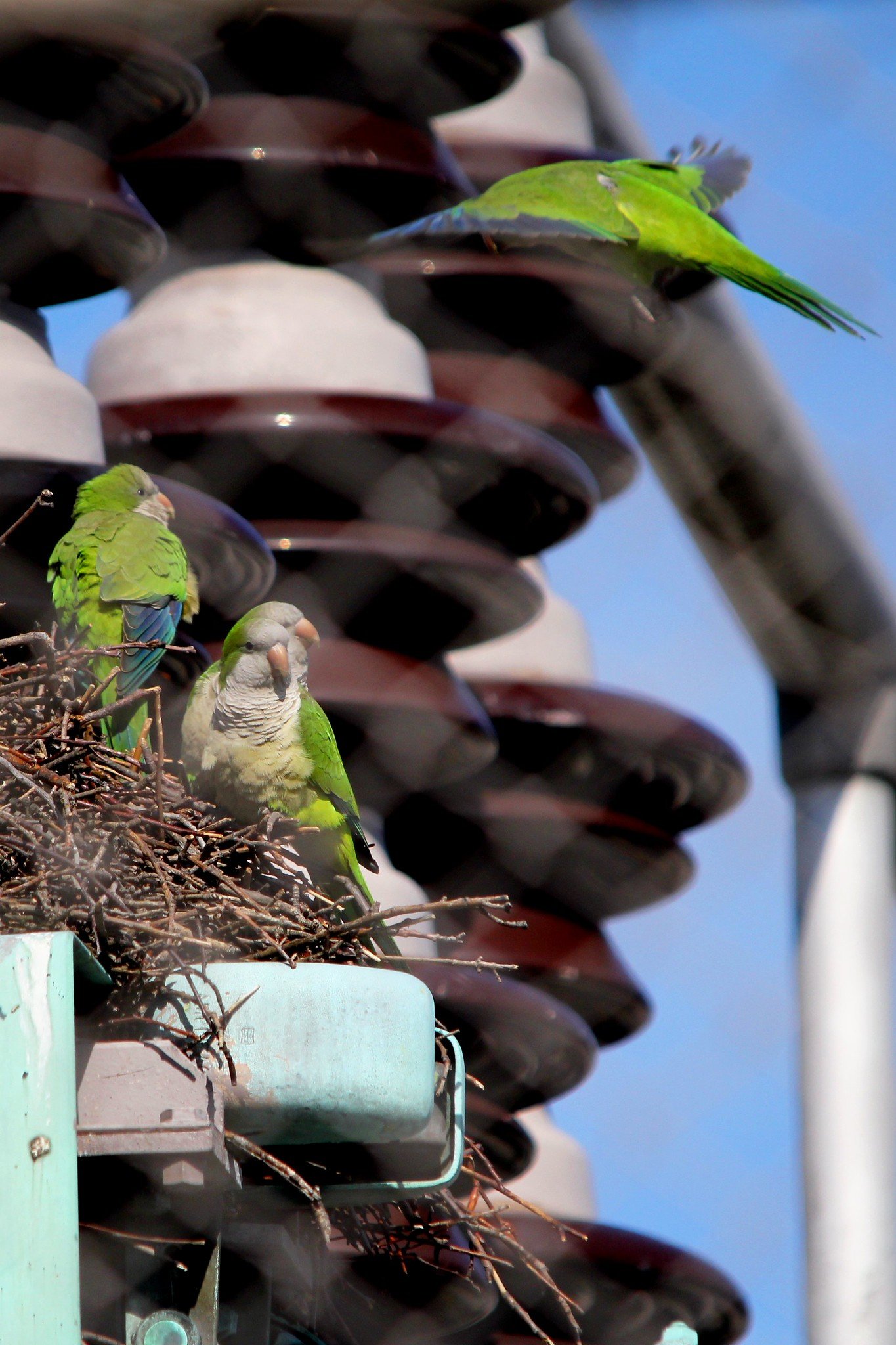
Monk parakeets nesting on a Con Edison substation near Green-Wood Cemetery in Brooklyn. (Photo: Jeremy Seto, used under Creative Commons license)
With the benefit of hindsight—and with less emotion than might be involved if we were still actively pursuing eradication—we might consider whether our control efforts made sense. We might ask whether we were cruel. First, let’s consider what sort of thing it was we went about killing. Was it reasonable to go straight to culling as a first-line control method?
I spoke with Antone Martinho-Truswell—a zoologist, evolutionary biologist, and the author of The Parrot in the Mirror: How Evolving to be Like Birds Made Us Human—about what we can and cannot reasonably say as far as parrot cognition is concerned. He first explained how difficult they are to research: the species we’ve studied live for 40 years, often much longer, so starting a research colony of 12 or so individuals is a career’s work. Then there’s variation between individuals. Some are willing to take tests, while others aren’t. Some speak, while others never pick up human language. There’s also variation between species. Macaws seem to be every bit as smart as African greys but have less of a reputation for it because they don’t speak as readily. Sulphur-crested cockatoos are very intelligent but also incredibly loud and emotionally needy. Then there’s the wrinkle that we’re a primate devising tests for a bird. We evolved with hands; they evolved with wings and a beak. The upshot is, some things that come naturally to us are cognitively taxing to birds, and vice-versa.
As to how we should think of monk parakeets specifically, Martinho-Truswell said, “We should generally read cognitive capabilities into all parrots. I’ve no particular reason to think [African] greys are special.” When asked what he made of comparisons between apes and certain parrots on cognitive tests, he responded, “the only fair comparison for parrots as a group, is primates as a group.” But, any rank ordering of intelligence is fraught; given our current evidence, we just cannot do that with any confidence. He went on to say that maybe the biggest difference between the two orders is that parrots don’t have a “breakout star” the way humans are for primates—though he suggested such a standout parrot might be the palm cockatoo, which can live for 90 years, is the only animal aside from humans to make musical instruments (they drum), and is, of course, fiendishly difficult to study in its remote habitat. He touched on the fact that all parrots, monk parakeets included, need socialization and, if they’re deprived of it, they exhibit behaviors like compulsion and self-harm that, “in a human could only be called mental illness.” The type of socialization varies between species. Monk parakeets live in colonies, so they form a pair bond with a mate but are also social with other individuals. Other species tend to form very strong bonds with one individual and “exhibit jealousy” toward them, Martinho-Truswell said. This can be challenging when they’re kept as pets, bond with one person, then attack his or her spouse.
I also spoke to Timothy Wright, a professor of biology at New Mexico State University. He began by saying that the “concept of intelligence is very broad. We tend to frame it with talking and tool use because that’s what we’re good at.” He studied vocalization in monk parakeets in particular and explained that they “have individually distinctive calls” and they hear other individuals’ calls, learn from them, then innovate on what they’ve learned. In this way, the species develops distinct regional dialects. Wright added that we once thought monk parakeets might be unique in this but have since learned that many parrots do the same. Parrots writ large “learn new vocalizations better than any ape, except us.”
We can’t rank order these species by intelligence, but, if parrots are broadly comparable to primates, suppose, rhetorically, we were talking about a population of monkeys. In that case, we might remark that monkeys are less impressive than apes. Nevertheless, we’d do well to remember that monkeys are still very smart, and very social, and we’d likely be a bit aghast if we culled them for the sake of convenience! Hopefully, we’d bother to look into other control methods first, or at least be sure control was necessary. I would argue that our first recourse should be to find ways to live together. Much like monkeys in urban settings, parakeets are loud and they can make themselves into inquisitive little nuisances. Does it reflect well on us, though, if we kill something because it has an annoying voice?
Now, ethics of culling aside, both Martinho-Truswell and Wright agreed that culling can make sense if an introduced species is threatening the survival of native wildlife. We may owe parrots some deference, but we also have a responsibility to make sure our careless animal introductions don’t drive other species extinct. Wright specified there’s “no question invasive species can have negative effects.”
That said, was it even necessary to attempt to eradicate New York’s monk parakeets? In hindsight, probably not. Introduced parakeets of this sort tend to make their homes in urban or suburban areas. That’s not exculpatory since such places are important habitats in their own right, but it does indicate that parakeets are not out-competing native wildlife in natural habitats. Moreover, they might compete with other birds like pigeons and sparrows, but these are introduced species themselves. The main concern was that they’d become major agricultural pests, and that just wasn’t borne out. Wright said evidence of crop damage is “limited” and that there’s also “relatively little evidence that they cause a lot of crop damage in their native habitat.”
Ironically enough, the U.S. used to have a native parrot—the Carolina Parakeet—that actually did eat crops, and we drove it to extinction during the 19th century on that basis, with the last known individual from a rump population dying in 1918. The actual threat to agriculture was probably overstated in that case too, though, which seems to be a running theme. Another notable example is that New Zealand farmers used to shoot kea parrots, believing that they eat sheep. (Shockingly, they do, but not in meaningful quantities). At all events, a parrot ranging from Florida to New York isn’t an ecologically new phenomenon, even though the newcomer does not fill remotely the same niche as its extinct relative.

Monk parakeets congregating at Santa Ponsa, Majorca. (Photo: Wikimedia Commons)
Perhaps, then, the arc of this story is that we made some mistakes but have mellowed toward the parakeets, even come to see them as lovable New Yorkers.
Perhaps. Yet a similar story plays out elsewhere without the peaceful coexistence in the end. In Florida, many introduced wild parrots do all right with minimal intervention. But, being introduced, they’re not covered by the Migratory Bird Treaty Act, meaning anyone can kill or trap them. Miami, for instance, has a small self-sustaining macaw population, but they’re continually in danger of being netted and made into pets. Even in New York, state protections never passed the legislature; so, I’m free to take the subway out to Howard Beach, scale an electric pole, and capture myself a brand-new pet bird! With nothing to stop me except good sense.
In Europe, the issue is even thornier. The U.K. ran a successful monk parakeet eradication campaign, with fewer than 20 birds left in the country in 2019. Spain has much larger populations, perhaps 12,000 in Madrid alone, which makes them much more challenging than the small New York colonies. The Netherlands has thousands of rose-ringed parakeets, a species that might be more concerning for native wildlife. Still, even the rose-ringed parakeets are mostly confined to cities.
Practically, it’s understandable that not every Barcelona resident wants 1,000 screaming parrots in a park. Wright mentioned that people just tend not to like a 500-pound stick nest hanging from an electric pole over their cars. But these are intelligent, emotional animals that have more in common with us than is obvious at first glance. So maybe we shouldn’t treat them as pests to be dealt with. That’s especially true when their impact on native species is minimal.
Being Better Neighbors
I’d argue that these animals deserve better treatment from us than they often get, but what exactly would that entail? First, they are wild, and we should mostly stop keeping them as pets. The pet trade—which is how we got into this situation to begin with—is decimating wild populations, with most captured animals dying in transit. Moreover, few people are capable of caring for a parrot properly: neglect and abandonment are rampant and shelters (often just an individual who gets guilted into taking in dozens of abused birds) are filled to bursting.
Second, we should re-think culling. Contraceptive control methods do not seem to work at scale yet for parrots, though they show more promise for other municipal “nuisance animals” like rodents. But there is research in the field and perhaps it warrants some public funding. That’s not to say we’ll never need culls to protect native ecologies, but we should at least apply some sort of cost-benefit analysis instead of just making it a default option. For instance, Martinho-Truswell noted that rats and cats—with cats “a complete disaster anywhere they’ve been introduced”—are the most harmful invasive species to native wildlife. Stray and outdoor cats kill tens of billions of animals in the U.S. alone each year. So, if we’re culling vertebrates to protect native species, cats would logically be a top target. And if we’re unwilling to kill stray cats, why is it all right to kill parakeets that cause far less (or no) damage?
Third, instead of playing Whac-A-Mole with invasive species, we need to think critically on the matter. Figuring out which ones are benign and which are harmful is challenging, and mistakes can be costly. But a “kill them all just in case” policy doesn’t reflect well on us. There are more endangered red-crowned Amazon parrots living around Los Angeles than remain in their entire native Mexican range (again, thank the pet trade). Are they invasive or have they just adapted somewhat to a new predator (us)?
Maybe it’s uncontroversial that we should do these things, so why don’t we?

We Have More Agency Than We Think
On one hand, the force of bureaucratic inertia can be strong. It’s hard to read reporting about the monk parakeets and think utility companies have it out for them specifically. Their nests are simply an obstruction on electrical equipment and are removed as a matter of course; it’s not like they get paid a bounty for removals. Assemblymember Rosenthal wrote of the protection act, “the bill was unable to advance as written because the animals are deemed an invasive species[…] and our laws do not provide any legal protections to invasive species.” So, eliminating invasive species remains an easy default option, until we amend the law.
On the other hand, while researching this piece, I was struck by my conversation with Sen. Addabbo. He said he started introducing the Monk Parakeet Protection Act both because he often saw the birds in his old district (before lines were redrawn) and because animal rights activists asked him to. He was surprised it never moved out of committee because it was a pretty uncontroversial measure (not to mention, it would not have required any state spending). I’d expected to hear that utilities opposed the bill but, to his memory, there was “not much opposition at all”; he even mentioned that, while replacing infrastructure in Jacob Riis Park, he’d seen electric companies leave old poles standing so as to avoid harming nests.
When I asked Addabbo if he’d ever start introducing the bill again, he said, “normally bills move with support.” By that, he clarified that he meant the public, noting that there are people who care about animal rights in New York and that building a constituency to protect the birds is eminently doable. That’s a pretty empowering thing! We’re used to reading about animal rights abuses, thinking it’s sad, then resigning ourselves to the “fact” there’s nothing we can do about it. In reality, taking the 90 seconds or so required to call or email one’s state legislator (the same way I got them to speak to me for this piece) can raise the salience of these types of bills. Few people actually do this, so those who do have a bigger impact than they realize. And many politicians genuinely try to be responsive to their constituents. That noted, there is effort required of us. It’s not effective to call in and say, “I like animals,” or to advocate for a policy that would cost half a state’s budget. To be effective, we have to be thoughtful and informed about animal welfare. It does take effort, but I think creatures that talk to us in our own language are worth caring about.
Lawrence Costa is an economist who writes about trains and operas on Substack because he lacks interpersonal skills. His research has focused on housing, labor markets, and education. He has also contributed to Asterisk and Slate. He once went to Scranton (inadvertently).