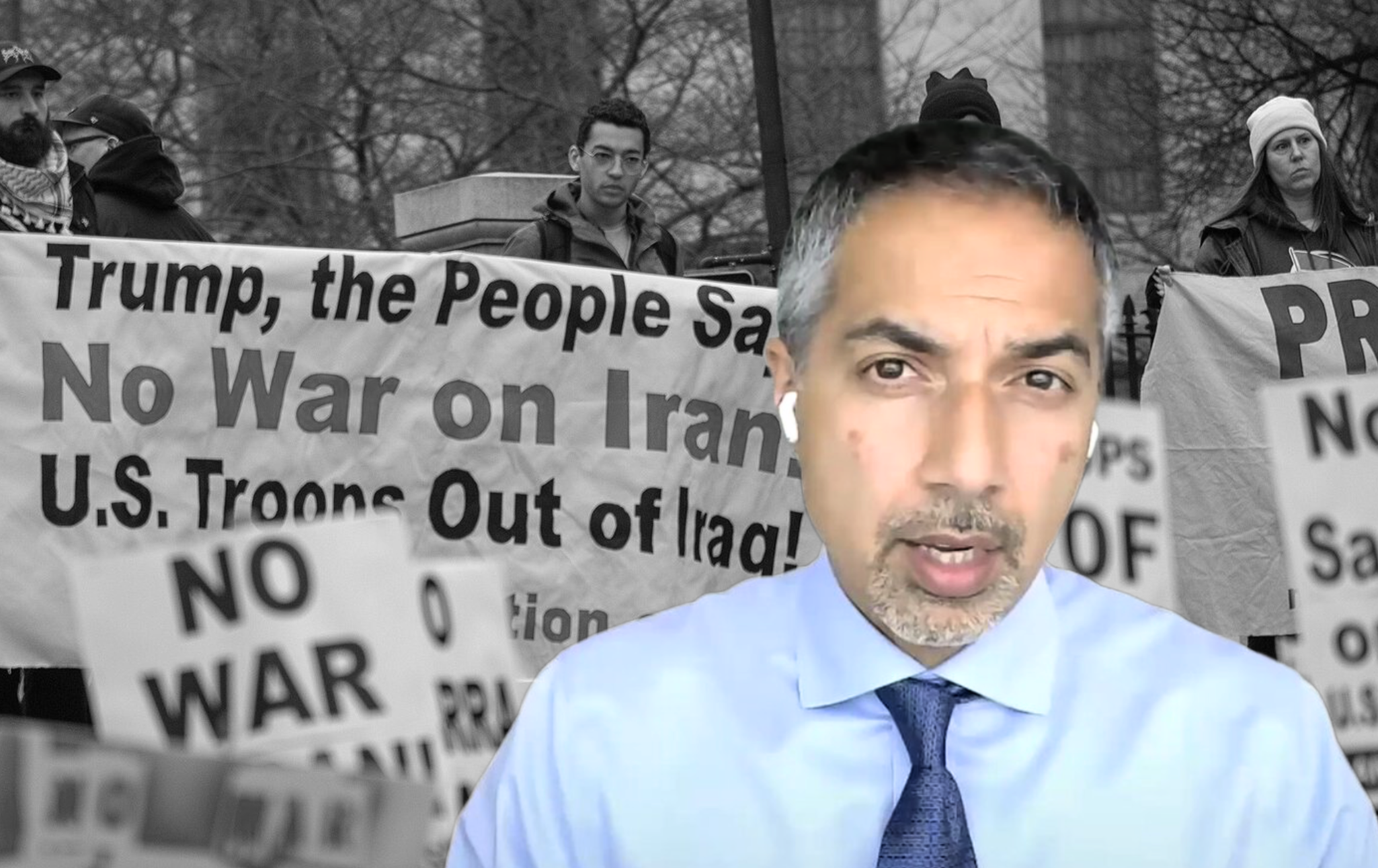
The Iran expert explains how Washington is repeating the same political mistakes that turned Vietnam and Afghanistan into generational conflicts.
Trita Parsi is one of the leading experts on U.S.–Iran relations and the co-founder of the Quincy Institute For Responsible Statecraft, a think tank formed to move the U.S. away from constant aggression and toward the pursuit of international peace. The Iranian-born analyst joined Current Affairs for the second time this year to discuss the dismal state of peace negotiations with Iran—and why, he says, American wars so often turn endless: "Because the political courage to end them does not exist, and it takes less political courage to just continue them and lie to the American people that victory is around the corner."
Watch the full conversation on Youtube here.
Nathan J. Robinson
I believe the last time we spoke was actually before the signing of the Memorandum of Understanding (MOU) between the United States and Iran, which means that in the time since we have spoken, the United States' war on Iran has ended and then begun again. You have a post on your Substack from just a couple of days ago entitled "Yesterday's US-Iran escalation is a mere prelude to what is likely to come."
So let me start by asking you: How did we get to this point where the war appeared to have ended with the United States accepting an agreement that was referred to by some as a "surrender agreement" that was quite favorable towards Iran? Now you suggest that we might be on the path to further and further escalation. Could you explain what got us here?
Trita Parsi
So the way we got here is, to a very large extent, a result of the fact that there were some ambiguities in the MOU, particularly on Article Five on the handling of the Strait of Hormuz, but also that there was a concerted effort by some in the administration on the American side to essentially try to change the facts on the ground—instead of trying to use the MOU and the channel that had been established to reach a deal, to simultaneously go outside the MOU and try to change some of the realities.
So, for instance, the MOU says that there's going to be a 60-day period, and they're going to find some sort of a final conclusion on how to handle the situation of the Strait. Within that, the paragraph is not entirely clear. The Iranian interpretation is that they're responsible for the maritime security of the Strait during this period, but they will not stop any ships and will not charge any ships; but they're responsible for it because they're the ones who mined the strait, and they have to undo it. The US side interprets that as not necessarily controlling all the Strait, but rather the Iranian territorial waters and what the US considers to be international waters. The Iranians believe that half of the waters are Iranian and half Omani. There's no international waters in the Strait at all, in their interpretation. Anyway, we can set that aside.
But simultaneously, the US side is then trying to fortify a southern channel in the Strait, which is in the Omani waters, and to do so in a manner—at least from the perception of the Iranians—in which if war were to restart again, that southern channel would still be operational. As a result, the Iranians would lose a tremendous amount of leverage that they currently have, which is that they can put this chokehold on the international economy if the US attacks them again.
Now, one can argue that from the US side and from the side of many of the GCC states, there's a clear interest to create that southern corridor. But on the other hand, you just signed an MOU that said that through the MOU, you are going to come to a final conclusion on this. You are trying to create this alternative channel outside the MOU. Then you're trying to change facts on the ground instead of doing it through the negotiations.
And the Iranians then view this as a threat. On two occasions, they shoot at ships, which incidentally were going through the southern channel without coordination with the Iranians and were turning their transponders off. They had been warned, and then the Iranians shot. I, personally, think that the Iranians overreacted. There was no need to shoot at them, but I do at the same time understand that if you come to an agreement to resolve this through negotiations, and then simultaneously the US is essentially trying to create that alternative channel, then that is a problem. And also incidentally, it's important to note there were ships going through the southern channel without getting stopped by the Iranians because they coordinated with the Iranians. All they needed to do was to indicate that they're traveling through it, and that was fine. They never stopped any of those ships. They only stopped the ships that were not coordinated with them. So this is not the same thing as closing the Strait. It's just making sure that they're taking, in their view, their responsibility for the core initiative.
So that's one element. The other element is what happened in Lebanon, in which the MOU essentially says that the Israelis are going to have to leave Lebanon and there's going to have to be a full ceasefire region-wide in order for there to be a ceasefire between the US and Iran. But then Marco Rubio goes and negotiates a different deal between Israel and Lebanon that essentially says that Israel will remain in Lebanon until Hezbollah is disarmed, which is a condition that did not exist at all in the MOU and also is a condition that will lead to civil war in the country.
Robinson
Right, which won't happen.
Parsi
Yes. So essentially, since there won't be a civil war, there won't be a disarming of Hezbollah; Israel can stay there more or less indefinitely. Complete contradiction of the MOU. So you have the US sign this, and then simultaneously go outside and do a lot of other things. And on top of that, there's a movement of ships and other assets to the region. This then led the Iranians to conclude that the US was planning another war, and they were just using the MOU to prepare for the next war. And whether that is right or wrong, I don't know, but I do think that this led the Iranians to view every other move by the US in that light and assume the worst. And that, I think, contributed to them taking military action or shooting at these ships, which may not at all have been necessary.
There may have been other pathways to do this, but then that created a dynamic of its own, combined with the impatience of Trump, in which he constantly wanted positive news to come for him to stick to the diplomatic track. And expecting that is a little bit absurd, given how far away the two countries are from each other in terms of the final outcome. And all of this has now led to this scenario in which we have a resumption of the war. There is so far nothing seen in this war that suggests to me that the United States has a plan on how to make this new war more successful than the previous one.
Robinson
I wanted to ask you about that. My understanding when the MOU was signed was that when you read it, it read as quite favorable towards Iran. And one of the reasons for that was the United States had understood that unless an agreement was reached to end the war, because a ground invasion was off the table and they really hadn't figured out a way to prevent Iran from exercising de facto veto power over whatever goes through the Strait, the United States felt they had to come to terms with it.
And yet, has the US government developed some kind of different understanding of what the dynamics here are? Are they delusional? Have they figured out some way in which the situation that led them to, not out of a preference for diplomacy, but out of a feeling of necessity that the economic implications were going to be so devastating that they needed to call off the war? Has something changed that would lead the United States to believe that there would be a more favorable outcome from a resumption of the war?

Parsi
If something has changed, then that is not in the public record, because when you take a look at the public record, there's absolutely nothing that suggests that this would be more successful than the previous round, unless there is a tactic that they have not yet embarked on. There's the speculation—well, Trump himself today said that there would be an attack against what the Israelis claim is this new nuclear site. It could be that Trump is thinking, "Okay, I'm just going to do another one of those successful military strikes I had." Remember the four strikes that destroyed that facility. There were no American casualties, and it was over within 45 minutes. He can essentially say, "Look, I won," and then see if you can go back to the table or withdraw or something like that.
Well, if that was the plan, what we've seen for the last 10 days or so seemed to have been just a complete sideshow because there's nothing that has been done here except for a lot of destruction that decisively changes matters. Now I think again we have to put the psychology of Trump into the equation here because it's not just whether this is logical or not. He still seems to have this expectation that because he's blown up so much in Iran—and you see that oftentimes he's frustrated with the mainstream media. He says, "I've blown up all of these things in Iran, but the New York Times still says that I lost the war." It's a joke, because in his mind, he who blows up the most wins the war. It doesn't matter if it's strategic. Anything that actually translates a tactical and operational gain into a strategic gain just doesn't seem to compute.
And so now he's thinking, "Okay, I didn't blow up enough. The Iranians are still very hardline in the negotiations because I didn't hurt them enough, and as a result, I'm going to go back. I'm going to punish them militarily, and then once we return to the table, they will have a softer position." Here again is a fundamental miscalculation. The more the United States is willing to take military action against Iran because of Iran's control over or desire to control the Strait, the more the Iranians will believe that they have to control the Strait of Hormuz as a way of pushing back or undoing Trump's military plans. Because if it is that valuable of a leverage, they're not going to give it up.
So rather than pushing them towards a softer position, I think you are going to see a hardening of the Iranian position. I think, for instance, they're not going to rush back to the negotiating table at all. They're going to try to drag this out to make it as painful economically and politically as possible for Trump. They're not going to allow for a situation in which Trump can start a war at will, and then whenever he calls for negotiations, the Iranians will show up. That will only incentivize him, the Iranians believe, to do this again. Whenever he thinks that negotiations are not going his way, he'll just go back to military action, and then whenever he wants to go back to negotiations, the Iranians will say, "Well, okay." If that's the case, he will do so as often as he can, they believe.
So I suspect that again, the calculation is that there would be two or three weeks of war and then back to the table; I don't expect that to be the case. I think the Iranians will drag this out.
Robinson
I was watching John Mearsheimer yesterday, and he was comparing the escalation here to one of the dynamics that fueled the endless Vietnam War, which was even though in that case United States policymakers actually didn't believe they had good military options and understood that escalation wasn't likely to achieve anything, they felt like they couldn't do anything but escalate because accepting an unfavorable agreement, accepting defeat, was so unpalatable that there was simply no alternative in the minds of Johnson and Nixon but to accelerate the war. Even without a theory, and even being told there is no actual option for a military success here. But that's unpalatable to presidents. How do you see this as fitting with the dynamic?
Parsi
I think there is an element of this. Now that's one example; John is absolutely right to bring that up. But we have plenty of additional examples. This is how we ended up in these endless wars.
We know now from the Afghanistan Papers from The Washington Post that the US military knew very well there was no victory around the corner in Afghanistan. They kept on telling the American public that we were on the right track and we just needed six more months, and they asked for that 10 to 15 times. But again, it was better to continue a losing war than to pay the political cost of ending that war and having to accept that there was some sort of defeat. This is how wars become endless, because the political courage to end them does not exist, and it takes less political courage to just continue them and lie to the American people that victory is around the corner.
What's interesting with Trump, and this is why this is so sad what we're seeing right now, is that he is such an unconventional president in many aspects that he has the ability to make a pivot towards peace, declare himself victorious regardless of what the actual facts on the ground are, and pay the price of ending a war because he views that as being worse than continuing it. He has that ability to just say that everything is fantastic, and much of the country will accept that whether it's true or not. And this is part of the reason why, contrary to a lot of people who thought that precisely because of this old pattern he would never accept the MOU and never really go back to real negotiations, he actually did. He did sign it. In the beginning of it, you could see that the administration actually was implementing it. They were pushing back against the Israelis, etc.
So he has that ability, but it's precisely because he has that ability to just make a 180 that he can also then make another 180, and that's what he's done now. He may try to do yet another 180 because he has no path dependency whatsoever. But I just don't think it's going to end up working the next time, at least not in the manner that he wants it.
Robinson
Obviously, it's impossible to predict the future, especially, as you say, with someone as mercurial as Trump. You say in your piece,
"The paradox of Trump is that he is willing to break with convention, which makes him open to pursuing peace. Yet that same disregard for convention leads him to dismiss the disciplines, protocols, and methods that successful diplomacy requires."
I know you can't see inside Donald Trump's head, but based on your understanding of how this has gone so far and looking at lessons of history from other wars, do you have a most expected likely outcome at the moment in your mind?
Parsi
I'll tell you what I think would be the possible best-case scenario out of all of this, and I can't put a number on it. But the best case—it's probably not in any way, shape, or form the most likely case—is that within two or so weeks there actually is a return to the table. Not much will have changed. Unfortunately, a lot of people have died. A lot of things would have been destroyed. Nothing much will have been gained, except for potentially one thing: the lure of thinking that a return to military action actually improves your negotiating position may have diminished significantly, if not been completely dismissed, because it's been tried again and it didn't work. So no guarantee that it will. But again, that would be the absolute best case.
But as I mentioned earlier on, I'm not convinced Iranians are going to come to the table in a timely fashion. They'll come. They're not going to completely dismiss diplomacy, but they're going to take their time, and perhaps they want this to drag out until at least up until the midterm, perhaps beyond it, to maximize the pain on Trump politically and economically. That may, however, be a mistake for the Iranians to do, because they may end up helping to have an American president in his last two years be a lame duck that will blame his political misfortunes on Iran, no longer be constrained by future elections, and not care about who wins 2028.
He can't run, so why would he care? And as a result, he ends up becoming far more unrestrained militarily than he's been so far. At the end of the day, there are a lot of things that the United States or Trump himself said that they could do, and physically they could have done it, such as targeting Iran's oil installations, but they didn't because they knew that the Iranians would then strike GCC oil installations, and we'd have a global recession as a result. He may not care that much about that after the midterms if he blames Iran for the defeat in those elections.
Robinson
I was recently revisiting a very interesting exchange on social media between Stephen Miller and Cenk Uygur of the Young Turks in October 2024, and Cenk said to Stephen Miller:
"Will Trump help Israel with the war starting with Iran? Will he finance it? Will he use the US military to help Israel fight that war? You know he's going to do everything Israel asked him to, and when that happens, you'll pretend it was self-defense that you had to do it for a special ally. We had to show how tough we were. You'll get us mired in a giant war in the Middle East, just like Dick Cheney, and you'll pretend you were against war as you do it endlessly."
Stephen Miller replied:
"Cenk, I don't know how I can be more clear. Trump will end and prevent war in the Middle East. He wants peace, while Harris and her neocon cabinet want war and more war."
[What Cenk said] seems a remarkably accurate prediction of exactly what turned out to happen. Was this always just a piece of flimsy election rhetoric on the part of the MAGA right?
Parsi
No, I would differ a little bit there in the sense that I think it probably was very flimsy for Trump, and that he recognized that this is a good election message. It certainly does work, and that his opposition to war is not actually because he's opposed to war. It's because the track record is that they're very messy, and it leaves you with bad options. And as a result, he was not going to go down that path until the Israelis managed to convince him that no, this will be super easy, just like Venezuela. It's going to be over within four days, and you're going to be a hero, so this is not a risk at all.
And I think part of the reason why the Trump administration never bothered to sell the war to the public was because they thought they didn't need to, because the war would be over before the American public even noticed that a war had taken place. So it's not that he ever truly was against war; it was just that war was very messy, and he was against anything that didn't have a very high likelihood of success.
However, within MAGA there are those, and they're not a small number, and some of them are very prominent, that actually truly believed in these things and were very much against these wars. They've seen the cost that this has inflicted on the United States, on the younger generation, particularly in red states where most of the American soldiers come from, and they go back to those red states in coffins, without a limb, with PTSD, with suicide thoughts. So that cost is real, and many of them were serious about it. And that's part of the reason that someone like Tucker Carlson broke with Trump and even went as far as to say on his show that he regrets and will regret for the rest of his life helping get Trump elected. This is a person who's very close to the most powerful person in the world, and he's willing to break with him over this war.
So I think it's very clear that there are people within MAGA that were very serious about anti-war, and they thought Trump was as well. And this is part of the reason why they're so upset and having such a strong feeling of betrayal.
Robinson
I want to just conclude by asking about a couple of other domestic things. The State Department has denied the reports that it was planning to revoke your green card, but you have suggested that this episode was part of this broader effort to intimidate dissenting voices. We've seen a lot of really alarming rhetoric out of the Trump administration about anti-war and leftist critics. We've seen the NSPM-7 memo. We've seen this latest Cuba report that just dropped yesterday that suggests that a lot of anti-war leftists are essentially quasi-agents of the Cuban government and a Marxist conspiracy.
How seriously do you take these threats by the Trump administration to crack down on domestic dissent?
Parsi
Oh, it's very clear that the atmosphere in the United States has been deteriorating for quite some time, and I'll be frank, it's not just under Trump. We saw that very clearly both at the beginning of the Ukraine war and with Gaza—not to this level, not to this kind of systematic approach that we're seeing now, but nevertheless an atmosphere that, at least in the beginning, to me, was very similar to the groupthink scenario, an atmosphere we had in Washington in 2003 with the Iraq War. I was working on Capitol Hill at the time, and it was suffocating. So, we had that.
Now, I can't speak to those broader issues because I don't follow that closely. But I can tell you that in my specific case, I want to say within the Trump administration, there were elements working with elements outside the Trump administration who are doing this not because they're trying to shut down debate necessarily. They're trying to shut down specific voices who are critical of these wars, and particularly in the case of the Quincy Institute and myself, have the ability and have been working to get the anti-war left and the anti-war right to work more closely together on these issues. That is a major threat to the neocons who have already more or less been chased out of much of the Democratic Party and now are facing the same type of scenario in the Republican Party.
And as a result of that, and of course the criticism against Israel and Israel's role in getting us into this war, I was a target by them. Of course, I've been a target of them for quite some time. But I don't know if I would necessarily put all of that in the same category because I simply don't know enough about these other efforts that they're doing.
Robinson
This is a separate topic, but I don't know if you saw the recent New Yorker report with a lot of Biden Administration State Department officials talking about the Biden administration and the war in Gaza—essentially revealing that behind the scenes they all kind of knew that Israel was committing war crimes, but couldn't or wouldn't do anything to stop Israel, and some of them expressing seeming contrition and regret for their role. I wonder what you made of that.

Parsi
So I've deliberately not read it because I know that I would be in such a bad mood for at least 48 hours after reading it. So I'm leaving it for the weekend. But I've seen snippets of it. And the bottom line is, there's not been any sufficient or even half-assed apology or acknowledgment of what they have done. You're seeing essentially limited approaches to cast themselves in a better light or express some limited regrets, hoping that will be sufficient. And I very much doubt that it will.
At this point, certain of these individuals are completely persona non grata in large circles within the Democratic Party, but there's going to essentially end up being some sort of a civil war in that party between progressive circles and the establishment. We're already seeing it in almost every major primary right now, and that is, I think, a fight that, unfortunately, right or wrong, needs to be had. There has to be some reckoning with this. The Democratic Party, the Democratic leadership, and the president—all of these individuals—are complicit in genocide. And as much as the Democrats were correct in criticizing the Republican Party for never really dealing with the crimes that were committed with the invasion of Iraq, the Democrats are now doing exactly the same thing by not having any real systematic effort to get to the bottom of this and call for accountability. You saw the DNC had some sort of an autopsy as to why they lost the election to Trump, and they didn't even mention the word "Gaza" once. If that's the direction they go, this party will not be around for much longer. It's going to lose all of its young people, and it's just going to be a hollow shell.
Robinson
Final question here: Are you worried about the future of international law at the moment? Marco Rubio just came out and published an op-ed in the Wall Street Journal, promising to dismantle brick by brick the International Criminal Court. We've also seen a debate flare up over Zohran Mamdani's insistence that he's still going to look into whether he has the legal right to arrest Benjamin Netanyahu, who's under an ICC warrant.
How do you feel about the present and future possibility of holding people accountable for violations of international law at the moment?
Parsi
Going back to the beginning of your question, I am deeply, deeply worried because I see a pattern that has now been reinforced in which the Israelis have already been waging a war against international law for quite some time. From the US side, at least under the Democrats or under the Biden administration, there wasn't that type of an explicit effort. But a lot of the talk about the rules-based order was really an attempt to replace a law-based order, and there's a difference there. Because who's making the rules in the rules-based order is the United States and its allies, with the expectation that everyone else has to follow them. Whereas law actually comes into place consensually and through objective, open processes—in which, for instance, the United States never signed the Rome Statute and, as a result, is not obligated to arrest Netanyahu. Mamdani can choose to do so, but he's not obligated to do so because they never signed it. But the rules-based order would be a system in which, whether you sign or not, you would be held accountable to rules that are set by the United States and some of its allies. That in itself was a major threat to international law.
Now, you see a much more open campaign against international law, which is also obviously very, very dangerous. But I want to just make clear: it wasn't as if we were in a fantastic situation before. It was a much more subtle campaign against it. All of this, I think, is absolutely disastrous. I am stunned by the silence in Europe. I remember what happened when the Rome Statute was signed. I was early in my career, and in Europe, in particular, Europeans have put so many resources into this, and it was seen as if a new evolutionary stage of humanity had been achieved through the ICC. Because now, through law, wars and crimes could be prevented, not just on a national level but on an international level. And now we've seen the complete abandonment of it by most European countries because it didn't just target people in Africa, but it was actually going after people in Israel and allies of Europe. And we saw the Germans saying that they're not sure whether they would implement it. That in and of itself is an attack against international law. You're obligated. You cannot come and say, "Well, perhaps I don't care about the law." You can't say that and then point your finger only at Rubio, as if Rubio is the only one who is currently doing so. The silence of Europe in this is as damaging as whatever it is that Rubio is saying or doing at this point.
Robinson
Well, I'm afraid we're going to conclude there on a very pessimistic note from you, Trita Parsi. Everyone should check out your Substack for your latest updates on primarily geopolitics, but on other topics as well. Thank you so much for returning.
Parsi
Thank you so much for having me. Appreciate it.
Transcript edited by Patrick Farnsworth.

%20(crop).jpg?width=352&name=wile-e-coyote%20(resize)%20(crop).jpg)