The political commentator explains why Democrats keep losing to the far right, how she lost faith in the establishment, and what a genuinely progressive alternative might look like.
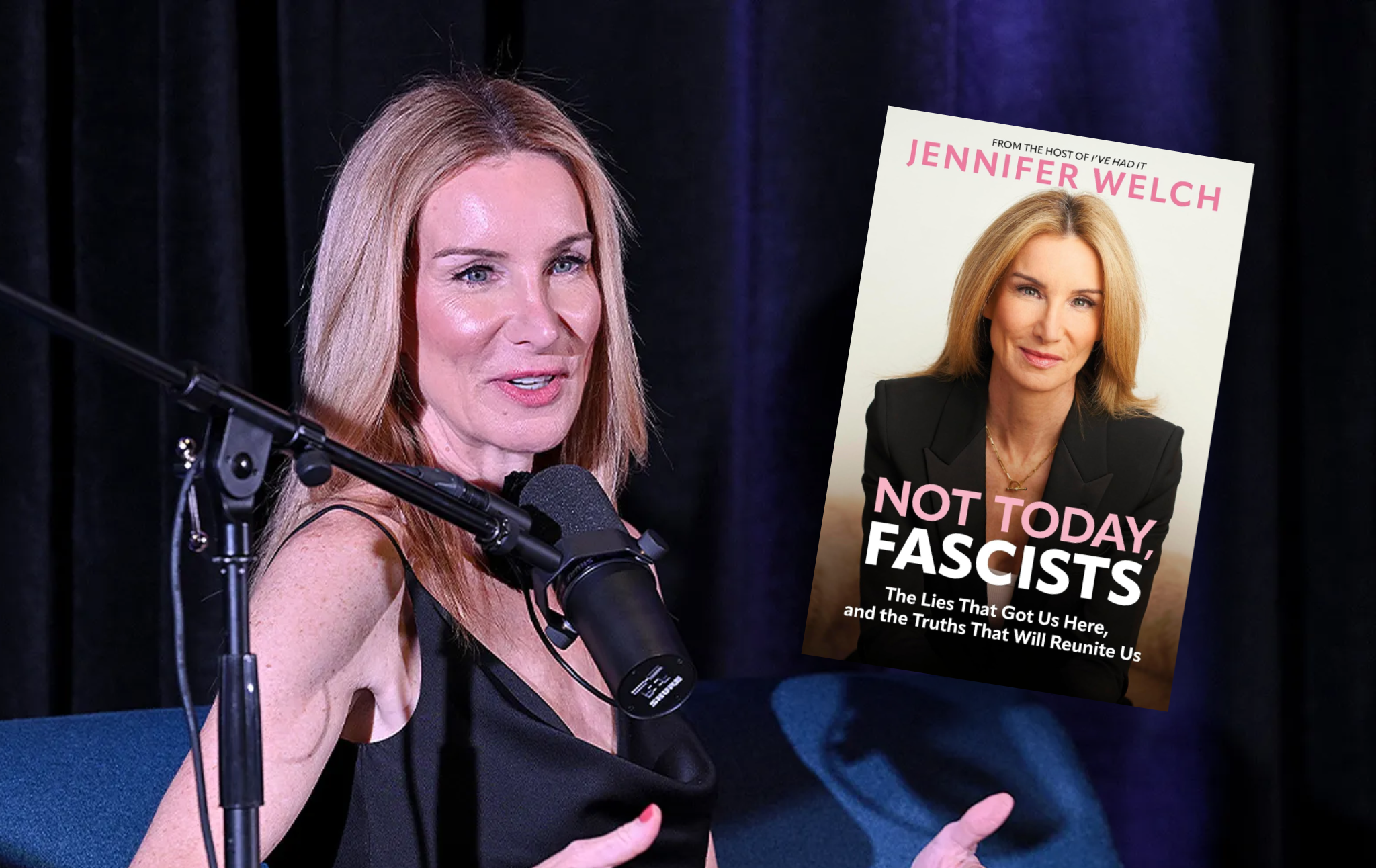
Jennifer Welch is an interior designer from Oklahoma who has become one of the most outspoken progressive voices in political podcasting. Known for her fiery commentary and willingness to take aim at Republicans and Democrats alike, Welch calls herself as a “rage-filled progressive.” She wasn't always quite so radical, though: Once a self-described "corporate Democrat with faith in the establishment," Welch has grown increasingly disillusioned with a party she believes has failed to meaningfully resist the rise of the far right.
She sat down with Current Affairs to discuss her new book, Not Today, Fascists: The Lies That Got Us Here, and the Truths That Will Reunite Us, what growing up in the Bible Belt taught her about Christian nationalism and the MAGA movement, and why Democrats keep losing to a Republican Party whose policies are so deeply unpopular.
Nathan J. Robinson
Let's start with a little bit about your background here because one of the interesting things is you are—this is your description, not mine—rage-filled. You are a rage-filled progressive. But you are from Oklahoma, and you grew up around the people who would become MAGA. I'm wondering if your background gives you some insight into why this kind of hard-right form of Christian nationalism has taken hold so much in your home state, and why progressives and Democrats have struggled there.
Jennifer Welch
Yes, I think that my upbringing really helped me understand this rise of MAGA because so many of the people I grew up around, their whole identity is being a Christian and being a Republican, and it's very fused together. There's hardly any separation from those two entities. So even before Trump, this idea of Christian nationalism in Bible Belt states was ubiquitous. The political right brilliantly projected themselves into churches because the number one indicator to determine if somebody votes is church attendance. So they made very little daylight between being a Christian and being a Republican.
And when I saw Donald Trump rise up and all the evangelicals race to support him, it didn't surprise me one bit because Trump is exactly like an evangelical Christian man—not a Christian man, but an evangelical Christian man, a Southern evangelical. Think about a megachurch pastor, and then think about Donald Trump. There's not that big of a difference there.
Robinson
You discuss the kind of hypocrisy that runs through the church, because a lot of people from the outside, those of us who were raised secular, look at the adoration of Trump in these certain Christian communities and think, "But how do you explain the fact that he's a totally un-Christian and sinful man?"
Welch
So these people are that. These people are exactly like him. So I can't tell you how many scandals there were growing up. Now, I grew up an atheist, but I had all these religious friends who wanted to convert me all over the place.
Robinson
Yes, you write about that.
Welch
They wanted me to get saved, and their pastors were always involved in some grab-ass with the secretary or some person who went to the church. There was always some sort of scandal, and how they deal with this in evangelical Christianity is forgiveness with zero accountability. That's a part of the whole religion. So Monday through Friday, they could go out and play grab-ass with their secretary, maybe go out and do gay stuff, and then come Sunday, "Jesus, please forgive me," and then rinse and repeat.
So there was a familiarity to Trump being so morally depraved and having all of these problems; it was very easy for them to forgive him for the Access Hollywood tape, for any of the things that he's done, because this is a culture they grew up around: moral depravity, and then the person just says, "Oh, I'm sorry, Jesus, forgive me." They sweep it under the rug and then just move on down the road.

Robinson
Although he kind of leaves out the part where you ask for forgiveness on Sunday.
Welch
Yes.
Robinson
Does this mean that red states aren't going to turn blue again unless we have a kind of progressive politics that can fuse with Christianity? I'm thinking of James Talarico, someone who can speak in a Christian register but with democratic and progressive values. How do you think about how progressives should approach religion?
Welch
I'm torn by this. I'm hopeful that Talarico has the magic potion to do that, although I'm very skeptical of the electorate, knowing how long Ted Cruz has been the senator there. But it's really interesting. I think the fundamental thing is that the Democrats abandoned a 50-state strategy. So let me just give you an example of my home state of Oklahoma. You have a Republican Party. They have the governor, both the state house and the senate, and the Supreme Court.
Yet everybody says, "We need to make Oklahoma better," blah blah. Well, if you don't like Oklahoma, Alabama, Louisiana, or any of these supermajority states, it's a Republican's fault. This is Republicans' policy. But there's no Democratic Party there to come message this because they've abandoned all 50 states. So then that leaves these crazy-ass Republican primaries where they out-crazy each other, and it's a race to the bottom. I would be interested to see if a progressive—and it might take four or five election cycles—really went into all of these states and simply said these MAGA politicians or Republican politicians are liars. They've been lying to you. They use your faith to lie to you.
And I think if they were to play offense instead of defense, instead of capitulating to the narrative that we have to be religious—I think that's the Democrats' worst instinct. Go into rural towns and tell them how much Ted Cruz is a liar. He's such a liar that even Donald Trump calls him "Lying Ted Cruz." Tell them very plainly, and I think that that works. The problem with the Democratic Party is so many of them are bought and paid for. So when they go and try to message, it ends up being a word salad non-answer, and that's not going to hit well in flyover America or rural America.
Robinson
This was Bernie Sanders' theory in 2016, of course, and I believe he won the Oklahoma primary in 2016. His idea was that the whole right-left spectrum view of politics, where you win by being closest to the median voter or whatever, is totally wrong. And someone like Bernie actually has more of a chance of appealing to people who voted for Trump. I talked to Abdul El-Sayed in Michigan—I've interviewed him a couple times—and he says that he thinks he has a much better shot of winning over people who voted for Trump in rural Michigan than someone like Haley Stevens, who he ran against in the primary would. I wonder if you share that kind of theory of politics.
Welch
I completely agree. I think it's patronizing the way focus groups and the political strategists try to message. It's a very patronizing thing to say, "Okay, we're going to focus group and figure out what they're going to like the most, and then we're going to be that," instead of going to them. And only people like Bernie Sanders or Abdul El-Sayed or Zohran Mamdani can make this case because they're not political prostitutes. They're not bought and paid for. So they can show up and say, "You've been lied to. Neither party has delivered for you. And if you're pissed, I can't blame you for that. Here are the problems."
I don't want to see Democrats take an approach where we have to capitulate to any right-wing framing. Should we be religious a little bit right here because this is the South? They can handle it. I think that both parties have failed working class Americans so much that the Bernie Sanders, Zohran Mamdani, and Abdul El-Sayed approach will be far more effective in flyover America than anything that is scripted.
Robinson
I have to ask you your opinions of Kamala Harris. I detect that you have kind of mixed or torn feelings.
Welch
I do.
Robinson
I know you've interviewed her and seem to like her. But in the book, you write that Kamala's platform was anything but leftist.
"It was pro-police, pro-Israel, and pro-business. She reversed her original promises to ban fracking and decriminalize illegal border crossings, not as an abdication of values, but in the interest of seeking consensus."
You've mentioned there are politicians who speak in kind of empty platitudes, and people can tell, and that was one of the criticisms of her. Because she is now discussed as a potential 2028 nominee.
Welch
So, just off the top, I like Kamala Harris. I think that she is an exceptional human being. I think she's accomplished. I think she's incredibly smart. I personally like the advancement of seeing the first Black female president; that means something to the country. And I was all in for Kamala in '24. All in. And I bought into this narrative that we needed to be patronizing to the electorate and that she needed to act pro-police, or she needed to act this way. "Oh, she just got to put that on for now so that she can get the votes." When she lost in 2024—I don't think I'm alone in this—a lot of people thought, "How the eff have we lost to Donald Trump twice? How has this happened?"
And I really did a lot of soul searching with myself politically and came to the conclusion that when you capitulate to right-wing framing, as I mentioned in the excerpt that you just read that Kamala did, then people don't see that much of a difference between you and Donald Trump. They don't really feel that big of a difference. Now, should Kamala Harris run again if she wants to? Yes. Would I vote for her in the primary now? No, I would not, unless she came out and and things were different. But I think any sort of corporate Democrat or focus group messaging—it was only a couple of years ago, but it feels like decades ago—is not going to hit well with the electorate at all, and I think we're seeing that play out in the primaries.
Robinson
And one of the issues that you, in particular, have been outspoken in telling Democrats they need to be honest and courageous on, or at least the amount of courage it takes to call things what they are, is on Israel-Palestine. That was an issue where she deflated a lot of her progressive supporters by refusing to break with the Biden administration by not letting a Palestinian speaker speak at the Democratic convention. I mentioned in the intro your grilling of Cory Booker. You have really argued that the moral failure of the Democratic Party to forthrightly confront the genocide in Gaza has really been one of those things that you think have to be corrected if we're going to go forward and claim to be a party of moral values.
Welch
It absolutely has to be corrected. If you step back from it for a second, and then you see the images coming out of Gaza, and then you hear these physicians who are there that have treated toddlers who have sniper bullets in their head or in their chest—you really step back and you think, okay, if I were watching a movie, you would think the bad guys did that because the bad guys are doing that. The United States is funding that. That's why they're doing it with impunity. And during Kamala's run-up to this, this wasn't an issue for me. I lived in a red state where an abortion ban was taking place, and my politics were very local and domestic, but in the personal autopsy that I did, and that everybody did after asking, "How did we lose?" you realize what a moral failing it is that we're on the wrong side of this.
I think about the rural towns that I drive through in Oklahoma and how the schools are so poorly funded that the kids can only go to school four days a week, and they're lucky if they might get a free lunch with that. They're lucky. The state of Oklahoma is the 50th ranked in education. And I think about the fact that if in that same family, when I drive by that house, somebody got cancer, they could file medical bankruptcy, but any tax money they pay is prioritized over helping them by going to helping Israel kill Palestinians. And there's just no room for daylight on this. The United States of America is on the wrong side of history; we are the bad guys in this story. And people like to attach emotions and all of these other things to it, but it's very crystal clear: Israel is a bad-faith actor, and so are we. And I haven't seen any evidence to the contrary of that. In fact, the more you dive into it, the worse it gets for the United States and Israel. The more you learn, the worse it is.
Robinson
One of the things I appreciate about your book and your perspective, though, is that you are not just dedicated to criticizing and exposing Christian nationalism and the right—what you call the Christofascist state. And I'm just reading from your conclusion here,
"The only way out is revolution," where you talk about the Republicans "who joined hands with the Evangelical Church and preyed upon the faith and the worst impulses of the devoted." But you say, and we've touched on it already, "The Democratic establishment rolled out the red carpet by refusing to put up a fight." And when you say, "I'm filled with rage and I'm not holding any of my punches," the first thing you talk about is not Trump, but you say, "America deserves better than the Democratic leadership that colluded with the right to bring on this authoritarian takeover, playing patty-cake with the fascists and writing strongly worded letters."
Welch
Just hearing you read that makes me mad all over again.
Robinson
Sorry!
Welch
When I sit here and I think about that, our opposition leaders are Chuck Schumer and Hakeem Jeffries. There aren't enough words that I can use to describe how they are not the men of this moment at all. You have Hakeem, who's having secret meetings with Jared Kushner, and then Jared Kushner leaks that, and he's like, "Oh, we were talking about affordability," and then you have Chuck Schumer, who's in donor meetings saying, "My job as Senate Minority Leader is to make sure Israel gets every cent they can get." And we have these really evil fascists that are being propped up by these really evil billionaires, and we all just saw the big party they had with Xi Jinping, the big communist. While everybody's like, "Oh, the communists are coming to get us," the call is always coming from inside the house with these people.
It really makes me so angry at the lack of resistance that the Democratic leadership has. It further makes me angry the way they treat the electorate in such a patronizing way, like supporters of Zohran Mamdani, supporters of Abdul El-Sayed, and listeners of Hassan Piker's stream—that they think that we're as dumb as the MAGA base. "We'll give you your marching orders. Here's who you can listen to. Here's who you can't listen to." And that works with MAGA, but when you get over to the Democratic side, it doesn't work, and I think they're finding out. I think it's such a disservice to the country that both of those people can't say, "Look, we're bought, we're paid for, we don't have the fight in us because the people who are funding him, they're also funding us." So I'm hopeful that we win the midterms, and then I'm hopeful that there is a rebellion within the Democratic Party, and we seat somebody besides Hakeem Jeffries. If we win the Senate, there's no way those senators are going to seat Chuck Schumer, and I think even Chuck probably knows that.
Robinson
Can I ask you a little more about your radicalization process, becoming a kind of revolutionary in a certain sense? Because in one respect, you are kind of an unlikely revolutionary. You say, "I was once a corporate Democrat with faith in the establishment." You are, as you say, an interior designer from Oklahoma. People might be surprised when they hear the force of some of your rhetoric here. Were there moments that were really eye-opening for you? Because you talk in the book a lot about the evolution of your politics. So what drove that?
Welch
I think I first started questioning, and I didn't want to say it out loud that much, when Biden continued to say he was running for re-election. I saw him, and I was just like, he cannot run again. Fascism is sitting on deck right now. He cannot run again. He cannot run again. And then, of course, ultimately he did the right thing, and then Kamala is in. And then I had another flash where I'm like, "This is kind of bullshit." And it was. People bicker about this shit on Twitter, but I'm going to tell you why this was important to me. When I saw Kamala parading around with Liz Cheney, let me tell you why it personally affected me so much at the time. Because I was having a brat summer. I was all chips in for Kamala. And I saw her trotting around with Liz Cheney. At the time, I lived full-time in Oklahoma City, where our governor had just enacted a full abortion ban, no exceptions. Period. So I hear all of these horror stories of these women who are having complications with the pregnancies they want, and the doctors are unable to treat them because of this abortion ban. So when I saw Liz Cheney there, who was a great incubator of all of this fascism, all of it—Liz Cheney voted with Trump 90-something percent of the time, and the only thing she disagreed with basically was him overthrowing the election.
But there's a specific clip of Liz Cheney that I'll never forget seeing. I was watching the news, and she's standing with some other right-winger, Bible thumper, Republican politician, and she's talking about abortion, and she says there are these fourth-term abortions where the baby's born and then killed, which is a complete lie. That is a complete lie that happens. It's kind of like Trump's lie that kids are going to school and getting sex changes. You can't even get an aspirin for your kid at school, much less a sex change. But the lie that American doctors and American hospital workers are killing babies after they're born, and that she says that with such impunity, with little pushback from the Democratic Party, I see the people that it feeds in Oklahoma, where you now have these women that vote for a rapist to have more rights than themselves or for their daughter, and Liz Cheney incubated that. She's a woman who can be in the position that she's in because of the progressive feminist movement. She climbs that ladder that so many people fought for her, and then when she gets to the top, she promotes a lie—a lie that has fed this horrific anti-woman erosion of women's rights and the overturning of Roe v. Wade, where now, if you are raped in Oklahoma and other states, or if you have an ectopic pregnancy or anything, tough titties; you have no privacy at your doctor's appointment.
So for me, when I saw Kamala Harris participate in fundraising with Liz Cheney, I had this thing: they're never going to like you, Kamala. These people are never going to like you, so why are you capitulating to their framing? Why are you running around with Liz Cheney, who is a liar, who basically claims that doctors kill babies in the United States of America with little pushback? I remember we were filming my podcast, and I kind of went off on it, and there was a moment where afterward we were like, "Well, should we cut that? We really want Kamala to win," so we cut it. We cut it from the podcast, but I was like, "What is she doing?"
But I didn't want to be a bad messenger because I really wanted her to win. But it really pissed me off for personal reasons that she did that. And then after the political race, of course, I just quit watching MSNBC and started reading more and more independent journalism, and it became very clear very quickly that so many of the Democrats take money from the same corporations that were funding Trump. Obviously, watching all the billionaires go and kiss Trump's knee and watching the lack of resistance—not only from the industry titans but also from the Democratic Party—I just radicalized really, really quickly as to what bullshit so many of the Democratic Party talking points are.

Robinson
The thing you said there about how they're never going to like you—for me, the Obama years were a big wake-up call. Barack Obama had a philosophy of, "Well, we'll sit down and we'll compromise. I'll go to the Republicans, and I'll offer them a healthcare plan that was designed by a Republican," or "I'll be very pro-Israel." In fact, Obama was very pro-Israel; people forget. But it didn't stop Netanyahu from calling him an antisemite. There are certain times when if you give them a little bit, they say, "Oh, thank you. We'll have all of it." And with Obama, he gave the Republicans so many concessions that they came back and said, "Thanks, you're a communist who's destroying America."
Welch
Exactly.
Robinson
What's the point? What's the point of making these compromises?
Welch
No, exactly. And I will say, during the Obama years, I was 100 percent in the tank for him, and I still have such a strong affection for Barack Obama, and I think Democrats moving forward do a disservice to wad up Obama and push him aside because he is so beloved in the party. But I also think as a party we should lodge critiques of past administrations, and I think it was a mistake to let off the Bush Administration for Abu Ghraib and for lying to get us into war in Iraq, and I think it was a mistake to let the big banks off the hook. And if you look back to what incubated this moment, the Democrats had a part in that. We're either a country of law and order or we're not.
And I remember back when George W. Bush was president, seeing those Abu Ghraib prisoners—they put them in pyramids, and then you heard about all the waterboarding and all of it. Not to mention, we killed like 900,000 Iraqis. And there's really hardly any accountability for any of that. Zero. And so I think that there's a lesson that we learn in that. I think Obama has alluded to something like this: He's the first Black president. Can he come in and just start doing X, Y, and Z? Well, I think the lesson for Democrats is to look at what they're doing now. You go in and you can govern, and you put your accelerator to the floorboard and you go full tilt the way Zohran is doing in New York, where I live now. You can govern.
You don't have to cede points to these depraved fascists, and tough titties if they don't like it. We're fighting for them to have healthcare. We're fighting for them to have better pay. We're fighting for them to have better infrastructure. And why do we have to go have some approval from these Republicans that every single time they're in charge of the government, it's a complete catastrophe? My entire life, it's been a war, it's been a deficit, it's been a recession—rinse, repeat—every single time the Republicans get in charge.
Robinson
Well, Trump is obviously incredibly unpopular right now because people see, once again, that electing someone manifestly incompetent and corrupt produces a country that they don't actually really want to live in. But as we look forward to 2028, so far a lot of the Democratic contenders are people who also seem like they might be disappointing. People like Gavin Newsom and Josh Shapiro. One of the the messages I take away from your book and from your perspective generally is you can beat the fascists because they're horrible and they push through things that people don't want or like, but unless you have a real meaningful alternative, they might continue to win.
Welch
I agree. I'm worried that there will be—not in the electorate, but in the governing class—this tendency if Hakeem gets the gavel and he is the speaker to go, "We just need to take it back to the way it was, and we just need to govern incrementally." The way it was incubated this. It's not just Trump coming down the escalator, and this happens, and I uncover all of that in my book. Both parties contributed, but the Republicans more so. There's no question about it, but both parties contributed to favoring corporations over human beings, favoring money over human beings, and not delivering for middle class and working class Americans materially.
And unless we go back to being the party of FDR, I think we just usher—okay, let's say we have Newsom in '28; that's one term. And then after that we've got Tucker Carlson or some other nut because the country is just so desperate. And here's the thing: the only thing that's probably saving us from Donald Trump is just how stupid and incompetent he is. Do you know what I mean? If he were smart right now, he wouldn't be going this fast. He wouldn't be this brazen about it. And so the fact that he's so emboldened and moving at such a fast click, and he's so incompetent in his execution, that may very well save us. But unless the Democrats really learn, when you have power, use it, use every bit of it, and govern. I very much worry about the future of our country because it really feels like an empire in decline.
Robinson
I always felt like the lesson of 2020 wasn't quite learned, which is that Joe Biden only squeaked into power, and he probably squeaked into power because of COVID. So it was almost like an act of God. If Trump's virus response hadn't totally discredited his administration, he probably would have gotten reelected. We probably would have had a second Trump term in 2020, which means that for 2016, 2020, and 2024, you still haven't managed to figure out the strategy for really beating this guy.
Welch
Yes, I think that Trump 2.0 has been so devastating to watch because he surrounded himself with just—I didn't know such incompetent, disqualified people could ascend to the levels that they are. Let's face it: Pete Hegseth, Kash Patel, Kristi Noem, and Markwayne Mullin. You can just go down the list of these people and see what sycophants they are and how obsequious they are to him. So I get Trump and I get ass kissers. I understand all of that. The industry titans that have rushed to prop up this fascist—that has really been like, "Oh, wow. Wow!"
They're making trophies for him. Tim Cook, a gay man, made a trophy for Trump and went into the White House in what I liken to a humiliation ritual and just debased himself. You've got a net worth that could choke a bull, and you're making up some chickenshit award and taking it to this toddler to appease his ego? That is the stuff where it's just like the moral collapse of watching that. And I wasn't one of these people five years ago; when I would hear the phrase "billionaires shouldn't exist," I'd be like, "Well, they're just jealous, whatever." Oh, I totally am now. This class of billionaires absolutely should not exist. They are horrible people, horrible.
Robinson
You write about money in politics a lot in the book, and I was in Michigan covering the El-Sayed campaign in the primary, and it really was extraordinary to see the real-world impact. We talk a lot about, "Oh, Citizens United got rid of all the constraints on money in politics," but then you would turn on the TV in Michigan, and you would just see attack ad after attack ad funded by the United Democracy Project, which is AIPAC, and just going, "Abdul hates women, Abdul hates women, Abdul hates women." They spend $60 million on this thing, and you're like, "Oh, this is what money in politics means." This is what having billionaires try to buy elections actually looks like.
Welch
It's so insane that we have a Supreme Court that is so reckless and so immoral in what they value, and a lot of them are big Christian people. They lead with their faith. Think about the handmaid Amy Coney Barrett. She's a huge Catholic. Yet, what does she show us through her faith? What I see from Amy Coney Barrett is that she values money more than she does human life. You have the Supreme Court, whom we constantly think are protecting Trump. No, they're protecting corporations. They're protecting a future where they want this type of rule that plunders democracy. And so I'm hopeful, if there is this blue wave, that the oversight committee, which is Robert Garcia, Ro Khanna, and Jamie Raskin, will go full tilt. I think Clarence Thomas needs to be impeached. I think Sam Alito needs to be impeached. I think John Roberts needs to be impeached. And I hope that we have Democrats who are that bold in saying that instead of "we don't want to upset the structure of the court."
The Supreme Court is an evil entity, and they have nobody that they report to. They're the only people on the globe that don't have some boss. It's insane. Even the president. There'll be another election, hopefully. But the Supreme Court has just got to be completely restructured, and the Democrats have got to do that. Not to mention all the seats the Republicans have stolen from us.
Robinson
This is the one point I wanted to challenge you on. Do you really think we should stay away from the word "socialism"? That was kind of the implication that I got from where you say we should call ourselves progressive or left because the right's done a really good job of branding the word "socialism." There's some new polling out that says most Democrats now are pretty favorable to the word "socialism." Mamdani kind of embraced it. Bernie Sanders obviously doesn't run away from this word. Do you feel like the the term is just not worth fighting over, or how do you feel about that?
Welch
So I totally see where you're coming from. I want to say that first and foremost. As somebody who lived in a red state for years, so much of the Republican Party has been defining Democrats. They've been on offense forever and ever, and I just know that when it comes up, when somebody says I'm a democratic socialist, I know all the people who are maybe moderates in Oklahoma and not Bible thumpers, who have voted for an Obama and then maybe voted for a Republican at some point, a John McCain or something—when they hear that word, the Republican Party has done such a good job with the brand damage of that. And so sometimes I think the Democrats have the very best ideas, but like "defund the police"—that was terrible branding.
Like whenever you have to make a point, then you have to explain, "Well, it's not really socialism; it's democratic socialism, and what that means is you have capitalism, and you have this with it." Whenever you have to explain what your answer is, versus saying, "I want regulated capitalism; I don't want these corporations to have this much power," it messages better in places where I come from. If you're saying the police have too much power and they need to have cameras on, then I joined this group called Defund the Police, and they ask, "What do you mean by that?" If you have to start explaining yourself, you've already lost the battle, and I know this because I've had so many exhausting conversations politically with people throughout my life. Being the token Democrat, being the token atheist, you can imagine how many conversations I've been in in my life, and whenever there's some branding like that and trying to pitch it, you're up against years of Republican propaganda of defining that word.
The majority of people do not understand the difference between socialism and democratic socialism. Furthermore, than if you say no, we're just talking about Scandinavia. Well, this is America. A lot of people don't even know what Scandinavia is. Our education system is not that great. So you just keep explaining and explaining. What is democratic socialism? It is very regulated capitalism with a strong social safety net for the population. And so if I had my choice when I'm pitching it to people, I wish I didn't have to use the word "socialism." But the polling is good, and I'm happy about that. I genuinely am.
Robinson
I just finished writing a book on JD Vance, who I went to law school with.
Welch
What?!
Robinson
Yes!
Welch
Do you know him?
Robinson
I never interacted with him personally. He follows me on Twitter for some reason I don't understand. But I've watched his rise from the very beginning.
Welch
What was his name in law school?
Robinson
I think he was still Hamel at that point. He may have changed over the course of law school. But I've been there for the start. I just finished writing this big book called Hillbilly Hypocrisy. But I wanted to ask what you think about it because one of the questions that I still kind of wrestle with is, is this guy going to be a successful heir to Trump, or is he just such an awkward ass kisser that it's actually a good thing if the MAGA movement falls into his hands because he'll fumble the ball? I don't know. What do you think about it? Because he's the most likely person to take over after Trump.
Welch
Yes, he or Marco Rubio, which I can totally see the Republican Party going for. "We're going to go for Marco. We need to go back to this kind of party." But JD Vance is really fascinating to me, so I can't wait to read your book. And the title is a chef's kiss: Hillbilly Hypocrisy. Kudos to you on that. But he's fascinating to me in the extent that he literally has no identity at all. He's changed his name three times and changed his religion three times. He has an Indian wife and mixed-race kids, and he refuses to condemn a racist Nazi group chat and says stuff like "Usha can't help it that she's not white." It's just the weirdest. He's the weirdest guy!
Robinson
Yes, he sort of implied, "Look, we all wish she were white, but she isn't."
Welch
Do you remember before Trump 2.0? Everybody thought that Ron DeSantis was going to be the new Trump, and then he face-planted spectacularly.
Robinson
Yes, right.
Welch
That's going to happen to JD Vance. I saw a clip that came out over the weekend of Peter Thiel saying he was a JD Vance guy, but he questioned whether JD Vance could take the party moving forward.
Robinson
And he made JD Vance.
Welch
He purchased JD Vance. I always say this. If you look at the pictures of JD Vance before Peter Thiel, he was kind of chubby and sloppy, and his hair was messy, and he didn't dress very well. Then Peter Thiel plucks him, takes him to Silicon Valley, he queer eyes him, and then he comes out thinner, better dressed, with better hair, and I just think JD Vance is the country's top prostitute, and that's really saying something considering who our first lady is.
Robinson
JD Vance and Ted Cruz have both hit on the fact that if you have a face that people consider punchable or inherently repulsive, get a beard. You cover the face, and all of a sudden you look like kind of a normal guy. That Thiel comment is crazy ingratitude too because Vance has said that the most important moment of his time in law school was meeting Peter Thiel, which is really funny because he also met his wife in law school.
Welch
He's such a strange person, but I really think that as we look at these people in the MAGA world, we have to remember, MAGA people that vote for this three times, they see themselves in these people. There's something they see in these people. We were talking about Natalie Harp, whom I refer to as the Bunny Boiler; she is a lot of MAGA women. A lot of MAGA women just worship Trump, think he's hot, would want to date him, and would write him crazy letters like that. Natalie Harp isn't like a lone crazy person, and JD Vance is, I think, emblematic of a lot of white people who have a token gay friend or a token minority in their lives but still carry the water for the racist patriarchy, and I think a lot of people identify with that, which is terrifying.
Robinson
I just remember that there's a quote in your book, page 79:
"The definition of masculinity is up for debate, since for all of Trump's bombastic bluster, he's a makeup-covered opera fan, more interested in interior design than governance, and Vice President JD Vance wears more eyeliner than I ever have."
The book is funny, by the way.
Welch
Oh, thank you. This whole brand of toxic masculinity that fascists have to promote, and then when you look behind it, they're all just such submissive trad wives. This is my personal opinion. I think Trump's bisexual. We see him talk constantly about how hot he thinks men are.
Robinson
Mamdani, my god.
Welch
Mamdani, the Saudi guy. The guy in the UFC fight—he's down there saying, "Oh, you're too good-looking to fight." Gave the microphone a blowjob. He gets really excited in the presence of men. He gets really excited about attractive men. JD Vance told his memaw or whatever he thought he was gay, and now he's going around telling everybody that James Talarico was obsessed with drag queens, and I'm like, "You were a drag queen, JD. You were a drag queen."
Robinson
There are pictures from law school.
Welch
Yes, and so I think at the end of the day, we can speak politely about these men, or we can just completely bully them because they're just real abject failures. All of them who have failed forward.
Robinson
Okay, we don't want to keep you too long, but I just want to, at the end here, do a quick rapid fire. I'm interested in your takes on some of the figures who might be important players in 2028. I'm just going to say a name, and you can tell me what what comes to mind when you think of this person. Gavin Newsom.
Welch
Oh, indecisive. Doesn't seem like he can pick a lane.
Robinson
Pete Buttigieg.
Welch
Corporatist.
Robinson
Alexandra Ocasio-Cortez.
Welch
Love.
Robinson
Chris Van Hollen.
Welch
I really like Chris Van Hollen. Principled. Integrity. Convictions.
Robinson
Jon Ossoff.
Welch
Hot. Behind that, problematic on some points, but very hopeful. There's a lot of time for him, so I'm hopeful that Ossoff can define himself in a very progressive way.
Robinson
I had two more, who were Josh Shapiro and Ro Khanna.
Welch
Josh Shapiro, not enough punch. Ro Khanna, I want to be the next Speaker of the House. I want a big revolt. I want drama out of the Democrats. Here's my dream world, Nathan. We win. It's a blue tsunami. We take the Senate. We take the House by a lot, and then the progressive wing of the Democratic Party is just like, "Sorry, Hakeem. This is a mandate, but not for your brand of the Democratic Party. For our brand, and we're going to vote in a different speaker." My hope is that they do that because that's what the electorate deserves and that's what the fight is about.
Transcript edited by Patrick Farnsworth.