There is wiggle room on matters of sexual misconduct and domestic violence in the USA’s most popular sports league. But speaking with a conscience is a step too far.
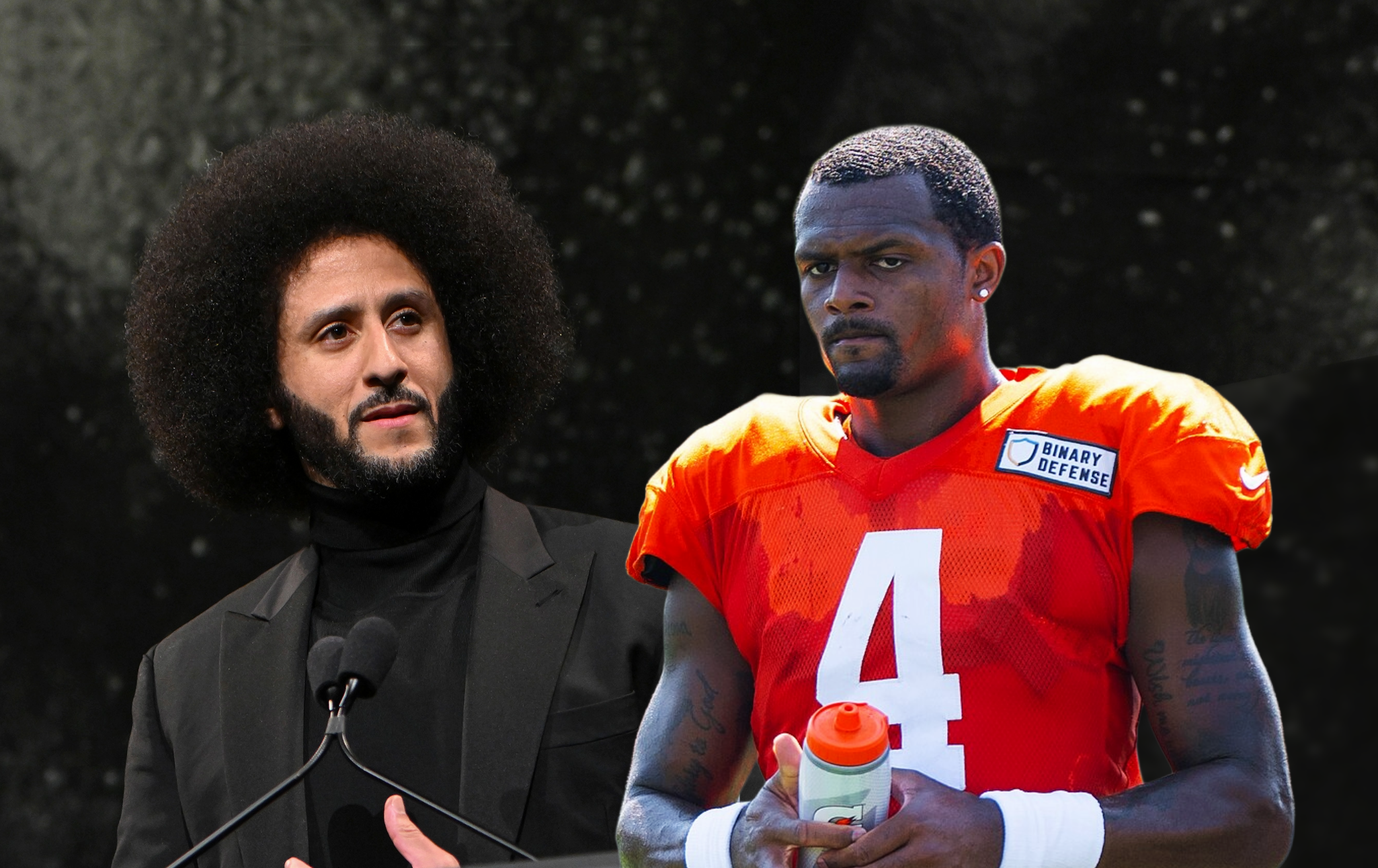
Do you think it’s a good sign when the owners of a sports franchise must release a statement saying they are “aware and empathetic to the highly personal sentiments expressed about this decision,” after they trade for a player whom they are about to pay an amount of money that would make Scrooge McDuck blush? You don’t need to answer that. That’s the situation the Cleveland Browns found themselves in—or rather, put themselves in despite zero pressure to do so—in 2022 after trading for quarterback Deshaun Watson, who at the time had 22 allegations of sexual misconduct and assault from massage therapists around the Houston area, a number that eventually climbed to 27. Over four years later, after playing almost exclusively awful football, Watson began the 2026 season still occupying the starting quarterback position for the Browns. I think “occupy” is apt because he seems to be staging a protest against playing good football, as evidenced by the Browns’ 34-10 thrashing by the Jacksonville Jaguars in Week One.
Virtually nobody outside the Browns’ front office wants Watson on the field, for the record. In Cleveland, fans have shown their disdain in numerous ways, from loudly booing Watson when he leaves the tunnel to placing protest signs on the team’s statue of Hall of Fame running back Jim Brown, saying things like, “$280,000,000, 27+ Victims, Zero Supporters.” One super-fan, known affectionately as “Jersey Guy,” has hand-sewn the names of 38 former Browns quarterbacks onto his shirt, from Tim Couch to Joe Flacco—but he refuses to add Watson, instead placing the solidarity flag for sexual abuse survivors where his name would go.
One allegation of abuse or assault should be enough for the NFL to take some kind of action; instead, Watson was given the largest guaranteed contract in the history of the sport while being actively “investigated,” meaning the Browns were so giddy to bring him into the fold that they promised Watson the full $230 million, no matter what unfolded in the coming years. Horrible football unfolded (and continues to unfold), and the league suspended Watson for 11 games and fined him $5 million about five months after the Browns acquired him. In other words, the NFL thought Watson’s actions were atrocious enough to fine him about 2 percent of his shiny new contract and allow him to sit on the sidelines for about 70 percent of one season (out of the contract’s five).
I won’t philosophize on whether Deshaun Watson being an abysmal quarterback represents some sort of cosmic karma that proves the Sports Gods remain watchful over their domain. He served a short suspension and then was allowed to return to the field with no further consequences, while making hundreds of millions of dollars. That’s a win for Watson, unfortunately. And it becomes all the more nauseating when you place it in contrast with the offense the NFL does crack down hard on: any form of political activism or speech that threatens wealth, power, or the hierarchy of the league itself.

If nothing else, cases like Watson’s show us how the NFL circumvents its own rulebook. Sure, the 2022 suspension was the first time Watson had been punished for violating the conduct policy, but he had about two dozen accusers. Under the league’s current rules, the penalty for an incident of sexual misconduct is a six-game suspension for the first offense, and banishment from the league for a second. Those rules, conveniently, were put in place in 2023, less than a year after Watson inked his contract. These are, essentially, the Deshaun Watson rules.
What could be more NFL than this? The league thinks what Deshaun Watson did was bad enough to revise its entire definition of “sexual misconduct,” but because the rules weren’t in place until after Watson’s punishment was handed down, he’s able to escape the harsher consequences?
This whole situation is absurd; the league decided that two sexual misconduct violations are enough (rightfully) to get a player banished from the league entirely, but the guy who was responsible for the league making that change is allowed to go play poor football every Sunday.
As for domestic violence, the NFL claims to give six-game suspensions for any player’s first violation, and a year-long suspension for their second. Those laughably lenient punishments are ostensibly an improvement from the “Just hope nobody notices” stance before then.
How did we get here? Another question you don’t have to answer. After Baltimore Ravens running back Ray Rice’s assault of his fiancée in 2014 was captured by an elevator camera, the NFL was forced to rethink (or think for the first time) about its domestic abuse policies. But the “reformed” policies—the ones no one seems interested in upholding in 2026—still being so lackluster was a clear sign that the new standards were more for PR than for actual public safety. Something is always better than nothing… but this was barely something.
Any punishment handed down by the league for off-field violence is done to appease angry fans, not because of a real ethical concern for the threats some players pose to people around them. After the world saw Rice’s assault happen, public pushback was strong enough that commissioner Roger Goodell was forced to address an epidemic in his organization and revise Rice’s original two-game suspension. Yes, Rice’s original punishment was for two weeks.
Teams give out questionable contracts all the time. That’s part of the sport. But Watson’s deal in 2022, and the sport’s reaction to violence before and since then, shows that commissioner Roger Goodell and the decision-makers around him have no interest in upholding any sort of standard for NFL players, and that the “sweeping changes” implemented to its personal conduct policy over a decade ago have, for some reason, expired. Despite plenty of lip service from powerful people within the league, their actions show they are indifferent at best, and welcoming of violence at worst. Everyone deserves a fair trial, but the NFL goes well beyond neutrality in cases of violence, time and again showing that it would rather protect its own image than have a coherent domestic violence policy.
As years pass, the enforcement of this policy becomes even less strict. This offseason, three prominent NFL players—Josh Jacobs of the Green Bay Packers, Puka Nacua of the Los Angeles Rams, and James Pearce of the Atlanta Falcons—exposed again, four years after the Watson trade, how arbitrarily the NFL picks and chooses what crosses the threshold necessary for consequence, and how random the punishment itself usually is. It’s almost like the NFL knows its own policies are woeful and just kind of spins a wheel of punishment whenever they’re forced to act. The lack of consistency would be funny if it weren’t so gross.
Jacobs was arrested in May for felony strangulation and suffocation, along with four misdemeanors including battery (domestic abuse) and intimidation of a victim. Right now, he remains on the Commissioner’s Exempt List; in other words, he gets a paid vacation while the league decides how to deal with his case, or sweep it under the rug. Corporate mouthpiece Adam Schefter reported that, even if Jacobs does get suspended, the time he’s currently spending on the Exempt List could count toward that suspension, and that, while the NFL claims that six games is the minimum suspension for any first-time violators of the domestic violence policy, “mitigating factors” could make it more or less. I’m looking far and wide in the conduct policy for the section that says players will receive a six-game suspension for domestic violence “or less, if we change our minds,” but can’t find it anywhere.
Puka Nacua, meanwhile, was sued after he allegedly bit a woman in the shoulder. Pearce was arrested for felony charges of battery and stalking after police visited his residence at least seven times in the months prior to his arrest, after a former partner who was not identified called 911 on him. His arrest finally came when Pearce smashed his car into the car of WNBA player Rickea Jackson (who is not the previously mentioned former partner) as she tried to drive to the police station. Pearce then evaded police officers, got back in his car, crashed his car at an intersection, then fled on foot.
Nacua has faced no consequences thus far, and it seems like he never will. Pearce was suspended for eight games, which he is currently serving. In other words, if a player’s actions don’t rise to the level of felony battery, they’re probably in the clear. We now officially know what a player has to do for the NFL to actually enforce its own rules, and it’s repulsive to read.
However, even the Pearce case shows how the league skirts around what it claims to value. If the league were true to its word, the seven calls to police that occurred in the weeks prior to his full-blown meltdown would have crossed the threshold necessary for consequence. The league’s personal conduct policy states that “It is not enough simply to avoid being found guilty of a crime in a court of law. We are all held to a higher standard and must conduct ourselves in a way that is responsible, promotes the values of the NFL, and is lawful.”
Those values, according to the league itself, include not doing things like “Stalking, harassment, or similar forms of intimidation.”
If you ask me, the seven calls to the police before Pearce’s arrest seem to fit that description to a T. However, three days after the seventh call, and two days before his arrest, James Pearce was honored in a swanky awards show put on by the league as one of the three best defensive rookies in the NFL. Not only was no action taken until Pearce was arrested, but the NFL literally took to the stage to sing Pearce’s praises. When he returns to the field later this season, I’m sure commentators will fawn over how strong he was in the face of “adversity.”
The most ironic part of this all is that the Philadelphia Eagles—who have won two Super Bowls in the past decade—are the only franchise in the NFL that currently outwardly refuses to employ any player with a history of domestic violence. They are not shy about this, either, as General Manager Howie Roseman is comfortable enough to say: “I won't watch ’em, I don't wanna talk about it, it’s just dealbreakers for us.” See how easy that was, everyone else? The current Philadelphia Eagles are living proof that rostering players with histories of abuse is not a prerequisite for success in the NFL. If the rest of the league took that cue, real steps could be made. Until then, the league’s completely subjective personal conduct policy gives players freedom to wreak as much havoc as they please.

As we’ve seen, there is plenty of wiggle room in matters of domestic violence or sexual abuse. But to no one’s surprise, that is not the case when it comes to players speaking up against violence and injustice. Then, suddenly, the rulebook becomes gospel. In Week One of this year’s season, while Puka Nacua took the field facing no penalties from the league, Houston Texans linebacker Azeez Al-Shaair was fined once again, this time for writing “Hind Rajab” on his eyeblack, in memory of the five-year-old Palestinian girl who was murdered by Israeli terrorist forces. No discussion necessary from the league on this one; the fine came just a few days after the game. Kei’Trel Clark of the Arizona Cardinals was also fined for writing “Glory Be 2 God” on his eyeblack. In Week Two, Al-Shaair wrote “Wafaa Akila” on his eyeblack, the name of an eight-year-old Palestinian girl who was murdered by Israel while walking home from school with her father. (If Al-Shaair put the name of one murdered Palestinian child on his eyeblack each week of the NFL season, he’d be doing it until approximately the year 3202.)
Indeed, the NFL has been strict on its uniform policies for years now—like when Pittsburgh Steelers cornerback William Gay was fined for wearing purple cleats to raise awareness for domestic violence just about a year after the Ray Rice story broke. The irony is so thick it’s hard to see through. I’m confident that plenty of players throughout the league have real beliefs that go against the grain of a major American corporation, but the NFL is so steadfast in its commitment to shutting down those who speak out against the shield that we’ll probably never hear from them.
Al-Shaair deserves real praise for understanding the risks that come with speaking out against injustice in a league run by people who are directly tied to that injustice. Robert Kraft, owner of the New England Patriots and an ultra-powerful force in the league, has donated millions to the genocide efforts in Israel, and recently rallied his fellow stadium owners to block Macklemore from performing after the rapper said “Free Palestine” from the stage. How would Kraft feel if someone like Al-Shaair was allowed to spread messages as divisive as “Stop slaughtering children,” with no consequence?
Al-Shaair is a perfect example of how the NFL, like other corporate bodies, wants to claim its employees are upstanding, but doesn’t want them to actually stand up. He was the Houston Texans’ Walter Payton Man of the Year winner in 2025, a title that each team gives to a player on its roster who contributes positively in some way to the community. According to Al-Shaair’s page detailing his outreach, “He consistently provides mentorship to various youth organizations, including from overseas in Palestine.” It’s fascinating the NFL’s website would even say the word “Palestine,” and that something that the league thinks is admirable enough to put on its website is also, when it comes to the all-important eyeblack rules, something worth fining him over. Because of course, following what’s in the code of conduct is a religion for this league. Unless felony strangulation is involved. Then it could go either way.
Of course, there is another enormous elephant in the room, who set the precedent of a player forcing the league’s hand by refusing to back down from a noble cause. San Francisco 49ers quarterback Colin Kaepernick, who is back in the news after releasing his memoir The Perilous Fight earlier this month, was effectively blackballed by the NFL when his activism against police violence broke containment from the league and became a national news story. There’s a reason Kaepernick’s story is still relevant nearly a decade after he played his last snap in the NFL. It’s because he saw his activism through until the end, and it forced everyone to see what happens when that’s the case: it cost him his football career. (It wasn’t his on-field play, despite plenty of folks claiming Kaepernick’s expulsion from the league was fully football-related. In his final season, Kaepernick had a better passer rating than six QBs who have played within the past two years).
Kaepernick’s story wasn’t a flash in the pan, and it remains the clearest example of what kind of “distractions” the NFL will allow. Abuse, assault, misconduct of any kind can all be moved past. But shaking the uprights in a real way is unforgivable, and that’s what Kaepernick did. He’s also taken the step that fans will be forced to take if they want substantial change in how the NFL operates as an institution: he’s turned the games off. “I’m not gonna support an organization that, one, is actively blackballing me, but two, has targeted my brothers who have been protesting as part of this as well,” he said in a recent interview with NBC.
Years after the NFL decided Kaepernick was too much of a distraction for addressing police violence, the league put the words “End Racism” in the endzones on fields across the league. Like Al-Shaair’s contributions to Palestine being promoted on the league’s website but punished when seen on the field, Colin Kaepernick’s actual attempts to bring attention to systemic racism were a step too far for a league that would rather stick with vapid platitudes.
The NFL’s moral center is nonexistent, and repeated brushing off of serious abuse and assault cases, paired with a concerted effort to silence any player willing to have a conscience, proves that time and again. Entire sections of the league’s own handbook are ignored when following them would force the league to confront truths it would clearly rather ignore.
Every time discipline is handed down in the NFL, it’s done so with the bottom line in mind—to not sacrifice any financial gains or risk angering an owner—and is only on the NFL’s agenda until the public moves on to another story. Since there’s always another story to move on to, football has been able to act (or not act) with immunity for years while continuing to grow into an unsinkable ship made of $100 bills.
Because while Deshaun Watson’s approval rating as Browns QB is submerging, it’s important to ask how much of that is because of disdain for the horrific acts of the man himself, and how much has to do with Watson’s shortcomings as a quarterback. If Watson were an All-Pro, would the currently discontented fanbase forgive his extensive track record of abuse? It’s an uncomfortable question to raise. And can changing that—making the performance of the athlete irrelevant, and being willing to boycott a team willing to employ an abuser, even if they’re succeeding—be what forces the NFL to enact real, lasting change to how it addresses abuse and assault? The league assumes we will watch no matter what, and so far, they’ve unfortunately been proven right. A sexual assault survivors’ flag on a jersey and notes on a statue outside a stadium aren’t going to keep Roger Goodell up at night, but a noticeable drop in revenue would. That could be a start for fanbases to take some power back from the league—as long as enough of those fans really do care enough about the character of the people they’re cheering on every week.
Placing blame on one person or party for the league being able to exist with such glaring and immoral contradictions isn’t possible. Roger Goodell oversees it all, of course; front offices don’t respect us enough to even try to rationalize why they keep scouting and signing players who have done abhorrent deeds; and, unfortunately, fans continue to support teams that go out of their way to draft, scout, and sign abusers. If this is fixable, it will (sorry) start with fans being truly willing to break up with the NFL.
In 2023, the Ravens honored Ray Rice as a “Ravens Legend,” bringing him onto the field before a game, where he was greeted with a roar from the Baltimore crowd. The man who was solely responsible for the league rewriting its conduct rulebook was welcomed back with open arms by the franchise that cut him back in 2014. So maybe we shouldn’t be surprised that the league has thrown that rulebook in the trash a dozen years down the line. That shouldn’t be acceptable for fans who want to enjoy watching football without feeling like the league they’re supporting has no compunction about the damage it allows.
Quinn Everts is a sportswriter and food service worker based in Philadelphia. His writing primarily focuses on what happens outside the lines, and how sports impact our culture and society at large.