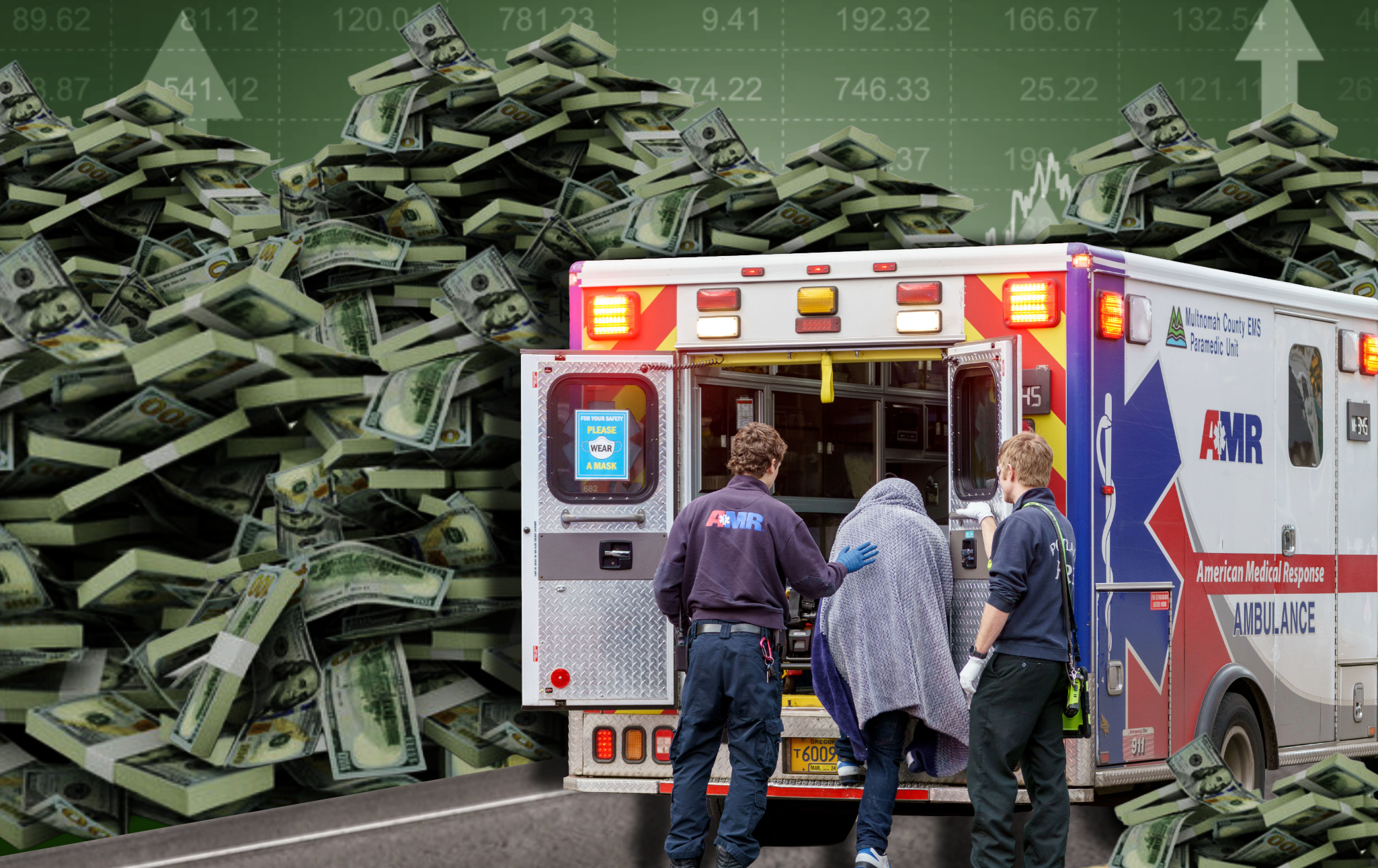
Between life-threatening emergencies and executives who care more about profits than patient care, working for a private ambulance company is its own kind of emergency.
My day starts just before the morning sky turns pale—energy drink in one hand and stethoscope in the other. With the weight of restless sleep in my eyes, I trudge into the ambulance station for my 12-hour EMT shift, greeted in the usual way by my crewmates smoking around a splintery picnic table: “Morning Seamus, your balls drop yet?!”
To the choir of hee-hawing laughter, I flip them the bird and begin my morning ritual of checking my ambulance and scarfing down a banana before joining the ill-matched group. To my left is Corey, a wiry 6’5” dairy farmer-turned-paramedic who’s on his first of five 5-Hour Energy drinks. To his right is Andi, a former Jehovah’s Witness with a distinctive undercut hairstyle, and sitting at the table is Mickie, a gay paramedic with an aversion to anything culturally queer (“I might suck dick, but I don’t do parades,” he says whenever the topic arises). As for myself: a graduate from a posh university, then an AmeriCorps teacher, before jumping into EMS. The only thing we have in common is a spiraling caffeine and nicotine addiction, and the fact that we’re members of emergency medical services. So for the next 12 hours, we’re in this thing together.
Today, however, the banter is cut short when our non-union supervisor peeks out through the doors, and Mickie halts his rant mid-Tony Soprano impression.
“Don’t forget: corporate is coming tomorrow,” he reminds us. Our response is a collective groan and a slew of profanity. Let me be honest with you: we’re all a part of corporate EMS with American Medical Response (the largest, private equity-owned corporate ambulance service in America: AMR for short). That means that every year—when the big bosses arrive for their annual check-in— we experience what can only be described as a humiliation ritual of unpaid overtime.
The first step in this ritual is to eradicate all signs of our day-to-day life. The couch area is replaced with foldable tables draped with a tablecloth; the whiteboard tracking this month’s leaderboard of “black cloud calls” (a distinction awarded for the grizzliest emergencies) is erased; and all tumblers and lunch coolers with “Abolish AMR” stickers must be stowed in our cars. The second step is to sit through an hour-and-a-half PowerPoint presentation full of corporate jargon and mind-numbing phrases like “ROI.”
Last year, the visuals alone were comical: polished dress shoes alongside scuffed boots, clean dress shirts next to our sweat-plastered uniforms. Things took an unfunny turn, however, with the patient care slides. Our glazed-over eyes snapped awake as the AMR suits patronized us on our “responsibility” to photograph patients’ driver’s licenses and collect Social Security numbers on uninjured lift assists, times when elderly people need help back on their feet. These are, they claimed, “billable calls” and must be recorded to ensure traceable payment. Nothing says patient care like an ambulance bill for Grandma who lives alone and slipped out of her chair. Anyone who does not comply will be written up. Executive order.
This obviously did not sit well, and our union quickly filed a complaint. Our responsibility—our sole responsibility—is to our patients. Despite the little pay and long hours, helping people, often society’s most vulnerable in their most vulnerable moments, is what keeps us going. But this is the reality of corporate EMS: being pinned between your employer’s priorities and your own ethical obligations as a healthcare professional.
The issue here exists beyond my personal anecdotes. Even the phrase itself—corporate EMS—is an odd contradiction. You might wince if I threw out analogies like “corporate firefighters” or “corporate law enforcement.” Yet these latter two services are considered federally essential, meaning governments usually maintain them to readiness capacities. But community need for ambulances doesn’t get met in the same way. Instead, AMR and other private ambulance services take the government’s fragmented funding as an opportunity to rake in massive profits from people experiencing medical emergencies. Patient-oriented work, right? That’s what idealistically motivated myself and my hodgepodge crewmembers to join the EMS academy. Ask any of us now, and the last thing we’d ever do is call for an ambulance.

The oxymoronic phrase emblemizes the root of many core issues in American emergency medical services. It’s a matter of priority; fundamentally, a corporate-owned ambulance decenters patients from our work and healthcare system. As a result, EMS is buckling from corporate rot and public neglect. To make things better for both patients and providers, it’s important to understand the current crisis of ambulances in the context of a decentralized healthcare system, how it emerged, and the quiet fight EMS unions are undertaking.
The Cost of Calling for Help
The current crisis of corporate corrosion occurs at a micro (patient) and macro (structural) level. Let’s start at the micro level: how corporate ambulances jeopardize patient care. Remember I said that no one who works on an ambulance would ever call one? Well, a quarter of Americans who responded to a YouGov survey would agree, reporting that they had experienced a medical emergency “requiring immediate transportation” but did not call for an ambulance out of financial fears. Others reported opting for ride-shares over ambulances. Full stop, this is not good.
As a provider, this makes me shudder. When you arrive on scene, people are often scared for their life. Some shake uncontrollably and ask us or Jesus for forgiveness; others cling to their family members’ hands until the moment we close the ambulance doors. People are scared. By definition, an emergency medical system cannot function if the fear of financial debt outweighs the fear of death and disability.
Unfortunately, this is not an unfounded fear. Not to discourage you from calling 911, but ambulance bills have skyrocketed over the last 15 years, and can easily run you thousands of dollars depending on superfluous things like distances traveled and level of care. Basic life-saving care can stretch you $1,000-2,000, while advanced life-saving care even more. My heart palpitates looking at the cost of a helicopter ride.
The only people who benefit from this model are AMR and other corporate ambulance services, which have intentionally lobbied to keep prices high. In 2019, Wall Street-backed healthcare companies spent more than $55 million lobbying against legislation to protect patients from “surprise medical bills.” When Congress finally passed the No Surprises Act in 2020, it conveniently excluded ground ambulance rides, meaning patients still routinely drown in debt from emergency transportation—which, apparently, they should have seen coming. It’s no coincidence that pre-hospital emergency care is the highest offender of said “surprise bills.”
I can say confidently that providers are sensitive to how this system undermines the good intentions of our very stressful work. On every call, we, as sub-livable wage workers, must ask another sub-livable wage person to sign an insurance contract en route to a for-profit hospital. Aside from the natural discomfort of the conversation, the extraordinary cost defiles our patient relationships and confuses our professional purpose.
But what makes extraordinary costs so pernicious is that the American healthcare system is decentralized. Emergency rooms, and by extension ambulances, serve as American’s primary contact with their medical system since they lack access to preventative care and unaddressed barriers to a healthy lifestyle. (Also because they’re the only place in America where you receive unconditional care under the Emergency Medical Treatment and Active Labor Act). Ambulances act as a sort of “catch-all” in a broken chain of care. Emergency providers must intervene when chronic conditions go unmanaged, when mental health services are inaccessible, and down the road when people’s SNAP benefits are cut.
The question should be what to do about this final link. People aren’t calling 911 for stubbed toes. If they’re so scared, so desperate that they’re calling for help, is this even a time to think about profits? There’s not a lot of bargaining when your patient is under duress or even unconscious. You’re their only option. AMR and private equity may think there’s no problem here as they clink champagne to their recent IPO. But for patients and providers, this is unacceptable. When emergencies strike, ambulances must be a public asset for the public good.
Ambulance Deserts
A knuckle-dragging oaf might counter: “Well, at least people have ambulances in their communities. Counties and townships might not be able to afford them otherwise. It’s better to have ambulances than not.” Wrong.
It is true that ambulance operation costs are a high burden, as much as fire trucks are. They need to be fully-staffed 24/7 with trained professionals, loaded with sterile and disposable equipment, and maintained. The costs are no joke, and rural communities have it rough with fewer calls to divide the cost in a reimbursement-based funding structure. Currently, large parts of rural America (in conjunction with mass closure of rural hospitals) exist in “ambulance deserts,” meaning they live more than 25 minutes away from an ambulance station. This can be largely attributed to the previously-mentioned unstable funding model, where you’re constantly trying to recoup costs at the end of the month. While AMR didn’t create these deserts, they benefit from the vulnerability and sure as hell aren’t the answer. After all, corporate ambulances only extend into areas deemed profitable.
You might ask yourself, what if an area no longer is profitable? What about the people? “To hell with the people! We don’t give a shit,” AMR would say in response. Actually, they said exactly that to Cayuga county in upstate New York, stating the operation was “no longer sustainable,” and abandoned a county of over 74,000 people. Patient-oriented work, right?
A step in the right direction might be declaring ambulances essential services, which is a government mandate requiring something for community health and function. Yes, this is a no-brainer, but doesn’t address the core issue. Because even if you do declare ambulances essential services, it is still not enough to keep AMR at bay; their very existence is corrosive to the system. When states declare ambulances essential services, counties then apply for a Certificate of Need/Necessity (CON)—a state-issued permit to run ambulances—that can either be given to a county-run ambulance service or bid on by corporate ambulances like AMR. With pockets as deep as AMR, they easily persuade county boards, intimidated by the high financial costs of operating an ambulance fleet, to swallow up these exclusive, multi-year contracts. You then cede massive power over a basic community function to a corporation that cares more about profits than the wellbeing of your community.
Additionally, other means of profit exploitation still exist in essential service states. These CONs don’t always satisfy community needs to the degree of readiness. So if something pops off, AMR can provide “mutual aid” and support to unprepared neighboring counties. My own station in upstate New York, for instance, will travel down into Northern Pennsylvania to help transport critical patients.
Okay, time for a breath. Let’s zoom out here for a second. The TL;DR on the current crisis: people are scared to ride in ambulances due to cost, and ambulance-owning corporations don’t exactly step up to fill in the gaps. The solution is simple because the problem is simple. Every American deserves to have access to affordable pre-hospital emergency care, and they don’t. This is more than a broken system—not something that Band-Aid subsidies can fix. American EMS needs public funding for publicly-owned ambulance stations, the same way we do for firefighters. Thus, ambulances cannot and should not be owned by corporations, nor, as it might surprise you, were they ever supposed to be.
Right and Then Wrong —Thanks, Reagan!
In fact, the modern EMS system was explicitly established as a public good. In the 1960s and ’70s, the federal government invested hundreds of millions of dollars in building a coordinated national emergency medical system, funding local ambulance services, training paramedics, and expanding access to emergency care. What went wrong is forgetting this original conception and destabilizing a direct funding structure. Corporations like AMR did not create this system, but they did arise because of it. Per usual, we have Ronald Reagan to thank.
Back in 1966 America, underneath the superpower’s global facade, the streets were filled with protesters for civil rights and against the Vietnam War. On those same streets, another unappreciated problem existed: American citizens were being crippled and dying from preventable causes at an alarming rate. This is a time before ambulances arrived in record time with any trained professional. Found yourself in a mutilating car crash? Expect a funeral director to show up and drive you to a far-off hospital. So while the country led medical revolutions with the discovery of the structure of DNA, eradicating polio, and organ transplants, many of its citizens died and were maimed by preventable causes.

Congress recognized the financial cost of this, and commissioned the National Academy of Sciences to investigate the problem in a historic white paper, published as “Accidental Death and Disability: The Neglected Disease of Modern Society.” Scathingly, they concluded: “The chances of survival of a seriously injured person were better in the battlefields of Korea and Vietnam than on the streets of the United States.” Indeed, the human toll was staggering, resulting in over 100,000 accidental deaths, 10 million temporary disabilities, and approximately 400,000 permanent disabilities in 1965 alone. With the scale of such tragedy, the authors called not only for systemic changes to American healthcare infrastructures, but recognized that it would be impossible without aligning civic responsibility with the public good. “Public apathy,” they wrote, “must be transformed[…] to serve his fellow man,” asking us how to collectively solve a public health problem. We had to do this together.
With a swiftness unrecognizable in our era of congressional ineptitude, in the same year, 1966, Congress implemented preventative public health measures with the National Traffic and Motor Vehicle Safety Act, establishing a federal regulatory agency within the DOT that included EMS, and passed the Highway Safety Act, which created national safety measures for our expanding infrastructure. This began answering the infrastructure portion of the recommendations, but would Americans answer the call for civic responsibility?
Lucky for Congress, Americans had already been organizing rescue squads and volunteer crews with their military medic training for decades. Many Black communities organized themselves to compensate for even greater gaps in healthcare. The Freedom House is the most remarkable example, becoming the nation’s first “community-based emergency medical service with trained paramedics.” The paramedics trained and worked closely with Dr. Peter Safar, a pioneer of CPR, and Dr. Nancy Caroline, who wrote the first textbook for American emergency healthcare (much of which is still used today). Without any profit-motive, they established Quality Improvement mechanisms, reviewing calls and collaborating on how to improve patient outcomes, and began carrying medical equipment, such as oxygen supplies, defibrillators, and medications; all of which are still used today.
The success of the initial legislation proved worthwhile, and formal funding of local ambulance agencies began with the EMS Act of 1973 for equipment, training, and systemic coordination. These direct subsidies proved incredibly effective for two reasons. One, because the funding was reliable, allowing for stable growth, and two, federal oversight enabled a sort of national collaboration through trial-and-error. Together, we created an effective, coordinated system with a common goal to help our fellow citizens.
Then, Reagan happened. Ironically, he decided to destroy the very system that saved his life during John Hinckley’s assassination attempt in 1981. I’ll let Mickie’s ‘Breaking Bad’ impression say it best: “We had a good thing, you stupid son of a bitch! But, no, you just had to blow it up. You and your pride and your ego!”
Indeed, things took a turn for the worse with the signing of the 1981 Omnibus Budget Reconciliation Act. Rather than continue what was working quite well, consistent federal funding turned into state block grants. Consequently, local ambulances scrambled to secure a fraction of their previously guaranteed federal funding, and the abrupt transition to state-level oversight broke the chain of national collaboration. State-by-state disparities quickly emerged with many local services forced to shutdown. This is not to say that EMS did not continue to mature in pockets, but the aspiring promise to provide professional emergency care to every American in their time of need ended.
From the patchworked chaos, local counties had to depend more on private ambulance services, which began to consolidate. AMR swallowed-up others and has been the largest ambulance service since 1997. The current system is nothing new, as EMT David Anderson described in a 2018 piece for Current Affairs, but history shows what happens when we replace public responsibility with corporate incentives.
COVID and the Quiet Fight of EMS Unions
The COVID pandemic stress-tested an EMS system already on the brink. In some areas, mostly urban areas, call volume exploded. In others, call volume plummeted out of fear of exposure and conspiracy-driven mistrust. Both were destructive in an already fragile system. But a stark contrast became clear: on one hand, AMR’s pocketbook priorities, and on the other, EMS unions, the only source of accountability to corporate foul play.
Basically, COVID revealed the problems that experts already knew existed in EMS. In urban areas, when emergency call volume exploded, bottlenecks emerged overnight, and the system relied on the goodwill of workers to function. Providers stepped up to the plate—big time, even when they didn’t always have the proper safety equipment to do so. In NYC, calls jumped up 60 percent; in Los Angeles county, up by 30 percent in the first few months. There, EMS providers clocked in for days on end, and they did so heroically. Providers ran their asses off to help their communities in a time of need. Conversely, in rural areas, call volume plummeted. The reimbursement-based model could not guarantee operational funds, and further exacerbated struggles with workforce shortages from burnout and layoffs.
When a system is tested, we’re taken back to first principles, and the horrific experience should have reinvoked the same questions from 1966. Should everyone have access to pre-hospital emergency care? Do communities deserve ambulances even if they don’t generate revenue?
It’s not clear to me that these questions occurred to AMR during the pandemic, since they seemed more concerned about cashing in fat FEMA checks. More importantly, or grotesquely, AMR reacted to the pandemic as if it was an opportunity to exert more control over their workers. Taking advantage of their workers’ civic responsibility, the labor violations started rolling in: infringing terms of union contracts and pushing the boundary of what they could get away with. Numerous and various forms of labor abuse emerged. In Connecticut, for example, AMR invoked emergency provisions to cut staff and hours against the terms of the union agreement. Or in California, OSHA investigated insufficient supplies of PPE and N95 masks even after they were readily available. Left stranded by the company, AMR workers allegedly purchased their own. A ProPublica article in the same California district reported EMTs had to file grievances to receive COVID sick pay. The examples go on, but showcase a total moral failing during desperate times. So while their providers made sacrifices on the front lines of a global pandemic, the higher-ups weren’t willing to do even the bare minimum.
The only pushback against total abuse has been from EMS unions across the country, who have consistently guaranteed better wages, benefits, and time off for their members. While the above-mentioned labor abuse violations are discouraging, know that every one was stopped or penalized as a result of union accountability. When AMR started slashing staff hours in Connecticut, the union stepped up. In California, when union members didn’t have proper safety equipment, the union filed OSHA complaints. The same is true for garnishing sick pay—their union took the fight for their members and entered the ring. As troubling as the abuses may be, EMS unions aren’t letting AMR’s bullshit slide. Without them, there would be no accountability, and the abuse would become even more commonplace. And so a dichotomy is clear. On one hand, AMR’s total indifference to communities, people, and patients. On the other, EMS unions collectively fight for their providers to do their jobs fairly and safely, and by extension, for their patients.
That said, this is an ongoing story. EMS unions continue battling against AMR and institutional neglect across the country: Massachusetts, Hawaii, Washington. The list goes on. Even in my small station in upstate New York, we’re fighting back. Well, I’ll let Mickie tell it.
This Splintery Picnic Table
As we turn to leave for the day, 12 hours later, ol’ Mickie pulls into the station, and Corey isn’t going to miss a chance to bust his chops. It’s been a long shift—not withstanding the surprise drop-in from corporate—and a little gallows humor is all we have left. Today, our call log went as follows:
[0627, Severe respiratory distress - COPD exacerbation after a home oxygen system failed from maintenance company delays. Bedbugs.]
[0800, Interfacility transport]
[0944, Motor Vehicle Accident - patient entered a diabetic coma and collided into the highway median (patient was flown via helicopter)]
[1142, Unresponsive patient - drug overdose. Combative family members. Called dispatch for police assistance]
[1316, Corey drank his second 5-Hour energy drink]
[1320, Behavioral emergency - suicide ideation]
[1410, Interfacility transport]
[1602, Cardiac Arrest. Called dispatch for firefighter assistance]
[1740, Return to station, complete backlog of insurance paperwork. Corey cracks the seal on this 3rd 5-Hour energy drink to start his night shift.]
Exhausted, we slump down at opposite ends of the splintery picnic table. A few minutes go by, and Corey’s half-cocked smirk slowly fades as he checks his watch. Mickie emerges red in the face with a slam of his ambulance door, spilling paperwork from the hospital, and spits off: “Did you see that damn email?”
A conveniently timed 16:40 email had arrived in our inboxes announcing that our dispatcher position will be eliminated since it’s no longer “required for operational success.” That’s easy to say from your air-conditioned Colorado headquarters. Check the call log: those are three lives put in jeopardy, five if you count our own.
Andi, our union president, has already started chain smoking and sending emails to all union members. Under her breath, she mumbles something about the “jackals of Babylon.” Now, we not only have to fight for patients’ lives every day, but we also have to fight against our employer just to do our job efficiently and safely. AMR’s playbook is always the same: delay, obfuscate, and drag out a problem that doesn’t affect them.
This is all to say that EMS providers—and the system more broadly—don’t need much to be happy. They just want respect and a system publicly funded the way our communities deserve. Every ambulance station out there already has people dedicated to helping the people of their community. Although it may look gruff, what connects us more than even caffeine and nicotine is that gratifying feeling of helping someone. And once you’ve helped someone, that feeling never goes away; that’s what makes the fight worth it. The call to action from 1966 remains true, to turn public apathy into civic responsibility. We’ve done it before, and we can do it again. After all, we’re all in this thing together.