For decades, the Pentagon Papers whistleblower filled notebooks with reflections on war, conscience, and hope. His family discusses what they reveal.
In October 1969, nearly 14 years into the Vietnam War and only months before the first civilian draft lottery, Daniel Ellsberg decided that Americans deserved to know the truth. The military analyst photocopied thousands of pages of classified documents and, after U.S. senators refused to release them, leaked them to the public in 1971—demonstrating that the U.S. government had known early on that the war was a lost cause.
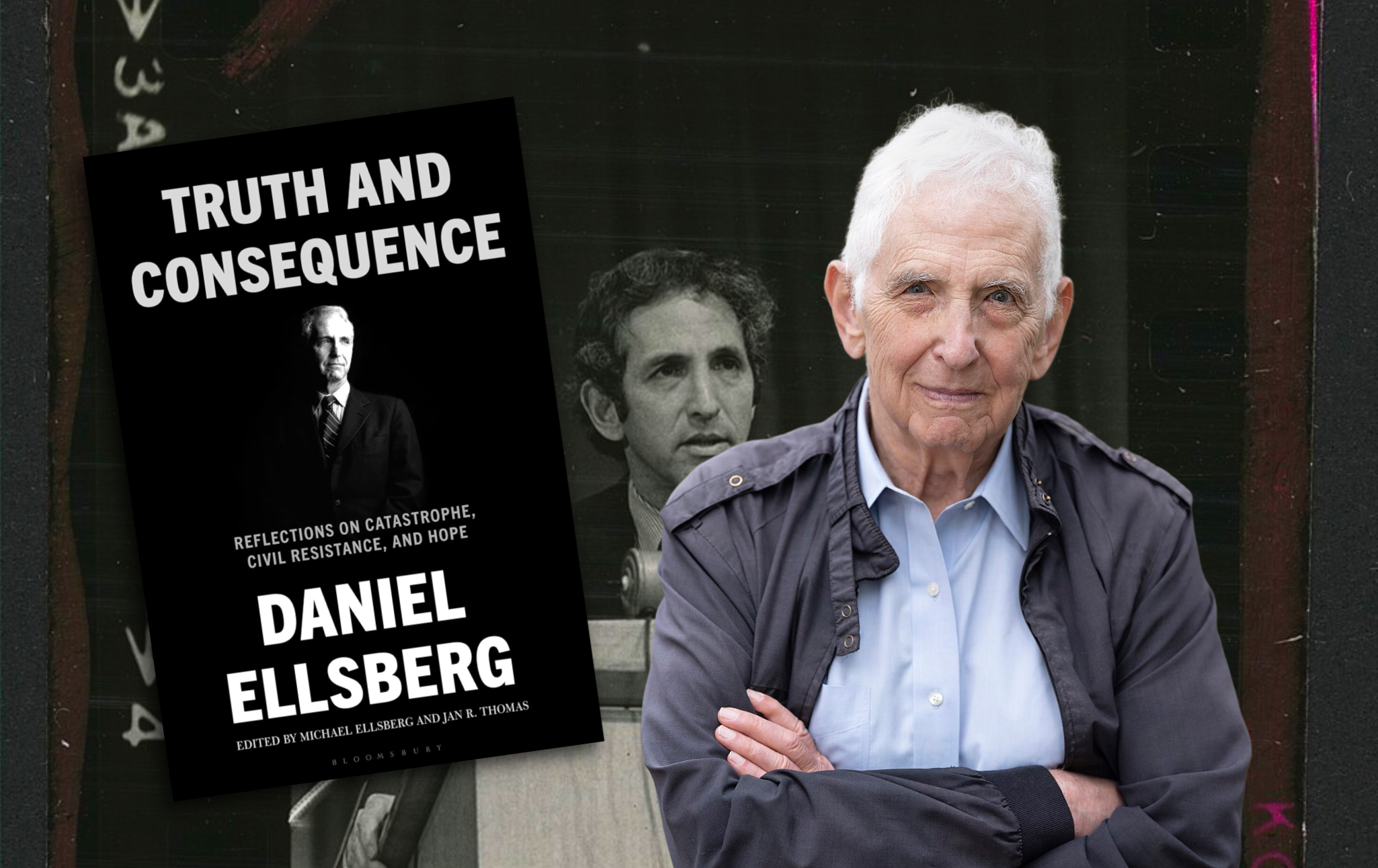
While most Americans are familiar with the story of the Pentagon Papers, far less is known about the man who risked everything to leak them. Released posthumously in 2026, Truth And Consequence: Reflections on Catastrophe, Civil Resistance, and Hope is a stunning collection of Ellsberg's previously unpublished writings, exploring the inner world of America's most famous whistleblower: from his continuous anti-war activism and advocacy against nuclear weapons, to his personal struggles surrounding the death of his mother and sister as a teenager.
Compiled from decades of handwritten notebooks and journal entries, the book offers an intimate portrait of Ellsberg's moral and intellectual life, revealing the convictions that shaped his extraordinary career. Current Affairs sat down with Ellsberg's sons, Robert and Michael, and his longtime assistant Jan Thomas—the latter two of whom co-edited the volume—to discuss Ellsberg's legacy and what readers can still learn from his example.
Nathan J. Robinson
I wanted to start with you, Jan, if you could talk a little bit about the material that we have here, what Daniel Ellsberg wrote over all these years, during which he was publishing very little, but he was writing all these thoughts. So tell us a little bit about what comprises this new collection.
Jan Thomas
So he, throughout the years, would routinely and deeply engage with his writing in his notebooks, and he was writing thoughts that he was not sharing. You didn't know necessarily what was on his mind, but he had a very deep conversation with himself in these notebooks. And at the end of his career, we were preparing to send off his papers to the archive, and it just seemed as though, let's wait a second here.
There was something important that was being captured as he was contemporaneously going through these events and having deep thoughts about them. Let's see what's there. So that began a process of harvesting what ended up being 600 file boxes worth of material that were dug through to pull out the notebooks, go through them carefully, and look for things that would comprise a book.
Robinson
And just staying with you for a moment, Jan, what is it that you found so compelling about these notes when you started deciphering them and understanding what he'd been thinking about and writing down all of these years? Other than the fact that obviously Daniel Ellsberg is an important figure in 20th-century history, what is it about these thoughts that you felt were so important that they be shared?
Thomas
Well, I think that there was a compelling nature and a distillation of his thinking. When you're handwriting something, you have to slow down and just get to the gist, and that was the quality of his writings. He really was harvesting deep reflections about things. He wasn't going on and on about them to then get to the point. The point was what he wrote. And so it's a really direct way to engage in a conversation with his inner conversation, his moral complexities and quandaries that he was sorting out.
So we can ride along with him through time, through 50 years of him having these frequent sessions with his notebooks, which he believed was only for himself. He never intended any of this material to be public, but when we saw the accumulated pieces, it just seemed as though it was going to fall into an amazing book, and that's what happened.
Robinson
Michael, let me turn to you because you co-edited this volume. When you read through your father's notebook, what kinds of thoughts in it struck you as profound? What kind of themes come out of this work that he was thinking about all of these years?
Michael Ellsberg
Yes, thank you. Well, I can divide that into two: my own personal experience and then his ideas that got rolling. My personal experience was very moving, and I write a little bit about this in the introduction, in that this really was my father's main waking activity: reading, writing marginalia, and writing in these legal pads hours and hours a day. So this was an activity he was doing most of the time when I saw him, and one relevant fact here is that his handwriting is almost inscrutable to everyone. He would need to read the birthday cards he wrote to me because I couldn't read even a word of it. And somehow, miraculously, Jan can read it with no problem.
So it was like one of those decoders, or the secret overlay revealing a photo, where all this stuff that he was doing for decades, my whole life—I'm 49 now—was revealed. It was like, "Oh, that's what he was thinking about," and it was very moving to me to kind of get access to this part of him that I didn't have access to before. So I'm grateful to Jan for that.
One thing that really became clear in the notes, among many we could talk about, is just how much the accident that he was in when he was 15 [affected him]. It's the subject of one of the personal essays that I had read—that was typed out, and I had read it a long time ago. He just, for decades, year after year, goes over the implications of this, and he really used that as a metaphor. Not to go into it too much, but his father falling asleep at the wheel, his father sort of obeying this very unsafe command that his mother made to drive through the night. And that became probably the core metaphor of his life that he interpreted a lot of his later political actions through; this kind of core obedience that he witnessed and caused his mother and sister to be killed.
Robinson
I want to talk a little bit more about the accident. Because the accident, the piano playing, and the Christian Science were all things I had no idea about until I read this volume, because he left them out of his book Secrets.
Robert, I'd like you to tell us a little bit more about the aspects of your father's thinking that people who just know about him from what they might have read in the New York Times aren't aware of—because people know him as having leaked the Pentagon Papers. They might know that he had a crisis of conscience about what he understood about the Vietnam War, and they might know what he exposed. But what the notebooks show—and people who have caught up with the book that he wrote, The Doomsday Machine, might understand—is the sort of full dimensions of his thinking.
For his entire life, Ellsberg was one of the pioneers in "decision theory." He was trained as an economist, and he seems to have spent a lot of his life thinking very deeply about questions of why atrocities occur, human complicity, guilt, responsibility, and decision-making. Can you sketch for us a little bit more the broad scope of your father's thinking?

Robert Ellsberg
Well, of course, he's very well known for leaking the Pentagon Papers and as a very important resistor to the Vietnam War, whose actions actually bore extraordinary fruit in helping to bring down the Nixon Administration because of the overreach of Nixon and his plumbers trying to silence him. But people were not so aware that the whole episode of the Vietnam War, and his preoccupation with that, was really a kind of detour from his lifelong preoccupation with the threat and danger of nuclear war. That's where his career began in the late 1950s, working for the Rand Corporation: working on the question of how you could present an effective deterrent—in particular by making sure that an enemy could not just simply knock out your command and control with a bomb on Washington or something like that. How could you make sure that we could present a credible deterrence? So his preoccupation was not fighting nuclear war but trying to prevent it.
He later, though, began to see that the whole thing was a kind of insane and murderous, as he would call it, evil system, which he characterizes as a doomsday machine. We had created this apparatus that had the capacity to destroy all human life, and it was an idea that was popularized in the movie Doctor Strangelove. Well, he goes in and works for several years on Vietnam, and then in resistance to the war, after he'd served there for two years.
But when the war was over, he returned to his original preoccupation, which was warning and trying to alert the public to the dangers and the catastrophic possibilities of nuclear war, and that was something he continued right up until his last breath by demonstrating, by writing The Doomsday Machine, lobbying, and he felt in many ways that at the end of his life he didn't have as much to show for those efforts as he would have liked. But he felt that there was always one more thing he could do, and he wasn't going to rest until he had done that.
Robinson
There's also the new documentary, An Ordinary Insanity, which I watched today, which is a half-hour documentary. Everyone can watch it for free online on YouTube, and it really is an extraordinary document. I'm not sure exactly when the footage of him was recorded, but it's in the last years of his life, so it's all narrated by him as he talks about the danger of nuclear war and how he came to view it as insane and evil and the extraordinary risk of the system that we had built.
I think what comes across to me through revisiting his work is: I don't know many other people who've spent as much time thinking deeply about questions like, "What allows human beings to participate in evil systems? Why do we take certain risks? Why do we blind ourselves to certain risks?" Could one of you help me understand a little bit more the threads that tie together his work in economics, nuclear war, and Vietnam, the things that preoccupied him?
M. Ellsberg
I love that you caught that thread. So this book introduces readers to a side of my father's thought that most will be unfamiliar with, but anyone who knew him personally would be very familiar with. He constantly analyzed and thought about the way that morality works through organizations, and one of the key points that I took away from reading this material was that he makes this really clean distinction between the way morality works among kind of day-to-day families and friends and communities, versus how it works in organizations.
His point is that they're almost exactly opposite: that in our day-to-day lives we have the kind of playground morality—don't hit people, don't lie, don't steal, don't cheat, that kind of thing—and you're responsible for your actions and have to take responsibility. Whereas his analysis over many decades of organizations is that they're essentially responsibility-deflecting machines. So that allows an organization to take a lot of people who individually, in their day-to-day lives, are probably very moral and ethical people who follow all that common-sense morality. But because they're in a machine that has systematically allowed them to deflect responsibility, the machine itself, the organization, gets to act in ways that would be considered sociopathic if an individual were doing it. But the morality in the organization is "follow the leader; don't question; obey; you're justified if you have enemies; you're justified in doing these things to your enemies." So they're almost exactly opposite moralities.
Robinson
One of the things that's striking in the documentary and in The Doomsday Machine is him looking back at his time in the Rand Corporation and doing this nuclear war planning work. He's kind of trying to solve the puzzle of how he, as an ordinary person of ordinary morality, could have participated in something that—I think he said that the project is "the most evil piece of human planning that has ever been done."
That is to say, the United States's own contingency nuclear war plans involved the mass murder of hundreds of millions of people. Planning, not intending to do, but at least planning for the possibility of carrying out killing on a scale that dwarfed the Holocaust. And as he looked back on that, he seemed to be trying to wrestle with it. As I understand it, it's part of why he didn't publish for a long time because he didn't have a satisfactory answer to the question of how he and other perfectly normal people could have gotten wrapped up in something that seemed on the surface so rational, but then was also so insane.
Thomas
You're spot on with that, and one of the things he would say often was, "How can good people do such evil things?" Or as the files that we held his writing on go, "How could we/they?"
So he was partly processing his own complicity and trying to work it out because he felt like he was someone who had every good intention, and he was in the system to serve his country, and yet he realized that he had unwittingly participated in creating a system that could end life as we know it. So it really troubled him, and he worked to piece together that riddle. That's what Michael was speaking to: the bureaucratic morality, the distinctions that allowed those kinds of things to go forward.
Robinson
This book is a collection of fragmentary notes, as we've said. So I'm going to ask each of you—and Jan, maybe you could start—do you have particular notes in here that stayed with you, or particular insights that he had, or things that made you think? Because all the time he's trying to think, he's trying to understand the world. So as you read it, what do you think some of the more profound of his conclusions or reflections are?
Thomas
Well, I think for me some of the most meaningful ones had to do with speaking to people directly that could inform their own moral conversation. There's one quote, or rather a couple of quotes:
"We are in a crisis. Open up the options. Think radically and creatively. Act as if peace were possible. Take responsibility for your beliefs, your actions, your lives. Free your own power and use it. Don't delegate conscience. End complicity and silence. Join a community of risk, of concern, of change."
M. Ellsberg
So I just had this one bookmarked, and this is from 1984, so I was seven years old. On the first page, there are a lot of little pithy one-liners that really make you think. So the first one there says, "Groups do not have a tendency to mature, to grow up."
Now that's really interesting. I'd never thought about that. Obviously, all of us, we and our friends and family, hope that we grow up over time. But if you think about various organizations, have they actually grown up? Has the US government matured? I think that's a question mark.
So this is the one I wanted to read here, and it says, "Model group of evil." So this is just two paragraphs that I think encapsulate a lot of his political philosophy:
"Subordinates feel part of an omnipotent organization or team, righteous, protected, and safe from criticism or judgment. Hence, they are free from constraints against hurting others, free of the fear of retaliation, and free from a personal sense of judgment or failure. Leaders feel themselves to be servants of the Cause (capital C) serving the organization, team, or state. They, too, feel diminished and take no personal responsibility for policy. They see themselves as being responsible to stockholders, the organization, or voters in a way that 'leaves them no choice.' Hence, they are protected from the constraints of personal conscience."
The book is just suffused with these meditations on personal conscience and the way it works in organizations in these really pithy ways that, as Jan mentioned, he certainly didn't intend them for publication. He did give us permission at the end, so it is a consensual publication. He was just trying to work these thoughts out in his own mind for himself.
Thomas
And he certainly never believed that it would actually happen. He gave a permission, kind of like, "Oh, yeah. Sure." He didn't give any consideration that this would see the light of day.
Robinson
Robert, as you read through these notes, are there particular thoughts?
R. Ellsberg
Well, I've mentioned that not everybody is aware of this preoccupation he had with nuclear war, and he certainly considered that the most urgent message that he had to share with people, because he felt that people didn't really understand the nature of the risks and the possibilities. But there's a whole other side of him that he just didn't share that much, though he did with family and friends. This question really runs through all of these notes: Who are we as a species? In other words, the danger that he saw was not just from the weapons themselves or kind of our nuclear plans, which could be changed, could be improved in various ways with different technology, different policies, different ideology, or whatever. But he really was trying to get to the heart of what it is about human beings, not just in bureaucracies.
He also pointed out that we are kind of unique among species in making war on our own kind, and this way that we have—I think Michael referred to it also—of distinguishing between our tribe, our in-group, our family, and the other, and most people don't really care that much about the other. And so in this documentary you mentioned, Ordinary Insanity, he says the idea that you can win a nuclear war is a kind of insanity, but it's a very ordinary insanity because it's so widely shared.
In a way, he felt that we had to develop an ordinary sanity. There had to be some kind of moral evolution, and the question is whether we had time to achieve that. Now, part of his work was to model that other model, a different kind of ethic, a different way of being, demonstrating that there were people who care about the others, who care about the future, not just about what's around the corner in the next midterm election or something like that, and are willing to take risks, make sacrifices to achieve that end. So he was very concerned. But what would it take, and what could we do to awaken that capacity for a kind of inclusive empathy and solidarity with not just other human beings, but also other creatures?
Robinson
The film is really remarkable, and if there are any teachers listening, I recommend playing it in schools, having a discussion, and getting people thinking about these things. Another thing people might not quite realize is that Daniel Ellsberg had basically the capacity to succeed at the highest level in the establishment. He got a PhD from Harvard. He ended up in the Rand Corporation and the United States government. Jan, you write that you think the word "genius" would apply to him.
But what's interesting about his particular kind of genius was that he could have been an assistant secretary of state, someone who was a senior professor of economics at Harvard. But it seems to me like his mind was so restless on these moral questions that he couldn't accustom himself to, accept, or reconcile himself to things that felt wrong about the institutions that he was in. I may be misreading. I didn't know him. You knew him, but this is what comes across to me. If you're in the Rand Corporation, you're supposed to ultimately just accept the logic that nuclear war can be rational. If you're working on the Pentagon Papers, you're supposed to sort of swallow the contradictions. And he was someone who ultimately seemed like, on an intellectual and moral level, he just couldn't accept these things and put aside his restless inquiry into, wait, hang on a minute, this is violence; this is madness. Jan, you worked with him a lot; tell me your thoughts on that.
Thomas
I think you have just shown tremendous insight in those comments. He started out being totally dedicated to serving as a patriot of his country, and even when he was in the war planning role, he believed he was protecting the country and doing everything he could to make things safer in his own way. As time went on and as he learned more, the center didn't hold. He just had so many things that came up.
First, he was pushing off those doubts, and then Vietnam continued. He just learned more and more. He saw with his own eyes, and he could not align himself with the policy objectives that were being carried out. And I think it just went on and on and on until the weight of the contradictions just snapped something in him, and he had to really line up behind his moral considerations, which had governed him in the early stages as well. He had every bit of moral sensibility that he carried with him, but he hadn't met the realities in a way that caused him to have to turn aside. And he went from being the ultimate insider, as you said—his background destined him. He was just decision theory, how to make decisions under uncertainty. He was such a resource in all of those policy ways. He went from that to being called a traitor. And I think that the system really wanted to crush him because he was such an insider, and they just couldn't let that stand.
R. Ellsberg
I think it's worth pointing out that, in effect, there were kind of two big before and afters in his life. The first one was the accident when he was 15 that killed his mother and his sister. The second one, though, occurred after he was—he was fully against the war, but so many other people that he worked with in the government didn't feel any different than he did. Everybody was against the war. And then he encounters this young man who is about to go to jail to resist the draft, and it suddenly kind of broke open his heart in this way to think, "What could I do if I were willing to go to jail?" That really broke his life, and he went from being an insider at that point to then realizing what the power of nonviolent civil disobedience and truth-telling could achieve.
And so that was also one of the great messages of his life that he wanted to share with people: that you don't know what the effects can be of even just getting up and giving a speech, and it can be one of those things that kind of breaks the spell of obedience when you see that there's an alternative, there's another way; you can respond in a different way. Aside from preaching about the dangers of nuclear war, he also wanted to convey this idea of personal responsibility and how ordinary people, by casting their whole vote—Thoreau's phrase—could possibly change the world, change the future.
Robinson
Michael, you mentioned earlier this accident. I didn't know anything about this, actually, until I read this book. These first three essays that the book opens with are really remarkable because each aspect of his early life, his parents' religious faith—they were from a Jewish family, but actually they practiced Christian Science—and the fact that his mother decided when he was born that he was going to be a top concert pianist. And she spent most of his childhood trying to force him to be one of the greatest pianists in the United States, and then all of a sudden his mother and sister died.
And you mentioned that actually, the sudden death of his mother and sister in this horrific car accident, he replays this over and over throughout his life. And there are even lessons from that in terms of these ideas about how you need to be able to dissent when you see a situation that is headed for catastrophe. He goes over this to try and understand it, to try and make sense of it, to try and think: what should people do in various situations? Could you tell us a bit more? Because you hinted at this earlier.
M. Ellsberg
Yes. So it was actually a fairly direct example of a lot of the things that he later talked about in organizations he witnessed to disastrous effect in a family unit. And without giving away the whole chapter or going into too much detail, basically there was a family disagreement between his mom and his dad. The mom wanted to get to Denver from Detroit very quickly in a rush. She had a bunch of reasons, and she was insisting that they drive through the night, and it was definitely a mother-led family. The mother was in charge. That was pretty clear.
His dad, my grandfather, objected and said, "No, I'm too tired. This isn't safe. We should wait. We should miss this party." And basically, it was always overruled, overruled, overruled. "You must obey orders," more or less. And then that led to these disastrous consequences.
And so this was this a very upfront and consequential window into what happens when a subordinate knows that a plan is dangerous, raises the danger with a, I'll just say, kind of crazy leader who is making not wise, dangerous decisions, and doesn't disobey. Because he could have just refused. He could have said, "No, sorry, I'm not driving." And so my father really took that as a model of why it's so important to independently consider the wisdom of policies that you're being asked to put forward when you know that they're putting lives at tremendous risk in dangerous ways.
Robinson
In the new film, he talks about Stanislav Petrov, the Russian soldier who defies orders in the 1980s, and the importance of making your own independent assessment and not doing something that you know is going to lead to disaster. And you could see, having read the essay—Jan, I think you're about to say something?
Thomas
Well, I just was going to say it's interesting to me that the whole thrust of his life became preventing catastrophe, and it's not an accident that he had such a formative catastrophe in his formation.

R. Ellsberg
He was very interested in other examples of catastrophes, such as the Titanic. He often used that as a kind of metaphor. You've got this ship that is trying to set a record going across the ocean and is ignoring dangers of floating ice. And so he's raising this question: Where are we? Are we destined for this collision that's going to happen, or is there still time to change things? Is it possible that we can mutiny against this crazy insistence of the captain that they keep on sailing?
Robinson
I forget who it was among you who said that early in his life he thought of himself as a real, true, red-blooded American patriot. But at one point in here, he talks about patriotism as well, and he talks about being accused of being a traitor and says, "I'm so insulted by this because I really do feel like the duty of someone who cares about their country is to exercise this kind of independent evaluation of conscience whether the country is doing something self-destructive." And in the case of the Vietnam War, he had a patriotic obligation to risk his freedom to ensure that the US public could make informed choices about the war that was being waged in their name.
Thomas
I think that's what a true patriot looks like. You can throw the word around, but he took it very seriously.
R. Ellsberg
He often said that the highest obligation of an American citizen is to the Constitution, not to the party, not to their boss, not even to the nation in some kind of international conflict or whatever, and that all public officials take that oath. And so the irony is that he would be called a traitor because he put loyalty to the Constitution or what was right above loyalty to his tribe, his in-group.
Robinson
As we conclude here, perhaps each of you could just give your assessment looking back on the extraordinary and long life of Daniel Ellsberg. What should each of us take for our own lives out of examining his?
We've mentioned some of the themes that preoccupied him and that come across in these notebooks. The responsibility to use your mind and use your conscience and to not set aside things like nuclear war just because they're painful to think about. If we're headed for the precipice, we have to confront these things and talk about these things. We have to examine institutions. But I want you each in your own words to say, as you look back on his extraordinary life and work, what you think each of us can take away from it.
Thomas
Well, I will say that to me he is the epitome of a moral exemplar, and that is in such deep contrast to the times we're living in. Truth is lies. Transient values. So I think that taking on this example of a life truly well lived from his gifts—he took his gifts and he used them in every way he could to improve the world and make us safer. So I think we can each take that example and just say, "What is my moral responsibility as a human being? How do I want to show up in this life?"
And there's just a whole lot that we can benefit from his insights. He took his smart mind, and he worked out a lot about life and humanity, and so there's a lot to be learned there. And with each reading, it seems I learn more.
M. Ellsberg
I'll answer that question in a slightly different way. If you read the book, what you see is a mind grappling with questions over 50 years and really trying to get to the bottom of things. And I, personally, was very inspired throughout his life, and also reading this book about this commitment to not just settle for easy answers. One thing I really appreciate about my father is that he wasn't really an ideologue. He was on the left, but he wasn't ideological about it, and he was just as willing to criticize people on the left side of things as on the right. And you can really see that working through these notes over 50 years of trying to question everything and get to the bottom of some answers that he could feel comfortable in.
So I would think that anyone reading this could see how you can live a life devoted to ideas, devoted to commitment and action, but not from a simple ideological way, but from really having thought things through.
R. Ellsberg
I think what I would say is, my dad was not an optimist. In fact, I said to him, "No, you're a catastrophist." He spent so much of his time thinking about the unthinkable, thinking about the worst-case scenario, which he didn't feel was really slim odds. He felt that slim odds were that we were actually going to survive the nuclear age. But he was a person of hope, and that was not the same thing as optimism, just a confidence that it's all going to work out somehow.
He felt that by living hopefully, you make it possible that there's a different future, and the stakes are so high that that's a very good way to use your life. Even though you, in your own lifetime, might not see the ultimate fruit of that. He'd seen in his own life that you just never know what the outcome of your actions could be. The Pentagon Papers had much greater impact than he could have even imagined, but not in the way he expected. And so he called himself a person of hope. And I don't know how he came upon this, but the subtitle, I think, really puts all those things together: Reflections on Catastrophe, Civil Resistance, and Hope. And hope was, I think, his most important legacy.
Robinson
Robert, if you don't mind, I'll just read a tiny little bit of your foreword here, where you say,
"He knew that he was not irreproachable in all aspects all the time in his life, but the survival of the world could not wait for irreproachable people. It would require many people of compassion and hope who could recognize the dangers facing our planet and were prepared, as Albert Camus put it, to speak out clearly, pay up personally, but require a kind of awakening to the moral and ethical dimension of our crisis. He had hope that such an awakening could occur. This hope was not the same as naive optimism. He reckoned realistically on the low odds, but low odds were not zero odds, and he retained hope that catastrophe could be avoided."
That's just a sliver. People should pick up the whole book for Robert's entire foreword. Although I think it was also published on Common Dreams, so you can check it out there. I really hope everyone picks up Truth and Consequence. The great Norman Solomon, who's also been a guest on this program, says, "You will never read a more profound book about obedience and conscience."
Transcript edited by Patrick Farnsworth.

%20(crop).jpg?width=352&name=wile-e-coyote%20(resize)%20(crop).jpg)