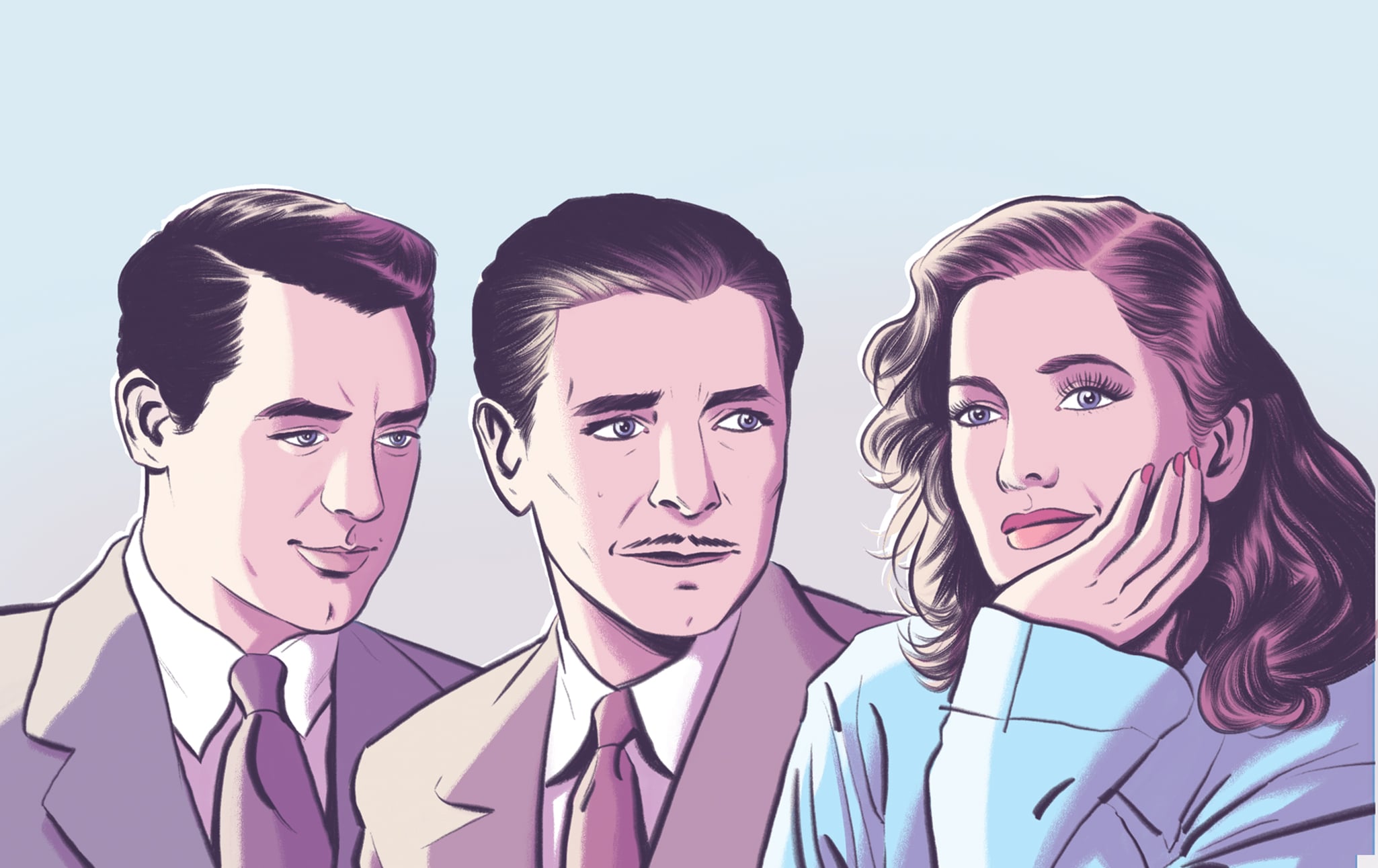
Cary Grant, Ronald Colman, a fugitive labor activist, and an unconventional love triangle: 80 years later, “The Talk of the Town” has a lot to offer.
In a just world, I could sell just about anyone on The Talk of the Town (1942) with the words “it stars Ronald Colman and Cary Grant.” Two titans of charm and glamor that never let being gentlemanly get in the way of being hilarious, it’s a crossover as tantalizing as John Wayne and James Stewart co-starring in The Man Who Shot Liberty Valance. Yet in the world in which we live, more drastic measures are required. Like its star, the film was ahead of its time but has nevertheless fallen through the cracks of modernity.
The Talk of the Town is about a Supreme Court nominee who learns that the law and justice are not necessarily the same thing. It is also, improbably, a screwball comedy about Cary Grant and Ronald Colman falling in love with the same woman—and, perhaps more importantly, with each other.

Colman was an actor unstuck in time: a would-be icon of 1970s Hollywood who, through cosmic mishap, was born in the 19th century. The soulfulness and subtlety with which he plays to the camera—decades before Marlon Brando would popularize a film acting style totally distinct from that of theater—leads me to conclude that he was actually meant to play Robert Downey Jr.’s role in Zodiac, but decided to travel back in time so he could have a transatlantic accent and pencil mustache, no questions asked. He became a film star in the silent era, yet his greatest gift as an actor was his dulcet voice: rich, resonant and instantly recognizable, he sounded like an English gentleman without any sense of snobbishness or superiority.
Colman’s voice was so distinctive that his appeal extended well beyond the movies themselves. In the 1952 novel Invisible Man, Ralph Ellison namedrops Colman in his description of a particular manner the narrator wishes to adopt: “dazzling eloquence … polished … charming. Like Ronald Colman. What a voice!” That voice was particularly remarkable in the early sound era, when actors were still figuring out how to perform for a microphone. In Bulldog Drummond (1929), Colman’s first sound picture—the poster boasts that it is “all talking!”—everyone on screen is caught between the acting styles of silent film and stage, except for Colman, larky and tenacious and utterly natural, who invents the next century of sound-screen acting in front of your eyes. It’s hard not to wonder what he might have done with the decades of film history that followed. I have no doubt that had he lived past 1958, Colman would have played some interesting role in the rising independent and youth-led film movements just around the corner—even if only joining the roster of elderly leading men for Roger Corman’s trashy exploitation movies.
But even Colman, in his newly revealed velvety baritone, isn't the only one who commands the screen. His co-star in The Talk of the Town, Cary Grant, was hardly less perfectly suited to the part.
Cary Grant, in the year he became a naturalized American citizen and legally changed his name from Archibald Leach, plays Leopold Dilg. In a noirish opening montage—light on dialogue and heavy on newspaper headlines—Dilg is arrested on suspicion of burning down the mill where he works and killing the foreman in the process (though no body is found). Facing the death penalty, he breaks out of prison partway through the trial. Dilg injures his ankle during the escape, and so doesn’t get far: just to nearby Sweetbrook Cottage, homeplace of his old schoolmate Nora Shelley (Jean Arthur). Unfortunately for the fugitive, his planned hideaway comes with unexpected company; Miss Shelley, now a schoolteacher and living with her mother in the town, is renting out the home for the summer.
The new tenant arrives minutes after Dilg does: famed law professor Michael Lightcap (Colman), hoping for some peace and quiet to write his book. In zany, madcap fashion, Shelley tries to contrive reasons she needs to stay at the cottage—ranging from “I had a terrible fight with my mother” to “I am currently wearing your pajamas”—so she can keep Lightcap from discovering Dilg hiding in the attic. She contacts Dilg’s lawyer, Sam Yates (Edgar Buchanan), hoping to lay the groundwork for Dilg’s innocence.
“He's the only honest man in town and they want to hang him,” Yates tells the Professor. “Mind you, he's just a worker with gumption enough to fight the boss.”
He thinks that if Lightcap—“the most distinguished legal mind in the state” and a prime candidate for the Supreme Court—could be convinced that a miscarriage of justice is taking place, he could successfully call for a fair trial for Dilg, away from the town’s prejudice and the mill owner’s interference.
Lightcap isn’t buying it. “My business is with the principles of law. I can't get mixed up in these little local affairs,” he says, “The philosophy behind the deed, that's my field.” One of the youngest men to ever graduate from Harvard Law School, Lightcap is an idealist in the truest sense: he lives in Plato’s world of Forms, where the law is perfect and abstract, untainted by petty human concerns.
In the 18th century, he dictates, “Law became, for the first time, the instrument of pure logic… It was the aim of the lawmakers and the law administrators to build the law firmly on principles, which are above small emotions, greed, and the loose thinking of everyday life.”
Dilg overhears this, having crept into the kitchen to sneak some food. He stands over the open fridge, furrows his brow, tilts his head, and hobbles out with his swollen ankle, munching on half a dry roll of bread. “Impossible,” he announces: “What is the law? It’s a gun pointed at somebody's head. All depends upon which end of the gun you stand whether the law is just or not.”
It’s insanely reckless on Dilg’s part. He’s an injured fugitive who blows his hiding spot simply because he couldn’t stand bullshit to go unchallenged. (“When I hear nonsense, I get an impulse.”) He knows the law is political, because he is the victim of a political prosecution. He knows the law can be bought and paid for, because the mill owner has bought the judge in his case. He knows the law is a gun because it’s planning to kill him. But it’s not just his personal experience: since he was a schoolkid, he’s always known you can’t rely on the law for justice; you have to fight like hell for it yourself.
“Always collecting a bad reputation, even after you grew up. Speeches on street corners, petitions,” Shelley says at one point. “Any kind of a squawk, Dilg's right in the middle of it.” He leaves it to Shelley to scramble for a cover story: she introduces him as Joseph, the gardener.
It’s also a brave move on the film’s part, when they could have easily milked the hiding-a-fugitive farce for another 30 minutes. But once Dilg and Lightcap meet, The Talk of the Town really gets down to business. It’s from here that the film reveals itself, as film critic Nathan Cook puts it, as “a universally appealing story, asking ‘who does our legal system actually protect?’ and ‘why are these attractive people clearly in love but pretending they’re not a throuple?’”
These apparently disparate questions are deeply entangled, as political debate functions as a kind of love language between the characters. They debate legal ethics, play chess, and eat voraciously. (Dilg’s preference for borscht with an egg in it becomes a key plot point.) Keeping Dilg’s true identity a secret continues to lead to hijinks, even as they try to soften Lightcap’s heart to this Dilg case. Shelley takes Lightcap to a baseball game so he can bump into the local judge, who admits—no, brags—about writing his opinion of the case before all the evidence has been presented. Lightcap’s ivory tower idealism begins to waver. He’s like a little boy, Shelley says several times. One who’s been pretending to be an old man since he started teaching at 22, and grew a beard to hide his baby face.
Lightcap and Dilg are a legal scholar and a working-class political activist with very different views of how the world works. For Lightcap, law is the transcendent prime mover, shaping every individual’s rights and responsibilities. It is written down and carried out accordingly. For Dilg, law is an instrument of the powerful, and must be fought against if necessary. Lightcap has a whiggish belief in the ongoing improvement of human reason. Dilg has the heart of a revolutionary.
The words the script uses to describe Lightcap and Dilg’s contrasting schools of thought are things like logic or emotion, theory or practicality. But it is clearly a political debate, first and foremost. Talk of the Town co-writer Sidney Buchman surely understood this: he had been Oscar-nominated for Mr. Smith Goes to Washington (1939), still one of the best political dramas ever put to film, and would later be found guilty of contempt of Congress and blacklisted by the Hollywood studios for refusing to name names at the House Committee on Un‐American Activities. This latter event is as good an example as any of Dilg’s argument that law functions to protect the powerful and is entrenched in moneyed interests: Buchman was punished as a worker through blacklisting, and was punished by the legal system with fines and a suspended sentence. Law and justice aren’t synonyms; often they’re in stark opposition.
Lightcap and Dilg’s debates are about whether that’s true, but more importantly, what we must do with that knowledge. And unlike any debate between a liberal and leftist on Twitter, their conflict is not one of bitterness or rage, but is earnest, kind, and funny. “The odd houseshare comedy that takes over Talk of the Town is all about its principles effectively falling in love with each other…” writes the blog Movie Musings. “Grant learns to respect Colman’s self-effacing, shy wit. Colman learns to enjoy Grant’s instinctive intelligence. Both of them find deeper feelings growing for Arthur’s feisty Nora, just as she finds herself drawn to the charm, good nature and honesty of the other two.”

It’s widely claimed that director George Stevens filmed two endings—one in which Shelley ends up with Lightcap, and another with Dilg—and let test audiences decide which they preferred. Annette Bochenek’s analysis of the George Stevens papers housed in the Academy of Motion Picture Arts and Sciences library suggests this isn’t true, but the claim speaks to a narrative equality between Dilg and Lightcap. Most love triangle stories are not actually about choosing between two equally plausible love interests. You know from the jump who’s supposed to end up together. A man will tell Shirley Maclaine that he doesn’t like her hair cut short, or say that Katharine Hepburn shouldn’t wear pants, or work in private equity, and you know the female lead isn’t meant to be with him. There’s no serious possibility that Bridget Jones will choose smarmy Hugh Grant over sweet Colin Firth, no matter how bad a first impression he makes.
But in The Talk of the Town, there is no delineation between romantic lead and potential rival. It’s what I call a “two guys and girl” movie: that is, a movie in which two men are in love with the same woman, and also with each other. It sounds like bisexual polyamory wouldn’t come up that much in mainstream cinema, but once you notice it, it seems to pop up everywhere. There’s Ernst Lubitsch’s delightful screwball comedy Design for Living (1933), which Louis Chilton writes “remains the urtext for exploring throuples on film.” Butch Cassidy and the Sundance Kid and Paint Your Wagon are both variations on the theme set in the old west and released in 1969. There’s Ferris Bueller’s Day Off (1986), Michael Collins (1996), and Y tu mamá también (2002). In these films, as Challengers (2024) director Luca Guadagnino put it, “The triangle is not just two people after one, but the corners touch together all the time.”
Dilg and Lightcap are both explicitly in love with Shelley, but utterly adore each other. “You wouldn't believe it, Sam, the way those two like each other,” Shelley tells Dilg’s lawyer. Like Grant, Dilg is only nominally closeted in his bisexuality. “Naturally you feel like kissing him,” he says to Shelley about Lightcap, “He's a wonderful man.”
Lightcap, on the other hand, has dutifully cut himself off from all hotblooded feelings, sexuality included. Both Dilg and Shelley are instrumental in thawing his heart. He goes from telling Dilg he’s “no oil painting”—a claim it’s hard to deliver with conviction, since he looks like Cary Grant—to telling him “I’ve never been fonder of a man in my life.” They each use the phrase “I know just how you feel” when describing how the other two are in love.
And that love, inevitably, relativizes abstract ideals. The Rev. Dr. Martin Luther King Jr. once said, “Justice is love correcting that which revolts against love.” Love melts Lightcap, and builds him back stronger, fiercer, and believing, at last, in a justice that is bigger than the law. In a justice that demands everyone’s active participation, down in the dirt. He’s gonna be one hell of a Supreme Court justice.