The Silicon Valley “war king” thinks an uncontrolled arms race is the route to peace. He is so, so wrong.
The United States is plagued with some uniquely twisted and malevolent billionaires. There’s Larry Ellison, founder of Oracle, who is ardently committed to supporting Israel’s ethnic cleansing of Palestinians, and appears hell-bent on personally owning and controlling as much of the media as possible. Jeff Bezos built an empire on the backs of exploited warehouse and delivery workers who can’t go to the bathroom. Elon Musk is a white nationalist who disowned his transgender daughter and has consigned hundreds of thousands of people in Africa, primarily children, to agonizing deaths thanks to his gleeful USAID cuts. Even Warren Buffett, the avuncular, self-effacing Nebraska philanthropist, has unashamedly made a fortune from predatory mobile home loans.
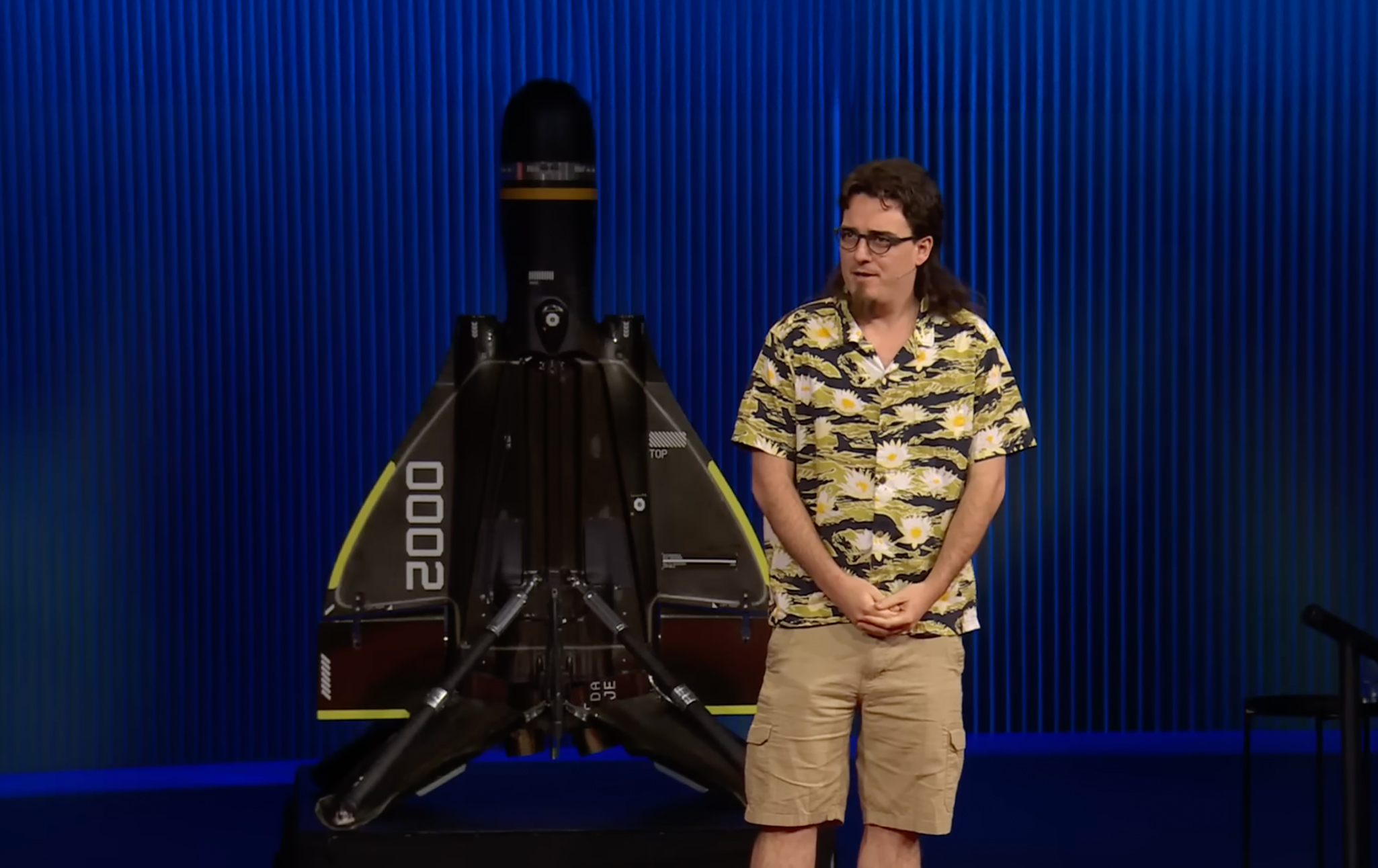
But if there is one oligarch who not only disgusts, but downright disturbs me, it is a man named Palmer Luckey, the 33-year-old founder and CTO of a weapons company called Anduril, who has been branded Silicon Valley’s “war king.” A video game fanatic and virtual reality tycoon, Luckey has made it clear that he views human beings as little more than targets on a screen. Over the last decade, his company has held more than 120 contracts with the federal government; in March 2026, these were rolled into one giant enterprise contract worth up to $20 billion.
Like Peter Thiel’s Palantir, Anduril’s name is a Lord of the Rings reference, this time to a sword. (J.R.R. Tolkien, a World War I veteran who deplored the casualness with which people plotted new wars, is surely revolving violently in his grave.) The company makes autonomous weapons, surveillance systems, and drones. It “aims to infuse artificial intelligence into U.S. weapons systems.” Luckey’s dream is to use “automated manufacturing to churn out weapons like Tesla cranks out cars,” and to turn America into “the world’s gun store.” Luckey is clear that this will mean making autonomous killer robots that decide who to kill. Last August, CBS News questioned Luckey about the fact that many see this technology as “evil,” including the UN Secretary General, who described it as “politically unacceptable and morally repugnant.” Luckey’s response was that he “usually doesn’t bother” making an argument in response to such people, but if he does, he says:
I’m like, “Okay, so do you think that NATO should be armed with squirt guns or—or slingshots? How ‘bout sternly worded letters? Would you like that? Would you like it if—if NATO just—they just have a bunch of guys sitting at typewriters, a thousand monkeys writing letters to Vladimir Putin begging him to not invade Ukraine?” Our entire society exists because of a credible backstop of violence threatened by the United States and our allies all over the world. And thank goodness for it.
Luckey has been clear that not only does he think the U.S. military should have more than “squirt guns and slingshots,” but that they should have the most terrifying destructive powers imaginable. Asked recently by Axios whether he has any “red lines” for the kind of weapons he makes, Luckey seemed to have never even considered the question:
AXIOS:
What won’t you build? What’s your red line?
LUCKEY:
What wouldn’t I build? That’s an interesting one.
AXIOS:
Nuclear weapons?
LUCKEY:
I would definitely build nuclear weapons. I would build fission weapons, I would build fusion weapons. I think that nuclear weapons have been one of the most stabilizing forces in history ever. It’s never been like that in history, where total war is off the table. So fission weapons, fusion weapons, absolutely, I would build them
Luckey did say that he “would not build biological weapons.” (I’m not sure I believe him, especially because he has ominously stated that “there are actually things I would like to build that the DoD would not use and would not deploy, that they do think are beyond the pale.”) But when asked about chemical weapons, Luckey said “chemical weapons I would build, but in a very specific vertical.” Pleading with the Axios interviewer not to just quote him saying “Yes, I would build chemical weapons,” Luckey gave an elaboration, arguing that it’s “a huge mistake” that the U.S. military isn’t allowed to use tear gas. (Indeed, tear gas is banned on battlefields by the Chemical Weapons Convention, although the convention astonishingly contains an exception for domestic law enforcement, meaning police are allowed to use chemical weapons.) Luckey then promised, less than reassuringly, that “there’s no real slippery slope between literally hot pepper juice to nerve agents that are going to kill you.” It remained unclear, at the end of his answer, which chemical weapons the so-called War King might ever refuse to build.
I suspect the truth is that there aren’t many, since once you’re willing to build any and all nuclear weapons, it’s hard to draw moral “red lines.” And Luckey has been emphatic that he is among those who are “enthused and excited about exacting violence on others” (for “good aims” of course), and that such “sick” people are socially necessary. As he explained to a crowded auditorium at Pepperdine University in 2024:
Some people are like “oh, but isn’t it terrible to celebrate the power of weapons?” and I say, you know what, societies have always needed a warrior class that is enthused and excited about enacting violence on others in pursuit of good aims. I think that it’s reasonable for philosophers to degrade those people and whine about how they’re sick in the head. But society needs them. Even if I’m sick in the head. We need people who are willing to fight for our country—and I’m not doing that directly, my life’s not on the line. But you need people like me who are sick in that way and don’t lose any sleep making tools of violence
(Luckey has been hostile when the press has quoted this passage, suggesting that they are omitting crucial context, so I have made sure to leave in the context. I don’t think it makes it any better.)

Again, I’m not quite sure I believe Luckey when he says he’s simply carrying out a socially necessary function. He admits that he also thinks weapons are cool, and people come to work for him in part because they enjoy working on cool weapons. Business Insider says he builds augmented reality headsets for the military that turn “warfighters into[…] ‘technomancers’ who slay [real-life] opponents while peering at a screen that looks straight out of ‘Call of Duty.’” Luckey began his career as a designer of video game equipment, and for a gamer who wants more of a rush, war is the ultimate thrill, because you’re playing with real lives. Luckey allegedly owns the world’s largest video game collection and is an enthusiastic Dungeons and Dragons player (his character is a “chaotic-neutral wizard named Nilrim V”). In childhood, his favorite manga character “was an anti-hero named Seto Kaiba who inherits a weapons empire and then ‘proceeds to kick everyone’s ass using this incredible technology.’” Now, he boasts, “I build cruise missiles, and I post on X.” Indeed, like fellow billionaire J.K. Rowling, he tends to get in more Twitter-reply arguments than you would expect of a person in his position.
He even once created a virtual reality headset that kills its user in real life if they lose the game they are playing—a bizarre, horrible device he described as a piece of “thought-provoking” “office art.” According to Luckey, “Pumped up graphics might make a game look more real, but only the threat of serious consequences can make a game feel real to you and every other person in the game.” So there you have it: someone’s brain exploding is little more than a “thought-provoking” consequence for losing a game. You’ll have to forgive me for thinking this man views real-life humans as little more than tiny, plastic figurines for him to creatively wipe off the map. After all, war is much like playing Risk for the people who get to wage it without incurring any personal danger.
Luckey presents the usual case that the more heavily armed the United States, the safer its citizens. In a TED talk last year, he said that he is all about preventing World War III, by “deterring” (an annoying word that means “threatening to murder”) others. The more we can be assured that any opponents of the U.S. suffer instant and agonizing death, the less likely they will do anything to challenge us. Luckey believes it is his duty to fight and win the arms race, and explicitly sees himself as preparing for a potential war against China, and soon. (According to MoneyWeek, “One of his teams has an in-house slogan: ‘China 27.’ It signifies that any products or features not ready for potential conflict in 2027 must be cast aside.)
Of course, a weapons manufacturer has a strong personal financial interest in claiming that the best way to assure a peaceful human future is to manufacture as many weapons as possible. If Palmer Luckey does not successfully convince others that we urgently need to spend billions developing autonomous killer robots, his company’s anticipated IPO will not be as lucrative. (The Iran war has been great for him.) Luckey, who once studied journalism, has also said that he no longer thinks with a journalist’s regard for truth: “Absolutely not, I’m a propagandist[…] I’ll twist the truth. I’ll put forward only my version if I think that that’s going to propagandize people to what I need them to believe.”
He also appears to have become a weapons maker in part because he was cast out of Silicon Valley’s mainstream, and wanted a kind of vengeance by turning to the dark side. Back in 2017, Mark Zuckerberg fired him from Meta, where Luckey worked on virtual reality, allegedly because Luckey donated to a pro-Trump group. Luckey has since hosted multiple fundraisers for Trump at which attendees paid up to $150,000 to attend, and donated over $15,000 to groups backing JD Vance in his Ohio Senate campaign. (As a venture capitalist, Vance invested in Anduril.) Weapons manufacturing and military work were still quite taboo in Silicon Valley, and “defense was a dirty word in tech,” as Business Insider puts it. At the time, “about 4,000 Google workers signed a letter asking the company to cancel Project Maven, an intelligence-gathering Pentagon program, and to get out of ‘the business of war.’” In contrast, Luckey seemed to almost relish the fact that by starting Anduril, in his words, “everyone was going to think I was evil.” He describes himself as “a crusader for vengeance” rather than a “crusader for truth.” Anduril co-founder Trae Stephens says Luckey has “a very innate sense of justice,” by which he does not mean that Luckey has a social conscience, but that “if he has been wronged by you, he has a long memory.” Luckey has suggested that as he pivoted from VR to weapons, he was also developing an “obsession” with “malice” after being “stabbed in the back”:
“[With Oculus] I was just trying to build toys that delighted people. There was no vengeance, there was no malice, there was no killer instinct involved. I think I didn’t develop that obsession or framing until I felt I was stabbed in the back by a lot of people who should have treated me better.”
Even though personal psychology seems more important than careful reasoning in explaining Luckey’s choice of profession, we should note the problems with his argument that “autonomous weapons ultimately promote peace by scaring adversaries away.” Luckey insists he’s helping us “stop World War III” rather than fighting it, using the same reasoning that justifies nuclear arsenals: when the consequences of war are too horrific to contemplate, there is a powerful incentive to avoid war.
There are two problems with the argument. The first is that it’s not at all clear an arms race will prevent a catastrophic war. Even if wars would be disastrous for all parties involved, they can still occur due to miscalculation or the perceived need to avoid dishonor by backing down. The catastrophe of World War I, which erupted over a small matter that should theoretically have been solvable diplomatically, and which ended up being immensely costly for all sides, shows that countries can blunder their way into war even if it would be a disaster. The U.S. and the Soviet Union were very close to an all-out nuclear war during the Cuban Missile Crisis, because neither side felt it could back down, and high-up figures in the Kennedy administration advocated courses of action that would certainly have led to nuclear war. That close call showed just how alarmingly plausible it is that a chain of events could occur that lead two superpowers to think they have no choice but to wage a nuclear war. And, as Andrew Bacevich, a former U.S. Army colonel, notes, investment in military power can make it more likely that military solutions to problems will be used: “Belief in the efficacy of military power almost inevitably breeds the temptation to put that power to work. ‘Peace through strength’ easily enough becomes ‘peace through war.’”

The second problem with Luckey’s argument is that it assumes that it is good for the U.S. to be able to impose its will on others. Luckey assumes that U.S. military power will be used defensively, and not for war crimes and aggression. But the history of U.S. foreign policy, from the napalming of Vietnamese villages to the recent missile attack on an Iranian elementary school, shows that U.S. weapons are not simply used to deter attacks by external aggressors. They are used to pursue what is called the “U.S. national interest,” and there is a long track record of U.S. military power being used in brutal, illegal, and outright horrifying ways. Of course, weapons developed for the U.S. will also likely be shared with Israel, a genocidal state that has used its military power to wipe out tens of thousands of Palestinians and enforce an apartheid regime that has been universally condemned by human rights groups. You will not be surprised to learn that Luckey describes himself as a “radical Zionist,” defending Israel’s right to a formal two-tiered system in which Jews are valued over non-Jews. Acknowledging that people call this “problematic” or “ethnostate adjacent” (or even, in the words of human rights groups, apartheid), Luckey’s response is blunt: “I don’t care.”
So one major problem with Luckey’s belief in giving the U.S. as much military strength as possible is that recent history indicates that power will not be used toward “good aims,” but to overthrow inconvenient governments. (We have already overthrown and kidnapped the Venezuelan head of state, and it looks like the president might invade Cuba before his term is up.) But perhaps Luckey believes companies should stop selling weapons to the U.S. government if it uses them for war crimes?
Nope. He believes that weapons manufacturers should not second-guess the president on policy, and he is staunchly critical of the AI corporation Anthropic for trying to restrict how the military used its products. Anthropic wanted a guarantee that its products would not be used for lethal autonomous weapons or for the mass surveillance of Americans. In response, the Department of War blacklisted Anthropic and lambasted them as a national security risk. Luckey is firmly on the side of the Trump administration in this dispute, saying that any attempt by a government contractor to add ethical guidelines to its work is an affront to democracy. (Luckey has also wrongly suggested that he cannot impose such restrictions on government use of his products.) This is because the president is elected, while corporate CEOs are not, therefore such restrictions amount to rule by corporations, and any company rules governing ethical use of products give “more power to corporate executives than the president of the United States.”
He asks: “Do you want to live in a corporatocracy where Big Tech CEOs decide foreign and military policy?” Personally, I think this is sophistry: we can draw a meaningful distinction between “rule” by corporations and the belief that corporations should have some ethical baselines for their work that they are not willing to violate just to improve their profits. I do not want to live in a corporatocracy, but neither do I want to live in a world where CEOs hold to the Friedman doctrine that the only social responsibility of business is to increase its profits.
But Luckey frequently pretends not to be able to make distinctions when it comes to evaluating ethics. For instance, on the question of whether companies should make offensive weapons without any human decision-maker in the loop, Luckey goes full Jordan Peterson: “What defines offensive? What defines no human in the loop? What defines weapon? What defines use?” Likewise, he rejects the idea that a weapons company should stop supplying weapons if they are used to target innocent civilians: “Well, what is targeting? Like is it inadvertent versus explicit? What is innocence? Is it determined by the courts? Is it determined by the Hague? Is it determined in Brussels? Is it determined by Dario [Amodei]? What is a civilian? And who decides? What if there are civilians mixed in with other things?” This is classic fallacious reasoning, assuming that because the lines between categories can often be fuzzy, we cannot make meaningful distinctions between the categories. The Geneva Conventions are quite real, many violations of them are obvious, and it’s not just the obligation of every corporate executive, but every person within any system, to refuse to participate in war crimes. Luckey pretends that it’s impossible to know what a war crime looks like in order to escape his basic moral responsibility as a human being.
Peter Thiel has called Anduril “the company that can save Western civilization.” Personally, I think it’s the single company most likely to hasten our doom. I cannot think of anything more dangerous than having people whose worldview was shaped almost entirely by video games being contracted by the U.S. government to design the deadliest weapons possible. The U.S. track record of gruesome violence is extreme—we are, after all, the only country to have dropped a nuclear bomb on a civilian population. Luckey shows none of the understanding of the horror of war that military veterans like Andrew Bacevich and J.R.R. Tolkien have had. I am sure he only ever imagines his weapons being used on Chinese people and Iranians, not his own wife and child. I fear the kind of world that such a morally frivolous gamer billionaire will drag us into, and if we are to have peace, men like this must not build our future.
Corrections: This article has been updated to reflect the fact that Luckey was fired in 2017, not 2018, and is the CTO and founder of Anduril, not the CEO, despite news organizations having mistaken his title, as well as adjusting the description of a contract reported to be worth "up to" rather than "over" $20 billion.


%20(crop).jpg?width=352&name=wile-e-coyote%20(resize)%20(crop).jpg)