
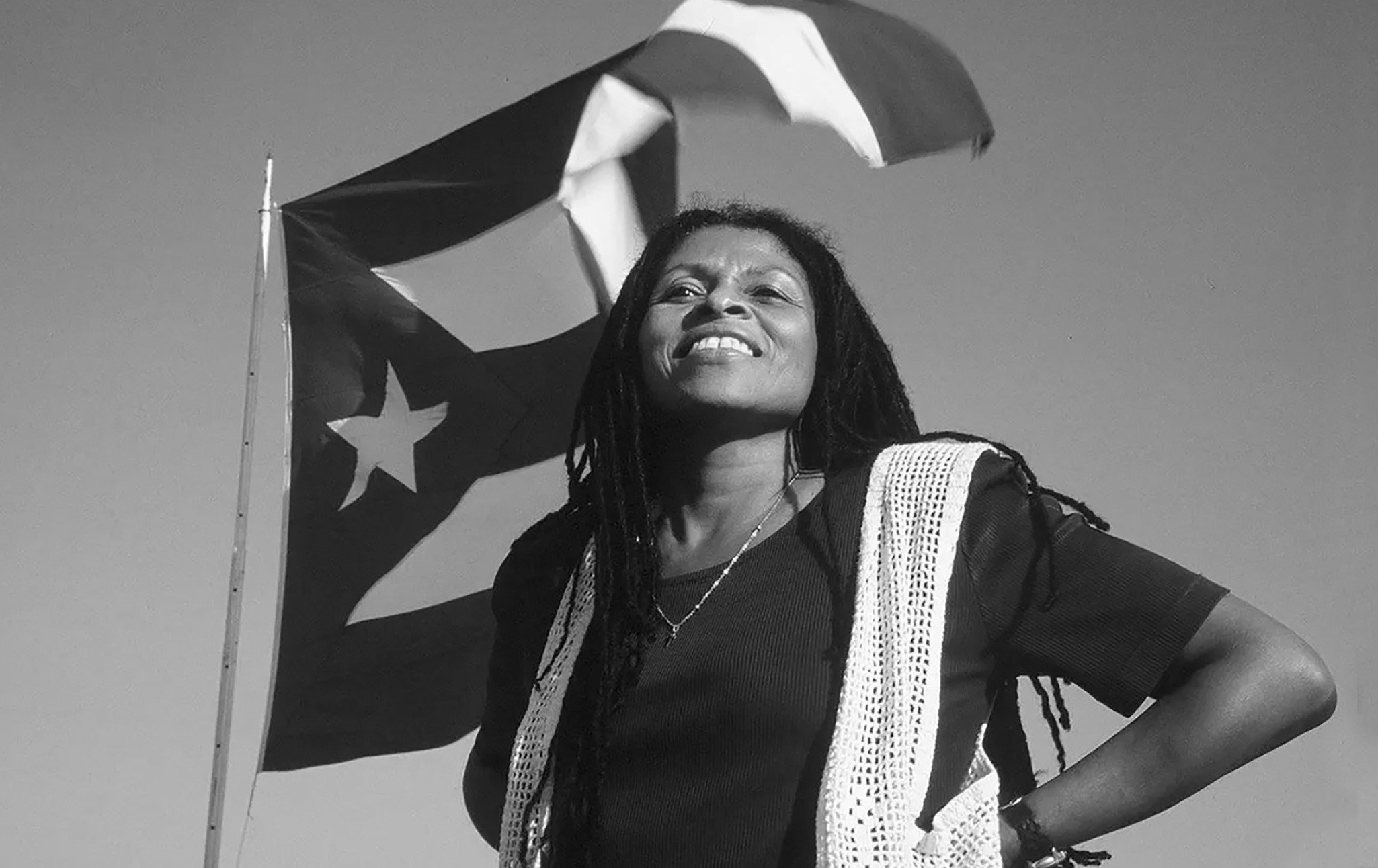
When we speak of Assata Shakur, her recent passing, and her legacy, we speak of someone who, at great cost, refused to let the state define who and what she was. To the state, she was a “terrorist,” and even in death, FBI director Kash Patel tells the public they shouldn’t mourn her. But to so many others, she was a beacon of revolutionary optimism. More importantly, she was a mother, poet, writer, and someone who endured political, racial, and carceral violence—and learned to strike back against it.
Assata Shakur, originally named JoAnne Debra Byron, was born on July 16, 1947, and was a legendary Black activist who worked and fought for both the Black Panther Party and the Black Liberation Army. Growing up and attending mostly white schools as desegregation started, Shakur often felt anti-Blackness and misogynoir from her fellow classmates and teachers—sometimes open, with teachers who singled out Black students for punishment and bullies who hurled slurs in her direction, sometimes “undercover, like their parents’ racism.” In her memoir, she recalls being taught to admire George Washington and Abraham Lincoln as heroes, only to discover that Washington “had once sold a slave for a keg of rum” and Lincoln “was of the opinion that black people should be forcibly deported to Africa or anywhere else.” All of this sat with her, and grew the seed of her questioning what she was being told, and the American education system itself. As she would later conclude:
The schools we go to are reflections of the society that created them. Nobody is going to give you the education you need to overthrow them. Nobody is going to teach you your true history, teach you your true heroes, if they know that that knowledge will help set you free.
During the mid-1960s, Shakur attended the Borough of Manhattan Community College (BMCC) and later the City College of New York. As a college student, she immersed herself in various political activities, civil rights protests, and the SNCC (Student Non Violent Coordinating Committee), the largest students’ organization for Black civil rights at the time. This is where she gained her interest in activism and political organizing.

In 1967, the NYPD arrested her and 100 other BMCC students, which resulted in her first criminal charge—for trespassing on her own campus. The students had chained and locked their entrance to a college building in protest of the inadequate representation of Black faculty, along with the absence of a Black studies program. Three years later, in 1970, the college would start just such a program. The pressure had worked.
Upon completing her studies at City College, Shakur relocated to Oakland, California, where she became a member of the Black Panther Party. In Oakland, she actively participated in organizing protests and community education initiatives alongside the BPP. When she returned to New York City, she assumed a leadership position in the BPP chapter in Harlem. There, she coordinated programs like the free breakfast program for children, along with free health clinics for people who couldn’t get medical care any other way. They were so effective that the state took notice. In fact, J. Edgar Hoover once described the free breakfast program as “potentially the greatest threat to efforts by authorities to neutralize the Black Panther Party.” Their problem-solving was met with state hostility from the top down: in Harlem, historians report that the police “started rumors the food was poisoned” in an attempt to shut the Panthers down.
Both the FBI and the Panthers understood that feeding communities and providing for them while they are in need leaves lasting impressions on the minds and spirits of those affected. While it is a common myth that the Black Panther Party were gun-toting, America-hating Black supremacists who spewed hate and division, they were really Marxists, anti-capitalists, and believed in the liberation of all peoples. As anti-capitalists, they believed food, medication, and housing were human rights and bridged the gap to that reality through programs like free clinics and the free breakfast program. The reach and success of the Black Panther Party’s free breakfast program highlighted the organizing abilities of common people, as well as highlighting the inadequacies of bureaucracy. It is, after all, hard to say you cannot feed people because of red tape when community members find a way to do so without permission. The same fear and trepidation is paralleled in Donald Trump’s America, where millions of Americans face the loss of their SNAP and WIC benefits, and mutual aid and community support are just as important today as they were in the 1960s.
Activism can create long-lasting community. Assata Shakur was the godmother of the renowned rapper Tupac Shakur, having formed a close friendship with Tupac’s mother, Afeni, during their time in the party. However, frustrated with machismo attitudes and lack of a focus on Black history, she left the BPP, writing that “A revolutionary woman can’t have no reactionary man.”
Shakur joined the Black Liberation Army, an organization inspired by the tactics of the Vietnamese and Algerian independence fighters, in 1971. After joining the BLA, she adopted the name Assata Shakur, no longer identifying with JoAnne Byron. She felt completely detached from her birth name, once stating: “It sounded so strange when people called me JoAnne. It really had nothing to do with me. I didn’t feel like no JoAnne, or no Negro, or no amerikan. I felt like an African woman.” This was during the climate of other prominent Black voices rejecting their “slave” names and embracing identities and titles they got to choose themselves, like Malcolm Little to Malcolm X, Cassius Clay to Muhammad Ali, or Stokely Carmichael to Kwame Ture. Fittingly, “Assata” means “one who struggles.”
Shakur gained notoriety in 1973 when she was allegedly involved in a shoot-out on the New Jersey Turnpike. The tumultuous event resulted in the death of a state trooper (Werner Foerster) and injuries to another trooper and herself. Subsequently convicted in a highly controversial trial, police sources identified her as the de facto leader of the BLA. She insisted that she was targeted by COINTELPRO, the ruthless FBI program that had earlier been implicated in the assassination of Black Panther Fred Hampton, for her involvement in Black Liberation organizations. Since the incident, she always maintained her innocence. It is important to mention that Foerster’s partner had admitted “that he lied in a police report when he said Shakur opened fire on Foerster.” Like with the death of Michael Brown in 2014, “forensic evidence showed that Shakur had her arms raised when she was shot.”
During her trial, she stated her case simply and convincingly:
They call us murderers, but we did not murder Martin Luther King, Jr., Emmett Till, Medgar Evers, Malcolm X, George Jackson, Nat Turner, James Chaney, and countless others. We did not murder, by shooting in the back, sixteen-year-old Rita Lloyd, eleven-year-old Rickie Bodden, or ten-year-old Clifford Glover. They call us murderers, but we do not control or enforce a system of racism and oppression that systematically murders Black and Third World people.

During her time in prison, Assata faced extreme carceral violence. Her attorney, Lennox Hines, emphasized the deplorable conditions of her imprisonment, including invasive genital and rectal cavity searches. He argued that Shakur’s treatment was unprecedented in New Jersey’s history, emphasizing her continuous confinement in a men’s prison under 24-hour surveillance. Behind bars, she connected her experience directly to capitalism and the pursuit of profit:
“Don’t you know that slavery was outlawed?”
“No,” the guard said, “you’re wrong. Slavery was outlawed with the exception of prisons. Slavery is legal in prisons.”
I looked it up and sure enough, she was right. The Thirteenth Amendment to the Constitution says: “Neither slavery nor involuntary servitude, except as a punishment for crime whereof the party shall have been duly convicted, shall exist within the United States, or any place subject to their jurisdiction.”
Well, that explained a lot of things. That explained why jails and prisons all over the country are filled to the brim with Black and Third World people, why so many Black people can’t find a job on the streets and are forced to survive the best way they know how. Once you’re in prison, there are plenty of jobs, and, if you don’t want to work, they beat you up and throw you in a hole. If every state had to pay workers to do the jobs prisoners are forced to do, the salaries would amount to billions… Prisons are a profitable business. They are a way of legally perpetuating slavery. In every state more and more prisons are being built and even more are on the drawing board. Who are they for? They certainly aren’t planning to put white people in them. Prisons are part of this government’s genocidal war against Black and Third World people.
Assata was recognized as a political prisoner by Angela Davis and community supporters. In October 1973, an international panel of jurists invited by Lennox Hines reported to the United Nations Commission on Human Rights that Shakur’s solitary confinement conditions were “totally unbefitting of any prisoner.” Their investigation focused on alleged human rights abuses, citing her as a victim of FBI misconduct through COINTELPRO strategies.
In early 1979, members of the BLA planned and successfully managed Assata’s escape. The details are harrowing and can only be fully understood by reading her firsthand accounts in her biography. Even afterward, she maintained her innocence, insisting that she’d been the victim of a deeply corrupt system:
Neither Sundiata Acoli nor I ever received a fair trial. We were both convicted in the news media way before our trials. No news media was ever permitted to interview us, although the New Jersey police and the FBI fed stories to the press on a daily basis. In 1977, I was convicted by an all-white jury and sentenced to life plus 33 years in prison. In 1979, fearing that I would be murdered in prison, and knowing that I would never receive any justice, I was liberated from prison, aided by committed comrades who understood the depths of the injustices in my case, and who were also extremely fearful for my life.
The movements and activities of her friends and relatives were monitored by investigators in an attempt to re-arrest her. So she sought political asylum in Cuba, where she resided since the 1980s until her recent passing. (Cuba, too, has great historical importance as a safe haven for U.S. political refugees, as well as a long and storied history of solidarity with Black liberation movements globally, like in Angola and South Africa.)
Assata: An Autobiography, written in Cuba and published in 1987, is essential reading. It provides an insight into her life, activism, and the events surrounding her imprisonment and escape. Her story contributes to discussions on abolition, the experiences of systemic racism, and police brutality, all of which are live political issues today. If you choose to listen to Assata, then you understand that “Black Americans are 7.5x more likely to be wrongfully convicted of violent offenses.” Assata Shakur dedicated her life to challenging these injustices and advocating for the rights of Black Americans. As a Black woman, her experiences highlighted the connection between racial and gender-based oppressions. “Black and American Indian or Alaska Native women are consistently overrepresented in state and federal prisons,” she reminds us. And that kind of repression naturally creates resistance:
Black revolutionaries do not drop from the moon. We are created by our conditions. Shaped by our oppression. We are being manufactured in droves in the ghetto streets, places like attica, san quentin, bedford hills, leavenworth, and sing sing. They are turning out thousands of us.
Shakur’s life sheds light on the complexity of identity, activism, and resistance. Despite facing legal challenges and imprisonment, Assata remained steadfast in her decisions and beliefs for liberation for all people, insisting that “oppressed people have the right to free themselves by whatever means they deem possible.”
Assata died free, which is a beautiful thing. We should continue to celebrate and honor that reality—but what did freedom cost her? Her life, everything she ever knew, her family, her reputation. It is easy to paint Assata as an extraordinary woman, which she was. Easy to paint her as a powerful force—which she had the capability of being. But she was a human being. She was someone who did suffer. She was a victim, too. In a world where Black suffering is seen as a normality, the reason why people cheer for Assata is because despite those odds she did not die in prison. However, to not acknowledge that exile is in itself a prison, would be to discredit all that she withstood.
Assata’s enduring legacy is a powerful call to action, because freedom is never simply granted—it must be fought for and earned, often at great personal cost. Her recent passing forces us to confront our own complacency and inaction. If you are reading this, you are likely someone who cares deeply about justice, who protests, donates, boycotts, and stays engaged. But Assata’s example compels us to do even more. There are always new bridges to build, bolder actions to take, and stronger communities to cultivate in this relentless struggle. Her life challenges us not just to admire her courage, but to embody it everyday.
We must confront a vital question: How much are we truly willing to risk and sacrifice for our collective freedom? Are we prepared to give up our comfort, our perceived safety, our silence? In today’s world, raising our voices is not the main goal—not in the face of the Trump administration, Project 2025, or the mounting crises that threaten justice everywhere. Not while genocides devastate Gaza, Sudan, and Congo, or while the working class is exploited both at home and abroad. Freedom is not a passive entitlement—it is built and protected only through courageous, persistent action. If we truly honor Assata, we must not only speak out but act. Assata’s enemies are still around; the forces she had to fight for are still present today. They may wear different labels, but the desire to dominate makes them obvious.
Because when your neighbors are arrested by ICE, it is as if you are being arrested by ICE. The National Guard coming to a city in a different state means they will be in your state next. Trans people being targeted and called violent extremists means you can and will be called a violent extremist. Black people being murdered by police with no justice means you can be murdered by police with no justice. Assata being forced into exile means you can be forced into exile. We have to believe that we are all equal and that if one of us faces injustice and fascism, we are all facing it… because we are all facing it.
This realization is not nihilistic but sobering. What does Assata’s sacrifice demand of us in a world where freedom is still incomplete? Do we throw each other under the bus and capitulate to the right in the attempt to claim so-called power? Or do we collectively find power for all of us? Assata Shakur’s life shows us that to see freedom for one is to see freedom for all.

No one can stop the rain. Things may look dire now, and they did for Assata, many times in her life. But she kept going. There was no other choice. “You died. I cried. And kept on getting up. A little slower. And a lot more deadly.”
In this moment, I think it is important to see that freedom or liberation is an action word, and an active choice. We have to choose our liberation, despite the odds, despite failing, or despite the pain. The Black Panther Party and their political collaborators have suffered immensely in this fight. The passing of Assata highlights the many activists who were murdered by police or are still political prisoners.
Despite this devastating reality, we must continue to fight. We must utilize the tools and skills we have acquired from the activists before us who made radical strides towards our liberation, at great costs. As Fred Hampton once said, you can jail a revolutionary, but you cannot jail the revolution. The idea is already like wildfire. To know a world where people celebrate Assata, despite the rise in fascism, shows me one thing: that they cannot control the narrative completely.
In her poetry, written in exile from Havana, she said it best. “You can spy on the grass. You can lock up the grass. You can mow it down, temporarily. But you will never keep it from growing.” No one can stop the rain. Not even the fascists can.
Destiny Washington (she/they), AKA Lucretia McEvil, is a multi-disciplinary artist and activist from Brooklyn, NY, currently in Harlem. Their artistic practice intentionally bridges the worlds of subculture, art, and activism. Find their work on YouTube, Instagram, and at McEvil.art .


.png?width=352&name=Screenshot%202026-09-04%20at%204.00.52%20PM%20(1).png)
%20(1).jpg?width=352&name=miasma-1%20(1)%20(1).jpg)