The author discusses the limits of liberal solidarity, and why human rights cannot depend on being likable.
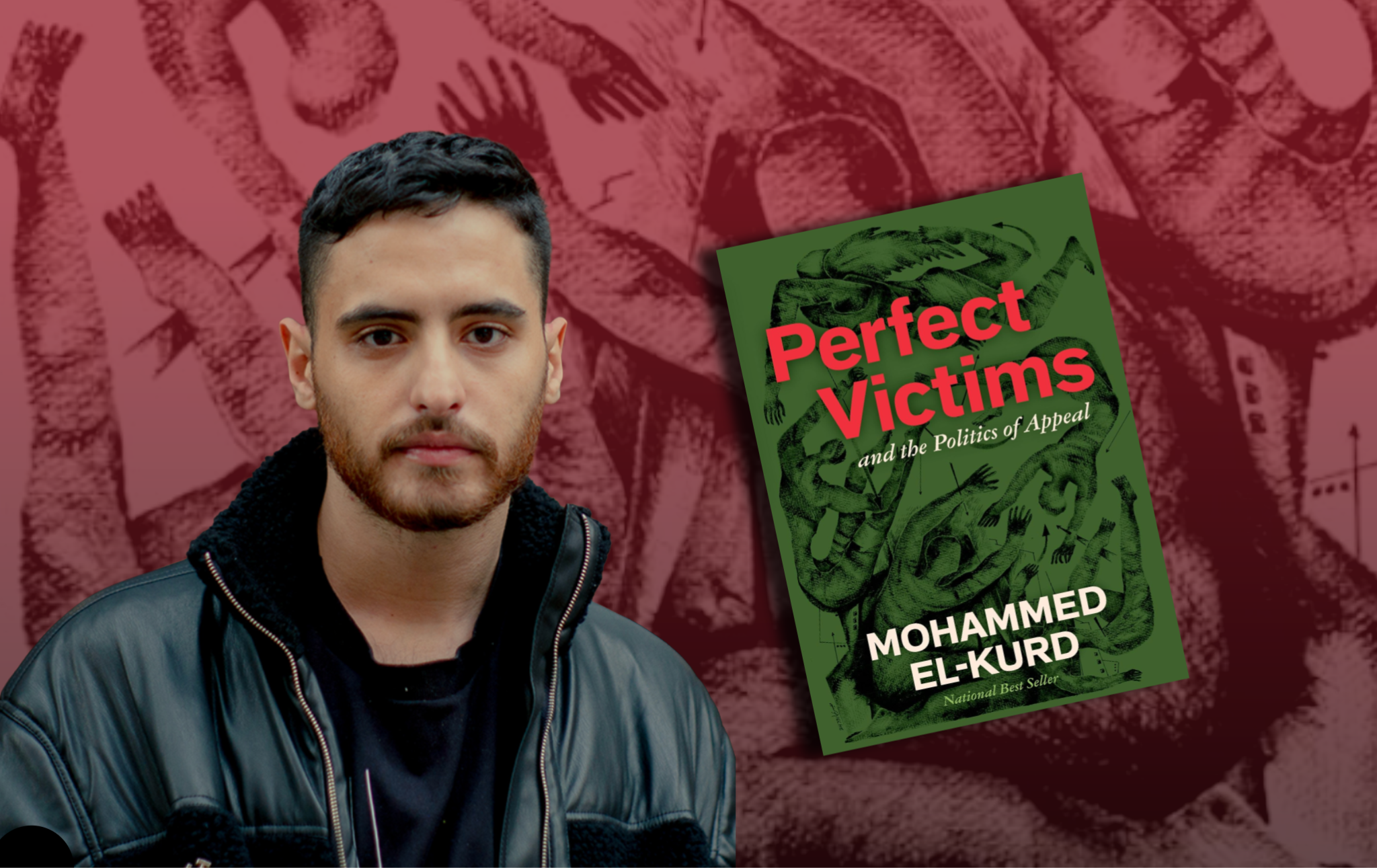
Mohammed el-Kurd is a Palestinian poet, author, and journalist from Sheikh Jarrah in occupied East Jerusalem. At 11 years old, his family home was taken over by armed Israeli settlers—and since emigrating to the U.S. to attend college, he has spent significant time explaining to Westerners what life is like under occupation. El-Kurd’s new book, Perfect Victims and the Politics of Appeal, takes aim at a deeply ingrained feature of Western discourse: the expectation that Palestinians must prove themselves innocent, sympathetic, and sufficiently “human” before their oppression can be condemned.
In his conversation with Current Affairs, el-Kurd discusses the language we use to describe resistance, the dehumanizing distinction between “innocent civilians” and deemed legitimate targets, and how even well-meaning allies can reproduce the assumptions of the people they oppose.
Watch the video version here:
Nathan J. Robinson
A great deal of your work, Mohammed, focuses on all the ways in which even those who are sympathetic to, or consider themselves in the West sympathetic to, the Palestinian cause—even some Palestinians themselves—talk about Palestinians in ways that mislead us about the conflict and dehumanize people. What you do in this book, and what you did in this great Nation piece, is about all the stupid questions that you have to answer as a Palestinian. And you deconstruct many buried assumptions that people have that frustrate you. In the book you talk, for example, about legality and this constant talk about the legality of what Israel does.
So where do you start to talk to someone who you feel like is a sympathetic person, or a person who means well, to deconstruct all the kinds of totally problematic and wrong assumptions that they have about how we should talk about Palestine?
Mohammed el-Kurd
I think the book was born out of this realization that really, the Palestinian cause is not about acquiring a Rolodex of facts and statistics through which you could fight your enemy. It’s more about a narrative war, and a narrative war that is not based on just UN resolutions and history and whatever. It’s also based on power dynamics and power relations. It’s the understanding that having the right sentiment is not enough to create change in the world, and it’s more about tackling the Zionist project in such a way that undermines it and undermines the general status quo in the case of the Palestinians.
And in the case of the people who are sympathetic to Palestinians, the general liberal status quo seeks to infantilize the Palestinians by way of being in solidarity with them, and I found that to be super problematic. And also the general reason why I wrote the book was very much that I saw there was such an absence of books that speak directly to people who are already sympathetic to the cause, people who already have the right opinion, and challenge them to deepen their understanding a little bit further. That was really the genesis of Perfect Victims.
Robinson
I think people who read your book will find themselves noticing things that they didn’t notice before. You point out a lot of things that are, as I say, kind of unconscious in the way that people try to present the case for Palestinians, like the emphasis on women and children or the emphasis on harm to civilians. You point out that when we do that, we suggest, for instance, that Palestinian men or people who take up arms to resist a colonial occupation—we kind of implicitly accept the presumption that they are unworthy of life.
And so if Israel happens to be killing unarmed people, happens to be killing women and children, well, that would constitute an atrocity, but if they are sticking to “men of military age” or armed men, they would have the right to do that. But hang on a minute—this is a colonial occupation where there is a right to armed resistance, and you point out all sorts of things that even people who are trying to make an argument for the Palestinians in their minds end up doing things that dehumanize or devalue Palestinian men or the right to resistance.
el-Kurd
Yes, 100 percent. In creating this binary that only women and children should be protected and men are condemned to death, you’re reinforcing this notion, not only that men deserve to die but also the idea that women and children are bystanders in the struggle for their liberation. As if they’re just watching idly with so much dismay as these Palestinian fighters wreak havoc on their communities.
The fact of the matter is, women and children have been both part and parcel of the Palestinian struggle for decades. Palestinian women have led the first Intifada, and also these are their children, these are their sons, and these are their husbands who are in the resistance. In the same way, I think it’s unbelievable and uncanny when we expect Palestinian journalists or Palestinian medics to retain a certain air of “professionalism” when they are reporting on their family members being murdered or when they are tending to the wounds of their wives and daughters and whatnot. And I wanted to dismantle this binary, and I wanted to challenge the reader to really offer their 100 percent solidarity to the Palestinian people as a cause without qualifiers, because the Palestinian cause should be supported because it is a righteous cause, because we are anti-racists and anti-colonialists. Not because we are good people or perfect victims.
All of these things are, to me, non sequiturs. They’re completely irrelevant to the focal point being genocide. I think we fall into the trap of putting the Palestinian in the arena of the accused, and we ask the Palestinian to prove their innocence before we can stand in solidarity with them, and that’s really a profoundly racist impulse, even if it’s unintentional.

Robinson
In your Nation piece on stupid questions you have to answer, you talk about the accusation against Palestinians, which says, “Well, you want to throw the Israelis into the sea,” and you point out that the instinct many people have is to say, “No, of course, I don’t want to throw the Israelis into the sea.”
But what you say is, “Well, if someone who is under a colonial occupation fantasizes about throwing the colonizer into the sea, that’s a legitimate fantasy for them to have.” We’ve responded to this in the wrong way, which is to say, hang on a minute—and your whole book is about this—why do we have to be these perfect victims? If a Palestinian feels anger in the middle of a genocide, why is that illegitimate?
el-Kurd
It’s really totally absurd. Politics aside, the assumption that you are going to meet the people whose boot has rested on your neck for the past seven decades with a certain hospitality and kindness is an absurd assumption. People are constantly talking about Iran and are saying, “The Iranian people are chanting ‘Death to America.’” Well, the Iranian people are under sanctions by the United States. Do they expect the Iranian people to go on the streets and chant, “Long live America”? It’s absurd. It’s not only that we are brutalized by these people, but we’re not even allowed natural human reactions to their brutality, and that’s the part I find extremely offensive. Not only do you want to kill me, but I cannot protest your killing. And so I think a better approach is, instead of correcting those diatribes and those baseless accusations against us, if they want to say, “Palestinians want to throw us into the sea,” I would say, “Yes, you should learn how to swim then.” I think that dismantles the whole rhetoric.
Robinson
You point out that even you yourself have felt this kind of pressure to prove the humanity of Palestinians. You write in the book about how when you wrote about your own grandmother, you were told that you had to humanize her—and so you had this instinct to kind of soften any anger or take out any problematic statements. And of course, the irony is that in doing so you actually erase people’s humanity and their complexity.
el-Kurd
Yes, you’re 100 percent creating automatons. You’re saying these are robots. You’re saying the Palestinian people will turn the other cheek, will smile in the face of calamity, and will accept whatever fate is bestowed upon them. You hear people—particularly, I think, Jewish Americans who go to the West Bank—say, “Well, I spent a day in the West Bank, and they fed me, and they were so decent with me, and they didn’t want to kill me, and blah blah blah.” I think it’s nice because these journalists are trying to convey to their frankly racist audience that Palestinians are not monsters. But even within that nicety, there still lingers an air of racial bias, of Islamophobia, and the expectation that Palestinians and Muslims and Arabs are these violent people and that you need to be coddled when talking about them.
But even beyond that, I want to go a step further and say even if Palestinians were vitriolic, and even if Palestinians were hateful, and even if my grandmother was so full of antisemitism, that does not excuse Jewish settlers taking away her home. That’s beyond the point. It’s totally beyond the point what Black people feel towards their white oppressors—what Palestinians feel there towards their Jewish oppressors—because the point here is material, policy-backed institutionalized racism. We’re talking about genocide and colonialism. We’re not talking about sentiment and rhetorical bigotry.
Robinson
I notice you said the word “settlers” there, but in your book you actually critique the use of this word. We all kind of fall into this trap of using the kind of pre-approved language here, and it’s hard to break out of the propaganda. And what you do rather nicely in the book is at least draw our attention to how we are using language and subtly conditioning how we’re thinking about the conflict. Because obviously, as you write in the book, the settlers are homicidal burglars. These are thieves. Just the word implies the concept that they want to imply, which is the barren territory being settled. But this is just theft.
el-Kurd
One hundred percent. And I also think the language disparity plays a role in it. You grow up learning the English words and their translation in Arabic. But as you grow older, you realize actually the translations are not necessarily literal. So for an Israeli military barrier in English, I would say “checkpoint.” But the word for it in Arabic would be “obstacle” or “barrier.” And so in your mind you’re imbuing a certain refusal. You’re saying to the young child who’s learning the language that these are occupiers, that this is not a place for them here. Whereas in English, this totally gets lost in transition.
And this is why I think it’s so important that we pay attention to language and to these linguistic tricks that the Israelis use time and time again that force us to be on the defensive and to kind of explain ourselves and prove our innocence. And I think they have been extremely smart about this. If you look at the name of the military, it’s called Israeli Defense Forces, which implies defense. Their military operations have been protective shield. I can’t remember other things, but there’s always something about being defensive. Always something about taking the second action, the reaction, and not being the hostile perpetrator.
And I think that has been by design, and they’re very good about it. And I think that’s why it’s important for us not to say “Israeli Defense Forces” but to say “Israeli Occupation Forces” and so on.
Robinson
As I wanted to emphasize, even people in the West who see themselves as understanding the reality of Israel’s apartheid and genocide—I think of how Ro Khanna, the congressman from California, recently went on a trip to the West Bank, and he came away horrified, as you do. But then he sat down with Drop Site News’ Jeremy Scahill, who tried to point out that the way he talked, he would affirm that Israelis had a right to defend themselves with violence, even though when they are defending themselves with violence, they are defending a colonial occupation. But he could not bring himself to affirm that Palestinians have a right to use violence in self-defense.
Palestinians are expected to be 100 percent peaceful, and Israelis are given the right to use violence so long as it is in self-defense. But of course, Palestinians have a right to use violence. In fact, they have a superior right because they’re under a colonial occupation.
el-Kurd
Yes, that interview was really both crazy to witness because it was inherently—a lot of the time these people who are doing this kind of propaganda have a coherent internal logic, but even he could not have that. The logic completely fell on its face. But I think it was also really revealing and a very useful pedagogical tool for people watching to see the kind of nonsense that rests at the helm of Zionist logic.
Robinson
There are other examples that you use in the book of the way that victims are subtly betrayed by their supposed allies—people who think of themselves as trying to advance justice in Palestine but emphasizing when Israel kills a U.S. citizen, as if it’s worse to kill someone with an American passport. Or you write about the book I Shall Not Hate by a man whose daughters were killed in the Gaza Strip in 2009. And you point out that the publisher’s description says the father is a Harvard-trained physician who’s devoted his life to medicine and reconciliation between Israelis and Palestinians, treating patients on both sides of the line, and that he’s a humanitarian who sees education for women as the way forward in the Middle East.
So don’t worry! Don’t worry. He’s not an angry Palestinian, and he went to Harvard too! My God, if he went to Harvard, how can you not sympathize with him?
el-Kurd
I think the hardest part of writing the book was conveying or synthesizing how that is so offensive, why those kinds of examples that I’ve used in the book are so incredibly dehumanizing and offensive. Because to me it’s quite implied that it is incredibly racist and offensive. But I think conveying it to people that this is so beyond the pale that you have to prove that this guy who’s lost all of his family to Zionist terror has to be Harvard-trained and has to have a heart of gold and has to have volunteered his time tending to the Israeli wounded for him to secure your sympathy is so dehumanizing.
But this remains to this day. It remains a feature of the public debate about Palestinians, and we’re seeing one piece of knowledge production after the other where this kind of rhetoric is centered. I think it’s really disappointing and, to be honest, embarrassing that after three years of literal nonstop genocide, we are still resorting to linguistic and rhetorical tactics that have done nothing for us beyond disrespecting us.
Robinson
Well, you dedicate the book partially to Dr. Refaat Alareer, the poet and academic in Gaza who was killed along with many of his family members by Israel. As I was reading the book, I was thinking about how there are two ways you could talk about him. You could talk about him in the “politics of appeal” way, where you could emphasize that he loved English poetry, and Israel killed someone who was actually an admirer of Western culture. And you could give a biography of Dr. Alareer that emphasized him as this academic. He said, “The only weapon I have is an Expo marker,” and you could create sympathy by pointing out how they killed a great intellectual.
And that would be true, because they did kill a great intellectual. They did kill someone who wrote his dissertation on English poetry. But he was also a man who was angry and unapologetically angry. And if you erase that side of him, I feel like you would be doing exactly what you caution us not to do in this book.
el-Kurd
Yes. He was incredibly a flippant man, as well as being all the great things he was. I remember when there was an absolutely ridiculous story circulating that Palestinian resistance fighters had baked Israeli infants in the oven; he had responded and said, “With or without baking powder?” And that kind of joke would not land you in the perfect victims museum.
Robinson
Which, by the way, was totally false.
el-Kurd
One hundred percent false.
Robinson
And he was pointing out how ludicrous and racist this idea was.
el-Kurd
Yes, he was just using humor to highlight a certain racism or a certain kind of absurd myth-making. But I think that’s what was so wonderful about him. There are lots of disadvantages to the fact that no Western media has been able to enter Gaza, but I think one of the advantages is that we’ve been introduced to a new cohort of citizen journalists and professional journalists from Gaza who would have been otherwise censored and suppressed if they were just reduced to being just fixers to international correspondents.
Robinson
Let me ask you then, let us assume that we are largely speaking to an audience of people who have no illusions that what has happened in Gaza is a genocide, who want to see the end of the occupation, who want to see justice in Palestine, but who still find themselves prisoners of these kinds of discursive and ideological assumptions.
What most frustrates you about the way that your purported allies talk about Palestine, and what do you wish we would pay attention to and purge from the way we talk?
el-Kurd
I think ultimately the issue really falls on a lack of humility. I know that sounds a bit counterintuitive to say, but there are certain correspondents and pundits that I see speak with so much certainty. I see men and women whose vocabulary really lacks words like “perhaps,” and “I think,” and “I don’t know,” and “maybe,” and “possibly.” Men who talk with so much certainty about things they know very little about, and their voices take up so much space. And I’m not saying this from an identitarian point of view, by the way. I’m not saying that the only voices one should listen to are Palestinian voices, and I do acknowledge that certain Palestinian voices can be atrocious and ignorant, but I think there needs to be a certain ethic to the way you talk about this cause, and that ethic should involve being in touch with the streets, on the ground, and being aware of the power dynamics and of your own material involvement in the occupation and your own benefiting from the occupation.
I don’t want to mention names, but if the likes of these people that I’m thinking about just stopped for a second and thought, “I have been so wrong consistently about so many things. What makes me think I’m right this time?” I think that would spare us a lot of the absolute bullshit that we see all the time.
Robinson
Finally, I mentioned that you in part dedicated the book to the memory of Dr. Refaat Alareer, but you also dedicated it to Omar, and I wonder if you could tell us his story.
el-Kurd
Thank you for asking. My friend Omar al-Khatib is a now liberated Palestinian political prisoner who was captured on his way back—I think he was coming to Palestine back from Kenya, doing some kind of program there. He was captured on the way back, and he was held in Israeli prison for one year and four months without charge or trial under what they call “administrative detention.” Basically, the Israeli security, the Shin Bet, can just say that they have indicting evidence but cannot show it to you. “We can’t show it to your lawyer. We can’t even show it to the judge because it’s a matter of national security. However, we need to hold you.”
And he was held alongside thousands of Palestinians who were held without trial, and he lived for a year and some months under extreme conditions. Everybody in the prison where he was at had scabies, for example, because they’d been deprived of food and their ability to shower. He’s shed half of his weight. I think when he came out, we heard a lot about a prison system that is so sadistic that it operates entirely outside the law.
There was a news story a couple of weeks ago about Israeli security minister Itamar Ben-Gvir saying that he wants to encircle the prisons with crocodiles, and then that effort was killed. But those things, as sadistic and as cartoonish as they sound, really do not scratch the surface of the kind of violence and brutality that Palestinian prisoners endure. But I want to highlight the fact that Palestinian prisoners have such a culture of pride that it has been such a hassle and such a torture for journalists like myself to try to extract stories of abuse from Palestinian prisoners because Palestinian prisoners do not want to say the kind of horrors they have endured.
They do not want to say the kind of torture they had to live through because to them it’s like “I’ve cracked” or “I showed weakness” or whatever. And so the very few stories that you hear about sexual harassment and sexual abuse and rape and extreme torture that come out of Israeli jails are only the tip of the iceberg. It’s insane.

Robinson
After reading your book, I did think one of the things that we need to do when we talk about Gaza is to stop talking like the people who are in Hamas are not also people. Because there is a real strong instinct in Western discourse about Palestine to accept the premise that if someone is Hamas, they could be killed. But also to understand why people are part of resistance in Gaza, why people would take up arms, and to not to try and constantly be doing this thing where only women and children matter.
And just to conclude here, every single Palestinian, without exception, is a human being, and every single person on this earth deserves to not be colonized and occupied and placed under a racist apartheid regime, and that’s a pretty categorical thing. What I get out of it is that it is an absolute. That doesn’t depend on who you are.
el-Kurd
I think you’re absolutely right, and we’ve seen beacons of liberal media fall into—not even fall into this trap, but kind of be architects of this trap. We’ve seen the likes of Christiane Amanpour ask Yuval Harari, “Do you believe that everybody deserves human rights?” And then she corrects herself very hastily, and she says, “Well, not Hamas. I don’t mean Hamas.” And it’s as if the members of Hamas or the sympathizers of Hamas fall outside the Universal Declaration of Human Rights.
But really, if you keep following along this path, if you try to tread along with this logic, you will recognize at some point that the goalpost will continue to shift because ultimately, the issue that they have with us is not about how we exist or how we resist. The issue is that we exist at all. There is no such thing you can do to assuage the accusations of your opponent and of your enemy. And I think we waste our time trying to paint ourselves in a more flattering light when we know that even if we were to sew the wings of angels on our backs, we would still be condemned as demons.
Robinson
I do recommend that all of our listeners and readers pick up Perfect Victims and The Politics of Appeal, as well as read your essay on idiotic questions in The Nation. Your book is so mind-expanding for many people who I think probably haven’t critically interrogated the ways that they talk. You will find yourself, I think, after reading this book, thinking more deeply about the way you express yourself and the way you think about this conflict. Robin D.G. Kelly calls this book a version of the classic discourse on colonialism for the 21st century, and I really think it is. So, Mohammed el-Kurd. Thank you so much for joining us on Current Affairs today to explain some of this.
el-Kurd
Thank you so much for having me. It’s been an absolute pleasure.

%20(crop).jpg?width=352&name=wile-e-coyote%20(resize)%20(crop).jpg)