Now 100 years old, the legendary comedy director has lampooned and skewered racists, and his work holds up better than most “politically incorrect” humor.
One of the great canards of the culture wars is that you couldn’t make Blazing Saddles today. It’s a half-truth that disguises a bigger lie. There are a thousand and one reasons why it would be hard—though, as Django Unchained proved, not impossible—to get a movie like Blazing Saddles made in contemporary Hollywood, from the declining public knowledge of the Western genre conventions it parodies to the general demise of big, mainstream comedy movies from the major studios. But the idea that you couldn’t make Blazing Saddles today is not about any of that. It is, more than anything, about the prodigious number of N-words the film jams into 93 minutes. “You couldn’t make Blazing Saddles today” is the rallying cry of people who think politically correct cancel culture is a major force in American society even as the U.S. slides deeper and deeper into Christian-nationalist fascism. The irony, of course, is that were Blazing Saddles to be erased from memory Yesterday-style and then unleashed on the world afresh tomorrow, Elon Musk would spend more time crying about it on X The Everything App than he has about Christopher Nolan’s The Odyssey having Black people in it.
There are many features that set Mel Brooks’s films apart from other parodic and gleefully transgressive joke-a-minute comedies. Amongst the zaniness, there is a literariness that makes him more than a gag writer; there is a deep cinephilia that makes his genre parodies rich in detail so lacking from Scary Movie et al. (Young Frankenstein captures the look, sound and feel of 1931’s Frankenstein to freakish precision. Ditto High Anxiety for Hitchcock and Silent Movie for the silent era.) There is his emphasis on Jewish identity, both his own and his characters’, which he has always cited as key in the development of his comedy. Born in a Brooklyn tenement a century ago, his father died of tuberculosis when he was just two years old, and as he grew into a small, sickly boy, he used humor as a defense against his bullies. When he served in the Army during World War II—as a combat engineer, among other roles—he once heard Germans singing over the other side of the river, and responded by singing “Toot, Toot, Tootsie (Goo’ Bye!)” into a bullhorn.
Humor, for Brooks, has always been a kind of weapon. “The angrier he is, the funnier he is,” his improv partner and best pal Carl Reiner said. “He will say things you can’t believe, but you realize it’s the absolute truth.”

After working in television—notably as a writer for Your Show of Shows, where he met Reiner—Brooks made his film debut writing and directing The Producers in 1967. Zero Mostel plays Max Bialystock, a failing Broadway producer who seduces wealthy old ladies so they invest in his next play. (“I made [the cheque] out just like you told me, to ‘cash,’” says one such investor, “That’s a funny name for a play…”) He’s sweaty, balding, and seemingly devoid of scruples. Gene Wilder plays the perpetually anxious accountant checking his books, Leopold Bloom. “I stole the name from Ulysses,” Brooks told The New Yorker in 1978; “I don’t know what it meant to James Joyce, but to me Leo Bloom always meant a vulnerable Jew with curly hair.” (Mostel had played Joyce’s Leopold Bloom in Ulysses in Nighttown, a long-running off-Broadway production of a section of Joyce’s novel that is written as a playscript.) “Max and Leo are me, the ego and id of my personality,” Brooks said in 2004, “Bialystock—tough, scheming, full of ideas, bluster, ambition, wounded pride. And Leo, this magical child” who rubs his cheek against his security blanket.
As he reviews Max’s finances, Leo realizes his last play raised $60,000 from its backers but took only $58,000 to produce. “That’s $2,000 unaccounted for,” he tells Max. “That’s fraud! If they found out, you could go to prison!”
Max begs him to cover it up—the same kind of emotional manipulation he uses to con New York’s elderly female population—and Leo reluctantly agrees. “I’m sure I can hide it somewhere. After all, the Internal Revenue Service isn’t interested in a show that flopped.”
That’s when an idea occurs to him. “Under the right circumstances, a producer could make more money with a flop than he could with a hit.”
He and Max go about trying to make a show guaranteed to fail. They have to find the worst script: Springtime for Hitler, a “gay romp with Adolf and Eva” written by Franz Liebkind (Kenneth Mars), a former Nazi soldier who panics at the idea of people realizing he’s a Nazi yet still wears his army helmet. They need the worst cast: Hitler is played by Lorenzo St. DuBois (Dick Shawn), AKA LSD, a hippie whose every other word is “baby.” They need the worst director: Roger De Bris (Christopher Hewett), “the only director whose plays close on the first day of rehearsal.” De Bris is, simultaneously, a fairly cheap gay caricature and a stinging critique of public ignorance of what was then still very recent history: “Do you know, I never realized that the Third Reich meant Germany! I mean, it’s drenched with historical goodies like that.” He decides it should be a musical, and have a happy ending where Germany wins the war.
“This won’t run a week!” Leo says, delighted.
“A week? Are you kidding?” Max replies, “This play has got to close on page four.”
I generally disagree with the notion that comedy has a distinct likelihood to age poorly—Charlie Chaplin falling down will be funny in every time and every culture—but when it comes to shock humor specifically, shock does tend to wear off over time. Other kinds of shock wear off, too: I’m sure when Mel Brooks saw Frankenstein (1931) it was truly frightening in a way that it isn’t for me, because what was once shocking and transgressive has been so integrated into pop consciousness. That’s not a criticism—Frankenstein is still one of my favorite movies. It’s just that the boundaries of what shocks, whether with the intention to amuse or disturb, shift rapidly. That doesn’t mean shock humor “ages poorly,” but it ages differently. The gap between shock that prods at societal taboos because it has something to say about those taboos and shock that exists for its own sake becomes starker. Ralph Bakski’s adaptation of Fritz the Cat doesn’t work the same way it did when it got an X rating in 1972, because for decades cartoon characters who swear and have sex have seemed utterly banal. That it was shocking for the sake of shock isn’t necessarily bad; it can be, in its own time, a kind of free speech activism. But a movie that uses shock for higher purposes is definitely more interesting.
The Producers is a classic work of shock humor, and was received with the degree of sniffiness typical of such. Stanley Kauffmann wrote for The New Republic that Springtime for Hitler “doesn’t even rise to the level of tastelessness.” Pauline Kael argued that The Producers only seemed unconventional because it was so “so amateurishly crude.” As Roger Ebert recounts Brooks quipping to a woman who told him The Producers was vulgar, “it rose below vulgarity.” Yet the film’s shock humor is carefully calculated. To fulfil the narrative requirement of a play so bad and shocking that it would be guaranteed to flop, the play-within-the-film could have had, I don’t know, just a guy having explosive diarrhea for a couple of minutes. But Brooks uses humor as a weapon, and nothing about Springtime for Hitler is as arbitrary as that.
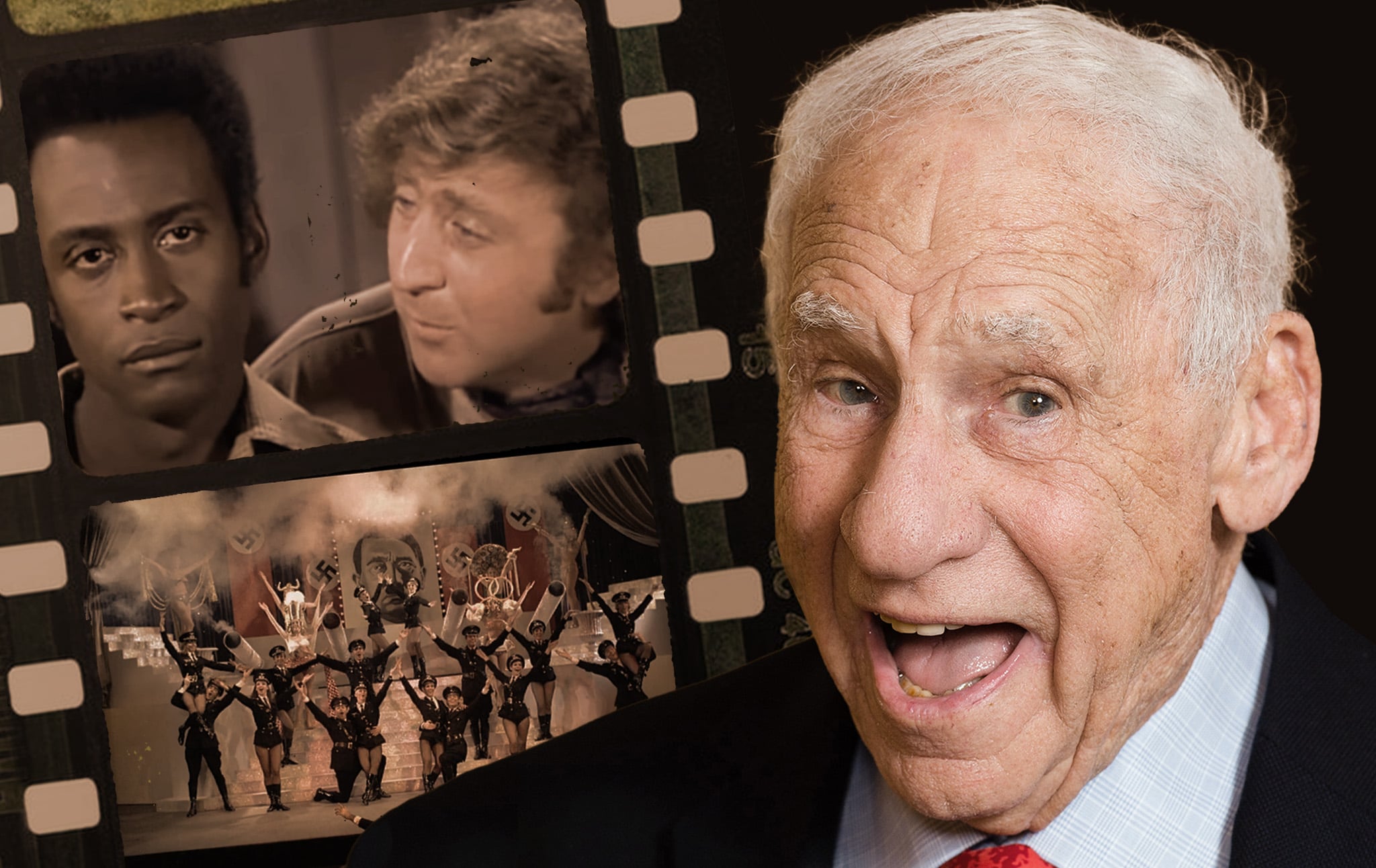
Especially in the musical sequences, the play functions as a sophisticated commentary on fascism and Nazi aesthetics. As Walter Benjamin famously argued, a core element of fascism is the aestheticization of politics: creating the sense of self-expression in the masses not through political rights, but through cultivation of spectacle. Brooks fills the stage with stormtroopers doing the can-can, or a parade of women in absurd skimpy costumes meant to evoke German national heritage, like pretzels or beer. It’s ridiculous and hilarious—but only a notch or so away from actual Nazi aesthetics. At one point, an overhead shot shows Nazis dancing in swastika formation. It’s a wacky juxtaposition of disparate imagery of the 1930s: the banality of evil in the form of the complex geometric choreography of 1930s movie musical mastermind Busby Berkeley. Except it’s not a wacky juxtaposition; it’s directly taken from a Hitler Youth rally in 1933, where young goose-steppers really did form a huge swastika in the center of an arena.
By repurposing real Nazi aesthetic choices in a context where they seem absurd, Brooks reveals the absurdity of Nazism itself, puncturing the po-faced grandiosity of the images’ original usage. As video essayist Dan Olson reminds us, contemporary mental constructs of the Nazi regime are “deeply informed by propaganda film[s] produced by the Nazis for the explicit purpose of creating that mental construct.” Brooks does not simply trivialize Nazi aesthetics—which could risk denying their effectiveness as propaganda tools—but brings to the forefront that which must remain silent for the propaganda of those aesthetics to work effectively: that it’s kind of silly. This might seem less relevant now, since our fascists try to style themselves as defenders of comedy and transgression, and getting people to take the threat they pose seriously seems like the real challenge. But contemporary fascists’ vaunted affection for irony and memes is only so flexible, and as becomes clearer and clearer as they solidify power, it ultimately forms a thin veneer over that same impenetrable self-seriousness. Lindsay Ellis once made the point that while Nazis will appropriate any and all avowed anti-fascist media—from Cabaret to American History X—Nazis have never reclaimed Springtime for Hitler as their own. It exposes their greatest tool as their biggest weakness. “If you stand on a soapbox and trade rhetoric with a dictator you never win,” Brooks said in 2001, “That’s what they do so well: they seduce people. But if you ridicule them, bring them down with laughter, they can’t win.”

Which brings us back to Blazing Saddles, Brooks’s 1974 satirical western. It’s a film more interested in joke density than narrative or characterization, leading some negative reviews to dismiss it as an overlong sketch. But history has been kind to Blazing Saddles. Co-written by, among others, Richard Pryor, it’s a film about how anti-Black racism has and continues to fundamentally shape the United States, and also has a funny farting scene. Cleavon Little plays Bart, a Black railroad worker who is plucked from the gallows and appointed sheriff of the town of Rock Ridge—a state of affairs that territorial attorney general Hedley Lamarr (Harvey Korman) hopes will drive away the white residents and facilitate a landgrab. The huge number of N-words in the film is not shallow provocation, but comes about because Blazing Saddles is extremely frank in its depiction of white racism, creating a hilarious contrast between the superficial politeness the audience is trained to expect and the bigoted invective on screen. On Bart’s first morning as sheriff, he says to a sweet-looking old lady, “Good morning, ma’am. And isn’t it a lovely morning?” Her response is immediate: “Up yours, n—r!”
Too many people think that moment is transgressive and funny simply because it breaks the taboo around the N-word. But its true transgression is acknowledging that little old white ladies are not sweet, angelic, or harmless, but are as or more likely than anyone else to have hearts full of violence and hatred. If you couldn’t make Blazing Saddles today, that’s why.