Hampshire’s legacy of radical pedagogy shows how higher education can be rebuilt to address the needs of a world in free fall.
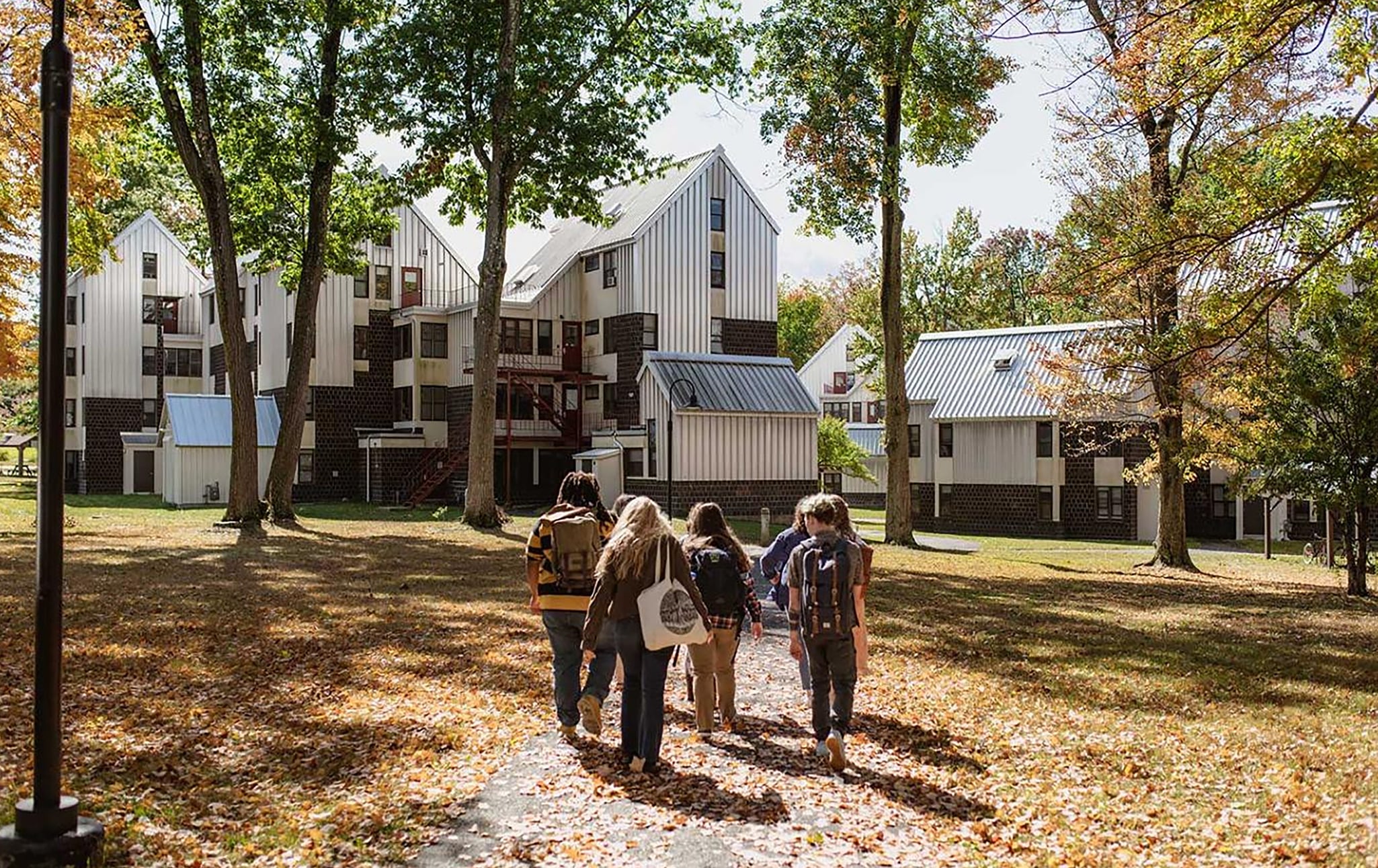
On Tuesday, April 14, it was announced that Hampshire College, my alma mater, a pathbreaking experiment in radical pedagogy, would be permanently closing in the fall of this year. With its first class of 250 students in 1970, Hampshire’s founders took the bold approach of believing that young people could design their own educations. The college never had tests or grades, and students created their own majors. This self-directed curriculum has been imitated elsewhere but retained its purest form at Hampshire. So long as you could find a mentor, you could cobble together a concentration in almost anything: game design, ancient Irish, cheesemaking—the world was your oyster. That was the idea, anyway. As you can imagine, at an underfunded school full of overworked faculty and weird teenagers, things often went pear-shaped. But failure and the self-discovery that went with it were all supposed to be part of the Hampshire experience.
Hampshire will join the hundreds of small liberal arts colleges that have collapsed financially in the 21st century: nearly 300 closed just between 2008 and 2024, according to The Hechinger Report. Hampshire’s closing, however, has attracted more publicity than most, because the school has a national reputation and prestigious alumni like actress Lupita Nyong’o, documentarian Ken Burns, and musician Elliott Smith. Author James Baldwin and artist Diane Arbus taught at Hampshire. In its early years, Hampshire was one of the hardest schools in the country to get into. The school reported 2,002 applications for 250 places in 1970, making it technically harder to get into Hampshire than Harvard. In 1970, a school liberated from grades and a credit system, where you were in charge of your education, was a hot sell. At a time when colleges were still gender-segregated, when women’s colleges had curfews, when courses of study for your major were set in stone, Hampshire presented unheard-of freedoms at the cutting edge of education.
56 years later, in our era of austerity, conservatism, and retrenchment across academia, Hampshire isn’t able to stay afloat financially. In the Wall Street Journal, economist Roland Fryer wrote gleefully of Hampshire’s closing as a welcome “market correction.” The Right is unsurprisingly delighted to see another “woke” college go down. It is therefore incumbent upon all those of us mourning Hampshire to cherish its legacy and spread its lessons widely. On the other side of Trumpism and neoliberal austerity, higher education will need to be rebuilt. When the time comes, Hampshire can provide a valuable example of the extraordinary feats of teaching and learning that can be accomplished when conventions are upended and the rules are rewritten.
Hampshire was conceived in 1958 when four college presidents, from nearby Amherst College, Smith College, Mt. Holyoke, and the University of Massachusetts, penned an ambitious document called “The New College Plan: A Proposal for a Major Departure in Higher Education.” In grandiose mid-century prose, they write:
This is a proposal for changes not in ends but in means. It affirms a belief in a liberal arts education—that appropriate for a free man. Although New College aims at producing useful citizens, it rejects vocationalism and a narrow concentration on science divorced from humanism. The challenge of authoritarianism must not be met by a surrender of the principle that the supreme goal of an educational system is the free growth of the individual student and of the intellectual community.
The American university system at midcentury saw a huge influx in incoming classes from the GI Bill, a growing middle class, and later the postwar baby boom. A “New College” education also appealed to the bootstrapping, go-getter mentality of its founders, who saw education as a form of intellectual entrepreneurship. The education was meant to be lower cost by having fewer teachers and sharing the resources of nearby colleges. The chief goal of the faculty would not be to teach courses but to teach “the student to teach himself” and to “master subjects chiefly on their own initiatives.”
By the time I enrolled at Hampshire in the fall of 1999, the New College Plan had altered significantly but retained many of its original tenets. The university presidents who created Hampshire couldn’t have imagined the cultural upheaval that would take place between 1958 and 1970 when the college opened, nor the shaggy-haired hippie intellectuals in its incoming class. The self-directed courses of study of these early Hampshire students concluded in fourth-year final projects, known as Division IIIs. Alongside more traditional academic studies, the first generation of these included an illustrated children’s book about ants, a study applying quantum theory to Marxism, and a history of the banjo.
As a high school student applying to college, I loved the idea that by the time you graduated from Hampshire you would have a completed work to set you on your life’s journey—a film, a novel, a study on the effects of metabolic inhibitors. I knew at 17 that I wanted to study literature and history. I knew I wanted my Division III to be a work of fiction. I knew I didn’t want to be bogged down in general education requirements like I was still in high school. I knew I wanted to be surrounded by similarly driven and focused students like me, people who cared about what we were learning and weren’t diploma-seeking robots.
My actual experience of the college, especially in my first few years, often did approach the scholarly utopia I had imagined. A good day could begin with a thrilling presentation on the life of Dostoevsky from a raven-eyed septuagenarian beatnik. Then, after a rousing 2-hour lunch with 15 new friends, a seminar on the literature of religious awakening from a former monk turned Vietnam War-protesting Euripides translator. Then 2 hours of baroque opera singing in the Hampshire College Chorus followed by a pre-dinner stroll to the Hampshire farm to play with baby goats. After dinner, the work begins: perhaps reading the Epic of Gilgamesh and taking a solitary walk in the pine forest to smoke a bowl of weak marijuana and ponder the death of Enkidu. The day might end with a dip in the pool and a kibbitz in the co-ed sauna. That would have been a good day at Hampshire.
There were no fraternities, no intramural sports, and no student athletes. I had one friend who was pre-med and another who majored in blacksmithing. Having the freedom to choose our education also came with enormous responsibility and high expectations of ourselves. We took learning very seriously, in some cases too seriously. One friend wrote her Division III (4th year thesis) on science fiction and feminism and decided she hadn’t read enough on feminism to finish and dropped out of school mere months from graduation. While I was attending, Hampshire reported having a 50 percent 4-year graduation rate. You were just as likely to drop out as to finish. Plenty enjoyed the freedom part of a Hampshire education but weren’t yet ready for the responsibilities that came with it. We were teenagers, and there wasn’t much in the way of structure or support. No one was going to stop you from treating Hampshire like a summer camp with recreational drugs. God help you if you enrolled without a generous supply of self-discipline.
There was also dark Hampshire, the flipside of utopia. The Hampshire where you’d wake in the morning and trip over a suitemate who had taken 3 tabs of acid and was having a bad trip on the hall carpet. Then you would head off to a slew of poorly attended classes where no one had done the reading. I once heard a conspiracy theory about Hampshire that claimed the school was created by the CIA to take the air out of the sails of the radical student movement. Bright young lefties would be put on an obscure rural campus with hippie deadbeats. At Hampshire, these teen geniuses would become so aggrieved by the deadheads they shared classes and dorms with they would either sink beneath the ganja cloud and join the slackers or become so cynical they would permanently set aside their radical politics. The experimental school would appear from the outside like a training ground for left organizing; but, instead of little reds, it would groom pessimistic, world-weary liberal individualists.
I always found the conspiracy theory funny because it felt a little bit true. The college’s Latin motto is non satis scire, to know is not enough. Whelp, it’s not enough but it ain’t nothing, my friends and I would joke after yet another class where half the class was absent or in a stupor. But then I’d go to my next class which would be packed to the gills with brilliant, over-prepared students and have some of the most intellectually rich experiences of my life. That was Hampshire in a nutshell, chaotic, inconsistent, utopian: a concentrated version of the American college experience where all the contradictions were magnified.
Hampshire was born of the belief that you could trust, not just in young people to take charge of their education, but in the world to accommodate this idiosyncratically educated cohort. According to The Hechninger Report, hundreds more small liberal arts colleges are predicted to close over the next decade. Meanwhile, large or public research universities are glutted with applicants. As ever, a majority of undergraduates will study job-market-focused subjects. They will take examinations, rack up credits, and work through the requirements in their majors. Schoolwide mandates will force students to use AI to do their thinking for them. Colleges will have been bedeviled by austerity, both mandated by Trump’s cuts to federal funding and self-inflicted by university administrations bent on turning schools into hedge funds. No one will major in blacksmithing or standup comedy; however, with the reduction in departments and course options, they also won’t perform in Macbeth, learn Italian, or read the Bhagavad Gita. With AI potentially wiping out millions of white-collar jobs over the next decade, these new STEM and business grads may be bound for unemployment. They will join the surplus labor force alongside liberal arts grads who did an interdisciplinary concentration in creative writing and puppetry.
Given the grinding maw of our unjust and unstable economy, the distinction between a bespoke liberal arts education and a job-market-focused degree could collapse in the coming years. If there is an academic hack to protect us from capitalism, then like as not it will soon only be available to a microscopic few. The bulk of the nation’s college-educated surplus labor force will be out of luck. And even for the microscopic few who get stable middle-class jobs, your education, your diploma, your startup, and your end times bunker will still not mark you safe from capitalism. That’s a job for solidarity. And solidarity is something I actually did learn decently well at Hampshire College.
Unlike similarly left-oriented liberal arts colleges, Hampshire put its money where its mouth is. It was the first American school to divest from South Africa’s apartheid government in 1976. In 2023, when colleges around the country were rounding up Palestine encampments, assaulting students and expelling them for demanding divestment from Israel, Hampshire was nowhere in the news. That’s because Hampshire had already divested in 2009. The culture of protest and civil disobedience at Hampshire runs long and deep. For its entire existence, student protest radically shaped the school’s investment portfolio and curriculum.
For me, it was the structure of my Hampshire education that contributed to my political development. Four years without grades or exams, of bare feet and freedom, of calling professors Bob and Joanna, helped me to not fully internalize the arbitrary grading systems of adult life. The independent thought that was encouraged at Hampshire also helped me to not take authority figures within artificial hierarchies too seriously. While I wasn’t politically radicalized at Hampshire (I was busy reading Euripides and flirting in the co-ed sauna) the school laid the groundwork for when radicalization was needed and available. When the new movement for democratic socialism came into existence, when fortitude was needed to go against family and friends in support of Palestinians, I credit my woke liberal arts college with helping me stay true to my values.
Across the nation, experimental schools that challenged the very precepts of modern Western education have been suffering. Goddard College had a similar curriculum design to Hampshire and students spent only 8 days out of every 6 months on campus so they could combine learning with real world experience. Alumni included Mumia Abu-Jamal, who finished his degree from prison and served as commencement speaker in 2014. Goddard closed in 2024 from lack of enrollment. In 2023, the New College of Florida, a public liberal arts college, got hijacked by Florida Governor Ron DeSantis. After ransacking the leadership and overhauling the curriculum of the once progressive, experimental school, New College has since lost 40 percent of their faculty. A few years ago they were in the news for carting their entire gender studies library to a local landfill.
Barbaric right-wing powers are currently setting fire to American higher education. When it is rebuilt on the other side of the Trump disaster, what educational model will be commensurate with human dignity and the needs of a world in free fall? The Hampshire model could go a long way towards instilling in young people the passion and focus, as well as the hope and optimism needed to attempt to reverse ecological collapse. The Hampshire model, however, was just a first step towards radically rearranging education. If I were to redesign the experiment today, I would spend more money on more teachers. I would take into account that everyone entering college has recently exited childhood. I would include more faculty involvement in the design of student educations, combining the self-directed Hampshire model with something like the Oxbridge model of weekly tutorials. I would do more to nurture students on their self-directed journeys. But I would retain the notion that undergraduates are capable of directing their own education.

Hampshire was a new and beautiful idea, but it was always fragile. The school’s administration and trustees failed, generation after generation, to protect it with militancy. Hampshire didn’t have intramural sports, but it also didn’t have anything to replace them with and to encourage a feeling of collective unity, a school-wide esprit de corps. A Hampshire education taught us to make art, to observe, to describe, and in small ways to cultivate, but it did not teach us to secure or build institutions. A Hampshire 2.0 may want to address the problems enabled by a worship of individualism as well as celebrate individualism’s creative and scholarly bounty.
Later this year, the Hampshire experiment will come to an end. Today, its 15,000 or so living graduates grieve its closure. As the next generation of radical pedagogues conceive of the next chapter in experimental education, they might consider how easy it is, as Lauren Oya Olamima says in Octavia Butler’s Parable of the Talents, to destroy a beautiful idea when it is physically bound to one place. To know is not enough. Neither is it enough to create just one utopia. Movements, however, with teachers and institutions spread across vast territories, can build that better world wherever they are. As Hampshire, that beautiful, quirky, flawed wonder, closes, its legacy reminds us of our responsibility to build a Hampshire wherever we are.