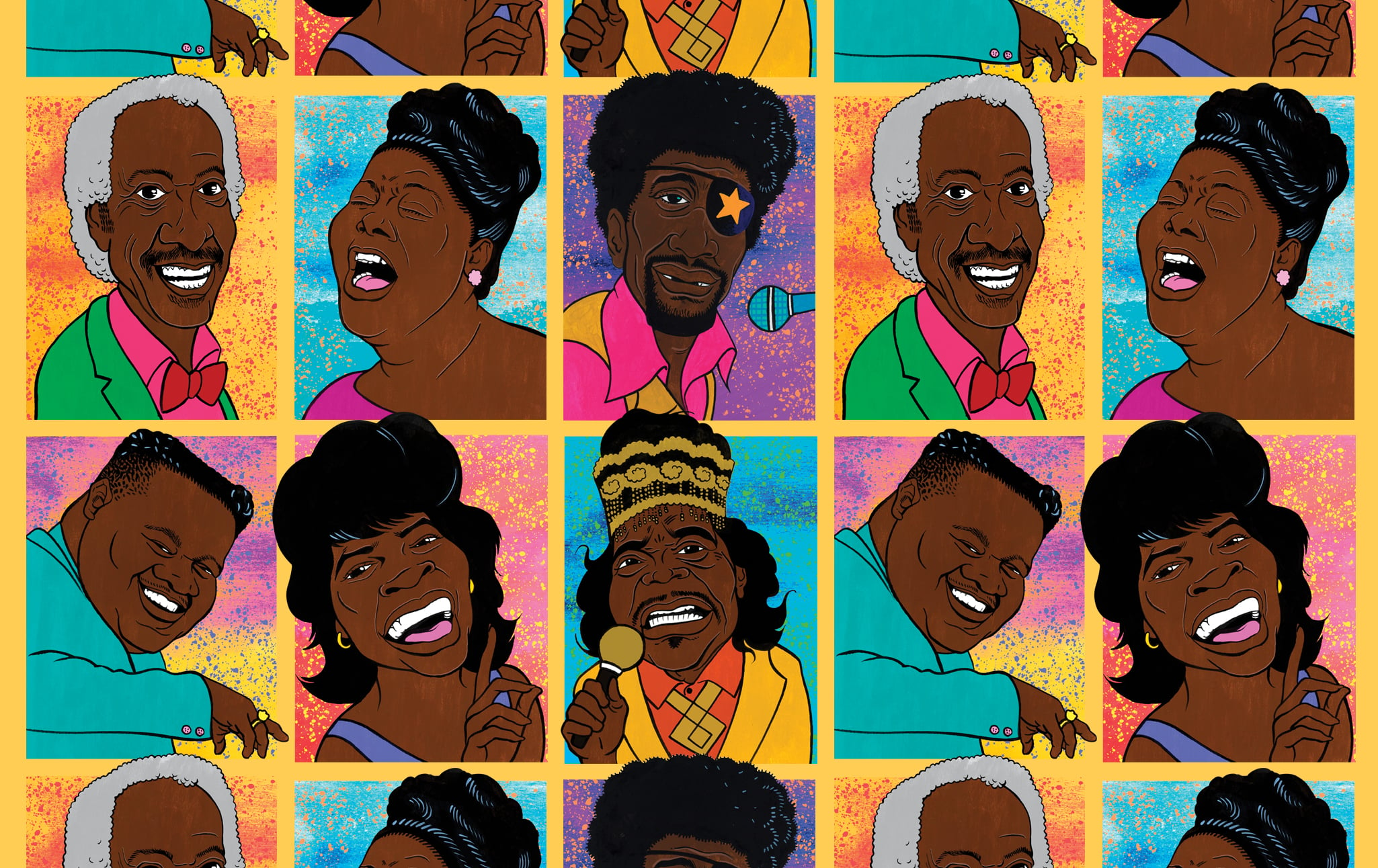
From Louis Armstrong to Lil Wayne, the Crescent City has given the musical world some of its finest art.
“There is a real mania in this city for horn and trumpet playing,” remarked the New Orleans Daily Picayune in 1838. “You can hardly turn a corner,” it lamented, without hearing brass players, quoting a local who said he “earnestly desired to hear the last trumpet.” We are coming upon 200 years later, and the situation hasn’t changed much. On my bike rides home through the French Quarter, I often get caught behind a second-line parade, usually for a wedding, the band belting out “L’il Liza Jane” or “Hey Baby.” Then there are the regular Sunday parades put on by the Social Aid and Pleasure clubs, with names like the Men & Lady Buckjumpers, the Uptown Swingers, the Dumaine Street Gang, the Pigeon Town Steppers, the Valley of Silent Men, and the Black Men of Labor. They snake through neighborhoods, with the brass bands blaring for hours at a stretch and the whole community coming out to dance.
Then there are the club performances, dozens every night. When a local radio station reads off the list of the night’s shows, it seems to go on and on and on. On a single night, you can see Irvin Mayfield’s Music Church at the Blue Nile, Audrey & the CrawZaddies at the Bourbon O Bar, the Jumbo Shrimp Jazz Band at the Spotted Cat, Corey Henry & The Treme Funktet at Vaughan’s, Tony Seville & The Cadillacs at the House of Blues, Bubbles Brown at the Apple Barrel, the Soul Rebels at Le Bon Temps Roulé, or about 30 other performances. On Frenchmen Street on any given night, one can wander from venue to venue sampling different musical acts as if one is nibbling cheeses from a vast platter. That’s before we get to the various buskers scattered around elsewhere, the private performances, and of course the legendary Jazz Fest and all the music at Mardi Gras, including the unforgettable chants of the Mardi Gras Indians. Local restaurateur Ella Brennan once said that in New Orleans, “we live to eat.” Not quite true. We also live to dance.
Since I moved to the city, the presence of music in the streets has been one of the most noticeable, and most pleasurable, differences from living elsewhere. In Boston, where I lived before, you could go to a show. But unless you consciously sought out music, it wouldn’t have a major presence in your life. Here, music is unavoidable. It overflows into the streets from the clubs and bars. It marches right past your front porch and into your walls. I hear people practicing pianos and saxophones in their living rooms. Music is in the air, quite literally—some of it better than others, with the excruciating tuneless carnival melody of the old calliope wafting across the French Quarter from its home on the Steamboat Natchez. It seems like every other car is blasting something, and half the time their windows are rolled down, filling the hot Louisiana air with bass. I’ve got a whole Spotify playlist composed of songs I’ve overheard when wandering around the city, and it’s eclectic, ranging from the Spice Girls to Creedence Clearwater Revival to the Preservation Hall Jazz Band. A few months back, I saw an older Black man on his bicycle with a giant speaker broadcasting Taylor Swift songs. Everyone wants to be listening to something.
Music sneaks up on you and takes you by surprise. This past Sunday night, I was working late at the office (as I tend to do), and I got a text from my colleague John, who told me that just a couple of blocks away, a man named Bobby Rush was performing at a local blues festival. I could hear the music from my desk, and so I set aside my magazine duties and I scurried over. Sure enough, 91-year-old Bobby Rush was beginning his set. Rush is one of the last of the great ’50s blues performers, and toured with Muddy Waters, Howlin’ Wolf, Etta James, and many other greats. He was in incredible shape, sporting a snazzy white jacket embroidered with bright blue butterflies. At 91, he still tears it up on the harmonica, does Michael Jackson moves (he claims he did them first, back in the ’50s), and even raps (he says he was doing this long before hip-hop).
That kind of serendipity—suddenly hearing a blues legend outside your office window—is an everyday occurrence in New Orleans, the city with its “mania” for music. I’ve been to Nashville and I’ve been to Detroit, both great American musical cities. I love them both, but music just hasn’t seeped into the sidewalks like it has around here.
Not only does New Orleans love music, but New Orleans has made staggeringly original contributions to American music, originating whole forms from jazz to bounce, and spawning artists from legendary horn players like Sidney Bechet to great rappers like Juvenile. It’s still hard for me to believe that jazz was literally born here. It’s a small city. Jazz is now such a sprawling, diverse genre with worldwide reach—to think it had an actual birthplace, a few small square miles, is astonishing. And of course none of it happens without a tiny patch of ground, Congo Square, where the enslaved famously gathered to perform and listen to music.
And it wasn’t just jazz. The role of New Orleans in early rock and roll is underappreciated. Just a few blocks from my house is the old J&M studios building, where Tulane University dropout Cosimo Matassa started an appliance store with a recording business on the side. The tiny recording studio soon began putting out 45s by artists who would become legends, like Little Richard, Ray Charles, and Jerry Lee Lewis. Two of its early recordings, Fats Domino’s “The Fat Man” (1949) and Roy Brown’s “Good Rocking Tonight” (1947) are contenders for the title of “first rock and roll record.” The great “Tutti Frutti,” was recorded there, in that humble building with equipment so primitive that songs had to be recorded live, in one take, with no overdubs. “Tutti Frutti” was ranked by Mojo magazine as #1 in the “Top 100 Records That Changed The World,” which called it "the sound of the birth of rock and roll.” Rolling Stone said it had “the most inspired rock lyric ever recorded (“A-wop-bop-a-loo-mop-a-lop-bam-boom!”)
J&M Studios’ work went so overlooked that by the time I moved to New Orleans in 2017, the building had become a laundromat, before being abandoned altogether. This year the Jazz and Heritage Foundation bought the building, which will hopefully soon have a more fitting tribute to the history-makers who made music there.
New Orleans music couldn’t be from anywhere else. It has a special sound to it, a mixture of joy and sorrow and life-affirming warmth that characterizes the cultural life of the city more broadly. It favors horns and pianos over guitars. It is cosmopolitan, drawing from different traditions—Jelly Roll Morton and Professor Longhair both sprinkled a Latin flavor into Black music, and my favorite New Orleans pianist, James Booker, could slide seamlessly between Chopin, ragtime, the Beatles, and blues. One of the things that surprised me most when I moved here was how sincerely the street bands would play songs that the rest of the country forgot about a century ago like “St. James Infirmary.” Washboard and banjos are treated as serious instruments—as they should be!
Not that New Orleans is exactly a paradise for musicians. A few months back I overheard an amazing local singer, Paris Flowerz, practicing the piano in a local coffee shop. (She came in to use theirs lacking a piano of her own.) She told me sadly that while busking, she had gone viral on TikTok. Someone came along and filmed one of her beautiful performances, posted it, and got a million views. Whoever took the video didn’t even name Paris, or link to her work. Nobody watching it knew who she was; nobody gave her a cent. Paris tells me it’s common for people to come along and take videos without so much as tipping afterward. The video-takers get the virality, and the performers are left with nothing.
Legendary New Orleans musician Cyril Neville wrote bitterly in CounterPunch in the aftermath of Hurricane Katrina:
People thought there was a New Orleans music scene — there wasn’t. You worked two times a year: Mardi Gras and Jazz Fest. The only musicians I knew who made a living playing music in New Orleans were Kermit Ruffins and Pete Fountain. Everyone else had to have a day job or go on tour. I have worked more in two months in Austin than I worked in two years in New Orleans.
I believe a lot has changed in the 20 years since he wrote that, but he’s right that most musicians have to have day jobs. They certainly don’t do it for the money. There’s plenty of injustice in music here—I’m always a little bitter that James Booker died in poverty, while his white piano student, the son of a prosperous, infamously unethical district attorney (Harry Connick Sr.) became a star popularizer of jazz.
But the first thing we can do is to recognize just how extraordinary an achievement New Orleans music is. Jazz, funk, R&B, gospel, hip-hop—this city has produced legendary performers across genres, from Mahalia Jackson to Lil Wayne. The cultural life of this country would be deeply impoverished without the contributions of New Orleans, and I’d encourage you to spend some time immersed in, and just enjoying, the timeless work of great figures like Allen Toussaint, Irma Thomas, Fats Domino, Professor Longhair, and the Meters. Then there’s Louis Armstrong, whose solo in “Potato Head Blues” still gives me the chills, who said: “Every time I close my eyes blowing that trumpet of mine, I look right into the heart of good old New Orleans. It has given me something to live for.” Amen, Pops.
.png?width=352&name=Screenshot%202026-05-13%20at%2011.16.14%20AM%20(1).png)