Did We Really Need to Squash All the Lanternflies?
An unorthodox request from New York City officials prompts questions on sentience, human nature, and the meaning of "invasive."
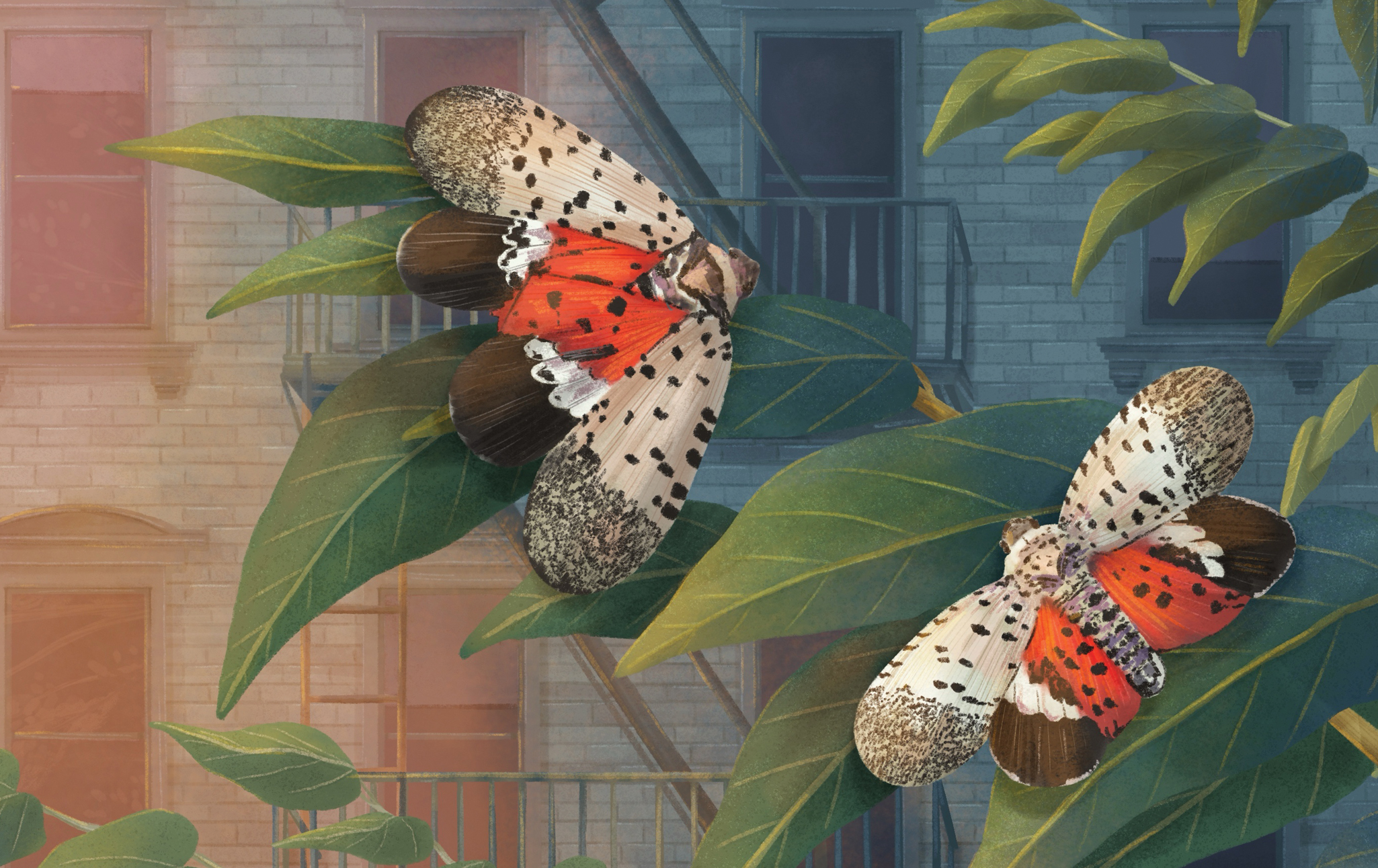
Dark gray splotches line the sidewalks of Broadway Avenue. Flattened gum, and then every so often, something a little more textured. A flash of red, a shard of a wing, polka dots, black spindly legs at impossible angles. A spotted lanternfly, mercilessly squashed by a good Samaritan passing by.
The short-lived invasion of the spotted lanternfly into New York City, beginning in 2020, produced an unusually clear directive from state agencies and local officials: see it, squash it. And New Yorkers happily obliged. People veered off course to stomp a single insect and posted videos tallying their kill counts online. In the following years, sidewalk extermination became a small ritual of late summer. The response felt like a citywide art project, creating a mosaic of smudged wings and fractured exoskeletons.
Today, the insects are far less common in New York City. It is tempting to say that that’s because the campaign worked: the city rallied together to confront an environmental threat and ultimately won. But both the ecological and the human story are more complicated. Now that the lanternfly population has sharply declined, though its presence is here to stay, we can look back and ask: What did all the stomping accomplish? And what does it say about us?
The spotted lanternfly, Lycorma delicatula, is native to parts of Asia, primarily China, Vietnam, and India. The insect feeds on the sap of more than 70 species of trees, shrubs, and woody vines, leaving behind a sugary mess called honeydew that can prevent photosynthesis and promote fungal growth. In the United States, it was first spotted in Pennsylvania in 2014, likely arriving as an unnoticed hitchhiker in quarry cargo. For several years, it attracted relatively little attention. But by 2020, in parts of the mid-Atlantic and Northeast, populations had grown dramatically. In New York City, lanternflies began to blanket tree trunks and building facades, cluster on stoops and handrails, and flicker through the air. Their appearance was so striking that they were hard to ignore.
Indeed, spotted lanternflies are the Coco Chanel of bugs, dressed for New York, arriving with impeccable timing just as the city prepares for Fashion Week. Adults emerge from their fourth developmental stage in late summer, hopping onto the city’s sidewalks with their rouge cheeks and delicate polka-dotted outerwear, as if debuting a new collection on the concrete runway. Writers have compared their patterning to exquisite Chinoiserie wallpaper, their wings to haute couture capes worn by André Leon Talley. It is the kind of beauty that heightens both visibility and vulnerability.
Lanternflies pose no direct risk to humans; they do not bite or sting. Their flight pattern is hesitant, a sort of stilted hop-fly that makes them easy to catch but just challenging enough that it’s worth the chase. When threatened, they flash their scarlet red hindwings, resorting to costume in the face of human danger. Their aesthetic excess, combined with this seeming lack of urgency, gives them a unique charisma. In this way, their arrival in the city felt very typical of “new” New Yorkers: overdressed, clumsily navigating the cityscape, determined to survive amid the glass and stone of a city that had no intention of welcoming them in.
Alongside this visual spectacle came a coordinated communication campaign. In 2019, researchers looked at the insect’s impacts as it spread through South Korea and estimated potential economic damage in the U.S. on the order of hundreds of millions of dollars. Environmental and agricultural agencies in the tri-state area began to warn about the lanternfly’s lack of natural predators and their potential damage to forest trees as well as vineyards, orchards, and other high-value crops. These agencies, with the help of local grassroots organizers, circulated posters and social media posts urging residents to kill the insects on sight and to scrape away their egg masses. The messaging was simple, permissive, and militaristic: if you see them, kill them.
Citizen science is, or at least can be, a powerful tool to democratize knowledge and decision-making. It lets the public participate in data collection, ecological monitoring, and scientific inquiry. It softens the boundaries between expert and layperson and invites people to engage with their surroundings in new ways. Local schools began to teach about the lanternfly, with Rutgers creating a curriculum for kids to learn its life stages and impact on the environment. Penn State developed trap designs you could make at home. More broadly, the campaign enabled a wide spectrum of people to consider a conservation issue facing their own communities and ecosystems.
But when the science behind an initiative is flattened into a slogan, and when moral judgment is embedded into that slogan, individual action can veer toward vigilantism. People reported sightings not only for study but also as badges of civic virtue. In videos circulating online, children “smooshed” clusters of bugs as their friends and parents cheered them on. Facebook and Nextdoor groups rallied together on the “front lines” of the invasion. An app called Squishr allowed users to compete for the highest number of kills; the subreddit r/LanternDie offered online inspiration, memes, and solidarity. The fervor revealed our capacity to rally around a shared goal, but it also exposed something more disconcerting: our appetite for destruction when given moral permission, and the ease with which we united around the eradication of something fragile and, in its way, beautiful. Citizen science, meet Gotham City.
There is something undeniably compelling about the kind of engagement that makes environmental problems not only the domain of experts and distant agencies but of ordinary people willing to act, especially when that feeling is part of a collective, and motivated, in a sense, by care. But it also raises difficult questions. Who defines which forms of life are expendable in the name of protecting others? And what happens when the language of environmental stewardship becomes indistinguishable from the language of elimination?
Invasive species are generally defined as living organisms that are translocated to new ecosystems through human intervention and pose possible damage to those ecosystems. International bodies describe “invasive alien species” as the second-largest threat to biodiversity after habitat loss. The risk of invasive species is often framed as global biotic homogenization or a “McDonaldization of the biosphere”: a future in which the same hardy generalists dominate everywhere, eroding local distinctiveness. Battles against invasive species often draw on a longing to restore a supposedly pristine nature, a vision especially potent among city dwellers distant from agricultural farms and intact forests.
Yet many ecologists and anthropologists debate the very category of “invasive,” noting that many non-native organisms contribute to resilience in rapidly changing environments. It’s true that some introduced species, most famously the cane toad in Australia (intentionally brought in to control insect pests) and the Burmese python in the Florida Everglades, can have devastating long-term ecological consequences. But others, like autumn olive and honeysuckle, can fill specific niches left open by urbanization and climate change, providing habitat and food to local wildlife. Some introduced species, like the European honeybee as well as most of our crops and livestock, might fit the textbook definition of “invasive” but are the backbone of our food supply. Amidst these shifts, the distinction between “belonging” and “not belonging” becomes harder to sustain in strictly biological terms.
The fantasy of eradication has a long history in not only ecology but also public health. Global campaigns against diseases like smallpox, polio, and guinea worm are framed as heroic battles against singular enemies. Their efforts can be transformative, but are rarely successful. Eradication has only been achieved for a single human disease: smallpox. Meanwhile, vertical programs that target only one pathogen (through specific interventions like drugs or vaccines) rarely address the underlying social and ecological conditions—poverty, housing, health care, and land use, to name a few—that shape vulnerability to many pathogens all at once. The desire to eliminate a single threat can distract from systemic changes that would reduce risk more broadly.
Attempts at total elimination also produce unintended consequences. To control urban rats, poisoning campaigns have often led to suffering for wild animals without solving the underlying problems, such as waste management, building maintenance, or food access, that sustain rat populations. To control lanternflies, homeowners similarly reported pouring dangerous pesticides into their own backyards. In the past few years, as residents strung sticky tape around trees to catch lanternflies, the Wild Bird Fund in New York City and other wildlife rehabilitators reported all-time highs in tape-related injuries and deaths for birds and small mammals. In Brooklyn, on a lanternfly sticky trap, a live woodpecker was recently reported writhing among the dead.
As an epidemiologist and disease ecologist, I am used to thinking about how organisms move through landscapes, aided or impeded by human behaviors and decisions. I am also used to the language of invasion, with all its metaphors of enemies, fronts, and wars. But when the lanternfly campaign intensified, what struck me was not just the policy, but the affect in New York City—the eagerness with which friends and colleagues and strangers embraced it.
It isn’t a coincidence that the insect’s population boom in New York, and our rallying against it, coincided with a period of deep economic, political, and physical uncertainty in the United States. By the late summer of 2020, when the insects first appeared en masse on Staten Island, COVID-19 had quickly and radically altered everyday life. Labeled by Donald Trump as the “Chinese virus,” the pandemic was repeatedly framed through tropes of foreign contamination, porous borders, and biological threats. The campaign to control the lanternfly, whose arrival in the U.S. was broadly assumed to also come from China, echoed the same vocabulary. Maps tracking its spread, like those developed for COVID-19, visualized the breaching of boundaries in real-time. The politics of biosecurity migrated easily from human bodies to environmental landscapes, reinforcing an immunological fantasy: that boundaries can be kept intact, that the world can be sanitized, that our ecosystems can remain pure. The effect was an emotional doubling, with both intruders rendered through the same lens of defense, sovereignty, and nativism.
At the same time, climate change was becoming harder to treat as merely a distant abstraction. Smoke from New Jersey wildfires reached Manhattan; summer heat waves intensified; subways flooded more frequently. The apocalypse was upon us, a biblical plague of fires and pestilence and insect swarms. Although the lanternfly didn’t arrive because of climate change, it arrived in a moment when warming and globalization were reshaping what species could live where, and so it became legible as a creature of the Anthropocene.
The scale of these overlapping crises exceeded any individual’s capacity to address them. Meanwhile, a lanternfly was an easy target, something an individual could confront alone and feel they had acted correctly. One insect, one stomp. The stomp became a release valve disguised as environmental stewardship and patriotism. Yet stomping did nothing to address our participation in the very systems—global circuits of goods, monocultural agriculture, extractive economies—that created the conditions for social and ecological disorder in the first place. Stomping offered catharsis in an age of crisis, but without a path to structural change.
Even if we accept the premise that the lanternfly population is worth suppressing, the efficacy of stomping itself is murky. In a modeling study in July 2021, researchers estimated that to reduce population growth, we would need to remove over 35 percent of egg masses. This intervention targets the “reproductive bottleneck,” since each egg mass contains 30-50 eggs, all of which will be prevented from maturing when scraped away. By contrast, stomping adults is a demographic gamble: you might kill a male, or a female that has already laid eggs, or a juvenile that would never have reproduced. Compared to destroying a single egg mass, killing hundreds of adults may barely dent the next generation. So to shift the curve downwards, the most impactful intervention is upstream, at the egg stage. Even so, given that lanternfly egg masses are camouflaged against tree bark (especially up in the crowns of larger trees), tucked away in truck beds, and hidden in countless other unseen urban crevices, the odds of reaching 35 percent of them is extremely low.
Today, the lanternfly population in New York has significantly decreased, although despite all our counting, hard data is limited (our best proxy is still the number of calls received by state hotlines). Like most wildlife, lanternfly populations are sensitive to innumerable and unpredictable ecological levers. The decline in their numbers could be related to local predators adapting to feed on them: birds, bats, assassin bugs, and even praying mantises have all been observed eating the insects. It may also have been related to a whole host of other factors: a lack of availability of suitable host plants, changes in weather conditions, and the natural boom-bust cycles observed in many insects. By early 2022, Penn State published an article stating that the insects have not caused nearly as much damage to hardwood trees as was once feared.
It is also unlikely that the stomping campaign altered the trajectory of the lanternfly’s spread across the U.S., with sightings now reported in 19 states, as far as Georgia, Tennessee, and Illinois. It has also become clearer that lanternfly populations tend to peak at the expanding edges of their range—a dynamic that makes their surges dramatic but not permanent. (The moments of highest abundance are also the least likely to be reversed by stomping.) These days, the most significant threat is likely to the wine industry, especially as the lanternfly advances toward California.
The question of whether stomping is effective or not also sidesteps a larger ethical question. In recent years, research has accumulated suggesting that insects—long treated as morally negligible—exhibit forms of learning and memory, tool usage, playfulness, and mood states that challenge the idea that they are mere automata. Insects experience forms of fear, stress, and pain avoidance in ways that extend beyond nociception (the reflexive response to damaging stimuli). Invertebrates ranging from sea slugs to crayfish to flies and ants have all displayed internal states reminiscent of what we consider emotions. If insects do indeed possess even a basic form of sentience, do we owe them a different kind of consideration, even when ecological management is necessary? When we declare certain lives unworthy of empathy, what line are we drawing in the sand, and how stable is that line, really?
One of the most striking ironies is that the lanternfly prefers to feed and lay eggs on the tree of heaven, Ailanthus altissima, the titular species from Betty Smith’s A Tree Grows in Brooklyn. The tree of heaven was imported into the U.S. more than 200 years ago, first as an ornamental curiosity and later widely as a street and shade tree. Its ability to thrive in poor soil and polluted air made it a symbol of resilience. But perceptions shifted by the mid-20th century: the tree of heaven became a common feature of neglected urban spaces, thriving in alleyways and vacant lots, an emblem of the weed-like tenacity of urban life.
The tree and the insect share a long evolutionary history, evolving together (and in competition) in their native regions of Asia. In the U.S., lanternflies have disproportionately chosen trees of heaven compared to any other plant; when they feed on trees of heaven, young nymphs survive at higher rates, and adult females lay more eggs. As a spotted lanternfly feeds on a tree of heaven in Brooklyn, it is exploiting an ecological relationship forged elsewhere and transplanted by us. The two are travelers from the same homeland, reunited in a landscape that belongs to neither but might just accommodate both.
I am also somewhat of a newcomer to New York City. This past autumn, walking through my neighborhood, I counted fewer than 30 lanternflies all season. Nearly all of them were already dead, crushed into the pavement, years after experts had begun to question the efficacy and the ethics of such a pursuit. (A live one landed on me just as I started writing this essay.) What feels strangest, to me, isn’t the fervor with which people stomped during the population boom, in the early days of a global pandemic and amidst a tense presidential election, but the eerie feeling of knowing that the stomping reflex is here to stay.
I don’t know if the campaign succeeded in any measurable sense; I cannot definitively say whether it was wholly misguided or especially effective. I am not sure what success would even look like in the long arc of ecological change. I expect the lanternfly will settle into the fabric of novel ecosystems we are creating, intentionally or otherwise. What I do know is that our reaction tells a parable of urban life under overlapping crises, shedding light on our willingness to collapse complexity into simple stories of invasion and elimination.
They say it takes at least ten years to become a New Yorker. Whether the spotted lanternfly will ever be granted that status is uncertain. The more relevant question, I suspect, is what kind of city we become in the meantime—one that continues to seek control through convenient enemies, or one willing to sit with the harder work of addressing a world increasingly shaped by movement, disturbance, and change. In this sort of world, belonging is not a simple category for any species, including our own.


.png?width=352&name=Screenshot%202026-09-04%20at%204.00.52%20PM%20(1).png)
%20(1).jpg?width=352&name=miasma-1%20(1)%20(1).jpg)