
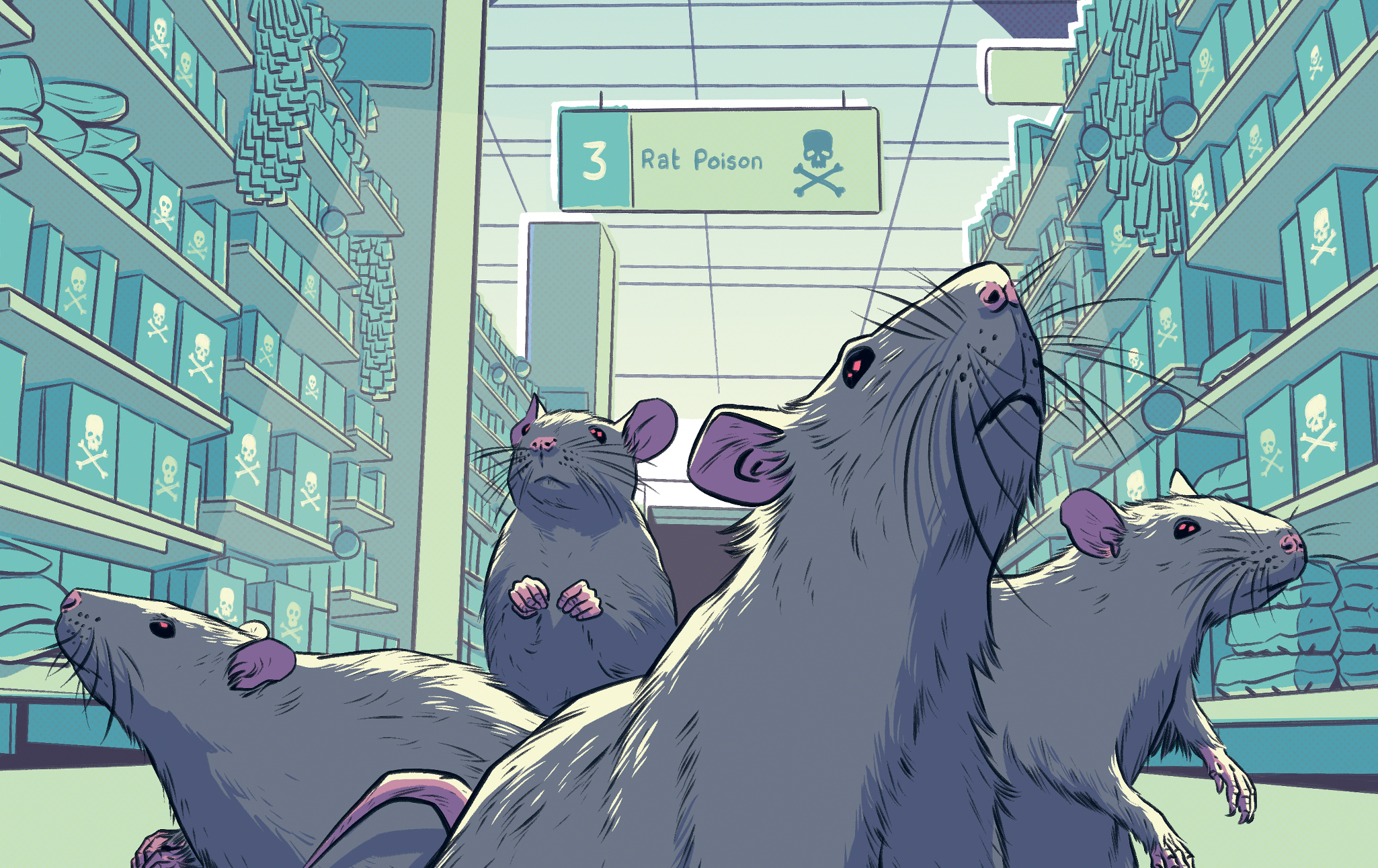
It’s unspeakably cruel to the rats themselves, and it harms humans and other animals in countless ways. There are better options.
There is infrastructure everywhere to which you never pay much attention—until you have a reason to care. Once you notice, you realize you’ve been taking something for granted about the communities we’ve created. Perhaps ramps were practically invisible until you became the one in a wheelchair or pushing a kid on a stroller. But those ramps aren’t a given: it took a lot of advocacy to make cities more accessible. Or maybe traffic cameras never stand out until you get a speeding ticket. (Upon reflection, though, it’s now rare to be in public and not fall under the gaze of a security camera.)
And, if you’re like most people, bait boxes are one of the features of modern life that still remain practically invisible to you. They’re black, about 3 inches tall, 5 inches wide, and 10 inches long. They’re as unremarkable as they are ubiquitous. They hug the sides of buildings everywhere– hotels, apartment buildings, subway stations. If you are among the minority that actually notices them, you know what’s inside their small, circular opening: food laced with rat poison.

Image: Wikimedia
It’s not shocking that rat poison is everywhere, as rats are commonplace in urban spaces. While there is remarkably little high-quality data on urban rat populations, researchers find that Baltimore, Maryland houses roughly one rat for every twelve people. New York City, meanwhile, is practically a rat metropolis, with nearly one for every four. What’s striking is the passivity of the solution. Occasionally refill the box with more bait, and hope that when the rats do eventually keel over, they’re far out of sight.
It’s also not so surprising that we would prefer a turnkey solution over a laborious one. But the downsides of convenience here are rather stark. Besides perhaps glue traps, no other method of rodent control comes close in its inhumanity. The most common class of rodenticides are anticoagulants, which interfere with blood clotting. Common symptoms of their consumption include bloody diarrhea, cessation of eating, and difficulty breathing. If blood accumulates into the lungs, rats will experience a sensation similar to drowning. The whole process takes several days, and this is by design: the initial lack of symptoms prevents other rats from noticing the association between consuming the bait and being poisoned.
From a purely ethical standpoint, the case for limiting the use case of rodenticides to a last resort measure is clear. Indeed, there is consensus within the wildlife control profession that population control “should predictably and effectively cause the least animal welfare harms to the least number of animals.” Pest managers also tend to profess adherence to integrated pest management, a philosophy based on minimizing the use of chemicals. For rats, that means first “setting traps, improving sanitation, and rodent proofing the building.” Pesticides should only be tried “when non-chemical methods are inadequate.”
Moreover, there are comparably passive solutions that are less cruel. In 2019, then-Borough President Eric Adams piloted drowning traps around Brooklyn. They are tall boxes, which lure rats up a lure to obtain bait; once they’re at the top, they fall through a trap door into a pool of oil-alcohol solution. Contrary to the distributor’s claims, the solution contains no miracle chemical that renders rats insensible instantly; it probably just covers up the smell of rotting corpses. Nevertheless, death only takes about three minutes, mercifully brief compared to poison. The passivity of rodenticides doesn’t merely reflect the fact that we like to economize money and time. It also betrays our casual attitude towards rats—we don’t feel we owe rats the consideration required to minimize the suffering we inflict upon them.

If we were willing to be inconvenienced, there is an entire arsenal of solutions available. Snap traps—the kind of archetypal spring-loaded devices seen in Tom & Jerry cartoons—can kill instantly under ideal conditions. But they must be set and frequently checked, while also taking care to responsibly dispose of carcasses. There are also novel contraceptive solutions that can be placed inside of baits in lieu of poison, like the straight-forwardly named Liquid Rat Birth Control. Aside from their greater expense, they also don’t work right away– you have to wait for the adult population to die before noticing the benefits of a lower birth rate. To cut off rats’ food supply, business-owners could put a tight lid on their dumpsters and lock them. But keeping the keys on hand is a pain, especially for the sanitation workers who make dozens of stops each day.
These humane alternatives are more expensive and labor-intensive, and consequently have mostly only been adopted by small, wealthy, progressive cities like Newton, Massachusetts and Malibu, California. The much-celebrated appointment of a “rat czar” in New York City may foreshadow that reform is also coming to cities with more poverty and complicated sanitation protocols. But that willpower isn’t coming from a sudden swell of sympathy for rats—members of the czar’s volunteer taskforce “are united by [their] visceral hatred of rats.” They’re diversifying their tactics out of a frank recognition that rodenticides don’t work as a stand-alone solution.
Even those who squeal when they see rats would probably acknowledge that they don’t “deserve” an agonizing death in any cosmic sense, and that it would be unseemly to take pleasure in their pain. But as a vector for leptospirosis, hantavirus, and other diseases, they do pose a clear and present danger. As a result, it’s probably not possible to abolish rodenticide just by pointing out that it’s inhumane. Responding to an open letter from animal activists expressing their outrage towards the drowning traps, Eric Adams quipped, “We can never put rats over children, and I am not going to do that.”

eric Adams attends the National urban rat summit, september 2024. (Image: Mayor adams via twitter)
It is possible to flip the think-of-the-children messaging strategy on its head, though. In a series of focus groups and interviews, my colleagues and I at Rethink Priorities, a think tank focused on neglected problems, asked American adults to rate the persuasiveness of six different anti-rodenticide messages we have seen in recent years. By far the most convincing message we showed them reads:
Rodenticides pose a danger to those we want most to protect: Our children and pets. Each year, thousands of children mistake rodenticides for an edible treat, sending them to the hospital. Pet dogs and cats risk hospitalization and even death from eating dead rodents or the rodenticide baits themselves. Some of the common rodenticides have antidotes, but other common ones do not.
Unsurprisingly, information about the negative effects on rats themselves was never mentioned as the most persuasive—and in fact, several participants rated it as the least persuasive. Anti-rodenticide activists tend to be savvy enough to mention this argument last, if at all. Yet, they tend to give equal emphasis to wildlife that are accidentally poisoned when they consume rats as they do to pets and kids. A representative example is the billboard campaign funded by Cities Against Rat Poisons, a collective of grassroots organizations: “Rodents aren’t the only ones poisoned by rat poison,” the ad reads, set against the outlines of various animals: not only a housecat, a pet dog, and a human baby, but also an owl, a mountain lion, and a hawk.
Even though our findings suggest that wildlife-focused messaging doesn’t pull on everyone’s heartstrings, groups like Raptors Are the Solution have successfully used this tactic to secure bans on the most powerful anticoagulant rodenticides in California and British Columbia (though they’re still legal in commercial settings, which have even more rats), and similar legislation has been introduced elsewhere. The group’s campaign featured majestic photos of eagles, owls, and raptors—the more sympathetic victims of rodenticide. Unfortunately, centering wildlife has its limitations. For one, not all rat poisons have been demonstrated to pose as large of a threat to wildlife. That means that even in California and British Columbia, non-anticoagulant rodenticides are still available at your local hardware store. Ironically, some of them have no antidotes for pets, like bromethalin.
More fundamentally, it’s worth reflecting on why we are willing to inconvenience ourselves for raptors, but not for rats. Raptors are also threatening when they are in close proximity. That doesn’t make them deserving of torture. Unlike raptors, rats are fellow mammals, and have some remarkably human-like behaviors. Why is it that sticking up for rats is interpreted as “siding with them” over humans, when we do not otherwise view the choice of population management strategy as a zero-sum conflict?

That’s a rhetorical question, because there is no mystery here. When we see rats scurrying around a restaurant patio, we don’t think of them as part of the same rodent family as the cute mouse you had as a pet growing up; nor as laboratory rats, whose pointless plight might steer you away from certain cosmetics brands. Those were clean animals, innocent of any wrongdoing. The rats who seem suspiciously close to the kitchen where your ravioli was made are large, dirty, invading your personal space. In other words, they are pests. We can’t help but feel fear and revulsion in their presence. When we’re acting in self-defense, we don’t feel much inner turmoil about the fact that we didn’t make their eradication easy on them.
Still, I hold out hope that there is a way to frame opposition to rodenticides that centers the welfare of rats. The truth is that pests don’t simply reach infestation levels in a vacuum. They reproduce at prodigious levels because we provide them with ample food and shelter to do so. We could wait to bring out our trash until the sanitation workers come. We could seal cracks in buildings so that they make a home elsewhere. But we don’t, because that takes a lot of effort for a problem that can always be mitigated by killing them later.
This principle of responsibility through complicity is one we accept in other contexts. If you are a landlord and fail to keep up basic maintenance on the property, you are responsible for any injuries or damages that ensue. If you don’t get your cat spayed, you are obligated to get her litter of kittens adopted. If you ignore warnings of misconduct in your institution, you are on the hook if they turn out to be substantiated. In all of these cases, you should have taken swift action to prevent the negative repercussions. If you fail to act, the outcome falls on you: whether that’s a tenant with a hole in their roof, eight new cats in your living room, or a hefty lawsuit.
Similarly, it is your responsibility to make an earnest effort to prevent rat population levels from growing. While it’s possible to live-trap a couple of rats scurrying around in your pantry, there is no humane way to knock down a major population in short order. Plus, you know that once the problem gets that bad, you’ll be too distressed to be picky about how it’s solved.

Of course, I am talking about “your” responsibility, as if you might be solely responsible for a rat problem outside your home. In reality, you might not even be responsible for rats in your own home; it could be your neighbors’ hygiene problem. The abundance of food, water, and shelter for rats is often a collective failure to design and adhere to best practices. The resulting diffusion of responsibility probably also contributes to why we don’t feel all that personally responsible for how we end up killing them. In general, I accept that the systemic origins of problems places some hazy limit on the personal responsibility we have for solving them. Maybe, as long as you—personally— keep your own space clean and reserve your own use of poison as a genuine last resort, you’ve done your duty.
On the other hand, in cases where you could easily affect the system, maybe failure to do so raises the specter of complicity. If you belong to a homeowners’ association, you’re well-positioned to convince your HOA that it should ask its pest management company to use a poison-free approach. I’d concede it’s probably smart to start by talking about the dogs and cats who live in the building. But somewhere in there, see if you can’t mention the benefits to rats themselves as well.



.png?width=352&name=Screenshot%202026-09-04%20at%204.00.52%20PM%20(1).png)
%20(1).jpg?width=352&name=miasma-1%20(1)%20(1).jpg)
