
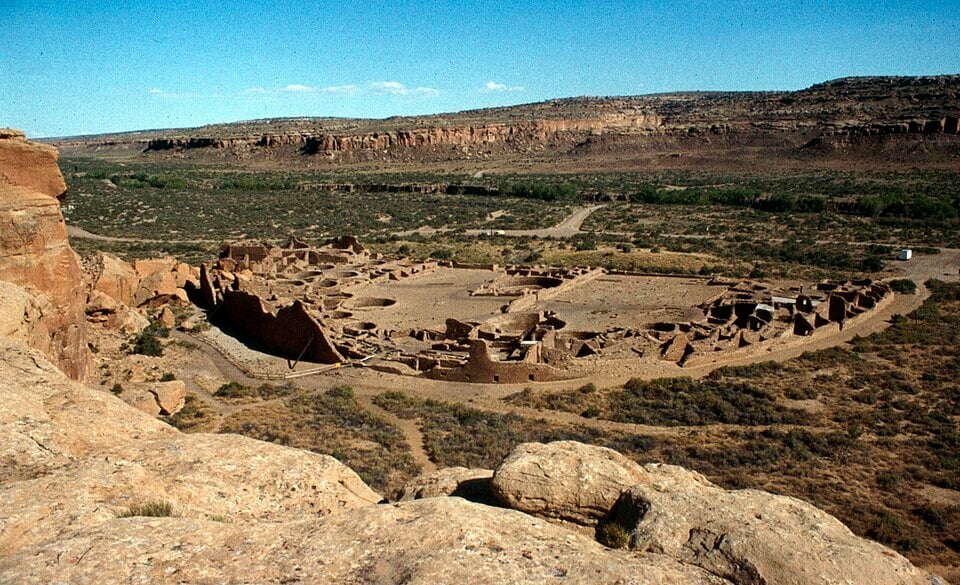
The assault on Chaco Canyon, Bears Ears, and other sacred lands is a blatant continuation of America’s centuries-long campaign against Native people.
On July 13, 2026, the Trump Administration announced that it would be cutting a cumulative 2.93 million acres from Grand Staircase-Escalante and Bears Ears National Monument, reducing the former to a mere 181,500 acres and the latter to approximately 121,000 acres. Under the umbrella of "common sense land use," which aims to prioritize the resources on or beneath the land, over its cultural or natural significance, the White House wants to open these sacred sites to massive logging, mining, and of course, the crème de la crème of U.S. Imperialism...oil and gas leasing.
In his, frankly cartoonishly evil announcement, Trump mocks the Biden Administration’s 2021 description of these ancestral homelands, calling the region “generic” and not “worthy of protection”:
Proclamation 10285 protects various generic features and landscapes found within the Bears Ears region, such as “deep sandstone canyons, broad desert mesas, towering monoliths, forested mountaintops dotted with lush meadows” and “low bluffs and high mesas.” While scenic, these generic features are not “landmarks,” “structures,” or “objects of historical or scientific interest” worthy of protection under the Antiquities Act.
A day later, the administration announced plans to slash protections for an important buffer zone surrounding Chaco Canyon in New Mexico, opening the land to, you guessed it, even more oil and gas leasing. If approved, the still-protected area of Chaco Canyon—which is a UNESCO World Heritage Site, a sacred ceremonial site for the Pueblo Peoples for over 2,000 years, and which contains evidence of human occupation dating back to 900 BCE—will sit directly next to these new extraction sites, causing irreversible damage. The administration's contention that Chaco Canyon, Bears Ears, Grand Staircase-Escalante, and surely future sites on the executioner's block, have no "historical significance" is false. They are important not only to our American history, but humanity's. To add insult to stupidity, the administration then limited the public commenting period on their decision to 14 days. To put this into perspective, the average commenting period is between 60 and 75 days. Boy, oh boy, do they want to lease that land, and boy, oh boy, did they anticipate that people would have something to say about it.
They were right. Before the ridiculously short comment period ended, over 100,000 comments were left by people expressing their horror at the decision. And for good reason. As mentioned, Chaco Canyon is a remarkable space and its significance extends not only historically, but also culturally. The scenic vistas described by the Trump Administration as "generic" are, according to the National Parks Service, currently culturally associated with 26 distinct Indigenous groups. Modern Pueblo and Hopi people, members of the Navajo Nation, and countless more still actively use the site for private ceremonial rites. It’s not only a national monument to their history, or a statue. It is a living breathing space where modern Indigenous People practice their religion. Pillaging it for oil and gas is tantamount to putting a pipeline through the middle of The Vatican.
The outcry from Indigenous representatives and groups has been loud and swift, and reflects the continuing importance of these sites. Rep. Derrick J. Lente (D-Sandia Pueblo) said in a statement decrying this decision: "Chaco is not [...] an ordinary parcel of land. It is the ancestral home of our people, and a place of continuing ceremony and prayer." Davina Smith-Idjesa, a member of the Navajo Nation and the co-chair of the Bears Ears Inter-Tribal Commission, which has been effectively disbanded by Trump's decision, said “When I talk about Bears Ears, I’m not talking about a place I occasionally visit […] I’m talking about home—a landscape that continues to care for our people.”
Unsurprisingly, the federal government also did not consult with any of the tribes or representatives associated with these sites before deciding to gut them, even though they are required to obtain input. Emerson Hackford, a Bears Ears Inter-Tribal Coalition youth council representative, stated “one of my biggest concerns is the fact that zero tribal consultation was used during this decision. In these actions, there were no tribal representatives that were contacted, and the government is supposed to have an obligation to listen to us.”
We can add the gutting of these sites to the long list of times the United States has violated land treaties with Indigenous People in the name of “progress," or more accurately, resource grabbing, with zero regard for the consequences to a) the land itself, and b) the people connected to it. Trump's use of "common sense law," and its application to Chaco Canyon and millions of other public and sacred acres a month ago, today, and likely tomorrow, just recapitulates this shameful pattern.
There has been some excellent journalism regarding the disastrous environmental impact of gutting these spaces, and millions more acres already sacrificed for resource extraction. The leasing of these lands will not only poison these sacred sites, but also the Indigenous people who live around them. Diné community members have rightly raised concerns around this:
The pollution does not recognize boundaries—it moves through [the] air we breathe and water we depend on, placing the greatest burden on our elders, children,” said Wendy Atcitty, a member of the Eastern Navajo Huerfano community, in a separate release shared following the press conference.
The damage to the environment and the people living in the area cannot be understated. However, if we focus all our rage on the environmental issues, we risk sidelining another vital piece of this American tragedy—one that is perhaps harder to grapple with because it involves using a very contentious word that starts with a "g.” These aren't just attacks on public lands or the natural world. They are a continuation of the centuries-long American genocidal project against the Indigenous people of Turtle Island that began the moment European boots crossed the gangplank of whatever boat brought them here.
This is the legacy that millions of American citizens who are descended from white settlers, me included, must contend with in order to discontinue the work our ancestors started 400 years ago. We must reckon with the idea of "cultural genocide." The desecration of these sites should be framed in this way.
Genocide is at its core an attempt at the complete and total erasure of a targeted group. It relies not only on the type of physical violence listed above, but also on what Raphael Lemkin, who coined the term genocide, referred to as "cultural genocide." Cultural genocide includes the systematic destruction of languages, institutions, and heritage including cultural sites and importantly, in the case of Chaco and other sacred places, places of worship. As one of the many heads of the genocidal hydra, cultural genocide gets far less attention and was left out of the UN Genocide Convention in 1948. Maybe because it doesn't fulfill our obsession with gross voyeuristic physical violence. Maybe because if included, we'd have to admit that some genocides never ended. Violence can take many forms. There is no doubt in my mind that the Trump Administration's endangering of Chaco Canyon and other sacred spaces is an act of violence, and falls under the umbrella of cultural genocide.

Some readers may ask how we can call this genocide if the current administration isn't explicitly murdering Indigenous people. The intent to erase is, after all, a vital part of the definition. I know from my own family history that the intent to eradicate is so baked into white settler culture and our psyche that even if we don't realize it’s part of the motivation, it’s still there, writhing beneath the surface. Do I think that Trump, and whoever is puppeteering him as he his cognition fades, is twirling their metaphorical mustache when signing away Chaco Canyon explicitly because it'll erase the Indigenous further? Not really. But many descendants of white settlers believe they have the right to exploit these lands for profit because in their minds their ancestors "won" and the space is theirs. To them, the violence of the past is in the past. What's done is done, and they can't change it, why dwell on it? This is internalized white supremacy. We must admit that we are all settlers on this land. This fight has everything to do with us, and the legacy our ancestors left behind. I am writing this on a laptop purchased by the accrued interest from money made off of centuries of exploitation. Are you reading it on one as well?
The gangplank my murderous white settler ancestors walked down was part of a ship called the Arabella, which landed on the shores of Turtle Island in 1630. I am descended from several of the families onboard through my grandfather, and one more, Captain Edward Johnson, through my grandmother. My great-grandfather was so proud of these connections that he researched, wrote, and self-published a book called Roots of Malcolm Carnegie McKenna (yes, that Carnegie) on the history of our family and how it correlates to the history of the United States as a whole. This family history book means that, unlike many descendants of white settlers, I know exactly what my ancestors were doing, when, where, and to whom. There is no hiding from the fact that they were involved in the centuries-long genocide that followed their arrival. I concretely know that my family benefited from the dispossession and murder of Indigenous people.
Captain Edward Johnson went on to settle in the Massachusetts Bay Colony and is known as the father of Woburn, Massachusetts. He fought in the Pequot War and likely participated in the Mystic Massacre of 1637, where settlers targeted a Pequot fort containing mostly women, children, and the elderly. After killing those guarding the fort, they burned the members still inside alive. Those who escaped the flames were slain by the settlers waiting for them.
Around 100 years later another ancestor, this one on my grandfather's side, Joseph Weare, settled in Maine. After a family member was kidnapped and held in captivity (she was released unharmed), he enacted a vengeance against the Abenaki People who had taken her; it was so complete that an article published about him nearly a hundred years after his death said that he would be exclusively known forever as an "Indian Killer."
The acts of violence I listed above that my ancestors perpetrated are just two examples, and are recognizably genocidal. There is no question as to whether or not this was a genocide: murder, theft, and sexual violence that they and thousands of other white settlers engaged in. It looks nearly identical to what we watch on our phones happening in Palestine every day. If you are not like me, and there is no book proudly documenting your family's crimes against humanity, you still can't escape what settling a place actually looks like anymore. If you haven't seen footage of Israeli settlers violently occupying land they've stolen from Palestinians, then I suggest you open your phone. Or engage with the work of Current Affairs contributor Jasper Diamond Nathaniel, who is doing an incredible job documenting the violent settling of the West Bank. There is no hiding from this truth. If you are descended from settlers, which many white Americans are, go watch what your ancestors did.
The violence of those early settlers was codified by the U.S. government. It became perpetrated through policy. Examples include The Indian Removal Act of 1830 and the state execution of The Dakota 38 in 1862. This is a history we are mostly familiar with. Although I'd recommend reading An Indigenous People's History of the United States by Roxanne Dunbar Ortiz, and watching Raoul Peck's mini series Exterminate All The Brutes on HBO for a fuller picture. Be prepared, it's devastating. And it's not over. It continues blatantly with the ICE kidnappings of both Indigenous and non-white bodies and insidiously with the development of sacred land. Policy adapts its method of genocide until the erasure is complete.
My ancestors who moved farther West in the 1800s did not kill indiscriminately, as far as I am aware. However, they reaped the rewards of those who came before them. Yours did too. They built homesteads and towns, and contributed to new cities springing up on the land that had been “emptied” by the previous generations. Even if you're not descended from the original batch of monsters like I am, what mine did enabled yours to build new lives in America.

The land that new treaties promised the Indigenous was continuously stolen by the US government and settlers when the discovery of resources suddenly made it valuable. Violence usually followed. For example, gold found on land given to the Arapahoe and Cheyenne in the early 1860s brought thousands of white settlers to the Colorado Territory. We don't have to imagine what their arrival meant. It culminated in the The Sand Creek Massacre of 1864. As far as I know, my ancestors hadn't killed anyone outright in a generation or more and were not at Sand Creek. But they were around Colorado. I often wonder if they visited the Apollo Theater or one of the Denver saloons where, according to Dunbar-Ortiz’s book, Chivington's men proudly displayed severed Indigenous body parts: the trophies they'd proudly collected from the dead.
Even if my ancestors didn't witness the horror of Sand Creek, they directly benefited from the clearing of this land, as have I. They started companies and opened mines that sucked the marrow out of the land that their predecessors stole. They sold cutting edge mining tools designed to maximize extraction (some to companies in New Mexico). They opened a mine in Colorado on what had been Arapaho land. Eventually my great-grandfather, the writer of the infamous book, purchased a piece of property at the base of the Indian Peaks Wilderness on the very Arapaho hunting lands earlier settlers stole for access to gold. We own that land to this day. As a little girl, one of my favorite things was to roam around the nearly 1,000 acres looking for arrowheads belonging to a people who I thought existed in the distant past, but whose art hung on the walls of the houses my family built on their land. That land is currently under conservation. It cannot be developed or mined or hunted on. Our privately owned property is currently more protected than Chaco or Bears Ears or Grand Staircase. Of course it is, it was bought and owned by settlers.
The leasing of these sacred Indigenous spaces should be framed as the direct attempt to erase the cultural and spiritual identity of thousands of Indigenous People. People who have survived over 400 years while being targeted for extinction by the most violent empire in modern history. They deserve our respect, our support, and our action. We must ask ourselves, why destroy this place? What purpose does it serve? If dealing another crushing blow to the Indigenous People who derive immeasurable value from the continued connection and use of the land in question isn’t part of Trump’s underlying intent, then what is? As U.S. Rep. Teresa Leger Fernández, whose district includes Chaco Canyon, points out here:
A molecule of gas from Chaco is the same as a molecule of gas outside that 10-mile buffer zone,” Leger Fernández said. “That molecule of gas could be easily, easily developed outside and without disturbing the 4,700…archaeological sites within that 10 miles. If we let the bulldozers of the oil and gas companies destroy any of those 4,700 sites, they can never be reconstructed.
They could easily mine elsewhere. So, why here? The answer is erasure.
As Davina Smith-Idjesa, co-chair of the Bears Inter-Tribal Coalition, said in a statement on the removal of tribal seals at Bears Ears:
They may be able to remove the signs and take down the Tribal seals, but they cannot erase who we are, our connection to Bears Ears, or our responsibility to protect it (...) Bears Ears remains a living cultural landscape, and our commitment to this place continues.
Bears Ears lives, Grand Staircase-Escalante lives, Chaco lives. Those of us who are the descendants of white settlers must also commit to protecting these places. Not just because they are beautiful and because it would be disastrous for the environment and the physical health of the communities living nearby if these extractions continue, but also because we no longer want to be complicit in cultural genocide and the way it fits into the existing American Genocidal Project. We should not want to continue the barbarous work that our ancestors started the second they set their eyes upon the coasts. It is past time to acknowledge the horrors that our presence on Turtle Island have caused, and commit to not continuing that legacy. We must stop looking for arrowheads and start looking at the actual living breathing people begging us to listen, to help.
While the absurdly shortened deadline for public comments on the opening of Chaco, Bears Ears, and Grand Staircase-Escalante has passed, the BLM hasn't decided whether or not to move forward with the project. They are currently weighing three different options: "no action,” in which the buffer zone would remain, accepting the “proposed action” (this is the worst case scenario, in which the entire buffer zone would be opened), and a third option that would open up only five acres instead of 10 (this is better, but still very bad). It's not too late to make your voice heard. Legal challenges to these decisions are expected. There will be protests you can attend. This project never should have gotten this far, we can’t let it get any further. So what now?
Follow Indigenous organizations and creators like NDN Collective. There are excellent Indigenous lead resources out there for how to organize against genocidal land grabs like these. Take their lead. Do what they tell you to do. There will be other sacred places added to the buffet of protected land that the Trump Administration is currently offering up to oil and gas companies. Earlier this month, they proposed a new open mining pit for rare earth elements in the Bear Lodge Mountains in Wyoming, mere miles from Mato Tipla (Bear Lodge). Public comments are open here. The deadline to comment is August 28. It's not enough to just be ashamed of our ancestors. We must act, we must do better.

%20(crop).jpg?width=352&name=wile-e-coyote%20(resize)%20(crop).jpg)