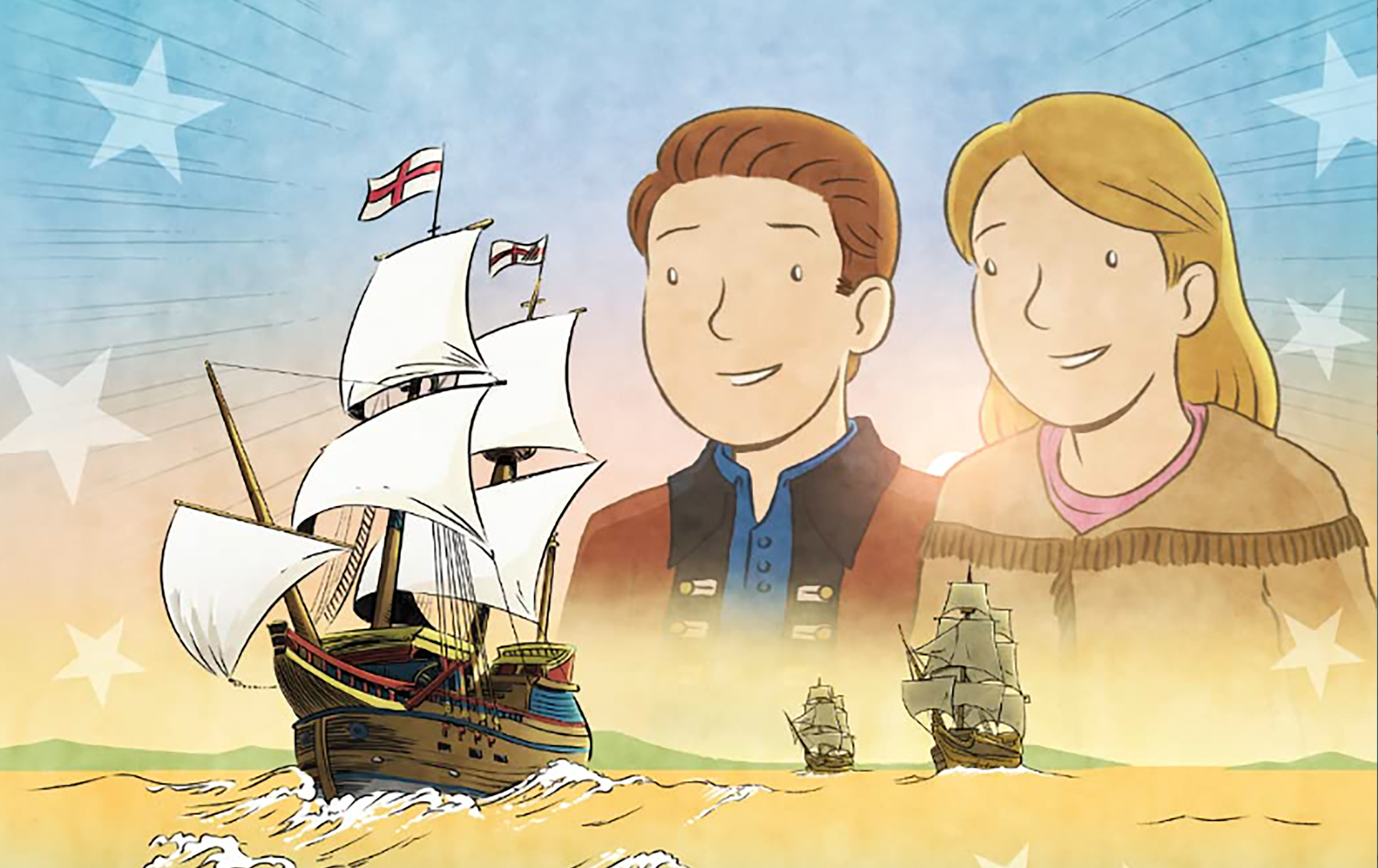
Back in the plague year of 2020, the disreputable socialist magazine editor Nathan Robinson sent me a heavy box filled with heinous libertarian children’s books. The books follow the adventures of Emily and Ethan Tuttle as they learn conservative life lessons. I read many of these and wrote a very slightly critical review, and the Right actually took unusual notice. The Foundation for Economic Education, which pushes for more free-market instruction in schools, published a response that didn’t actually reply to the criticism but instead focused on the review boosting Tuttle Twins book sales. CATO, the great Koch-founded libertarian think tank, shared the story. Nathan observed that frequently “the Right has money, not arguments.”
Since then, series creator Connor Boyack has been expanding his Utah operation, now producing full-scale school textbooks, to be assigned in the more misfortunate school districts. So now, for Current Affairs’ 10th anniversary, I give you a thorough review of America’s History vol. 1, 1215-1776: A Tuttle Twins series of stories. Does it encourage little kids to accept the most conservative version of historical events? It sure does. Is it rich in just embarrassingly ill-attested economic dogmas? You know it is. But for all the book’s features, it strongly shares one quality with its Tuttle-themed predecessors. It is really, really bad.
Critical Stinking
The 240-page book is intended as a supplement to conventional history textbooks, and is formatted like one, but with illustrated stories rather than historical narrative. The book claims that rather than focusing on dates and other “factoids” of history, we should instead focus on the ideas the U.S. was founded on, which apparently aren’t covered enough in traditional school-board approved textbooks. The books aim “to make history relatable” to kids, and if you read the last review, you’ll know how successful these books were at doing that for economics.
In the book, the Twins are consumed with excitement for “lessons” about America’s colonial history, mainly from their eccentric uncle, who likes to cosplay and develop elaborate physical challenges that teach the twins historical lessons. They learn how great it is to engage in trading goods by exchanging plates of food at dinner, how great and scary the ocean voyage was for early colonists by a long hike through a forest, carrying grains of rice to simulate the tiny ships. But page after page is devoted to the standard historical treatment familiar from the earlier books, where all history is made up of free people who just want to engage in trade and improve their lives, pitted against awful government tyrants who want to stop it in order to control people. Very quickly the standard black-and-white historical struggle between free trade and Big Government is developed, leaving aside the complex relationship between states and trade, which historically has often included using military force to open up markets for favorable commerce.
The setting varies. In one scene in the textbook, the kids drowsily watch a political debate on TV news, and then dryly discuss politics with their father. This, in a book kids are supposed to read. They talk about how to define the words “conservative” and “liberal” in the standard hoary libertarian way, but how kids in a classroom are supposed to enjoy reading about kids watching the news is beyond me.
One of the book’s worst features is the truly abysmal joke panels. Like many textbooks, small side-panels on history and other themes dot the text, including pieces by the main illustrator with jokes in them. My dear lord, I apologize for my actions in a past life that led to my deserving to read these. There is not much worse than really bombing with comedy, and let me tell you, this book goes on a Vietnam-level bombardment campaign.
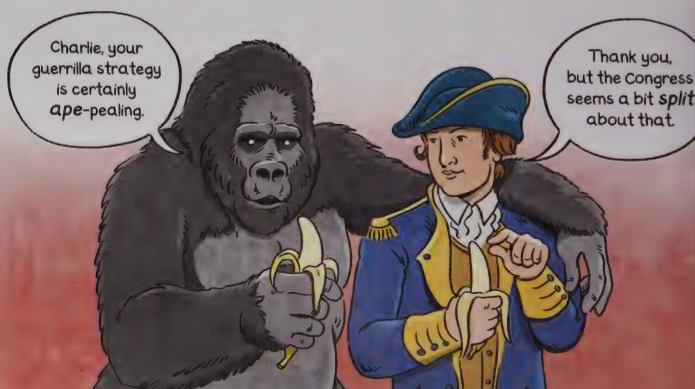
An uprising against the tax collectors of the Stamp Act depicts a torch-wielding farmer crying, “The only thing getting stamped today are his hindquarters!” In a section on colonial guerilla warfare, the page includes an illustration of a gorilla holding a banana and telling a colonial leader “your guerilla strategy is certainly ape-pealing,” while the general replies, “Thank you, but the Congress seems a bit split about that.” Not just puns, forced puns. And I know this is for kids, but it’s also annoying how much “it’s for kids” has come to mean “who cares if it’s any good at all?” And who knows who to even blame for these jokes, since this book lists a number of bad story contributors and awful content consultants?
I feel bad bashing an artist, in this case series mainstay Elijah Stanfield, but my God does this larger format show off his just utterly flat and lifeless art. Whole-page drawings with the dynamism of a greeting card, thematic illustrations taking just the most obvious and literal approach thinkable, action shots stiffer than a singing Republican. A number of chapter-page illustrations have more power, and I will say Boyack and Stanfield are well-matched. Ultimately the planar-flat affect of the earlier series of books is pitch-perfect throughout this new volume. Very poor.
Taking Geno-Sides
The treatment of Native Americans is arguably a rather significant subject in America’s history, and yet quite little about it appears in America’s History. Natives are usually mentioned sympathetically, but very briefly, as when the family notes that “there were people already here—all of the natives—and some of them thought the colonists were a threat to them.” Another adds “But some didn’t[…] Thanksgiving. There were some natives who helped the colonists.”
One striking moment comes when the kids are learning about the French-Indian War, in which the British and French colonial governments enlisted some Native American tribes to fight one another. The uncle’s retelling of the story to Ethan and Emily features one of the few actual on-page depictions of violence, including a lurid illustration, which makes sense when describing a war. However the depiction is not of the great expulsion and elimination of the many pre-Columbian civilizations of North America, it is of course an illustration of a native killing some poor Europeans.
The conflict begins when the French claim rich Ohio river valley land that was already claimed by colonial “land speculators,” and we learn a speculator is just someone who is “Guessing about the future value of something,” and therefore it’s “like investing.” The competing French and colonial claims lead to conflict, with George Washington leading a detachment into the valley since his family was one of the wealthiest speculators: “the Washington family believed the Ohio River Valley was going to be part of the colonies; so claiming it, and selling it to the new settlers, would make them very wealthy.” So war it is, to protect a rich family’s wealthy property bets!
The Americans (good colonists) heroically defeat the French (bad colonists) with native help, but then we learn the treacherous native leader was “only using the Americans so he could get revenge on the French.” What a native leader could want revenge against the French for, we don’t learn in this alleged history book! But even though the French had surrendered, the “warriors killed Commander Jumonville and other Frenchmen with their tomahawks before Washington could stop them.”
The illustration itself shows a victorious native holding up a bloody knife surrounded by corpses, while the kids look on in horrified disbelief at the violence. In the description of the battle, Emily says, “I don’t like to hear about George Washington killing people.” This is a bit laughable, especially in the context of a depiction of horrible Native American violence, since Washington is recorded as being nicknamed “Conotocaurius” by the Iroquois people, which is commonly translated as “Town Destroyer” and was sometimes used by Washington himself. One wonders if the author is actually unhappy to hear about Washington killing other white people. The twins agonize over the Boston Massacre, but the book has no room for the kids to learn about, for example, how many native peoples were removed from their lands in the period described, like the literal Massachusetts, being the Massachusett tribe which now barely exists but whose name we took, along with everything, everything else.
Most importantly, the fact that all this land being “claimed” by European empires or local settlers was long-occupied isn’t really engaged with. The natives “lost,” as Ethan says at one point. Another story describes how for Western explorers, “America was even better than China because there was nearly endless land for planting valuable crops.” Endless land! Unencumbered, one gathers, by an existing civilization such as China! A Native American does appear later in the narrative, as we’ll see later disgustingly, but certainly nothing like ethnic cleansing campaigns or genocidal violence disgraces these pages.
For all its specifically libertarian pretensions, like many such projects these plain biases and omissions of the less savory portions of U.S. history are just those of any conservative retelling. Huge-scale cruelty and atrocities to civilians are glossed over, with the book briefly acknowledging slavery was bad before returning to some reheated version of “But the ideas of free trade in America are so great and unique.” This frankly could be any forgettable Texas State Board of Education-approved jingoistic right-wing gloss. The classic insufferable libertarian flavor of smug “classical liberalism,” with its characteristic one-sided cosmetic thinking, isn’t always distinctly detectable in this format, although it certainly breaks through as we’ll see. But this section sets the standard for the original sin of U.S. history, and that standard is the ethnic cleansing of the truth.

Ill-Gotten Gains
Much like its strained predecessor volumes, America’s History is full of lengthy segments in which characters recite the libertarian political views of the author, similar to the landmark insufferable style of Ayn Rand’s “novels.” One early historical theme the book reasonably describes as greatly shaping early America is trade, the simple exchange of goods among peoples. The early trading routes of the Silk Road improved people’s lives, and “everyone was happy,” unless governments got in the way.
Trade and commerce are said to arise naturally because of the benefits they bring, which we economists call “gains from trade.” If we can exchange different kinds of goods for one another, people who are good at doing one kind of job or making some kind of product can specialize in it, which means they’ll have higher productivity than if they had to make each thing themselves. So trade is good because it gives us variety and more needful things to go around! To economists, this legitimately strong argument for trade among people is then used to justify any expansion of trade of any type.
But a less-celebrated feature of commerce is the “terms of trade,” the question of how many of my products for how many of yours. Maybe our terms are one-for-one, exchanging equal amounts of our valuable goods. Or maybe my goods are rarer, or more of a necessity than yours, and maybe I can get two of your goods for each one of mine. Or maybe I’m a trader who’s part of a large empire who took over your country and incorporated it into their colonial system, partially in order to inflict unfair terms of trade on your people. This latter, very natural feature of trade is seldom discussed by economists, perhaps because it suggests that some trade may not benefit both parties.
The Tuttle family teaches the kids that “as long as everyone traded fairly—or at least somewhat fairly—everyone got something.” That’s enough engagement with that threateningly inconvenient idea!
In most history and economic textbooks, including the one I teach with, the concept of gains from trade is included and explained at length, but not terms of trade. It’s in line with the mainstream economics field’s strongly pro-trade and pro-capitalism bent. This book continues that long tradition, but it’s for kids with fewer means to intellectually defend themselves, so it’s more icky.
Think For the Children
But cruelly, the kids’ history lessons are interrupted. They watch the town parade, noticing how solemn the military veteran marchers are and the deep respect they get from the crowd. But then! Unspecified protestors! Who are just in the parade somehow! Their signs say “Social justice now!” and “Still colonizing my land” and “Fascism in the USA!” The crowd doesn’t like them as much as the frowning vets, and heckles them. Ethan says “It’s pretty sad that some people are still focused on being so divisive and causing problems.” In another National Book Award-deserving passage, “Even the bright sun seemed a little less warm, as if a cloud had covered it.” Pretty cheesy, although I do like that the illustration of this moment shows a classic car filled with leftist protesters, and the car has tiny red and black flags on the corners of the front hood, similar to the U.S. flags on the presidential limo. Like the President of Socialism is in the back.
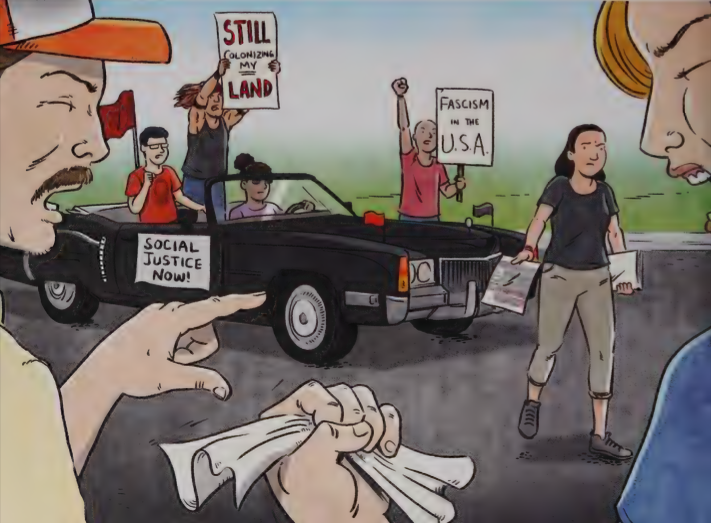
But the damage is done, as the kids have briefly encountered the threat of divergent viewpoints. Emily is especially devastated (as depicted in an artful rendering) by a “pamphlet” which contains things that apparently don’t deserve long illustrative lessons taught by eccentric uncles: “Slaves being sold. Treaties being broken. The Trail of Tears. The first slave ships.” Few of these things appear in the main book, but they turn up in this end-of-book story in the form of gate-crashing leftists. And I quote, “Where once the whole community had been chatting and laughing and cheering together, now some of them were quite sad.” This is made more offensive by the contrast of the rest of the book’s tone, which is one of prideful gratitude for living in a strong free country. Happy feelings now dashed!
Now, slavery is of course mentioned in the book, but mostly in passing. The exception is an early sidebar, a whopping two-pager, with the standard diagrams of nightmarish slave ship holds and the cruelty of slave auctions. The section grudgingly admits there developed a “market for slavery,” but this is immediately accompanied by the standard conservative framing of how historically and globally common slavery was, so it’s not so bad. The long chapter with the kids carrying rice through the woods, to conceive how far the colonists traveled, is not accompanied by another one in which the kids make the same journey shackled in a box.
After being at last confronted with a vague pamphlet’s-worth of this history, Emily sits alone in the woods, struggling with the vague leftism she has encountered. But she’s reassured in her flag-waving libertarianism by a Certain Kind of person. Readers of my review of the original Tuttle Twins series may recall its conspicuous tendency to anchor many of the longer political discursions on freedom and economics in the mouths of African-American woman characters. In the last review I referred to the many, many times this was done in just the portion of the Twins books that I have read (which is far from all of them).
The kids learn about markets from their teacher, a woman of color, and later about freedom from another Black woman when the government shuts down a market, and yet later in a choose-your-own-adventure format text yet another Black woman explains development economics. The authors of the series, of course, are highly white gentlemen from Utah. The trope was so gross, and so frequently repeated, I joked with my friends about whether this pathetically contrived feature of the original series would return in the textbooks. And it did!
But now this same embarrassing hand-puppetry goes further, showing that writer Boyack has really grown as an artist. This time the child is comforted and helped to still love America by a neighboring couple, the Miners: a Black woman and a Native American man! And both of them really don’t want to see a middle-class white child feeling sad when talking about what was done to their ancestors.
The resolution comes when the Black woman gestures to Emily and the holiday park-goers, “Are you going to do terrible things to me?[…] Are any of these other people? Most of them are white.” The answer of course is no, and folks, we leave it at that! No one you know is being actively enslaved or physically assaulting Black people, at this time, so no need to think about the legacy of this for a race of people still kept so outrageously low on every social and economic indicator relative to the white majority. (To say nothing of the full damn century after emancipation when Black people were still, in practice and law, second-class citizens and occasionally lynched.) This allows the BIPOC Miner family to celebrate America “because this country’s founding principles are worth celebrating. Even with the horrible things that happened—and they were horrible—it’s still worth taking a moment to celebrate what was good.” No lynchings literally today, no problem!
Interestingly, in a later between-chapter note including an unrepresentatively handsome rendering of himself, writer Boyack notes: “What I do think is important is that we not justify bad things in the past because good things came about because of them. The ends don’t justify the means.” The reader can judge if the present work achieves this balance.
Here on planet Earth, self-identifying “Libertarians” are over two-to-one male, and a whopping 94 percent white. Meanwhile African Americans are in fact the most socialist bloc of the whole US electorate, with 60 percent expressing support for (an undefined) socialism in an Axios poll. This yearslong, ongoing right-wing depiction of Black women, vanishingly small numbers of whom are actually libertarian, is really gross. Please stop it Connor, seriously.

Cut to the Fireworks
In the rousing conclusion, the kids celebrate their American freedoms at a picnic with fireworks. We find again that for all the endless salty libertarian antagonism to The State, there is a strong vein in the movement that does see the U.S. as unique in its baked-in constitutional protections for markets and free enterprise, through the Constitution’s well-established anti-majoritarian, pro-owning class structure.
It’s useful to keep in mind the common picture of the left- vs right-hand of the state. This common metaphor conceives of the state’s left hand as representing popular, leveling leftist-type policies like universal health and school benefits, and equalizing incomes. The right represents conservative goals of law and order and a strong national defense. Libertarians theoretically oppose both “hands,” but consistently line up with standard conservatives in favoring the right hand over the left, when it comes down to it.
On the one hand, taxes to pay for universal health care and small pensions to grandmas are a heinously illegitimate death penalty-deserving offense to principle. On the other, taxes to fund cops and the military, well, some of those are needed to protect our nice property, and maybe also pry open foreign markets to sell goods to foot-dragging foreigners. Although libertarians do tend to have a change of heart when it’s time again to bail out our banks and funds when we have another giant market bubble and crash every so often.
Boyack leaves us on an inspiring note, stating what he feels is “the lesson: we have to work with what we have[…] Even if we want to make bold steps forward for freedom, we have to start somewhere. And sometimes we have to start in circumstances that are less than ideal—such as in a state that has high taxes and regulations, in a community full of socialists, in a school with authoritarian teachers, or in a family that doesn’t believe in freedom.” What a smug dick!
I will conclude this review by saying the Tuttle Twins U.S. history textbook supplements are among the most grotesquely sanitized, lopsidedly biased, painfully unfunny, grossly contrived and abjectly reactionary sacks of crap ever stuck between two covers. The series continues—an animated TV series is in its third season—and may be further reviewed in these pages, but this continuation shares its core character with the original Tuttle book series: It is very bad.
I wash my brains of it!
Rob Larson is a Professor of Economics at Tacoma Community College, author of books including Mastering the Universe, Bit Tyrants, and Capitalism vs. Freedom, and is the House Economist at Current Affairs.


%20(crop).jpg?width=352&name=wile-e-coyote%20(resize)%20(crop).jpg)