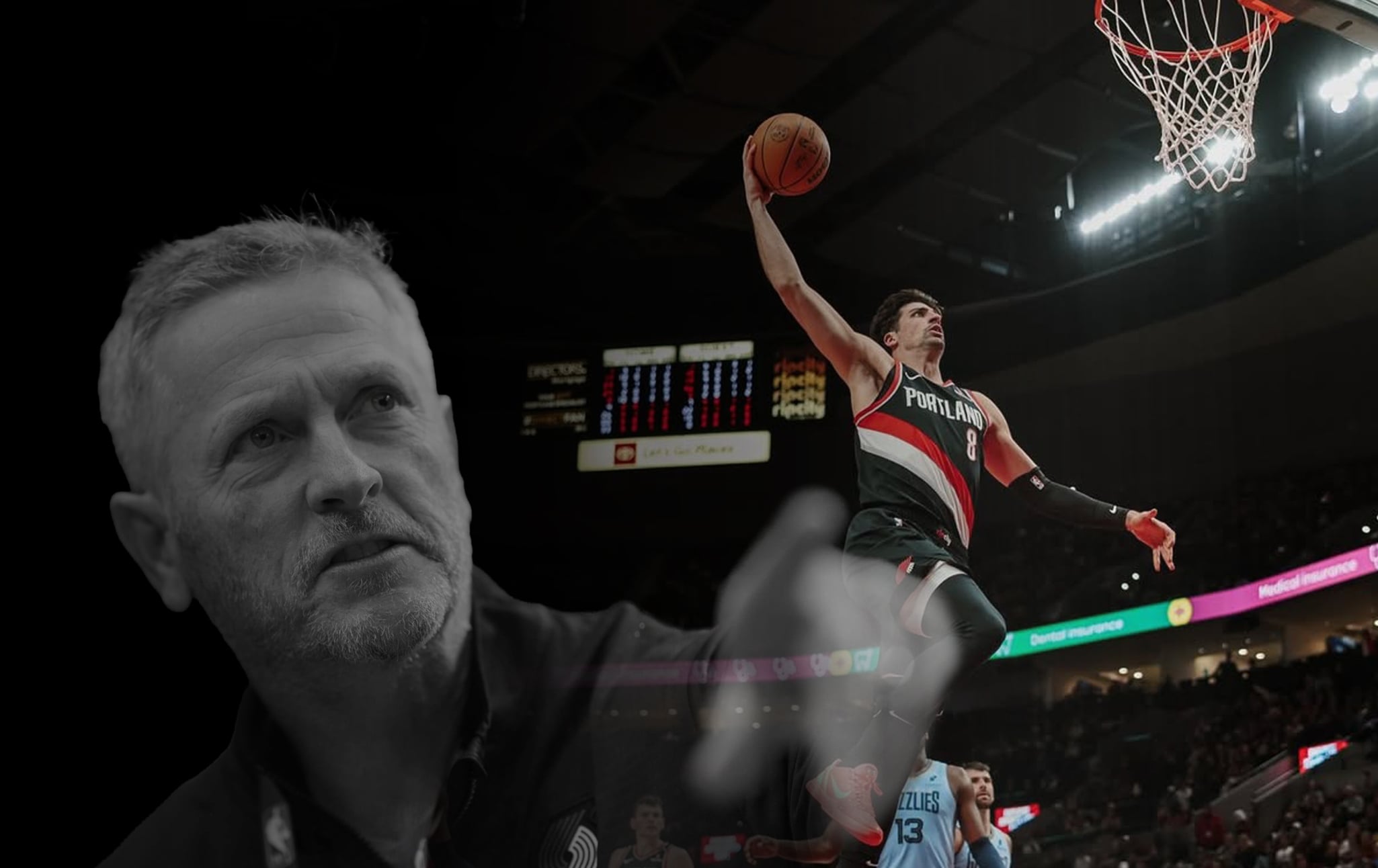
Ultra-rich owners think purely in terms of money, and they don’t care about players, fans, or the cities that support them. The Trail Blazers’ Tom Dundon is just the latest example.
Just weeks after Texas-based, shady car loan magnate Tom Dundon bought the Portland Trail Blazers, stories of his outrageous cost-cutting decisions quickly broke containment from the Pacific Northwest. Every national sports media outlet covered Dundon’s baffling measures to save himself a few bucks, which included making the team and staff wait hours in a hotel lobby to avoid late checkout fees, leaving part-time players behind in Portland while the team traveled to its playoff series in Texas, and angling to pay a potential new coach about 75 percent less than the going salary for other coaches around the NBA. (That potential coaching search would also ignore the opinions of the actual Blazers players, who have advocated for the team to hire interim head coach Tiago Splitter full-time.) Dundon has alienated himself from the team, city, and fans in record time.
Dundon has a personal net worth estimated around $2.3 billion, and he led a purchasing group that bought the team for over $4 billion, but as soon as he secured control, he started acting like a man desperately trying to avoid a bank overdraft fee. Trust me, I know how someone in that position acts.
Typically, the shady moves a billionaire makes after buying an NBA franchise don’t qualify as national interest stories. Team owners usually try to do their business behind the scenes, and while fans in the cities where these owners operate often hold strong sentiments about the oligarchs lording over the local team, most casual NBA fans would struggle to name more than ten owners league-wide, much less the specific ways in which they operate.
This was different. Fans in Portland are aghast with Dundon’s seemingly pointless cheapskate strategy, and the disdain has spread across the country. Numerous friends of mine who have never entered the state of Oregon (the place I have lived for most of my life) have reached out to ask my opinion on Dundon’s almost unprecedented stinginess. And while there isn’t an official metric that tracks the approval rating of NBA owners, I am confident in saying that early polling on Dundon from the people of Portland would not be flattering.
Dundon’s fast track to being roundly hated by fans, players, and team staff (of which he recently laid off 70) alike, is a story that shows how sports, like the United States as a whole, are at a class consciousness crossroads. The ruling class has more power over our lives than ever before, while simultaneously facing more scrutiny than at any point I can remember in my near-30 years of living. In large part, that frustration with the mega-rich among sports fans stems from a burgeoning lack of accessibility to sports for working-class people. Ticket prices continue to increase, streaming services continue to make watching live games bizarrely difficult, and youth sports have been almost completely overtaken by private equity. Earlier this season, NBA Commissioner Adam Silver said, in effect, watch the highlights and shut up if you can’t afford to watch games.

With anger among NBA fans bubbling, it’s no surprise that when a multibillionaire like Dundon started cutting corners as if he’s the one unable to afford fandom, that frustration exploded. Fans and local media in Portland immediately called him on his bullshit—and these moves are absolutely that. Not only are they infuriating, they’re also nonsensical.
On January 22, Trail Blazers rookie guard Caleb Love scored 20 points as the team blew out the Miami Heat, marking the Blazers’ ninth win in their previous 11 games. Love had suddenly become a cult hero in Portland—he went unselected in the 2025 NBA Draft, and the Blazers basically picked him up off the scrap heap before the season began. After injuries to players ahead of him on the depth chart, Love was forced into action and delivered hugely for the Blazers during the doldrums of an 82-game NBA regular season. Without his contributions, the team, in all likelihood, would not have made the NBA playoffs.
Because Love is a “two-way” player, someone who suits up for both an NBA roster and the franchise’s minor-league affiliate, he wasn’t eligible to participate in the team’s playoff games. Still, it’s standard practice for two-way players to travel with a team to their playoff series; just being on the bench is an invaluable experience for young players. This year, 15 of the 16 teams in the playoffs brought their two-way players on the road. Take a wild guess who the 16th team was.
Not only is this petty, saving Dundon literally a few thousand dollars at most, it’s also actively harmful to the on-court development of young players in the Blazers organization. Love may not be an integral part of the Blazers’ future plans, but there’s no harm whatsoever in seeing if he can develop into a consistent contributor for the team. Not letting him travel and experience a playoff series firsthand is a clear sign that ownership doesn’t care enough to try. Only after public backlash did Love and the team’s other two-way players travel with the team the next time they traveled for road playoff games. In other words, fan pushback immediately forced Dundon’s hand.
Not letting a player travel with the team may sound like small potatoes in the grand scheme, but I believe it shows that Dundon is going out of his way to make a point. Of all the moves he’s made so far, this one illustrates plainly that his “cost-cutting” isn’t rooted in any real plan. He, like his fellow billionaires both in sports and outside of them, make decisions that are built on a foundation of contempt for the average civilian. Not as part of some grand strategy, but because reminding us that they’re in charge is equally as important to them as the results of the moves they actually make. As Dundon’s fellow billionaire Tim Gurner succinctly described a few years back, “There’s been a systematic change where employees feel the employer is extremely lucky to have them. We need to remind people they work for the employer, not the other way around.”
In fact, if Dundon does have a grand strategy, it may be the exact opposite of what fans hope. When a billionaire buys a franchise, they often make immediate, drastic changes to let the world know the team is theirs; basically marking their territory. Sometimes, those changes come in the form of dramatic roster moves, which Dundon has not-so-subtly hinted will happen this summer. Sometimes they manifest more nefariously, like relocating the franchise entirely—essentially stealing a team from a passionate fanbase and community to seek greater profit in other markets, a trend that has become all too common in sports. It happened to a few of Portland’s West Coast neighbors in the 21st century alone; the Seattle Supersonics were uprooted and moved to Oklahoma City in 2008, while the city of Oakland lost both its professional football and basketball teams due to callous ownership.
I don’t want to overanalyze the wardrobe of an aloof billionaire, in part because every one of them is hopelessly swagless. But less than 24 hours after buying the Blazers, Dundon donned a Hartford Whalers baseball cap. Some eagle-eyed fans noticed that the Whalers are the NHL franchise that relocated to Raleigh to become the Carolina Hurricanes, a team that was eventually bought by (buckle up) Tom Dundon.
The Trail Blazers have always dealt with the hardships of being a small-market NBA team. Only since Dundon took over, though, has the idea of relocation started to cause unease throughout the fanbase. Right now, the Blazers, the city of Portland, and the state of Oregon are negotiating funding to renovate Moda Center and get the team to sign a new lease to stay in the stadium where they have played for 31 years. In short, the fear of losing the Blazers has been stoked by Dundon’s refusal to finance those arena renovations. Instead of funding the project himself (Dundon did privately pay for a similar project in North Carolina after he bought the Hurricanes), he is asking that taxpayer money cover the entire cost, according to reporting from ProPublica and the Oregonian. It’s like a twisted episode of Bar Rescue in which Jon Taffer buys the entire restaurant and threatens to turn it into condos if the servers can’t pool enough money together to get rid of the black mold in the kitchen.
You’d be forgiven for believing that Dundon has a strange vendetta against Portland and its people. I can’t speak for the man—hopefully I can never, ever speak on behalf of a billionaire—but Dundon’s run-ins with the state began long before he bought the Trail Blazers. Before he was an NBA owner, Dundon was a co-founder of Drive Financial Services, a company that offered predatory, high-interest loans to individuals who the company knew would likely struggle to repay them.
The state of Oregon was one of 34 states that sued Drive Financial Services (by then renamed Santander Customer USA) and settled for $550 million in 2020, most of that money in the form of loan forgiveness for customers. According to ProPublica and Oregon Public Broadcasting, the state’s attorney general at the time, Ellen Rosenblum, said these loans were “Predatory and harmful and will not be tolerated in Oregon.”
In short, the state of Oregon told Tom Dundon he couldn’t make a fortune preying on poor people in need of car loans. Six years later, he bought the most expensive institution in the state, and has certainly not endeavored to dispel rumors of a potential relocation. This apparent conflict of interest was apparently a non-factor in the lead-up to Dundon buying the Blazers, a process that requires the approval of the rest of the NBA’s owners. This was either a massive oversight by the league and its owners or intentional carelessness. I’m not particularly eager to give 30 billionaires the benefit of the doubt here, especially because we know how billionaires stick up for each other before anything else, a truth that is especially evident within the coterie of sports owners.

Whether or not Dundon bought the Blazers out of some leftover resentment toward Oregon being one of many states that sued the company he used to run, it’s alarming that someone who clearly operates with little regard for ethics, or the human cost of his business decisions, has been allowed to take over a team that means so much to the people of Portland. If he thinks it would make him more money, it doesn’t seem like he’d balk at taking the Blazers away from Portland entirely, and private ownership being what it is, there are essentially zero guardrails to stop that.
This all may sound like the plot of a straight-to-Tubi movie, but it’s not uncommon for owners of NBA teams to treat the franchise like nothing more than a business, as Dundon appears to be doing. A poorly-run business, for the record, but a business nonetheless. It’s highly frustrating, yet perfectly representative of why billionaires shouldn’t have a place in sports at all: their goals have nothing to do with the aspects of sports that actually make them important in the world, community-building being at the forefront. Fans see sports teams as an integral part of the fabric of their cities, offering a collective interest between people who may otherwise not share much common ground. Dundon and owners like him, on the other hand, see only investment opportunities, bottom lines, and returns on investment. The chasm between what owners want out of sports and what fans do is wider than ever, and it has led us here, to a world in which billionaires view fans as an obstacle to their goals, rather than the most essential part of sports.
An evil sports owner is not a novel idea. They’re everywhere. Don’t be alarmed, but there is probably one in your city right now. Admittedly, Dundon’s penny-pinching pales in moral comparison to the actions of other powerful NBA figures. Josh Harris, owner of the Philadelphia 76ers, is a mainstay in the Epstein Files and was spotted sitting courtside at a 76ers playoff game with Trump administration commerce secretary Howard Lutnick. New York Knicks owner James Dolan uses staggeringly invasive facial recognition technology at Madison Square Garden to, essentially, keep tabs on people he presumes to be his enemies, including transgender fans who he doesn’t want to appear on the TV broadcasts. Dallas Mavericks owner Miriam Adelson is perhaps the most well-known Zionist in the NBA and a mega-donor to Donald Trump. New Orleans Pelicans and Saints owner Gayle Benson was essentially working as a propagandist for the Archdiocese of New Orleans while decades worth of sexual abuse within the church was finally coming to light.
However, the immediate public backlash that Dundon has received from fans and media alike—which has been strident enough that NBA Commissioner Adam Silver was forced to answer on his behalf, on a Barstool Sports podcast of all places—is a new twist. Sure, progress toward shrinking the power of billionaires will come slowly until all NBA owners face as much scrutiny as Dundon has, but the overarching message here is clear: the people are sick of billionaires dictating every aspect of our lives, sports fandom included.
We have a long, long way to go in holding sports owners, and the ultra-rich in general, accountable for the direct and tangible ways in which they make our lives worse daily. There aren’t nearly enough calls for Harris, Dolan, or Adelson to sell their respective teams, for example. Adelson did face a deluge of public anger in February of 2025, but that was due to the franchise’s baffling trade of Luka Dončić, not her relentless support of Israel and Donald Trump. The trade was monstrously stupid, for the record, and did deserve backlash, but we need to keep the same energy when Adelson donates $250 million to Trump for his potential (and illegal) 2028 presidential campaign.
On a macro level, Dundon, Dolan, Harris, Adelson, Benson, and other owners are making it very easy to see how useless billionaires are as sports owners—just as they are as members of society. The lie that billionaires are necessary because they create jobs, or that we must sit and accept their rule because they’re the only people who can afford to buy sports franchises, has collapsed in on itself—not that it ever made sense anyway. No, billionaires don’t make the experience of sports fandom better. Instead, untethered power from the ultra-rich leads to teams being (potentially) bought out of spite, fans being tracked to the bathrooms by facial recognition cameras, and working-class folks being priced out of cheering on their team. When franchises succeed in the NBA, it’s seldom because of an owner’s leadership—it’s despite it.
These people make the experience of sports fandom tangibly worse for us all. A lack of privacy, a lack of community, and a lack of care for fans have become all too common, and it doesn’t take much mental gymnastics to assume there are even more abominable acts happening behind the scenes.
So, perhaps Portland’s treatment of Dundon can be a blueprint for fanbases elsewhere. He’s feeling the pressure of an angered fanbase, despite his ostensibly nonchalant attitude about the whole ordeal. And at the end of the day, public perception of an owner does matter in how they operate a team, and therefore how they operate in the world. Fans have strength in numbers, and the more fans refuse to accept the whims of a cruel owner, the more sports leagues will be forced to acknowledge behavior from owners that has long been swept under the rug or ignored entirely.
Thus far in his decade-plus-long tenure as NBA commissioner, Silver has forced the sale of two teams: Donald Sterling, who owned the Los Angeles Clippers, and Robert Sarver, who owned the Phoenix Suns, were both ousted by the league for blatant racism. Sterling, famously, was recorded telling his then-girlfriend not to bring Black people to Clippers games, and Sarver used slurs in public and implemented a pattern of vile misogyny within the Suns’ front offices.
Adam Silver bends the knee to team owners until his hand is forced, like it was with Sterling and Sarver. In his mind, he works for the owners, not the other way around. In reality, both Silver and the owners work for the fans. Without fan support, the entire operation crumbles. But even if that support is reluctant (because fans can’t imagine not cheering on their team), that’s good enough for Silver and the league. Reluctant support is still support, and professional sports leagues have never cared if league revenue is covered in blood or tears.

I am not naive enough to believe that fans protesting the billionaires who own teams will cause a change of heart among the ultra-rich and make them pure of heart. But there is reason to believe that, if a threshold for what constitutes an owner to be ousted by the league is more firmly established, then tangible change in how these billionaires act could feasibly be achieved through sports fandom. I pray that invasive facial recognition technology and numerous appearances in the Epstein Files would reach that threshold. When fans realize that their contributions are what keep these teams operating, the falsehood that owners can do whatever they please without fear of consequence disintegrates.
Forcing Sterling and Sarver out is the bare minimum. We all have rules at our jobs; repeatedly breaking those rules gets us fired. Apparently, the only rule that NBA owners have is don’t be outwardly racist or yell slurs. Outside of that, a fireable offense really hasn’t existed, and the treatment of fans has never been included in the league’s judgment of how well owners are performing in the cities of the teams they own—most of which the owners themselves don’t even live in, just like Dundon, for the record.
If that can change, and the standards of NBA ownership can be raised to include not being in the Epstein files, spying on people coming to watch their favorite team, or donating money to a genocidal apartheid state, it will be thanks to the efforts of fans – and nothing builds community quicker than a group knowing its opinion holds weight.
The fight against billionaires and the ruling class doesn’t stop when we sit down in arenas to watch our favorite teams. In fact, that’s one of the most important battlefields. The best (and likely only) way to chip away at the power held by billionaires in sports is by forcing them to see that the days of acting without consequence have concluded. Fans of the Portland Trail Blazers are taking the first step in applying that pressure on their new billionaire owner, who wants to convince you that he’s basically broke. This advice applies to any time a billionaire tells you anything, really: don’t listen.


%20(1).jpeg?width=352&name=euphoria-3%20(1)%20(1).jpeg)