The Pro Bowl athlete is standing up for Palestinians in Gaza, and exposing the NFL as a sleazy, amoral organization that wants its players under tight control.
There are a lot of ways to incur a fine in the National Football League. You might complain about the referees too much, like Kansas City Chiefs tight end Travis Kelce, or do a “shooting a gun” motion in your touchdown celebration, like Buffalo Bills quarterback Josh Allen. In more serious cases, you might get into a fight on the field or headbutt someone in a heated moment. The infractions vary from mild rudeness to actual assault. But in this year’s NFL playoffs, one player stands out from the rest, because he hasn’t done anything wrong at all. The only offense Houston Texans linebacker Azeez Al-Shaair is guilty of is speaking up for Palestinians in Gaza, and for that, he was fined $11,593 and threatened with ejection from a critical playoff game. It’s just the latest indignity from a multibillion-dollar sports league that wants its athletes to shut up, fall in line, and not do or say anything that might impact the flow of money—even when people are dying.
Azeez Al-Shaair has been putting his status as one of the NFL’s defensive stars to good use since December 2023, when he made headlines during the league’s “My Cause, My Cleats” promotional campaign. The program encourages players to create a custom shoe themed after a charity of their choice and wear it onfield; most people pick something worthy, but uncontroversial, like the YMCA or the Make-a-Wish Foundation. Instead, Al-Shaair chose the Palestine Children’s Relief Fund, saying he wanted to support the “men, women, and children being bombed [and] deprived of basic necessities” in Palestine.
The right-wing press wasn’t happy, with Breitbart publishing a snide article that accused Al-Shaair of “thinking only Jews are to blame” for the bloodshed in Gaza, all but calling him an antisemite. Undeterred, he brought back the Palestine cleats for the 2024 season, this time with a more elaborate design: the word “FREE” in the colors of the Palestinian flag on the outside of each shoe, with a smaller message on the interior, tallying “at least 41,788 Palestinians killed, 10,000+ estimated to be under the rubble, 96,794 wounded.” In February 2024, he also became one of only two active NFL players to join the international Athletes For Ceasefire campaign (the other being Eric Kendricks of the San Francisco 49ers). More recently, he’s also visited Gazan refugee families at a Houston hospital and invited their kids to visit his home stadium. Again, there was a media backlash, as conservative activist Brigitte Gabriel said Al-Shaair should be “banned from the NFL for wearing pro-terrorist cleats” and the Washington Free Beacon accused him of spreading “Hamas propaganda.” But it wasn’t until this year’s playoffs that the league would actually punish him for his activism.
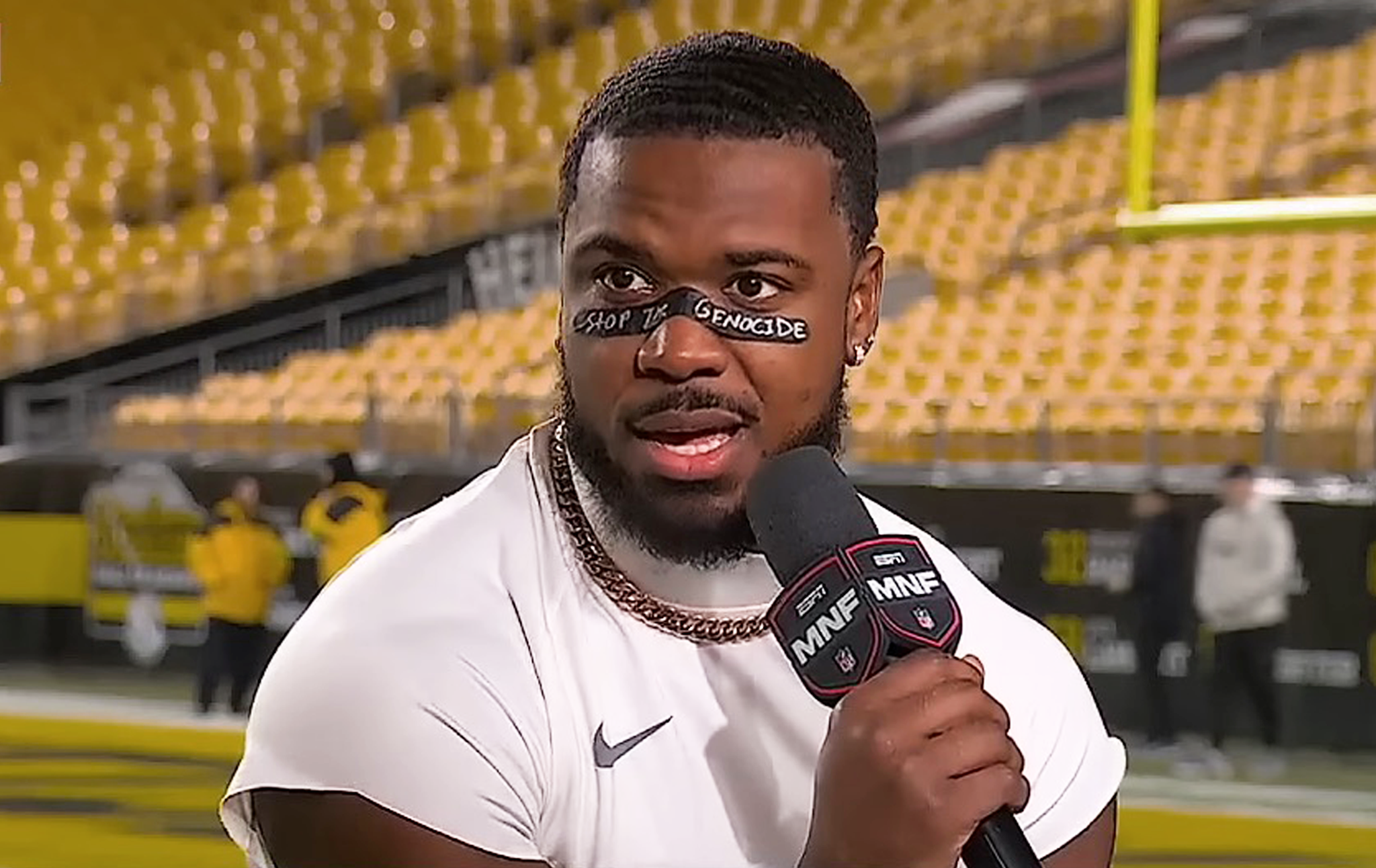
An estimated 29 million people watched the Monday night playoff game between the Texans and the Pittsburgh Steelers this month, and Al-Shaair took full advantage of the national spotlight. When he stepped onto the field, he had a message written in silver on his black face paint: “STOP THE GENOCIDE.” He still had it on when ESPN interviewed him after the game, too, allowing everyone to get a close-up view. And soon afterward, the league slapped him with an $11,593 fine for it.
Now, the NFL has always been inconsistent, to the point of incoherence, about whether or not players are allowed to send a social, political, or religious message through their uniforms. In the past, they’ve both fined Steelers running back DeAngelo Williams $5,787 for writing “Find the Cure” on his eye makeup, for breast cancer awareness, while supplying his teammate Cameron Heyward with custom “Tackle Cancer” eye strips, encouraging him to wear them. They’ve fined Patriots receiver Stefon Diggs for writing Bible verses on his face paint, but “let it slide” when former Broncos quarterback Tim Tebow wrote them on his wristbands. The only coherent rule seems to be that everyone has to abide by whatever the NFL decides on a given day—and as Al-Shaair discovered, “STOP THE GENOCIDE” is a message the league doesn’t want to see.
Al-Shaair told the Houston Chronicle he knew the fine was coming, since he’d played with Diggs before when he was fined, and he accepted it:
“At the end of the day, it’s bigger than me[...] The things that are going on make people uncomfortable, imagine how those people [in Gaza] feel. I think that’s the biggest thing. I have no affiliation, no connection to these people other than the fact that I’m a human being. If you have a heart and you’re a human being you can see what’s going on in the world, and you check yourself real quick. Even when I’m walking off this field, that’s the type of stuff that goes through my head, that I have to check myself when I’m sitting here crying about football when there’s people dying every single day.”
For him, of course, $11,593 isn’t a big deal, since he signed a $34 million contract with the Texans in 2024. What surprised him, though, was when he tried to wear the “STOP THE GENOCIDE” paint again before last Sunday’s divisional match against the New England Patriots, and was told that if he did, he’d be “pulled out of the game.” That hadn’t happened to Diggs, and the only difference was that Al-Shaair’s message was specifically about Palestine. Ultimately, he wiped off the words in order to play.
The moral bankruptcy of the NFL here is stunning, when you stop to think about it. The league’s leadership is constantly saying football is not just a sport, but “a unifier, addressing key social issues and serving as a constant force for positive change.” They paint slogans like “END RACISM” and “CHOOSE LOVE” in giant letters in the end zones of their stadiums, encourage their players to get involved with local charities, and give out the Walter Payton Man of the Year Award specifically for off-the-field social responsibility. But their treatment of Al-Shaair reveals that it’s all a colossal PR scheme, with no real principle behind it. When it really matters—when children are being blown to bits with American bombs, deliberately starved, and denied lifesaving medicines—the league shows its true face, and steps in to punish one of the only players who speaks up about it. They only want the appearance of a “force for positive change,” not the real thing.

The obvious parallel is to Colin Kaepernick, who the league’s owners blacklisted at the height of his athletic powers nearly a decade ago. Kaepernick was an undeniable star, with a Super Bowl run under his belt—but he had the nerve to object, loudly, to the police murdering young Black men. He angered the more conservative elements of the NFL fanbase, so when he became a free agent in 2017, nobody would hire him. In the end, nothing mattered but money. Today, Al-Shaair is taking a real risk, because there’s nothing stopping the Texans owners from doing to him what was done to Kaepernick.
It all gets even sleazier, too, when you consider what the league is willing to put up with from its players when it’s to their advantage. Another former Texans star, quarterback Deshaun Watson, was accused of “sexual assault and inappropriate conduct during massage sessions” by more than 24 women back in 2022, and although he did get an 11-game suspension and a $5 million fine, he subsequently got a historic $230 million contract when he was traded to the Cleveland Browns. After the 11 games were up, Watson was allowed back into the league—where, given his track record, he creates an unsafe work environment for literally every woman he interacts with—and he’s still on the Browns roster today. So you can be credibly accused of sex crimes, and still be an NFL star in good standing. It’s only when you speak out against the killing of innocent civilians, whether by the IDF or U.S. police, that you’re on thin ice.
But then, none of this should be too surprising. We’ve known for a long time that the NFL is an abusive workplace, where a handful of ludicrously wealthy team owners and executives call all the shots, and the athletes who actually make the game worth watching have to obey, or else. Every time there’s an incident like this, it just drives home the fundamental unfairness of that private ownership model, and makes alternatives more attractive. And it makes the few players like Kaepernick and Al-Shaair, who are willing to go against that power structure for a higher principle, all the more valuable. Plenty of bigger stars could do what they’ve done, like the quarterbacks, and face less risk, since it’s harder to replace them. But they choose to keep their heads down, “stick to sports,” and keep collecting the big checks. In the face of Gaza, that’s not enough. In the future, everyone will be asked what they did during the genocide, and Azeez Al-Shaair is one of the few celebrities who will be able to give an honorable answer.