He’s a genuinely awful politician, and the arguments against a challenge don’t hold water.
Well, it’s official: Chi Ossé, the promising young socialist member of the New York City Council, will not be challenging Representative Hakeem Jeffries in the 2026 Democratic primary. Ossé had filed paperwork to run for the House, saying the “dire situation” brought on by a hapless Democratic leadership made the move necessary. But when the issue came up for a vote at a recent candidate forum for the Democratic Socialists of America, mayor-elect Zohran Mamdani personally intervened to warn against challenging Jeffries. Representative Alexandria Ocasio-Cortez weighed in too, saying a challenge would not be “a good thing right now.” As a result, Ossé’s supporters narrowly lost the forum vote, 626 to 555. For his part, Ossé says he’ll respect the result, telling the New York Daily News that “I have no intention of running this race without the support of NYC-DSA, of which I am proud to be a member.”
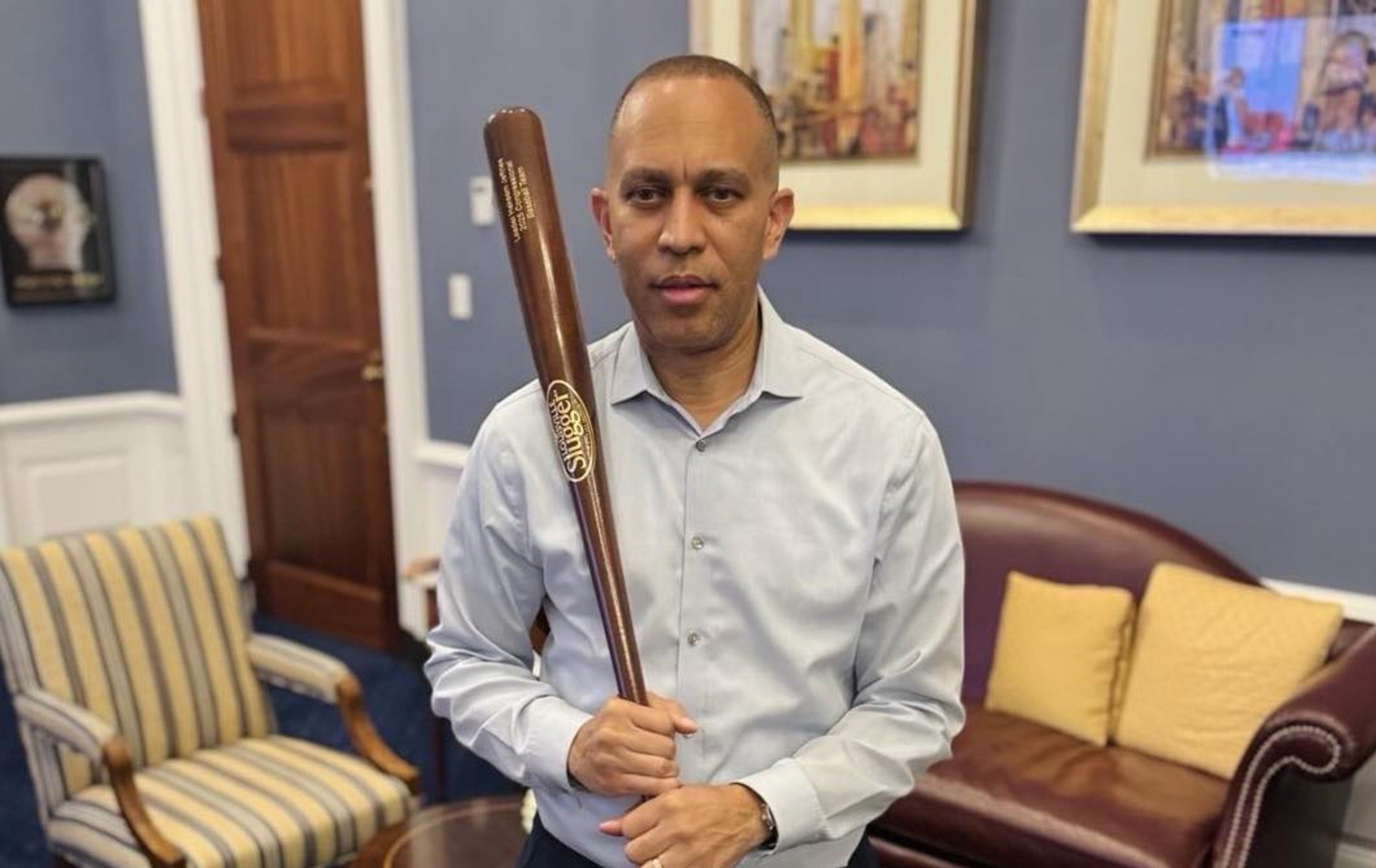
This is an unfortunate turn of events, because Jeffries is a genuinely horrible House minority leader. He’s weak against the Trump administration, unreliable on key issues like labor, and bloodstained by his support for Israel’s genocide in Gaza. He’s an ideological enemy of socialism, with a track record of meddling in New York elections to keep DSA candidates out and pro-corporate ones in. What’s more, there’s reason to believe he’s more vulnerable to a primary challenge than he lets on. You can make a plausible argument that Chi Ossé isn’t the right candidate for the job, and you can make a plausible argument that it doesn’t make sense for Mamdani to back a House challenger at this stage. But to say that Jeffries shouldn’t face a challenge from the socialist left at all is deeply misguided. The people of New York’s 8th Congressional District deserve better than him, and so do the millions of people nationwide who consider themselves Democrats. One way or another, he’s got to go.

At this point, even the most milquetoast liberals understand that Hakeem Jeffries isn’t fit to lead a bowling team, let alone the congressional Democratic Party. In a New York Times op-ed entitled “Democrats Need a Wartime Consigliere. Hakeem Jeffries Isn’t One,” Michelle Cottle points out exactly how much of a nonentity he’s been during his time in the House leadership. Jeffries “has the political pragmatism of his predecessor, Nancy Pelosi, but not her wicked street-fighting record,” she writes, which ultimately means he has nothing much. Certainly not principle, courage, or vision. When Senator Chris Van Hollen traveled to El Salvador on behalf of his constituent Kilmar Abrego Garcia, who was unlawfully abducted by the Trump administration and thrown in dictator Nayib Bukele’s CECOT prison camp, that became clear. Quoting a House staffer, the Bulwark reported that Jeffries wanted to “let the El Salvador stuff slow down” and was discouraging House members from taking any more trips like Van Hollen’s. This was ethically reprehensible, because we cannot let people suffer in dictators’ prisons when we have the power to prevent it; that should go without saying. But it was also terrible politics, because only a few months later, the polls showed a dramatic “U-turn” in public opinion on immigration, with a majority of Americans disapproving of Trump’s raids and deportations. The strong anti-CECOT stance Jeffries wanted to discourage was actually a good bet all along—and Van Hollen saw it, when his party’s so-called leadership couldn’t.
That wasn't a one-off, either. At every turn, Jeffries has faced the horror of the second Trump administration with a shrug. This month, reports came out that Secretary of War Pete Hegseth had committed a blatant war crime, ordering that survivors of the already illegal U.S. airstrikes on random Venezuelan boats should be shot dead as they tried to swim away. Hegseth now denies doing this, despite previously bragging about ignoring the Geneva Conventions in his book American Crusade and posting a juvenile meme of Franklin the turtle shooting a shoulder-mounted missile at Venezuelans. (Have you noticed that every Trump ally is mentally six years old?) In any case, these are obviously the actions of someone who can’t be trusted to remain in power. But Hakeem Jeffries doesn’t think so, because he said on December 1 that House Democrats will not be seeking Hegseth’s impeachment over the killings. Instead, he promised a “meaningful investigation which we can hope would be bipartisan.” (Good luck with that!) As this article went to press, Jeffries also endorsed Trump’s decision to give a preemptive pardon to Texas’ Representative Henry Cuellar, who was facing corruption charges over his alleged receipt of $600,000 in bribes from foreign donors, calling it “exactly the right outcome.”
When Trump stripped collective bargaining rights from thousands of federal workers with an executive order, Jeffries came up short again. Two of his fellow Democrats, Pennsylvania’s Brian Fitzpatrick and Maine’s Jared Golden, had introduced the “Protect America’s Workforce Act” to reverse Trump’s anti-labor decision, and they had the support they needed to force an up-or-down vote on it in the House. But as Politico reports, Jeffries sabotaged their effort for the pettiest possible reason. At the last second, his staff stepped in and prevented Representative Adelita Grijalva, a Democrat from Arizona, from signing the discharge petition for a vote on the Act. You see, if Grivalja had signed, the 218th and decisive vote would have been Representative Mike Lawler’s, and he’s a Republican from New York. Jeffries didn’t want Lawler to get the credit for casting the deciding vote, which he could use to “claim credit as a pro-union Republican.” So Jeffries held up the whole process instead, and federal workers still don’t have their union rights and protections. Despite his intransigence, the Protect America’s Workforce Act is finally heading for a vote, but the fact that Jeffries was willing to stall it for the sake of penny-ante point-scoring shows just how little he really thinks of working people. And that, again, shows his basic ineptitude at political strategy, because the loyalty of labor unions is critical in New York City—which suggests a smart challenger could probably peel some of them away from Jeffries.
All of this, though, is nothing compared to Jeffries’ support for apartheid and genocide in Gaza. It was genuinely disheartening to see someone like Zohran Mamdani, who’s been so good on Palestine, intervening on Jeffries’ behalf, because the Representative is one of the most consistent pro-Israel voices in politics today. All the way back in 2014, when he was a freshman in Congress, he was bellowing “Israel today, Israel tomorrow, Israel forever” in an echo of white supremacist George Wallace, who said the same about segregation. Mamdani himself called the ugly language out at the time, saying that “If Jeffries is considered a progressive, the term has lost all meaning,” and he was right. Later, when Benjamin Netanyahu and his accomplices started indiscriminately carpet-bombing Gaza in retaliation for the October 7 attacks, Jeffries insisted that “Israel is not conducting an ethnic cleansing campaign. Israel is not engaged in genocide,” but was merely “going after Hamas,” which was a “necessary and urgent project for it to complete.” Time has shown how false that was. When Netanyahu came to address Congress last year, Jeffries downplayed his colleagues’ objections to the war criminal’s presence in D.C., saying that “the divide is overstated.” He also voted “yes” on the 2024 Israel Security Supplemental Appropriations Act, which placed $26.38 billion worth of U.S. weapons in Netanyahu’s hands while banning funding for the United Nations Relief Works Agency (UNRWA). Undoubtedly, Palestinian children died hungry because of that vote. In terms of actual policy outcomes, Jeffries is functionally no different from Randy Fine or Mike Johnson, the most extreme pro-genocide zealots in the House. No wonder Breakfast Club host Charlamagne tha God dubbed him “AIPAC Shakur.”
These are only the reasons that every American should despise Hakeem Jeffries and drive him out of office at the nearest opportunity. There are other, more specific reasons that socialists should do so. Last month, Jeffries was among 86 House Democrats who broke with their party’s caucus to vote for a ridiculous, performative GOP resolution denouncing the so-called “horrors of socialism.” (The very real horrors of capitalism, as usual, went unaddressed.) Now, the most recent Gallup polls show that 66 percent of Democrats view socialism favorably, so Jeffries had no business doing this; it was directly against the will of his voting base. But it was especially embarrassing for him because the vote came shortly before Mamdani’s visit to the White House, during which Donald Trump greeted the mayor-elect warmly and said he’d have no trouble living in a New York City under socialist governance. Showing the political instincts of a moldy sponge, Jeffries had positioned himself to Trump’s right on economics.
But then, that’s not particularly out-of-character for him. Back in 2021, Jeffries told the Atlantic that “There will never be a moment where I bend the knee to hard-left democratic socialism,” and he’s spent years fighting the DSA in New York elections. As Jeff Coltin reported for Politico last year, Jeffries became “deeply involved in a state Assembly race to stop DSA from increasing its foothold in the historically Black neighborhoods he represents in Brooklyn,” backing incumbent member Stefani Zinerman against DSA-endorsed challenger Eon Huntley. Importantly, Huntley took a strong stance on Gaza, sending campaign mailers that denounced “U.S.-funded genocide in Palestine or police brutality right here in New York,” whereas Zinerman was supported by a pro-Israel PAC—just as Jeffries is at the national level.
It’s not the only race where Jeffries has intervened against the left, either. As Coltin writes, he’d been “feeling emboldened by taking out [NYC] Council Member Charles Barron [in 2023], a longtime foe with DSA leanings.” For Jeffries, it’s clearly ideological; he just sincerely believes that the left should be suppressed. And there’s an obvious asymmetry at work here, because he feels free to attack New York socialists whenever he likes, but New York socialists like Mamdani and AOC refuse to throw a punch back. Apparently, they’re hoping he’ll suddenly turn over a new leaf and become a useful ally if they treat him with kid gloves. That’s highly optimistic, to put it politely. The moment election day passes, Jeffries will no longer need anything from them, and will have no reason to cooperate.

So why are Mamdani and the DSA so reluctant to take this guy on in 2026? The strategy involved isn’t particularly complicated. As the New York Daily News succinctly puts it, “Mamdani was concerned [Chi] Ossé did not have a viable path to victory against Jeffries, who is popular in his Brooklyn district and has access to a vast fundraising network.” Furthermore, as NYC-DSA member Alyaza Birze writes, “A high-profile loss—especially against Jeffries—would assuredly be used against us by the media, spun to our detriment among potentially-receptive liberals, and quickly weaponized against both Zohran and any subsequent candidates we run.” In an interview with the Majority Report, Mamdani himself said that “this is not a question of the ballot box, of who you’d rather vote for; this is a question of how you want to spend the next year.” In other words, he intends to focus narrowly on getting his affordability agenda enacted in New York City, and is willing to sacrifice national goals like unseating Jeffries in service of that agenda, especially since he estimates that Ossé has little chance of winning. For him, it makes sense; it's what he promised New Yorkers he would do, and the agenda’s success or failure will make or break him as a politician, not to mention shaping the perception of socialism on the national stage. Jeffries is a key ally of Governor Kathy Hochul, who controls the flow of state money into NYC, so antagonizing him could imperil Mamdani’s policies at the city level. It’s possible, for example, that snubbing Ossé was the price of getting Hochul to say in November that she’ll consider raising corporate taxes to fund Mamdani’s plans for free childcare and other city services. That, at least, is the strongest version of the argument for leaving Jeffries unchallenged—that it’s a necessary evil for the greater good.
But there are reasons to doubt this argument, and there are unexamined assumptions within it that don’t hold up to scrutiny. For a start, let’s look at the idea that Jeffries is highly “popular in his Brooklyn district,” and therefore unlikely to lose to Chi Ossé or any other challenger. How do we know this is true? Since he entered Congress in 2012, Jeffries has never faced a meaningful primary opponent. His Ballotpedia page makes for startling reading: in 2014, 2016, 2018, 2020, and 2024, he either ran unopposed in the Democratic primary or had it cancelled outright. The lone exception is 2022, when he faced a challenger named Queen Johnson—an activist from a local nonprofit who received virtually no media attention and, if her FEC page is to be believed, collected literally no campaign funds. Jeffries put up Assad numbers against her, winning 86 percent of the vote—but that isn’t proof of his “popularity,” because like Syrian opposition parties, her campaign basically didn’t exist. Even in 2012, his opponent was the aforementioned Charles Barron, a former Black Panther who was widely criticized for saying he wanted to “go up to the closest white person and… slap him, just for my mental health” during a discussion about reparations in 2002. (Perfectly understandable, but unlikely to serve you well on election day.) So the idea that Jeffries is “popular” is suspect, because it’s never actually been tested in a hard-fought election.
The primary piece of evidence for his “popularity,” cited in at least one anti-Ossé article by a DSA member, is a poll released in City & State New York, which showed Jeffries with personal favorability ratings around 69 percent. (Slightly more people, 74 percent, said they “approve of the job Jeffries is doing,” although it’s not clear what they understood “the job” to be.) But when you read the full article, it’s notable that this was a “private” poll, released to City & State New York “on the condition that we not name the entity that commissioned it.” That’s inherently suspicious; if the data is aboveboard, why hide the name? The most likely suspect, despite their protestations to the contrary, is Hakeem Jeffries’ own staff—or, perhaps, some centrist PAC or think-tank favorable to him, which would make the protestations technically true. In any case, it’s incredible that so much weight has been given to numbers with an unknown and shady origin.
The assumption of Jeffries’ invulnerability gets even shakier when you consider that he isn’t actually a particularly good politician. He isn’t good at his main job, which is leading an opposition party against Donald Trump; as a result, 62 percent of Democrats now want the party leadership to be replaced. He hasn’t tied his political identity to a broadly popular policy, the way Bernie Sanders and Abdul El-Sayed have with Medicare for All. In fact, it’s difficult to say what differentiates him from any generic Democrat, other than anti-socialism and fervent support for Israel—and both of those are growing more and more unpopular with Democrats. He can’t identify what stances will become popular, as we saw in his disagreement with Van Hollen. He doesn’t have charisma or a compelling speaking style; as Cottle puts it, “His face remains strikingly still even when he’s fired up. The cadence of his speech sounds as though he’s delivering blocks of text committed to memory.” In other words, he sounds like what he is: a corporate lawyer by profession, known mainly for his “ability to not alienate the establishment.” The only distinct advantage he has is money and insider connections—and if those alone could decide elections, we’d probably have a President Mike Bloomberg and a Mayor Andrew Cuomo right now. This doesn’t look like a politician in a strong position. It looks like one who’s weaker than he’s ever been before, and desperately hoping nobody realizes it. Folding to Hakeem Jeffries before the fight even starts says less about his strengths, and more about socialists’ lack of confidence in their own abilities.
But let’s suppose, for the sake of argument, that the pessimistic take on Chi Ossé’s chances is correct, and that anyone who primaries Jeffries would be more likely to lose than win. That’s at least within the realm of plausibility. But would it mean there’s no point in making the attempt? I don’t think it would. To say that there’s no point in participating in elections unless you’re certain you’ll win is a liberal idea, not a socialist one. It’s the same self-defeating logic that led the Democratic Party to not bother running a candidate against Senator Tom Cotton in Arkansas the last time he was up for reelection. Historically, socialists have always taken a different stance: that even if you don’t win, election campaigns are valuable tools for organizing working people in large numbers, exposing them to socialist ideas, and exposing the fraudulence of your opponents’ ideas on the biggest possible stage. All the way back in 1895, Friedrich Engels made that case, saying that universal suffrage was the best thing that ever happened to the socialist movement:
In election propaganda it provided us with a means, second to none, of getting in touch with the mass of the people where they still stand aloof from us; of forcing all parties to defend their views and actions against our attacks before all the people; and, further, it provided our representatives in the Reichstag with a platform from which they could speak to their opponents in parliament, and to the masses outside, with quite different authority and freedom than in the press or at meetings.
That’s just as true now as it was then. In 2016, you could easily have argued that Bernie Sanders “did not have a viable path to victory” against Hillary Clinton, and therefore shouldn’t have run. In fact, he didn’t win. It was still worth doing, because it exposed a generation of young people to socialism as a concept, and laid the groundwork for dozens of campaigns that would follow. There would be no Mamdani or AOC without that initial, abortive run. In 2020, Bernie failed again—but he at least managed to push Joe Biden toward a few left-wing policies, most notably around labor and antitrust, that Biden likely wouldn’t have bothered with otherwise. Hollow consolation compared to what we could have had with a Sanders presidency, but not nothing. More recently, independent labor leader Dan Osborn failed to beat an incumbent GOP senator in Nebraska—but he came tantalizingly close, and provided proof-of-concept for how another candidate like him might succeed in the future. The only truly disastrous outcome is a blowout loss, like the one Queen Johnson suffered. Otherwise, even nearly beating the Democratic House Minority Leader would be a dramatic demonstration of power, and the race itself comes with a range of other fringe benefits.
One of the key concerns, for opponents of primarying Jeffries, seems to be that trying and failing would make the DSA and the broader left look weak. But they don’t seem to be taking the opposite case seriously enough: that doing nothing makes you look even weaker. As a political organization, you can’t allow someone to openly oppose and denounce you, the way Jeffries has repeatedly opposed the DSA, without incurring a penalty for it. If you do, it sends a message that others can do the same with impunity. The GOP under Trump knows this well, and it’s why they have actual party discipline and can effectively implement their agenda. The moment someone steps out of line, they get a primary opponent with Trump’s personal backing, and the threat is so effective that Marjorie Taylor Greene just announced her resignation from Congress rather than face it. The old Mafia rule, “they touch one of yours, you touch one of theirs,” always applies—and as even the New York Times knows, Hakeem Jeffries is no consigliere.

The strongest argument is simply that Chi Ossé might not be the right person for the job of taking Jeffries down. That’s the thrust of another article published by the Marxist Unity Group, a caucus within the DSA, titled simply “Why We Should Not Endorse Chi Ossé.” There’s his relative inexperience: he’s only 27 years old, and has little name recognition compared to Jeffries’ national profile. There’s a perception among some DSA members, too, that he may be an opportunist with “no enduring allegiance or accountability” to the organization, who simply hopes to use its “deeply effective mass electoral machine” to advance his own career. There are certain troubling votes he’s made in the past, like the one in favor of a city budget that included millions of dollars in funding for a “Cop City” training facility for the NYPD, which three other democratic socialists refused to endorse. But then again, I’m reminded of Hunter S. Thompson, who said of the 1972 presidential race that “McGovern made some stupid mistakes, but in context they seem almost frivolous compared to the things Richard Nixon does every day of his life, on purpose, as a matter of policy and a perfect expression of everything he stands for.” The things Hakeem Jeffries stands for are foul enough that even a flawed socialist would be a distinct upgrade. And if you don’t think Ossé is strong enough, the task is to find a candidate who is, not to give up entirely. There’s also Vance Bostic, who’s running an insurgent campaign with slogans like “Let’s Eat the Billionaires”—but as a complete unknown, without institutional support and endorsements, he faces an even steeper uphill fight than Ossé would have.
Speaking with Current Affairs, former Ohio state senator Nina Turner made a very important point about this election. “If, in fact, we live in a representative democracy, if in fact we pride ourselves in saying that people should have a choice… the question has already been called and answered. Is it the right time to have a primary? Absolutely yes, because voters should always have a choice.” That issue of choice is the heart of the matter. It’s the point of the word “democratic” in democratic socialism. Choice is exactly what Jeffries’ constituents haven’t had in over a decade, because nobody—except Queen Johnson and Vance Bostic, who frankly deserve some credit—has stood up against him. Now, it looks like the DSA won’t take on the task either, and the people of Brooklyn will be condemned to another two years of his mediocrity. It’s a shame, because Jeffries is a bad politician with unpopular policies, clinging to power as a wave of enthusiasm for the left sweeps across the country. It certainly looks to me like his seat is there for the taking, for someone with the nerve to try.