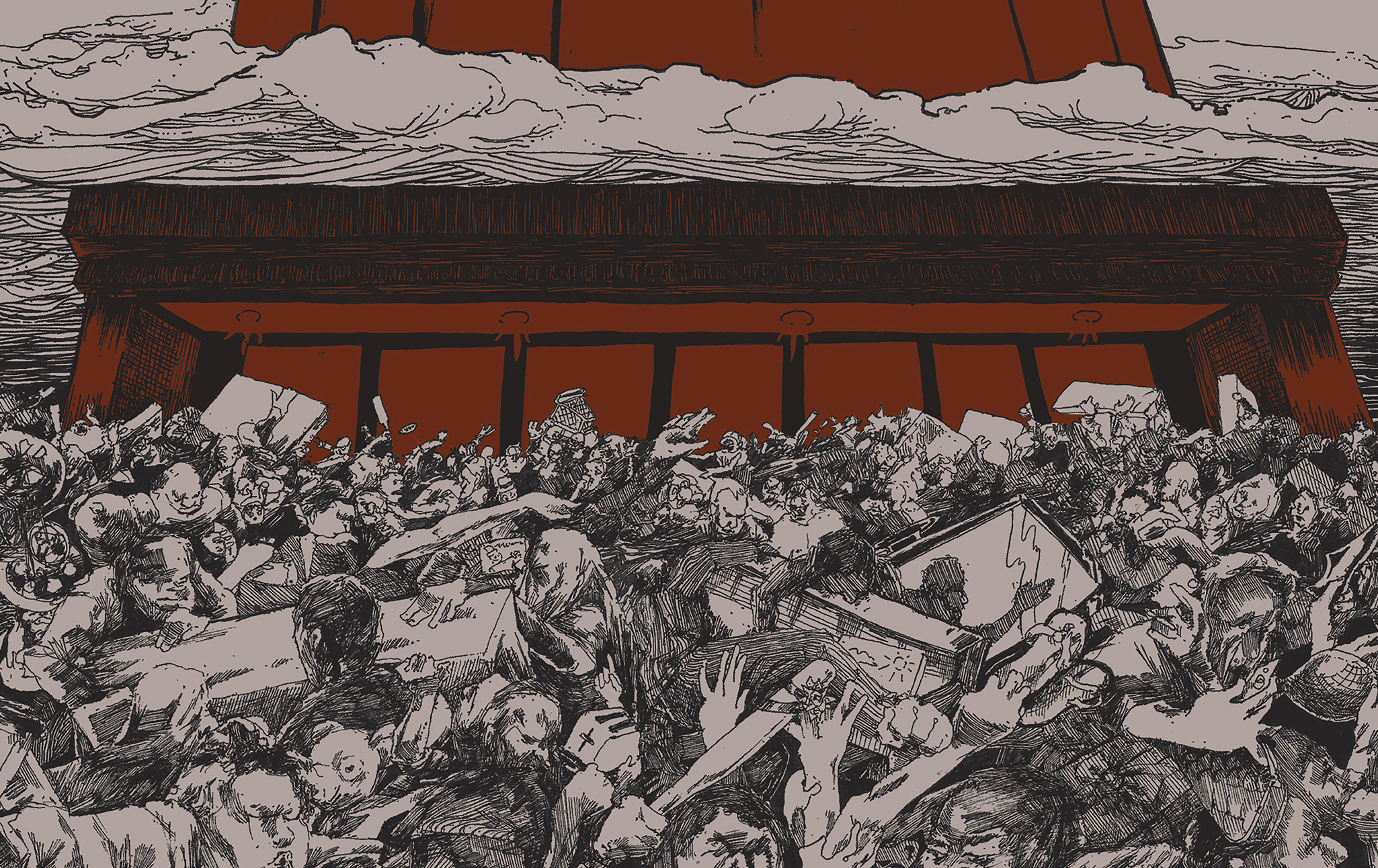
Every year, Americans hurt and kill each other fighting over Black Friday deals. To understand why, turn to nihilist horror author Thomas Ligotti.
I.
In late November of 2008, Jdimytai Damour was trampled to death by a few dozen of his fellow human beings. Damour was a large man, reportedly 6 feet 5 inches in height, and just 34 years old, but neither his size nor his relative youth could save him. He had the misfortune to work as a retail clerk at a Walmart in Long Island, New York, and it was Black Friday.
The store’s advertising had been unusually successful that year. According to the New York Daily News, a crowd of around 2,000 people had gathered outside the Walmart’s sliding doors, shoving and jostling to be first in line as they sought “deep discounts on a limited number of TVs, iPods, DVD players and other tech items.” Possibly the global financial crisis, just then reaching its deepest point, added a sense of urgency to their bargain-hunting. The local police were called in to help manage the crowd after it “surged past eight interlocking plastic barriers,” but in typical cop fashion they demurred, claiming it was “not in their job description” and avoiding any risk to themselves. So the job of guarding the doors fell to Damour and a few of the store’s “bigger staffers,” and he was still doing it when “the doors shattered under the weight of the crowd” and the mob rushed in. In the aftermath, the Los Angeles Times interviewed Nakea Augustine, a shopper who’d been there on the day, and got her firsthand account:
Augustine tried to keep her balance as she was pushed forward. She saw people fall and knew she had to keep moving or she’d fall too. One woman had cuts from the glass across her face. Augustine saw Damour sprawled out. She managed not to step on him[...] Augustine kept going, down the jam-packed aisles, still moving with the crowd, still heading to the deals. People guarded the televisions so no one else could grab them.
Augustine raced for the toy section and snatched up a bike, a dollhouse, 10 Hannah Montana dolls for $5 apiece.
Two hours later, Augustine checked out, just as the store announced it was closing. She got in line, and spent $495 on 36 items. She did not know what became of the man who had fallen to the ground[...] but word eventually spread through the employees that Damour was dead. Paramedics took his body away and police declared the area a crime scene.
In the end, Damour’s official cause of death was recorded as asphyxiation, meaning he was literally smothered by the sheer mass of people surging in. This also meant no single person could be directly linked to his death, and no one was ever charged with a crime. Later, one of Damour’s co-workers would ask the obvious question: “How could you take a man’s life to save $20 on a TV?”
But in the United States, people have often been willing to make that kind of trade. Black Friday has been an unofficial American holiday for decades now, marked by the mammoth “door-buster” sales that retailers count on to put them in the “black” financially. Every year, it brings a mindless orgy of buying and selling, often extending into the weekend that follows. And nearly every year, it’s punctuated by violence.
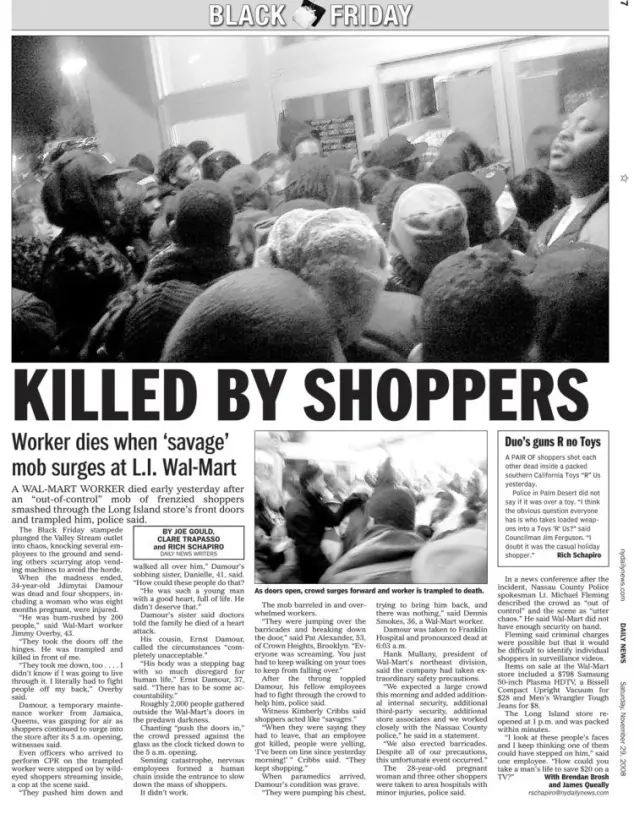
New York Daily News, November 29, 2008
As far back as 1983, we can find newspaper accounts of riots breaking out as parents physically fought each other for the much-coveted Cabbage Patch Kids dolls, which had just been released that year. “In Wilkes-Barre, Pa., a woman suffered a broken leg and four others were injured when 1,000 people, some of whom had been waiting for eight hours, rushed into [a] Zayre department store,” reports the New York Times, while “a pregnant woman was trampled in [a] stampede” in Bergen County, New Jersey. In 1998 it was the frenzied demand for Furby toys driving a crowd in Bethlehem, Pennsylvania to stomp each other down, leading the papers to joke about “Black and Blue Friday.” In 2011 a woman pepper-sprayed 20 of her fellow shoppers at a North Carolina Walmart, apparently hoping to grab discounted Xbox game consoles. On and on it goes. At the website Black Friday Death Count, you can find a tally of 17 deaths and 125 assorted injuries from the years 2006-2021 alone. Memorable cases include the 2011 death of Walter Vance, a 61-year old man who suffered a heart attack in a Target only to be completely ignored as people stepped over him to get to the store’s merchandise. There was also a 2012 incident where two people were shot during an argument over a parking spot at yet another Walmart. Soon it will be Black Friday again, and the list will likely grow.
More recently, “Cyber Monday,” Amazon’s “Prime Day,” and other online sales have started to supplant the in-person “door-busters.” But that doesn’t mean the violence has ended. It’s just taken another form, with a “mounting injury crisis at Amazon warehouses, one that is especially acute[...] during Prime week and the holiday peak – and one that Amazon has gone to great lengths to conceal.” Pushed to move more and more items, faster and faster, workers get injured by forklifts, hurt in conveyor belts, pull and strain their muscles from repeated motions, and suffer a dozen other kinds of pain. The only difference is that it’s kept out of sight.
How to explain this yearly ritual? What could possibly drive people to harm each other this way, all for cheap toys and trinkets? There’s a growing academic literature about Black Friday violence, which has seen criminologists, psychologists, and experts in marketing weigh in with papers like Thomas Raymen and Oliver Smith’s “What’s Deviance Got to Do With It? Black Friday Sales, Violence and Hyper-conformity.” But as insightful as some of those scholars can be, they also suffer the usual curse of academics: horribly boring, jargon-laden prose, full of phrases like “the underpinning social and cultural values of neoliberal consumer capitalism pervade relatively mundane leisure activities, cultivating harmful subjectivities.” You could call trampling someone to death in a consumerist blood-frenzy a “harmful subjectivity,” I suppose, but it doesn’t really capture the grim essence of the thing.
Trey Parker and Matt Stone did better with their Black Friday episode of South Park, where they portrayed America’s roving bands of shoppers as a monstrous threat akin to the White Walkers from Game of Thrones. But even that satire doesn’t fully work, because the show’s still trying to be funny (and sell Cartman and Kenny dolls of its own), and there’s nothing funny about a man lying dead on a cold Walmart floor. To really get to grips with this darkest of American (un)holidays, we have to turn to the language of metaphor and symbol. We need to consult the horror writer and arch-nihilist philosopher Thomas Ligotti.
Art by Mavis Figuls from Current Affairs Magazine, Issue 56, October-November 2025
II.
Thomas Ligotti is an American writer I’ve been fascinated by for a long time, and have written about before in the literary magazine Vastarien. Born in Detroit in 1953, he’s often compared to H.P Lovecraft, and superficially, the two have a lot in common. Both specialize in the short story; both write about strange cults, accursed objects, malicious nonhuman entities, and all the other trappings of so-called “cosmic horror.” But where Lovecraft leaned heavily on his colorful adjectives (how many things did he describe as “blasphemous” and “cyclopean”?), Ligotti is a far more subtle and stylish writer. Really, the better comparison would be to Franz Kafka and Jorge Luis Borges. Like them, Ligotti is largely uninterested in plot, but uses the surreal and the unnerving to create a strong sense of atmosphere. His stories, especially later in his career, are tone pieces. The difference is that Ligotti lacks Borges’ warmth and good humor, and he makes even Kafka’s melancholy look like a fleeting bad mood.
Following in the tradition of European thinkers like Arthur Schopenhauer, Emil Cioran, and Peter Wessel Zapffe, Ligotti is both a pitch-black nihilist and an anti-natalist, beliefs he details in his philosophical manifesto The Conspiracy Against the Human Race. Essentially, he feels that human life is inherently meaningless and absurd, a sick joke played on unsuspecting organisms by the cosmos, and anyone who feels otherwise is just deluding themself. Or, as he puts it in one memorable line, “Consciousness has forced us into the paradoxical position of striving to be unself-conscious of what we are—hunks of spoiling flesh on disintegrating bones.” This attitude pervades his fiction, too. Ligotti’s characters are always brooding and ruminating, saying things like “Life is a nightmare that leaves its mark upon you in order to prove that it is, in fact, real.” When they encounter something monstrous, whether it’s the masked cultists infesting the town of Mirocaw in “The Last Feast of Harlequin” or the sinister sideshow act in “Gas Station Carnivals,” it’s only a symptom of the fundamental monstrousness of the universe as a whole.
All of this might sound terribly depressing, and in a way it is. Like Kafka, Ligotti has also dealt with a range of physical and mental illnesses throughout his life, including chronic depression, anxiety, panic attacks, bipolar disorder, anhedonia—sometimes for years at a time—and “spasms of intestinal agony” from diverticulitis. The phrase tortured artist has rarely been so literal, and knowing this, you start to see where some of the pessimism and gloom comes from. In one interview, Ligotti described his writing as “all a matter of personal pathology.” But he’s being self-deprecating there, and it would be a mistake to write him off as only pathological. He’s political too, and as we begin to put Black Friday on the table and dissect it, it’s worth noting that Ligotti’s flavor of nihilism is utterly at odds with American consumer culture.
In the United States today, a lot of what passes for art and culture is really just vaguely agreeable, mass-produced kitsch—Thomas Kinkade paintings, airport novels, Jimmy Fallon’s whole existence, the Billboard Top 40. Anything strange, difficult, or thought-provoking is kept marginal by executives obsessed with the mass market and the bottom line, and pablum abounds. David Lynch couldn’t get Netflix to fund his last film before he died, but they gave Adam Sandler $152 million to make a Happy Gilmore sequel; that about sums up the state of play. Beyond this, the overall tone of our consumer society is one of “toxic positivity.” If you work any kind of job where you’re expected to interact with the public, you’ve probably perfected your “customer service voice,” always chirpy and upbeat regardless of how tired or frustrated or sad you really are. (Would you like your receipt? Have a good one!) Even in what remains of our private lives, an endless barrage of advertising and parasocial “influencers” encourages us to “consume product and then get excited for next products,” as one popular meme puts it. A panoply of cheaply-made merchandise, from socks to neon signs, bears the slogan “Good Vibes Only.” Think of the jingly music that plays in the background of a YouTube ad, and try not to gouge out your ear canals; that’s the perfect expression of this omnipresent dollar-driven pseudo-cheer.
All of it, of course, is built above a bottomless well of suffering, like Ursula K. Le Guin’s Omelas. But this can’t be acknowledged. Americans are never encouraged to think about the sweatshop slaves who make our Nikes and Funko Pops, or the gory consequences of our star-spangled foreign policy, or the way Jdimytai Damour died on Black Friday. Good vibes only, remember.
But if consumerism has made positivity toxic, Ligotti’s relentless negativity can be a welcome antidote. He may depress you, but he’ll never lie to you and tell you everything is just great when you know deep down that it’s not. He shares this quality with Franz Kafka. Recently, young people have been rediscovering Kafka in droves online and relating to him deeply, posting things like “[I] love reading kafka's diaries when i'm having a bad day cus no matter what kind of day i'm having kafka was having a worse one.” Reading Ligotti is a similar experience. As he put it in a remarkable 1982 essay called “The Consolations of Horror,” his aim when he writes is to convey “simply that someone shares some of your own feelings and has made of these a work of art which you have the insight, sensitivity, and — like it or not — peculiar set of experiences to appreciate.” This means he’ll never have mass-market appeal. People will never stand in line for 12 hours and storm a storefront to buy his books; even his publication by Penguin Classics is a minor miracle. But in his readers’ darkest moments, he stands there in quiet camaraderie, and says You are not alone. You are not crazy. Something really is terribly wrong with the world. Personally, I find him bracing, like an ice-cold shower or a shot of high-proof alcohol. In strange and twisted times, it can take a writer who’s profoundly alienated from mainstream society to see it clearly. And this brings us, at last, to the Red Tower.
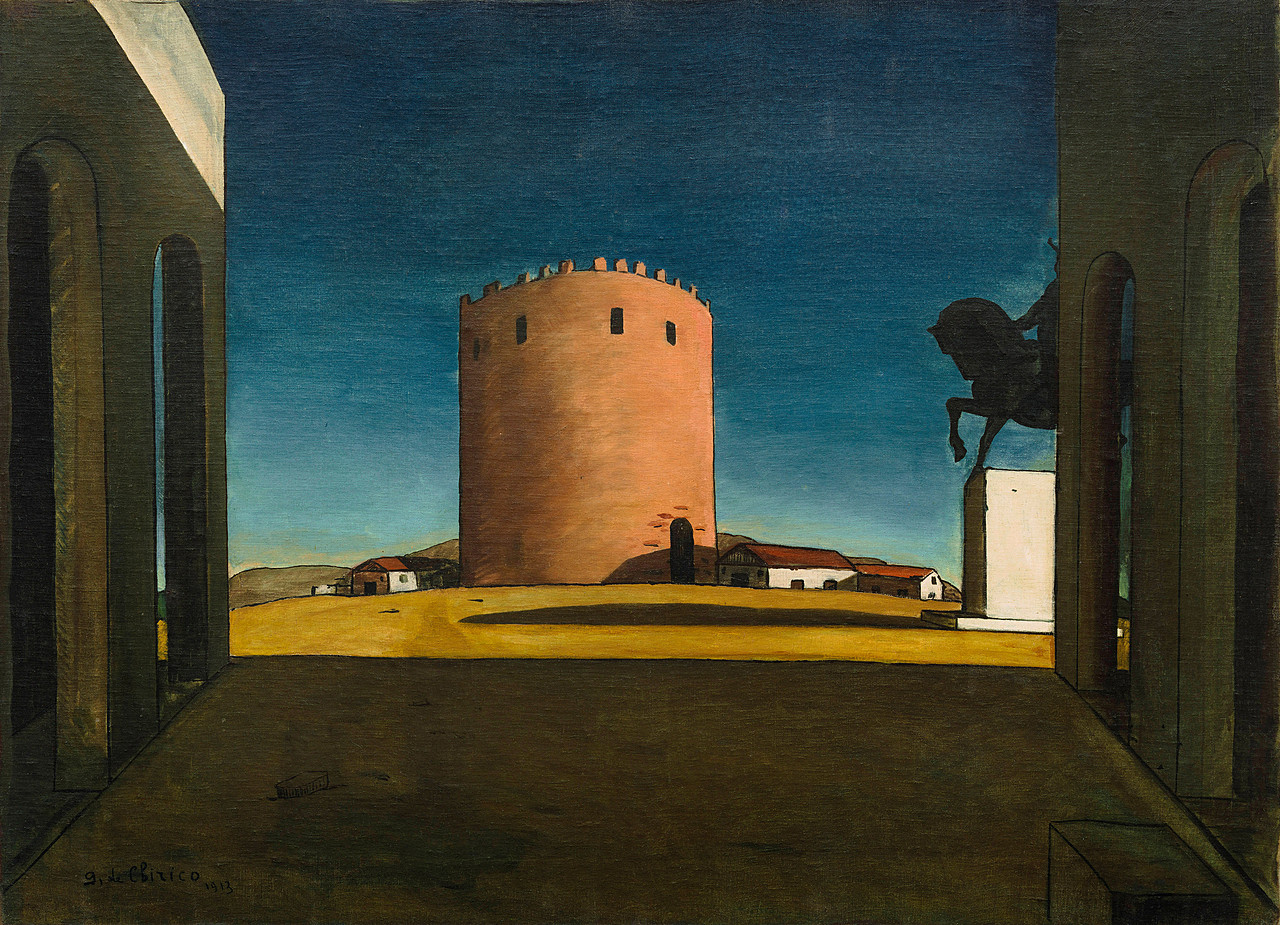
"The Red Tower," by Giorgio de Chirico, 1913. It remains an unconfirmed rumor that this painting inspired Ligotti’s short story, but the similarities are certainly striking. (Image: Guggenheim Museum)
III.
“The Red Tower” is one of Ligotti’s most iconic stories. It’s been published in two different collections, 1996’s The Nightmare Factory and 2006’s Teatro Grottesco, and even recorded as an audiobook on vinyl by Cadabra Records (a small independent label that specializes in such things). In the last few weeks a tribute anthology, We Will Speak Again of the Red Tower, was also announced. And the acclaim is deserved. “The Red Tower” represents a turning point in Ligotti’s literary career, where he started to abandon conventional narrative structure and really get weird. The story has no named characters, no dialogue, and very little plot. Like Borges’ “The Library of Babel,” it’s mostly just an extended description of a strange, dreamlike place—a “ruined factory” with no doors, and no roads leading to or from, standing alone in a featureless grey landscape. Inside the Tower, we learn, are “deep vats and tanks, twisting tubes and funnels, harshly grinding gears and levers, giant belts and wheels.” But it’s also an unreal, oneiric place, sometimes subject to “temporary erasures, or fadings” from existence.
And what, we might ask, did this bizarre dream-factory produce in its heyday? According to our nameless and seemingly rather unhinged narrator, its stock in trade was a “terrible and perplexing line of novelty items”:
There was a fake disembodied hand on which fingernails would grow several inches overnight and insistently grew back should one attempt to clip them. Numerous natural objects, mostly bulbous gourds, were designed to produce a long, deafening scream whenever they were picked up or otherwise disturbed in their vegetable stillness. Less scrutable were such things as hardened globs of lava into whose rough, igneous forms were set a pair of rheumy eyes that perpetually shifted their gaze from side to side like a relentless pendulum. And there was also a humble piece of cement, a fragment broken away from any street or sidewalk, that left a most intractable stain, greasy and green, on whatever surface it was placed.
“Trade,” though, is not exactly the right word. As it turns out, these items were not so much sold as they were distributed to unsuspecting people, without their knowledge and against their will:
As the unique inventions of the Red Tower achieved their final forms, they seemed to be assigned specific locations to which they were destined to be delivered, either by hand or by small wagons or carts pulled over sometimes great distances through the system of underground tunnels. Where they might ultimately pop up was anybody’s guess. It might be in the back of a dark closet, buried under a pile of undistinguished junk, where some item of the highest and most extreme novelty would lie for quite some time before it was encountered by sheer accident or misfortune[...] There has even been testimony, either intensely hysterical or semi-conscious, of items from the factory being uncovered within the shelter of a living body, or one not long deceased.
All very weird and disturbing, to say the least. But that’s not the end of it. As time wears on, our narrator informs us, the Tower went beyond producing mere inanimate objects, and got into the business of creating life. Below the factory floor, it had a subterranean level, equipped with a cemetery full of “birthing graves” where strange “hyperorganisms” emerged, zombie-like, from the ground. These are only described in terms of what’s unknown about them, with the narrator speculating breathlessly about “what creaky or spasmic gestures they might have been capable of executing, if any; what sounds they might have made or the organs used for making them; how they might have appeared when awkwardly emerging from deep shadows or squatting against those nameless headstones.” Whatever their nature, it seems the emergence of the “hyperorganisms” was what led the people living nearby (or possibly the landscape itself) to finally attack the Tower and reduce it to its current ruination, like the villagers with pitchforks storming Frankenstein’s castle. Or at least, those are the rumors our narrator has heard. As they later confess, “I myself have never seen the Red Tower — no one ever has, and possibly no one ever will.”

IV.
Like all great horror fiction, “The Red Tower” is not obviously a one-to-one allegory for any particular real-world thing. Its narrator does not deliver a monologue directly to the reader where they state the theme of the story. That would make Ligotti a hack. (Screenwriters of so-called “elevated” horror movies, take notes. We really don’t need another one that’s About Grief.) Instead, it captures the experience of having a weird, haunting dream. The story has enough bizarre imagery, seemingly freighted with meaning and yet not immediately legible, that it supports all kinds of interesting interpretations. If you’re into Freud, the image of a big phallic tower that generates life and death will keep you busy for a while. If historicism is more your speed, it seems significant that Ligotti is a writer from Detroit, writing in the late 1990s about a crumbling factory. In their episode on the story, the hosts of the Miskatonic Musings podcast floated the idea that the Tower represents the Earth, the landscape around it outer space, and the birth of the “hyperorganisms” the evolution of humanity—which, in keeping with Ligotti’s pessimism, is a bad thing. That, too, is plausible.
But there’s also a more obvious, literal reading: that “The Red Tower” is just a barely-exaggerated representation of how factories and consumer products really exist today, and the effects they have on people. For author and editor Jeff VanderMeer, the story is both “a tour of Hell” and “a commentary on consumer society.” Well, exactly. Looked at through Ligotti’s eyes, consumer society is Hell, and when it erupts onto Earth on Black Friday, the Red Tower looms large on the horizon.
Think back to all those news accounts of shop-floor carnage, and the items people were fighting over. Cheap Xboxes. Bratz dolls. Furbies. A slightly bigger flatscreen TV. In a word, bullshit. None of these are items anyone actually needs, and in a lot of cases, it’s unclear why anyone would even want them. Lots of the apparent prizes are just lumps of plastic in different shapes. But this is what American capitalism does. It mounts heroic advertising pushes to convince people that they really, really need whatever the new flavor of the month is, and whips them into a frenzy over it.
One of the most striking examples was Stanley-brand metal cups, which became a craze over the summer of 2024. There was a heavy online advertising campaign behind these things—masterminded by a marketing exec called Terrence Reilly, who previously helped to popularize Crocs—and it bore fruit. “Every time they release a new color, I’m like, ‘How will I live without that one?’” raved one TikTok influencer, in a video with more than 300,000 views. At schools, kids reported being bullied if they brought a non-Stanley cup to the lunchroom. And at stores across America, “ugly fights have broken out” in the dishware aisles.
Nothing about the item itself justifies any of this. It was, and remains, just a cup. But this gets at one of capitalism’s dirty secrets: it doesn’t actually manufacture goods to meet human beings’ needs and demands. Just the opposite. It manufactures demand to meet its capacity to produce junk, and feed its insatiable desire for growth. It uses artificial scarcity—only a few of the coveted mug in stock, a “limited edition” of something else—to pit people against each other, when it could easily just make enough for everyone. And it never, ever ends. No matter how many products you have, there’s always another one—a Temu or Shein dress, a Labubu, a Dubai chocolate bar. There’s always another “trend” to drum up the buying frenzy.
It might as well be a brick that leaves a greasy stain behind, or a “bulbous gourd” that screams, or any of the Red Tower’s other productions. That wouldn’t be any more pointless, absurd, or sinister. Really, the Tower is a marvel of efficiency. We have to go somewhere and buy plastic junk, then play with it for a few days before throwing it in the back of a closet and forgetting about it, while wondering why it’s so hot this winter. The Tower’s invisible hand just puts the junk in the closet directly. Even Ligotti’s most disturbing line, about the products showing up “within the shelter of a living body,” isn’t entirely unreal. All of our bodily tissues are full of microplastics now, thanks largely to our incessant buying and selling of the cheap crap our phones tell us to want.
In that way, every time Black Friday rolls around, we reach the bottom stage of the Tower, where that obscene cemetery lies. Twisted and deranged by consumerism, people become the “hyperorganisms.” They no longer relate to each other as human beings, but become creatures of pure consumption, willing to step over a man having a heart attack to reach the electronics aisle. It’s gruesome, but if you have a free-market system and a flourishing advertising industry, it’s always going to be the outcome. Right now, Terrence Reilly and people like him are sitting in boardrooms at towers of their own, planning what images and phrases they can put in their ads to make people maximally willing to storm those Walmart doors. They have to, if they want the line on the stock market tickers to flash green instead of red. And if a few more Jdimytai Damours perish in the process, well, that’s just the cost of doing business.
V.
Funnily enough, Thomas Ligotti describes himself as a socialist. At first this seems contradictory and weird, since socialism is an ideology of hope for a better world, antithetical to nihilism. But he reconciles the two—with a hint of black humor, one suspects—by saying that “I want everyone to be as comfortable as they can be while they’re waiting to die,” adding that he regards capitalists as “unadulterated savages.” This makes a certain amount of sense. After all, if you think existence itself is pointless and absurd, the pursuit of profit must be especially so, and just make a bad situation worse.
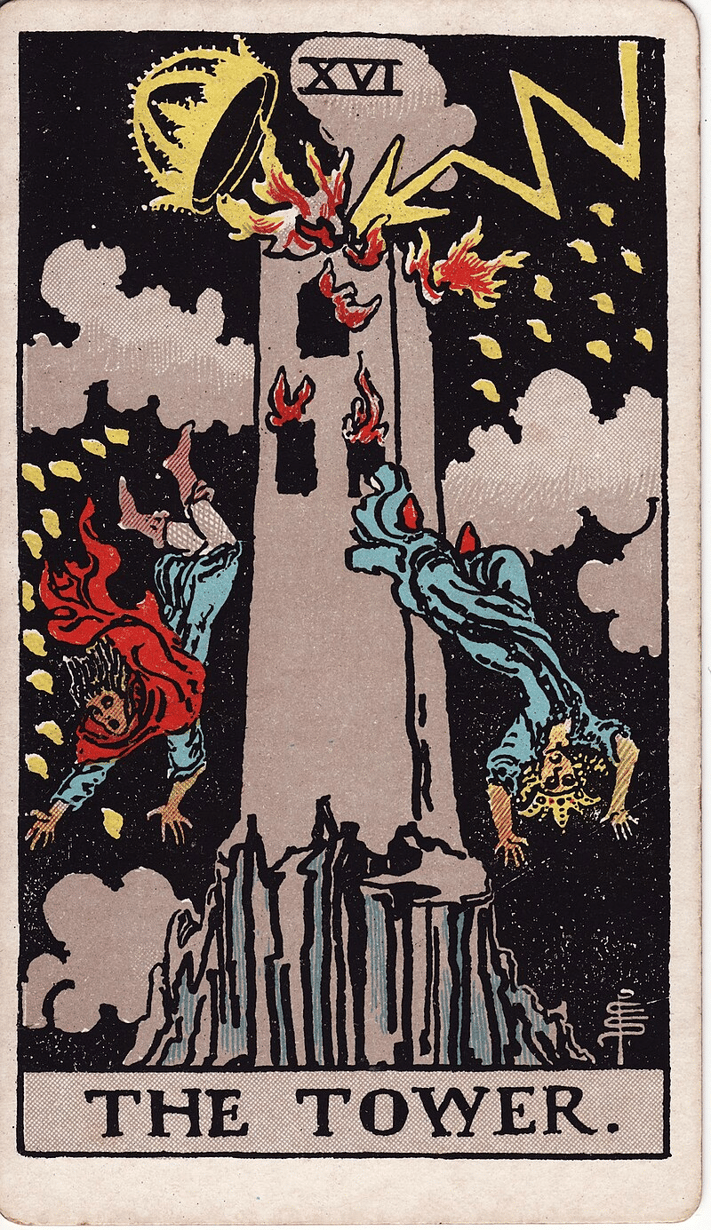
But Ligotti, despite himself, offers a hint of hope. Recall that in his story, it’s a “ruined” edifice we find. The details are hazy, but the narrator tells us that “forces of ruination were directed at the factory,” and “a shattering episode would appear to have terminated the career of the Red Tower.” It was not, in the end, invincible. This is a motif with towers of all kinds, throughout human culture. The Tower of Babel falls into confusion and chaos. The Tower in the tarot deck is struck by lightning, and its masters tumble to earth. Ligotti shows us the unremitting horror of our current society, it’s true. But if capitalism and consumerdom are a tower, it too can be thrown down. There’s a nice thought for a Friday in November.



#/media/File:RWS_Tarot_16_Tower.jpg)