
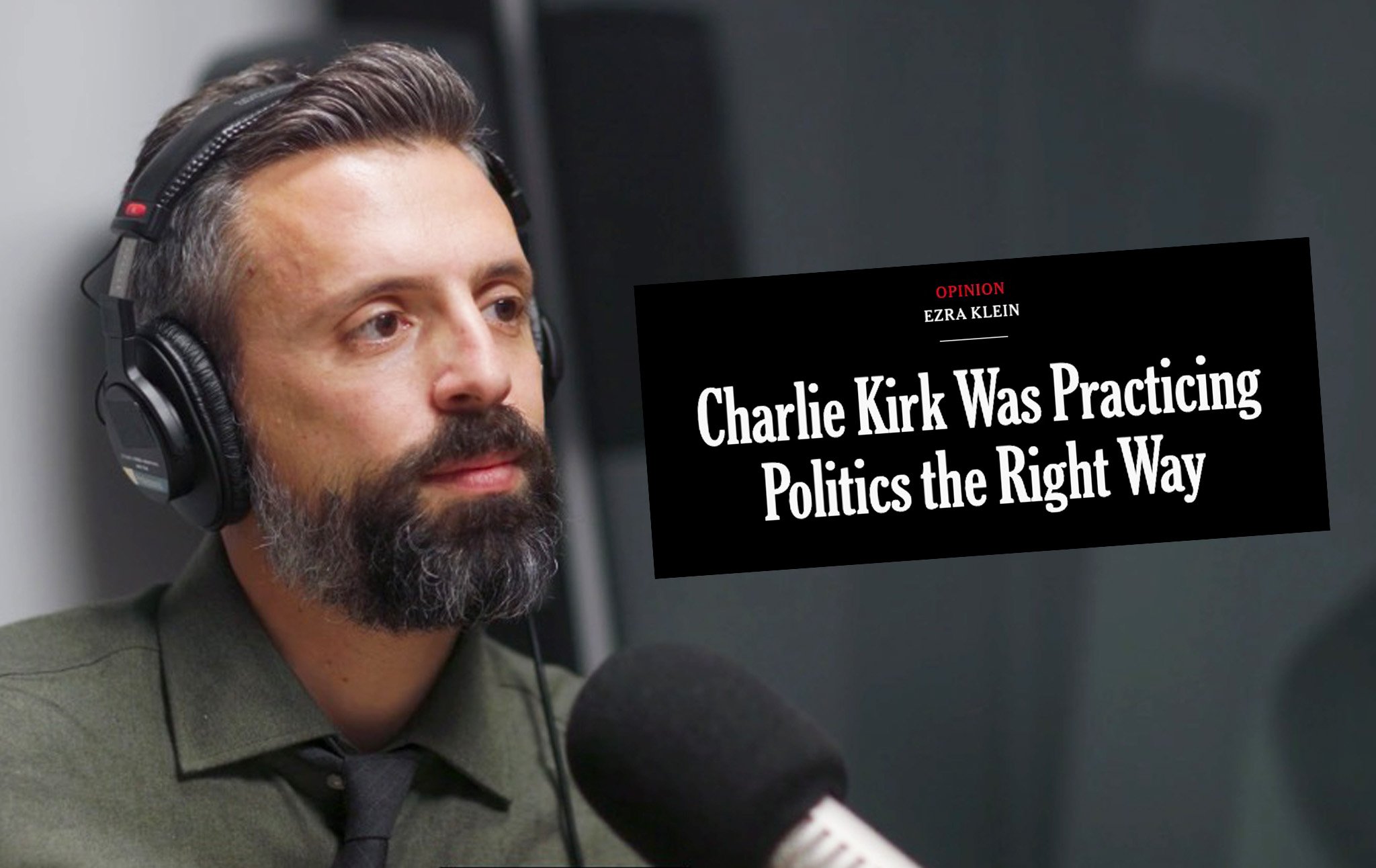
You can be committed to dialogue without pretending the right are reasonable and while aggressively challenging their views.
I am reluctant to keep going after the New York Times’ Ezra Klein, because I recently published a long review of his book Abundance (co-written with Derek Thompson), which was, well, not positive. I don’t want this to end up like my disagreement with “rationalist” writer Sam Harris, which concluded with him calling me “mentally unwell” for writing at such great length about him. (I had actually only written one article, but admittedly it was very long.) There are more things in heaven and earth than Ezra Klein’s bad opinions, and I promise to put a lengthy moratorium on Klein criticism from today forward.
But I really must protest, because Klein has lately published two pieces of material (a column and a podcast) that not only irk me, but are usefully illustrative of a particular kind of politics that we must avoid if we are to successfully arrest the country’s slide into authoritarianism. By examining them, and understanding why they’re so misguided, we can ourselves avoid becoming like Ezra Klein: hand-wringing accomplices to the right, sanitizing their propaganda for them.
First, in the aftermath of Charlie Kirk’s murder, Klein published a column praising Kirk. He wrote:
“You can dislike much of what Kirk believed and the following statement is still true: Kirk was practicing politics in exactly the right way. He was showing up to campuses and talking with anyone who would talk to him. He was one of the era’s most effective practitioners of persuasion.”
There is an annoying arrogance to this statement. Although this is an opinion piece, Klein does not present it as a mere opinion that Kirk was “practicing politics in exactly the right way.” He says it’s just a true statement, something everyone can agree on, whether you held Kirk’s beliefs or not. But there’s room for a huge amount of disagreement here. Numerous commentators pointed out that Kirk actually practiced politics in a horrible way. He had a closed mind, nasty bigotries, and his conversations with “anyone who would talk with him” were not attempts to achieve genuine understanding but opportunities to generate viral YouTube clips of him “owning” young people.

During the pandemic, medical experts spoke out against Kirk’s misinformation campaigns, while the YouTuber warned viewers that Joe Biden was sending “goons DOOR-TO-DOOR to make you take a covid-19 vaccine. The leader of Columbia University’s pandemic esource and recovery initiative noted that Kirk was an “unabashed promulgator of egregiously false information about the dangers of vaccination,” adding that “he probably knows better, but actively chooses to misinform.” His “Turning Point” organizations were little more than a dark money network that skirted campaign finance laws and was fined by the Federal Election Commission over its lack of transparency. Kirk started a McCarthyite public shaming list of professors (searchable with tags like “LGBTQ, RACIAL IDEOLOGY, and TERROR SUPPORTER”) and even funneled dark money into student government elections on college campuses in order to try to stack student councils with right-wingers. This is a man who literally wanted to rig and corrupt the student body election system. As he said: "It might seem like kind of a silly thing to try to take over student government associations… But the only vulnerability there is, the only little opening, is student-government-association races and elections, and we're investing a lot of time and energy and money in it."
That’s practicing politics the right way?

In Ezra Klein’s defense, he doesn’t actually seem to know anything about Charlie Kirk. As Ta-Nehisi Coates noted in a response, “there was not a single word in [Klein’s] piece from Kirk himself,” perhaps because if Klein had actually quoted Kirk he would have had to confront the fact that:
Kirk reveled in open bigotry. Indeed, claims of Kirk’s “civility” are tough to square with his penchant for demeaning members of the LGBTQ+ community as “freaks” and referring to trans people with the slur “tranny.”... he defined “the American way of life” as marriage, home ownership, and child-rearing free of “the lesbian, gay, transgender garbage in their school,” adding that he did not want kids to “have to hear the Muslim call to prayer five times a day.” … Kirk habitually railed against “Black crime,” claiming that “prowling Blacks go around for fun to go target white people.” He repeated the rape accusations against Yusef Salaam, a member of the exonerated Central Park Five who is now a New York City councilman, calling him a “disgusting pig” who had gotten away with “gang rape.” Whatever distaste Kirk held for Blacks was multiplied when he turned to those from Haiti. Haiti was, by Kirk’s lights, a country “infested with demonic voodoo,” whose migrants were “raping your women and hunting you down at night.”
Coates points out that Kirk’s rampant bigotry permeated throughout his institution, Turning Point USA. Within its ranks, staff members felt no need to dilute their true feelings about minorities:
Crystal Clanton, the group’s former national field director, once texted a fellow Turning Point employee, “I HATE BLACK PEOPLE. Like fuck them all: … In 2022, after three Black football players were killed at another college, Meg Miller, president of Turning Point’s chapter at the University of Missouri, joked (“joked”) in a social media message, “If they would have killed 4 more n-ggers we would have had the whole week off.”... Kirk subscribed to some of the most disreputable and harmful beliefs that this country has ever known.
What, then, does Ezra Klein mean when he says that Kirk was “doing politics the right way”? Well, he appears to mean only that Kirk didn’t throw bombs at people, that he advanced his political agenda using words (and money) rather than violence. But by that standard, David Duke was also “practicing politics the right way” when he decided the Klan should put on suits and ties and join the Republican Party rather than carrying out lynchings. It is certainly true that it is better to be nonviolent than violent, but it is also true that many of those who practice politics with words are not entirely “nonviolent,” insofar as they are trying to attain control over the government in order to enforce their political preferences using the threat of violence.
Letters to the New York Times about Klein’s column showed that many readers understood how absurd Klein’s argument was. One was from a professor targeted by Turning Point’s Professor Watchlist, who had personal reasons for thinking this was not the “right way” to do politics. She said many of her colleagues now “hesitate to speak or write publicly because of the tactics used by Mr. Kirk and those he inspired,” adding that many faculty members had been doxxed and threatened. Another pointed out that in his vaunted debates, Kirk dealt “almost exclusively in bad-faith arguments, distorting facts and bringing up the irrelevant, often employing rhetorical tactics to verbally and emotionally dominate his opponent.”
Klein, in a subsequent podcast, did not seem to have learned anything from the critics of his column. He doubled down, saying that “You can disagree with virtually everything Kirk believed about politics, you can detest some of what he said and did — yet still believe that he was, there on that stage, practicing politics the right way: showing up to college campuses and inviting people who disagreed with him to talk with him.” But Klein’s defense here hinges on the ambiguity of his headline: if by “practicing politics” we are referring solely to “the act of showing up and giving talks and doing Q&As,” then yes, he was doing it the right way. If we are referring to the totality of what Kirk did, then he very much was not doing things right, because we should practice a politics of empathy and care.
Klein points out that he feels a special bond with Kirk, because “I recognize some commonality with him,” because they were both engaged in “some effort to change this country in ways that we think are good.” But once again: so was David Duke. Everyone in political history, even Hitler and Mao, is engaged in “some effort to change” their country in ways they “think are good.” But to want to change your country is not inherently deserving of respect! If you want to change it in ways that are horrifying, well, no, I do not feel any commonality or bond with you just because we both hold beliefs and think those beliefs are good. Every single person on the planet thinks their beliefs are good and right—that’s what believing in something means. One can imagine Klein during the American Civil War: I feel a bond with Jefferson Davis because, while we may have our disagreements, we are both engaged in efforts to change our country in ways we think are good.

This tendency to downplay the actual stakes of politics, and to see comity as more important than substantive consequences, is fully on display in Klein’s follow-up to the Kirk column: a friendly podcast with Ben Shapiro. Shapiro is a racist (“Arabs like to bomb crap and live in open sewage”) who has put considerable effort into defending the genocide of Palestinians. His latest book, reviewed here just recently, is an utterly horrifying descent into the moral abyss, dividing the world into good, noble “lions” and parasitic “scavengers.” This reductive, dehumanizing framework is reminiscent of fascist language about ubermenschen and untermenschen and sets the state for acts of brutal violence. (We must destroy the scavengers before they destroy us, etc.)
Does Klein aggressively challenge Shapiro over his factual errors, genocide support, and childish worldview? No, he lightly pushes back on Shapiro, but gives him plenty of space to expound on his horrifying worldview. Klein certainly does not give Shapiro the kind of aggressive grilling he would get if he ever came on the Current Affairs podcast. (Ben, there’s still a standing invitation!)
It is a completely maddening conversation. Klein politely disagrees with much of what Shapiro says, but asks him a great many open-ended questions (“What is the difference between being a conservative and a counterrevolutionary?” “How do you define [Western civilization?” “What’s the [lions vs. scavengers] framework doing for you?” “Compared with a decade ago, are you more or less comfortable on the right?”) that simply allow him to spout his noxious worldview at length, before Klein asks for elaboration or poses a lightly challenging question. Even as Shapiro bashes Palestine protesters, explaining that the reason there are “queers for Palestine” is that both LGBT people and pro-Palestine activists are “scavengers,” Klein doesn’t point out how outrageous the claim is or explain the reality of the Gaza genocide or LGBT oppression. Having Ben Shapiro on is a perfect opportunity to confront him with the basic findings of all of the international human rights groups that Israel is committing a genocide, and to challenge him to explain how genocide victims are “scavengers.” But Klein treats Shapiro with a seriousness that his atrocious half-baked ideas do not deserve.
I am all for engaging intellectually with the right. I wrote a whole book called Responding to the Right that does this meticulously. I am a pacifist who deplores all political violence, although I am consistent in caring just as much about victims of U.S. violence abroad as about the death of a right-wing political commentator. (All murder is to be condemned.) So I agree entirely with Klein that political disagreement should be carried on through argument and persuasion rather than by beating up—or shooting—our enemies.
But I also believe in being forceful and honest and committed to humane principles. Honesty means telling the truth about Charlie Kirk’s odious views even as we fully denounce his murder. Forceful commitment to principle means that when you have someone with hideous beliefs like Ben Shapiro in your studio, you have an obligation to confront him on his lies and bigotry and not treat him with kid gloves. Ezra Klein is actually a bad advertisement for a politics of “discourse” and “engagement,” because he suggests that it involves being weak in our confrontations with white supremacy and genocide. It does not need to. We can be aggressive champions of the dispossessed while still using argument and rhetoric as our primary weapons. That is practicing politics the right way.


.png?width=352&name=Screenshot%202026-09-04%20at%204.00.52%20PM%20(1).png)
%20(1).jpg?width=352&name=miasma-1%20(1)%20(1).jpg)